This content was created by Tim Draper. This content was uploaded by Tim Draper. This is a YouTube video titled "Pairing Frugality with Science | Frugal Innovation Author Navi Radjou" (created 2015-07-19) featuring a talk by Navi Radjou. The excerpt is lecture-style and explains the concept of frugal innovation (jugaad) and its extension to "frugal science," contrasting NASA's $700M Mars orbiter with India's $75M Mangalyaan, describing use of software simulation over physical prototypes, and discussing how organizations can create more value with fewer resources. Radjou also comments on growing consumer frugality in Western economies after the recession. The clip is primarily a single-speaker presentation; a closing address to "Tim" suggests a host or moderator but no other speaker dialog appears in the excerpt.
Chapters
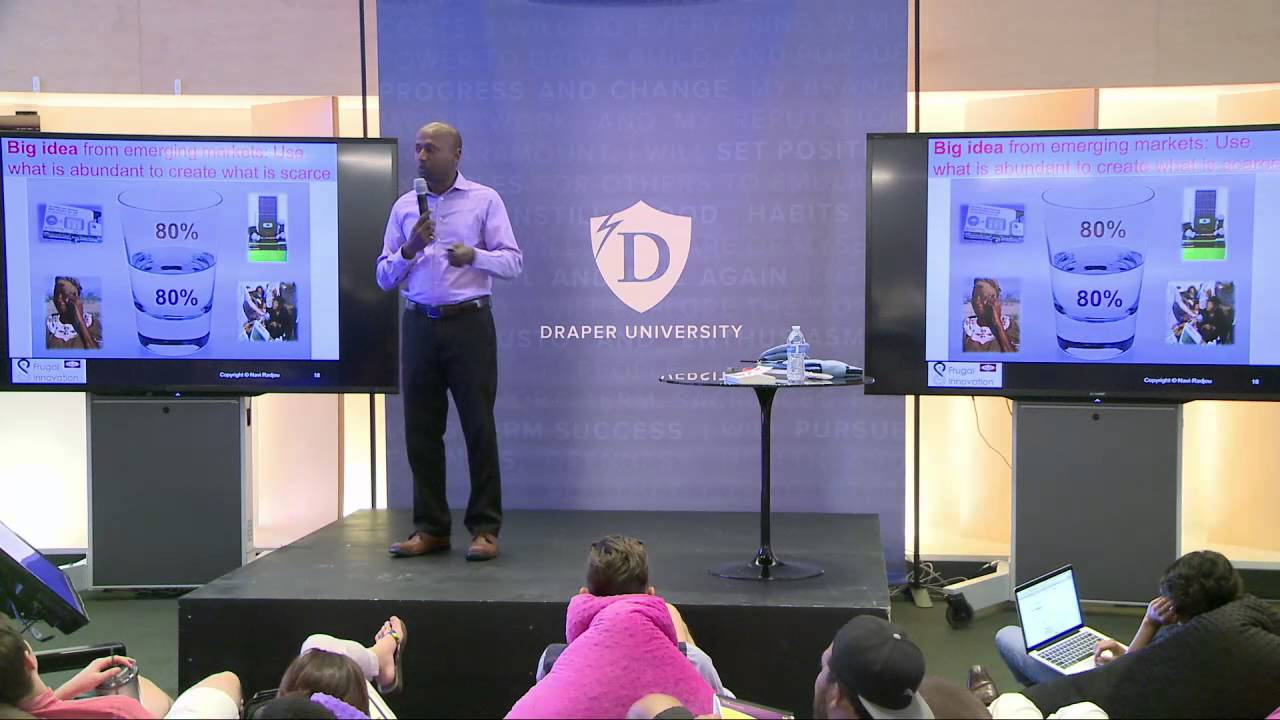
But where it gets more exciting is when you start looking at how this notion of frugality can extend to the domain of science, you know, the ultimate frontier, you know, so to speak. And even in science, you begin to see the notion of fruginnovation gaining traction. This is a mission sent by NASA that entered the Mars orbit in last September 2014. The satellite was developed at the cost of $700 million. It took NASA 5 years to set up this system. A few weeks— a few days earlier than that, India's own space mission entered the Mars orbit. It's called Mangalyaan, except that this project was conducted for a budget of $75 million. To give you a reference point, the movie Gravity with George Clooney cost about $100 million. So while Clooney is actually exploring in a fictional movie, you know, Indians have done it in reality at 25% less cost. And the way they did that is essentially they, instead of building physical prototypes, which is very expensive, they use what is abundant in India, which is software capabilities. So they do a lot of simulation work in computer, virtually, instead of building, you know, physical prototypes. And so this is called frugal science. We'll talk about that later. This is going to be really exciting because if some of you have a scientific temperament, same as engineering, because engineering and science are in a way complementary. This is gonna be a very exciting field as well to look at, you know, how to apply some of the emerging, you know, technology blocks to push the boundaries of, you know, scientific knowledge as well. So the big lesson we learned from emerging markets is essentially this idea that always look at the glass half full, never half empty, right? So that means always look at what you have as resource to address what you don't have, right? Instead of going for what you don't have, take advantage of the gifts and skills and resources you already have and leverage that to deal with what you don't have. So that's the kind of big lesson we learned from emerging markets. And that's why the frugality, the notion of frugal is essentially to say, start with what you have. You know, don't try to reinvent the wheel. Start with what you have and then try to apply that to create more value. So that was the first book I published about 3 years ago. called jugaad innovation. Jugaad is a Hindi word that means the MacGyver spirit. I don't know if you know MacGyver. Many of you are so young that I'm embarrassed to reveal my age by talking about MacGyver. But how many of you know about MacGyver, by the way? Okay. It's reassuring. But maybe in 10 years, I will look like an alien asking this question. But so MacGyver was a famous TV action hero in the '80s. He's the anti-James Bond because he doesn't have fancy gadgets. He can pull himself from any difficult situation using his Swiss Army knife and So it's this ability to improvise, you know, clever solutions in difficult situations. So that's really what jugaad means. So I wrote that book about 3 years ago. And then we begin to formalize the lessons learned from emerging markets with this concept of fruginnovation, which is essentially this kind of uncanny ability to do more with less. That means trying to create more value using minimum resources. And the value essentially is for customers, of course. shareholders if you are a publicly traded company or investors, but also for society. That's very important. It's about how do you create more societal value and for employees as well. And the resources interestingly apply to money, capital is important, but also natural resources, things like water as you know which is becoming very scarce, and then time. And the time would be in a way the Lean Startup idea, right? You know, how do you kind of get things quickly in the marketplace by reducing time? So this is kind of what we conceptualize as frugal innovation is, you know, how can companies essentially try to do both at the same time, which is not lose sight of the fact that value is really what matters, but creating more value, you can do that increasingly using fewer resources. There's a kind of a tension, you know, between trying to maximize value while minimizing resources, which comes naturally in people living in emerging markets, but it's a bit harder, you know, for companies operating in, you know, more abundant, you know, economies. And that's really what I will be talking about now is give a lot of examples of entrepreneurs, companies who are trying to embody the spirit of doing more with less, not in emerging markets but in mature economies like, you know, United States, Europe, et cetera. So I want to begin with just, you know, first kind of describing why there is a growing need in the first place to do more with less in the Western, you know, economies. The first reason is because consumers are becoming more frugal. This is some research that shows that since the economic recession, people in U.S. and Europe are looking for more discounts. They are willing to live with less. And this is actually a big phenomenon that actually started, I would say, even before 2008. And you know that today the middle class is feeling the squeeze. You heard about that, of course, in the news and reality you're living probably, you know, as well. And this is the first kind of message is that consumers, even middle-class consumers, are feeling the squeeze now, and they're looking for more value for the limited money they have. So they want to spend more judiciously the limited amount they have, you know, at their disposal. So, Tim, I think we're going to have to wrap up.