Part 8 Enhancing Posture | Pitching Workshop
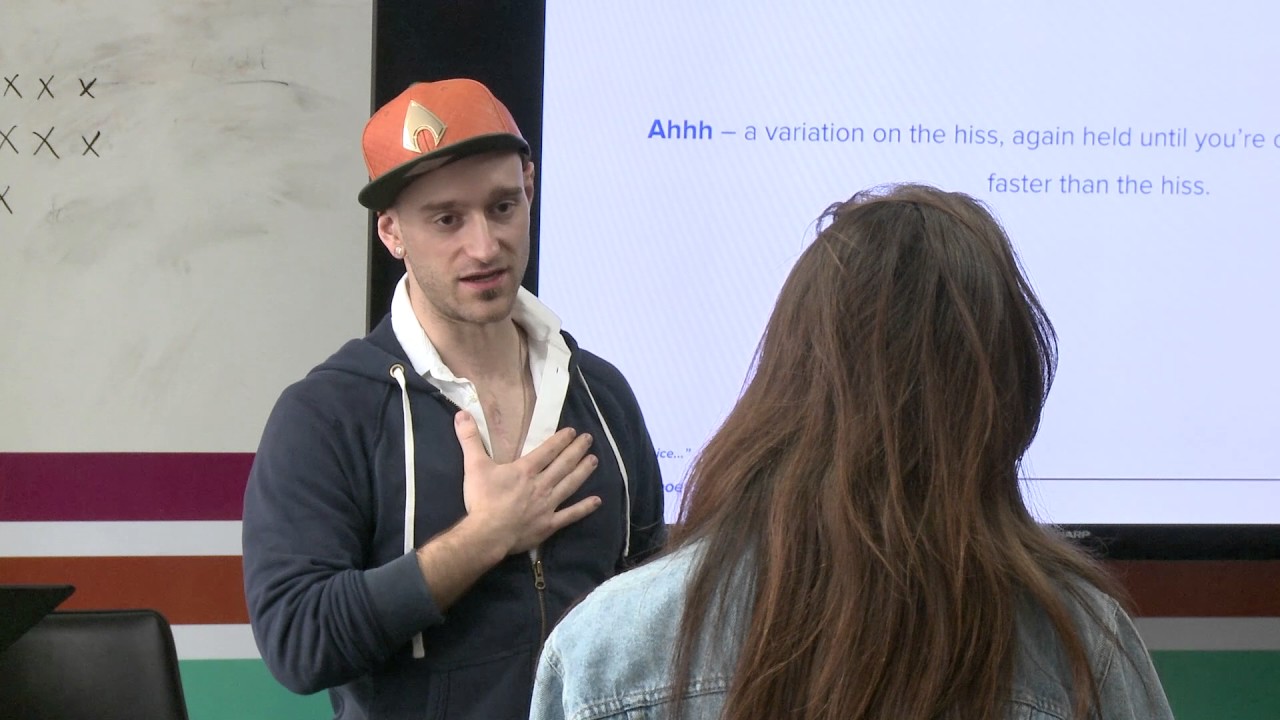
Tim Draper's pitching workshop covers posture and voice exercises to improve on-stage presence. The instructor leads founders through shoulder rolls, chest release, and standing drills, then vocal exercises like ha, hiss, and ah to strengthen projection when pitching to investors.
Chapters
Posture stuff. Shoulder rolls are easy. It's just lifting up your shoulders and rolling them back. Not real hard. This loosens up your back and chest area, which is important in projecting your voice. You don't want to go like super fast. It's kind of just a slow massage for yourself. You'll probably feel your traps squeezing together behind you. Should feel good. Even when you wake up in the morning, just getting up and kind of like, oh yeah, all right, feels Feels good. Simple one. Next one is the chest release. So this is going to open up your chest cavity. When you're projecting your voice, a lot of the vibration comes from your chest. So you're actually going to put your hands out like this and then tilt your fingers back behind you to open up that chest. And you're kind of pulling back, pushing back towards the wall behind you. This helps out a lot in projecting your voice and opening your heart. Feels great, especially as someone who's Had open heart surgery. I'm all about opening up the heart. Next one is pyramid. So this is pretty easy. You step out in front of you, one foot behind you, one foot back. Clasp your hands behind your back and you just bend over, over the leg. You don't have to go super far. You're gonna feel it in your hamstrings. If you have tight hamstrings, you probably won't go very far. Just hold it there, take a couple breaths, and then you just switch your feet and do it on the other side. If you're real advanced, something like over here, she's got her hands up above her head. If you can get there, I'm impressed. I can't. My back and shoulders are way too tight. I feel like most girls are pretty good at it, but most guys are stuck kind of like right at the base of the spine. Next one is chair pose. If you've done yoga before, you've probably done the chair pose. Arms up above your head and then you just sit back down like you're sitting in a chair. One of the keys to this pose is actually keeping your chest and back straight. You don't want to be leaning forward like this. You want to be standing up straight and bending more in your quads. Also, you can put your hands up above your head or you can put them here depending on kind of where, where you can go and how comfortable you are. It should get a little spicy in the quads if you're doing it right. Then the last one is going to be the standing side bend. So you just stand up straight, and you can either take your hand and put it on your head and go this way, or you can go above your head and kind of do like a ballet-type pose. You can also pull down. That's great. Opens up the neck a bit. Do it on both sides. You just do it a couple breaths. This is great. And what this whole sequence is doing is kind of stretching out your whole back and lung area so that you can stand up taller and project a little bit more. So the whole series again is shoulder rolls, chest release, pyramid, chair pose, and then talking about proper form standing. So the proper form for standing is head forward, your ears are in line with the middle of your shoulders, your chest is slightly out. And then your pelvis— and this is the one where a lot of people get messed up— is not tilted forward. It's not bent backwards. You're actually just squaring it off to the middle. And if you just later on today when you're walking around outside, just walk around with the proper form. If you generally slouch over or look at the ground, it's going to feel really weird because you're going to be seeing faces that you don't normally see. But as you walk around like this, After a couple days or a couple weeks, it'll start to feel normal and then you won't notice it as much. And it'll feel weird and it'll feel like people are looking at you weird, but I promise you they aren't, they are not noticing your proper, your proper posture walking around. So posture is really important for going into the room and standing up tall. When you're going into a meeting with investors, and I'm sure you guys can comment on it, it's really important to be confident in yourself and your business 'cause a lot of what they're investing in is you and your team. So if you're going in and you're a little more soft-spoken, you're just gonna have to stand up real tall and be confident. And on that note, the next thing is your voice. I noticed the Faber guys don't have a problem with this. You guys are pretty loud. We're hot bossy. Yeah, yeah, which is good. But we've had some students come through that are like even more soft-spoken than you are, like some girls that are like really, really, really quiet. And so I use some of the stuff from my theater training to enhance the voice a little bit. So the first thing we're going to do is called the ha. What's going to happen is we're going to breathe into our stomachs. And you can even put your hand on your stomach to feel it. You want to breathe with your diaphragm, not with your shoulders. And you're just going to breathe in and expel all that air in one go and just say ha. So ha. Ha. Ha. Ha. Ha. Ha. Ha. Don't be afraid to get loud. Ha. Ha. Ha. Ha. Ha. Ha. Ha. Ha. Ha! Ha! Ha! And what this is, you want to send that ha to the back of the room. You're just sending it out. And it's good to laugh with it too. Like, it should feel good. If you want, do the chair pose and ha it out. Go for it. Next one is the hiss. So we're going to take a deep breath in again. Hand on your stomach. And you're just going to hiss it out like a flat tire. And this is just building lung strength and control, so we'll do it one more time. 1, 2, 3. Bunch of snakes. Another one is the ah-ah. It's just like the hiss, except we're going to say ah. The first time we do it, we'll just do it monotone, so we don't have to go high or low. It's just out. So deep breath in again, and then ah. And when you're breathing that out, try to feel the vibrations nice in your chest, because that's where you'll be generating a lot of that volume from. And this time, we'll do it again. As you notice, it gets kind of sing-songy. So let's go low to high with it, just because it's fun. So deep breath in. Ah. Ahhhhhh. You lost it at the end there. Another one is counting it out. So you're gonna take a deep breath in and then just count starting at 1 for as long as you can go. So by the end of it, you're gonna be like, 27, 28, 29. Some people can get up to like 40. I'm generally around like 20s, but let's see how far we can go. So deep breath in and then we'll just Count. And don't, don't be like, 1, 2, 3, 4, 5. Just count normal. 1, 2, 3, 4, 5, 6, 7, 8, 9, 10, 11, 12, 13, 14, 15, 16, 17, 18, 19, 20, 21, 22, 23, 24, 25. 25, 26, 27, 28, 29. I think I took a breath in. There is a couple micro-breaths that you get in there. But really what that's also doing is since you're projecting it out nice and slow and you're trying to throw it across the room, you're also working out your abs a little bit. So you're strengthening your diaphragm and your abs at the same time. So you can skip the crunches for today. So we also, we used to have one about speaking slower. So some people get up and when they're nervous, they start spitting out the information for their company like very, very quickly because you feel like you need to get it all out there. So what I recommend doing is taking your, like a paragraph or a sentence like this in your pitch And you add just slashes like every 4 to 5 words where you're gonna take a breath. So if you have problems getting up on stage and talking too quickly, what that's gonna do is help slow you down. So you'd be like, your pitch isn't the only brand on stage. You are your own personal brand up there. If you listen to— It's like Obama does that really well when he does speeches. Yeah, actually Obama is really good at public speaking. Steve Jobs is good at it. What? Yeah. Oh, on TV? Yeah, on TV. If you go online and just listen to people who are really good at public speaking, you'll notice that they have a nice controlled way of presenting information to you. And actually, I don't like recommending it, but Hitler was actually really good at giving speeches. It's actually kind of amazing. So the takeaways are stand tall, project your voice. They talked about being concise. You don't want to be overly wordy with stuff, especially if you're getting into technical details of your product. Most investors don't know the technical details. So you don't have to say, like, hey, we use C++. And this function does this. You can just give like an overview on stuff. Take every pitch as an opportunity to gain a customer. So even if you're not asking for funding, they still technically could be a customer. So one of the things that Juan especially likes to talk about is take every opportunity to gain a customer. And then also your pitch isn't the only brand on stage. They're investing in you and your team. So that is going to be it other than practice, practice, practice. And later on we're gonna do an activity. I think they want to do it after Tim's here, where you guys are going to get to pitch over and over and over again in a short amount of time. It's actually one of my favorite activities that we do here, so it's going to be great. And I think that is the end of our pitch workshop. So,
More from Tim


He Sold His Car to Build This Startup, Then Pitched It for $1M 😳 #Startups #AI

This Startup Moves Your Crypto BEFORE Hackers Can Steal It 😳 #Crypto #Cybersecurity




15 Months Without Refrigeration?! This Startup Thinks It Can Go Global 🥥 #FoodTech #Startups



