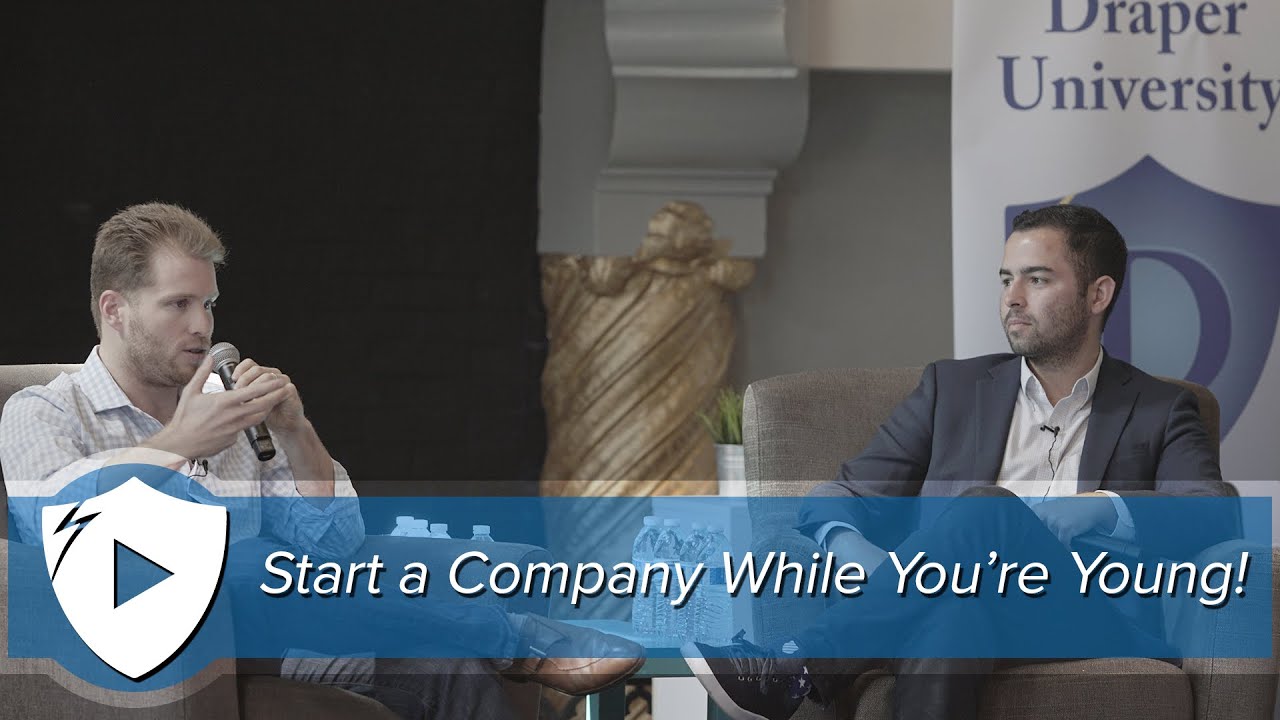
This content was created by Tim Draper. This content was uploaded by Tim Draper. This is a YouTube interview/talk titled "PayPal and Founding Palantir | Joe Lonsdale, Palantir & 8VC Co-Founder" (published April 1, 2019). The excerpt is an English conversation between Joe Lonsdale and an interviewer (labelled SPEAKER B) in front of an audience of young entrepreneurs. Joe recounts his early career—studying CS at Stanford, interning at PayPal, working with Peter Thiel, and the origins of Palantir (starting in his early 20s), including mentorship, team composition, and lessons about starting companies young.
Chapters
All right.
So it's a pleasure to have Joe here today. We've got like 8 water bottles here in case we get thirsty.
Awesome.
But Joe, I wanted to start with maybe going through your entire career. A lot of the entrepreneurs here are obviously young, in their 20s most of the time. And I know you started your career very early. So you graduated from Stanford, computer science, if I'm not mistaken. How'd you go into interning at PayPal?
Sure. So I actually interned at PayPal while I was at Stanford. I, you know, I had a— I think it's always very helpful to have unfair advantages in life. I was born in Silicon Valley. It's pretty unfair. And my friends taught me to program when I was pretty young. I'm sure some of you guys have that experience as well. And, you know, I guess when I was at Stanford, I was working on a bunch of projects, and a lot of people I met And I kept going to PayPal, and I was like, wow, this is attracting a lot of the best people. I want to try to go there. And they actually turned me down the first time I interviewed with Max. He's a friend now. I don't know if he remembers that. He had me on the whiteboard, and we argued about something, and didn't get an offer. But I met him and Peter again, and they gave me an offer, and I went there as an intern and was there for a couple years while I was in school.
How big was PayPal then, in terms of employees, or—
Maybe like 70, 80 people, and then it kind of grew to a couple hundred people, probably, something like that, when I was there.
And at that point, did you know that you wanted to perhaps start something in the future, or was this, you know, an opportunity as a computer scientist to go into a company, and that was kind of like the goal?
Oh, I was always pretty interested in building something myself. I always wanted to be an entrepreneur. I always wanted to fix problems that were broken. So I think the best way to fix things is build stuff with people.
All right. And PayPal was pretty exciting, I'm guessing, at the time.
I mean, it had a lot of— Really opinionated, really interesting people. It was quite a unique group that Peter and Elon brought together. I mean, looking back, you can say, oh, of course it was amazing, because it was Peter Thiel and Elon Musk, and they brought all their smartest friends, right? So I guess it kind of makes sense in retrospect, but at the time, like, who was Peter and who was Elon? And it just happened to be a bunch of smart people there, and it was pretty fun.
Yeah. How long did you get to work there?
A couple years, but I mean, I don't get any credit for PayPal. I was an intern. I brought some friends there. I learned a lot from being there, though.
And then what happened right after? Sure.
So, sorry, it's always awkward to talk about your own history. But I got to know Peter pretty well. I was into economics and history as well as computer science, and he was starting a hedge fund that was kind of in the high-level area of macro finance. And so I read a lot about that and talked a lot with him, and we had a lot of debates about different things there. And I went there and ended up hiring some friends, and we built out this macro fund, and I helped on the research team for a couple years, and while we were doing that, I was hiring a bunch of people to help us, and I brought in a bunch of my computer science friends from— I used to be a chess player when I was younger, so from, like, the chess world and the math world, I brought in all these guys I knew at MIT and Caltech, and, like, 4 or 5 of them just really didn't like finance. They thought it was really boring, but they were there for the summer already on breaks from their PhD programs, so we started mocking up some ideas we had around how we could take what PayPal had done and apply it, like, more broadly to investigations. Because we saw the government— at the time, my roommate and I from Stanford were really interested in the intel world, and we saw the government after 9/11 was spending just a ton of money on stuff that we thought was just, frankly, really stupid compared to what people were doing in Silicon Valley. So the dynamic was that the things going on in D.C. seemed like they were like 10 or 20 years behind some of what people in the Valley had figured out, which is very unintuitive to most everyone else, just because— I don't know if you grew up in the cryptography world at all, but when you study cryptography, at the academic level, you learn about all these stories of how the NSA was doing things in the 1970s that the academics didn't figure out until like the late 1980s why they were doing it, right? So, so, so, so, so the intel world had always been like 10, 15 years ahead of everyone else, and so that was how everyone saw it. But there's like a big shift sometime in the '90s where the way they were building technology and systems in DC just started to get way behind Silicon Valley because maybe of the bubble and of everyone coming here and building things. Silicon Valley got, got to be, in my strong opinion, a lot more advanced than what was going on with the systems integrators. You had a lot of these products being led by people in their 40s, 50s, and 60s who'd been doing things the same way since the 1970s and '80s, and frankly were just not doing a good job in D.C. After 9/11, this seemed like a really important thing to fix for a lot of different reasons. We had these guys who were with us at the hedge fund who didn't want to do finance, and so we started with my roommate and I trying to convince them to help us build this project. Most of them went back to school after the summer, but he and I kept going on the project, and that project became Palantir.
You were in your 20s there?
I was 21, yeah.
When you started Palantir?
Yeah, we were 20. Stefan and I were 21. Peter was 36. Yeah.
Wow. How was that, the process of starting something that's so huge now at such an early age? Was it— was the value there from the mentors? Was it still like a huge leap for you?
I think things are actually easier to start at an early age in some ways, because you don't know some of the mistakes you're making, and so you need mentors to help you fix some of the mistakes, but It's the same reason we send young people— this sounds really bad, I should be careful, but it's the same reason you send young men to war in the old days. It requires this certain crazy energy and obsession. You don't send people in their 40s to war, right? I'm not saying you can't start things when you're older. I think it's actually easier and more intuitive when you're younger just to work crazy, crazy hard on something and iterate and keep trying. I think that energy tends to be why I think a lot of young people do build companies, because it takes just an immense amount of energy. The key thing at Palantir, I'd say that the number one reason it worked is we had a lot of really smart friends, and we worked really, really hard with our friends, and we kept iterating with the potential customers, and kept coming back and showing them new things, and impressing them. On top of that, obviously, the mentorship of Peter was really key. We needed a CEO early on, just because you need someone who can interact with the— for high-level enterprise sales, I don't think you should have someone in their early 20s be the actual CEO. No one's going to take you nearly as seriously, especially not 15 years ago. Nowadays, maybe a little bit easier. But back then, it was even still a little more traditional. So Peter Thiel kept trying to bring in these people from the defense world. We didn't want to work with them because culturally they were too hard. And then Stefan and I convinced his old friend Alex Karp to be CEO temporarily, to have a CEO at least. And it turned out Alex was just a really wise person as well, and I learned a lot from him. So he ended up being the long-term CEO.
That's exactly why we have this age. Our average age here is probably 26, 27. It's because we want to teach them to fail really fast.