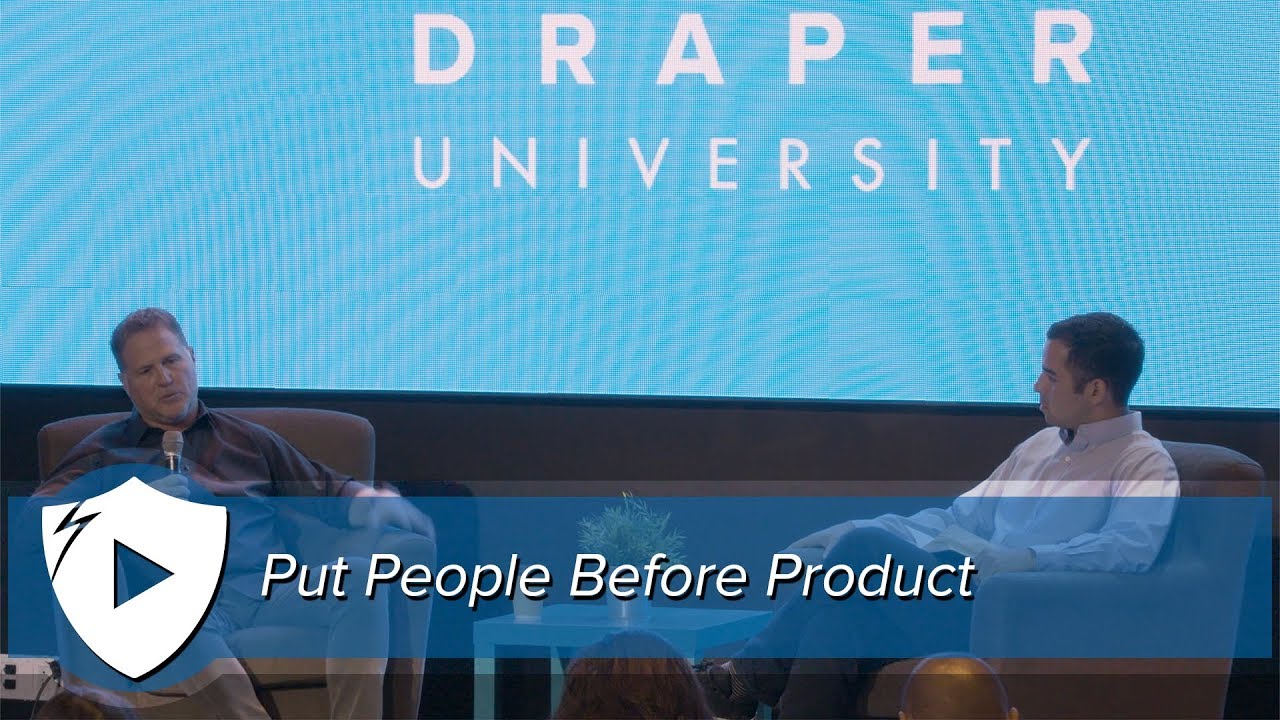
This content was created by Tim Draper. This content was uploaded by Tim Draper. This is a YouTube video titled "People Over Product | Zenefits CEO Jay Fulcher" (uploaded 2018-08-31) featuring an interview-style conversation between Zenefits CEO Jay Fulcher and an unnamed interviewer. Fulcher discusses team dynamics and mentorship (including an anecdote from his PeopleSoft experience), the early business model and rapid growth of Zenefits, regulatory/compliance challenges, and the turnaround actions he took after joining (significant headcount reductions, new management, shifting from a free-software-plus-brokerage model to a paid SaaS model, and moving away from being an insurance broker to focus on software).
Chapters
Great. And I mean, he mentioned the team dynamics, and I know you guys got to experience a lot of that this past week. So definitely know how important that is. Were there any people in terms of connections— you said you worked for other companies— any crucial people to the success in your journey?
Yeah.
I know that when you joined Zenefits, I know Andreessen Horowitz basically pulled you in. But along the way, were there some of those people there too?
I mean, there's a, there's a ton. I can't say enough about how important it is for any of us individually to curate an ecosystem of mentors and people that you can go to for advice, counsel, opinions, and frankly, people, especially if the relationships are strong enough where you can really be vulnerable about, I don't have this answer, I'm not sure what to do. You know, here's sort of the challenges that I'm faced with. What do you think? Because I was really lucky to have had a lot of those. Quite frankly, it's really hard to even sort of limit those to any one individual one. I would point out maybe PeopleSoft as being a really interesting example in that when we sold Red Pepper, I was a 31-year-old, pretty young executive with not much experience. Dave and the board there had asked me to run what became the largest business unit in the company at that stage. I basically said to Dave, because he's a very disarming, easy to get to talk to, very approachable guy, and I was like, I have no fucking clue what I'm doing. Are you kidding me? Are you really ready for this? Because I'm not sure I am ready for this. And he had just this— it was a great moment in time in my career where he reassured me that, you know, you don't have to have all the answers, but you got to be intense and prepared, and you got to be willing to work, and you got to be willing to be open-minded about kind of what you discover, not only about the job that you're in, but about yourself, about your own self-awareness. And it was just an incredible coaching dynamic that was created for me by Dave when they asked me to take on this role. And luckily, for a bunch of different reasons, it worked out really well. Worked out well for me. It worked out well for the company. Of course, PeopleSoft became an iconic brand and a great company. I learned so much about not just technology and the products, but I learned so much about how important the team is. Really, I'd say the one thing that's driven these connections and this ecosystem dynamic for me has been the team is everything. The people dynamic in tech companies is everything. So many people, I'm sure on this stage, talk about technology and they talk about products and they talk about all of the solution aspects of what they're doing, but there's nothing more important than the solution than the people that make up the company. and the people that make up the vision and the ethos of what the company's all about. That cultural dynamic is just crucial. And so for me at least, I'd say the PeopleSoft experience for me was one of those kind of stories that stands out for me in my career because it was delivered at a time where I needed— when I was really needing to hear that.
Yeah, I think this is really relevant to everybody. So we just ran Survival and we can't talk too much about it. But I've heard some stories of, you know, people leaving other people behind or people getting on board with everything, and things happen in the team. So we understand how important that is, and that's why we do these activities. So thank you for mentioning the team. When you came on to Zenefits, I know you care a lot about culture, but I don't think the room knows very well what was going on with Zenefits before you joined.
Yep.
So can you give us a little picture of what that looked like? And then now that you joined, what it's starting to look like.
Yeah, I think for those that don't know the Zenefits story, first of all, sometimes Zenefits, because it has been so much in the press, people think the company's been around forever. It's actually been around only 5 years. So it's been a very power-packed, kind of an exciting time for a company that really is only 5 years old. You know, Zenefits is an HR human capital management company. So it basically has a very broad HR platform around everything related to HR and payroll and benefits. But most importantly, when the company was first started, the company was really focused on disrupting a lot of the dysfunction associated with the healthcare industry. And how do you basically provide better insurance solutions? How do you provide better healthcare solutions? especially for small business. That's really Zenefits' approach, has been working with companies that have sort of fewer than 500 employees. We work with companies with as few employees as 3 or 4 employees, all the way up to several hundred employees. In the early days, the company had a very, I think, clever business model, which was to give away the HR software for free in exchange for being the broker of record, which meant that we collected the insurance commissions on any insurance that we sold to any of our companies that took our HR product. As I said, that was a really clever model. I think the one issue is that the company became the fastest-growing SaaS software company in history. That can be a really good thing, but growth at any cost and without any check and balance can be a really dangerous thing. We got to a point where the company was adding 100 people a month. We were growing so quickly, headquartered here in San Francisco but with offices elsewhere, growing so quickly that the company really had a hard time keeping pace in terms of governance and compliance issues and all the rest of it. Because when you're dealing with insurance, it's a regulated industry. You've got to be able to make sure that you've got everybody licensed and that sort of thing. When the company ran into some of those issues, Obviously, that became highlighted, as it should, and the company had to put some remediation in place. And really, a reset was necessary. And so when, when the guys at Andreessen called me, I had just sold Ooyala and thought I was actually finished with my operating career, quite frankly. And they felt like the leadership opportunity and what they were really looking for was a really good bit in terms of kind of my background. I've tried to build a really good reputation about building great teams and frankly building great cultures around companies that are trying to solve really big problems. I would argue I'm not sure that there's a bigger problem to solve right now in the U.S. than healthcare, and particularly for small companies. A lot of people don't realize that more than 99% of all companies have less than 500 employees in the U.S.
That's right.
So it's a huge market and it's a huge problem that needs to be addressed. So when I came in, you know, I pretty much immediately took the headcount down from over 1,000 employees to 500. I did that within the first few days of joining the company, which is, you know, it's not the most fun way to start a new job. But it was a very necessary thing to go do. And rather than having anybody in the prior regime be responsible for that. I felt it was really important for me to be the one that was orchestrating those changes. So we did that. And then I've been effecting a pretty major turnaround in terms of new management team, new business model. So we no longer are selling software for free. We charge for our products. We knew we built really great technology, but the validation point was when more than 70% of our customer base moved to the pay model. So they went from using our product for free to then 70% of them deciding that they would actually pay us for the product, which we thought was a great validation point because especially with SMB, with small businesses, getting them to pay for anything is difficult. And so that obviously was a great testament to the fact that we built some great software. And then beyond that, we've made the decision to no longer be a broker. And to work, rather than competing with insurance brokers across the US, we felt like it would make a lot more sense to collaborate with them and allow them to be, you know, great insurance experts and provide the advice and counsel that they typically do with their customers. And we would go back to being really at the core of what we are, which is a software company.