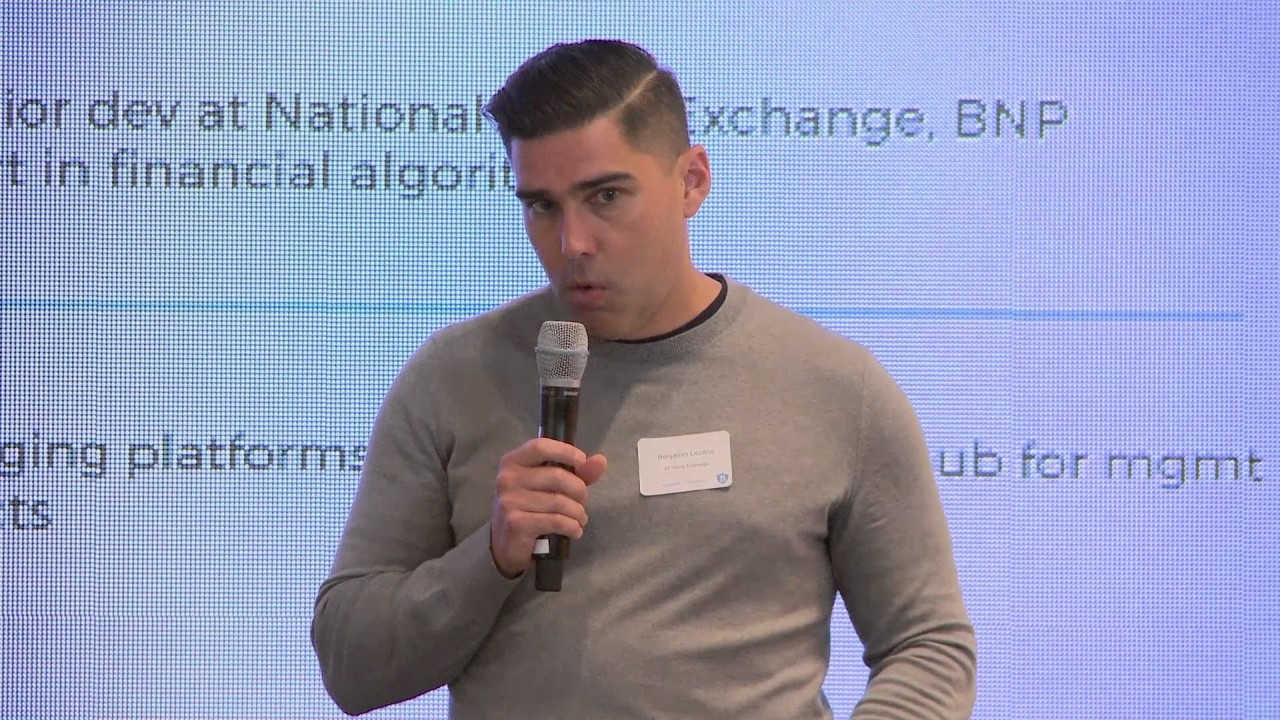
In this pitch, Benjamin Lozano, CEO and co‑founder of TrueNorth, presents a vision to create the world’s first public capital market for small businesses, called the San Francisco Stock Exchange. He explains that for 80 years small businesses have been barred from public markets, but the recent enactment of Title III of the JOBS Act now permits them to raise up to $1 million from the general public without full securities registration. By pairing this regulatory opening with a broker‑dealer license and a proprietary technology stack built on a private Ethereum network, TrueNorth aims to provide both primary issuance and secondary trading of small‑business securities. The platform offers traditional investment‑bank services—underwriting, risk modeling, settlement, brokerage, and asset management—tailored to small firms. Target issuers are revenue‑generating businesses ($1‑2 M+) that have audited financials and a CPA relationship, ensuring quality and reducing default risk. To launch the two‑sided marketplace, TrueNorth will initially source issuers through CPAs (the “fishing pole”) and attract local retail investors, especially millennials seeking alternatives to legacy finance. The company has built a production‑ready platform with sub‑second settlement, a blockchain explorer, and other innovations. It raised $300 K seed and is now raising $1.5 M to finish product development and launch in Q4, with an initial beta of three offerings to 5,000 retail investors, followed by a phased expansion. The team includes a blockchain architect with AI experience, a financial engineer from the National Stock Exchange of India, a COO with finance background, and Lozano himself, a fintech veteran.
Chapters
Great. Hi. Every once in a while, a series of events align just right and something radically new becomes possible. My company has discovered that a new law combined with a new set of technologies and driven by a powerful market demand has now created just such an opportunity. Inspired by this insight, we engineered a new model of finance, and now we're going to use it to consolidate the entire small business funding market. My name is Ben. I'm the CEO and co-founder of TrueNorth. We're building the San Francisco Stock Exchange. Today, large corporations raise their capital on public exchanges, but not small businesses. Since 1933, it's been unlawful for small businesses to raise their capital from the general public. This means for the last 80 years, small businesses have had access to one funding source: private lending channels. Startups raise private equity. And small businesses raise capital through bank loans. Until now. Last year, a new law called Title III went into effect, which allows small businesses to raise up to $1 million a year from the general public without having to comply with modern securities law. Now, most people today are still thinking about Title III as equity crowdfunding. Actually, that's shortsighted. We've discovered that you could use the new legal space cleared out by Title III, combine it with a broker-dealer license, and now create the world's first small business public capital market for buying and selling US small business financial securities. Now, why do we need this? What problem does it solve? Oh, this is not what I thought it was. There? No, this is a different deck than I have. Well, whatever. So why do we need this? What problem does it solve? Let me see if I can actually find the— somebody blew it here, Brett. What problem does it solve? First is the problem of supply. At the same time that small business funding needs are growing, regulation is actually forcing banks out of the small business loan market. Second is the problem of demand. Millennials do, believe it or not, increasingly have investable wealth, and yet since 2008, they have an aversion to legacy finance. So the question is, who's going to consolidate this $2.6 trillion market, and what role, if any, do millennials play? I think that's Let a great question. me see if I can figure it out here. The answer is a small business public capital market, and Title III now gives us the regulatory arbitrage to do it. So, and millennials will invest in these small businesses because they get a good rate of return, and they also are helping to build a new kind of financial system, one that they've created, one that they own, one that creates the kind of world that they want to live in. So that's what the San Francisco Stock Exchange is. It has a primary market where these securities get issued, and it has a secondary market where they get traded. And what we provide at the San Francisco Stock Exchange is all of the financial services that have traditionally been provided by investment banks, but now to serve the needs of our own customers. So we perform underwriting services, we perform risk modeling, Transaction and settlement, broker services, asset management. It's a new era of financial services and specifically designed for those people who since 2008 have been searching for a viable alternative to legacy finance. So, I don't know here. Let me just finish with the team since Oh, well, let me actually stop on our company highlights since I'm going to be given an extra 30 minutes because somebody blew it. So where are we at right now? So far we've created the platform. It's more or less production ready. We refenced our own private Ethereum network and hacked out 14 seconds of latency. So now we are down to sub-1 second for transaction settlement time. We've built our own blockchain explorer and we made a bunch of innovations in the technology itself. So TrueNorth is really essentially a tech technology stack that's built to support the San Francisco Stock Exchange. We raised $300K earlier, and now I'm raising $1.5 million to finish bringing the product to market. And this is our team. We've got a blockchain architect here who also has background in AI. We've got a financial engineer from the National Stock Exchange in India. Niraj, who you saw earlier, is our blockchain architect. He's a new creature. developers and architects who architect things with smart contracts. My COO Rafael has a background in finance, and my deal is— my background is also in finance and fintech. I spent the last 10 years trying to figure out how to build the world's first small business public capital market, and now we're doing it. We're building the San Francisco Stock Exchange, and finance is evolving. Thanks. Thank you, Ben. So, Ben, why not Why don't you call the whole thing San Francisco Stock Exchange or Stock and Bond Exchange instead of TrueNorth? Why have that? Why confuse people? Yeah, so TrueNorth has a number of products. The first product is San Francisco Stock Exchange, but honestly, we can bring our technology stack and our financial services platform wherever the legal climate is right. So it's right in the UK. It's also right in India right now. They also have the kind of equivalent of Title III or JOBS Act-like regulation. So TrueNorth is actually a technology company that's run by financial engineers, and we're building the San Francisco Stock Exchange, but we could also license out our IP. In fact, the first thing we wanted to do was totally de-risk the technology. So in itself, right now, the round that I'm raising, I've already de-risked the investment for my investors by having a technology stack that has IP value in itself based on just the major innovations we ourselves as TrueNorth have created to support the San Francisco Stock Exchange. So what's the ideal businesses that you're going to try to take to market year 1? So our ideal businesses are not Dave's Pizzeria, who was trying to raise $40,000 because his bathroom broke, or he fell behind in payroll. I like Dave. Well, you know, Dave should go to our deck. Our target businesses are businesses that generate sufficient revenue, they have operational history, and more importantly, the number one thing I'm targeting is you have to have a CPA who has audited financials. If you're going to list a bond or a stock on the New York Stock Exchange, you better be the cream of the crop. Likewise, if you're a small business issuing a bond or issuing some sort of security on the San Francisco Stock Exchange, you're someone who's generating $1 million or $2 million in revenue, and you would go get an SBA bank loan, not go to Lending Club or OnDeck to get a 30% rate of return because you don't have audited financials or you cooked your QuickBooks. Instead, you have a CPA that's auditing your financials, and he's going to be making— he or she would be making an introduction to Coast Community Bank to get an SBA bank loan. But you don't want to do that because you've got to put 25% collateral down and it's going to take 16 weeks to do. You'd rather come to the San Francisco Stock Exchange, get the value-added capital of public capital, but also it's only going to take 3 weeks and you're not going to have to put any collateral down because it's an unsecured bond. So for any marketplace, there's obviously the chicken and the egg problem of How do you get, on one hand, companies on this exchange, on the other hand, get investors? So who are you more focused on, and what strategies are you using to get companies excited about listing and get investors active on the platform? Yeah, good question. So the way you jumpstart a 2-sided marketplace is very carefully. You need to make sure that the supply and the demand are equalized, and I can't have defaults at some of my first 100 offerings, because if we do, we'll be dead in the water. So I'm hand-selecting the first businesses. Actually, our traction distribution channel for getting high-quality supply of issuers on the platform is actually to target CPAs, not the businesses themselves, because now I'm just paying for the cost of the fishing pole instead of the cost of the fish. If I can get some high-quality borrowers and build micro-monopolies from first just the Mission in San Francisco or Richmond Presidio and then San Francisco and so on, then I can, I can build out progressively as I start to take over the United States small business money market. As far as the retail investor side of things, it's a capital market, so it should feel like it's populated by a bunch of retail investors. Once I know where my issuers are, then I'm going to target those retail investors in the same area so they're investing in their local community. My vision is on Friday afternoon at an auction for a business, at a bar or dentist's office or whatever the case is, people are sitting there in the place itself bidding on the securities because they know this business, they love this business. So, you know, there's a longer answer there, but of course we don't have the time for it. Thanks. Amen. Thanks. When do you expect to launch this? Q4. Q4 this year. And what sort of— what are your success measures for launch? What are you trying to do? I'm going to do 3 offerings with 5,000 retail investors. We'll have a bunch more signups than that, but we'll just allow the 3 offerings in a closed beta. We'll know exactly who's going to be coming on. The next month I'm going to do 5 offerings and another 5,000 retail investors, and we'll just slowly build out my micro-monopolies that way. Any other questions? Thank you, Maddox. Our next presenter is Stephanie Biden.