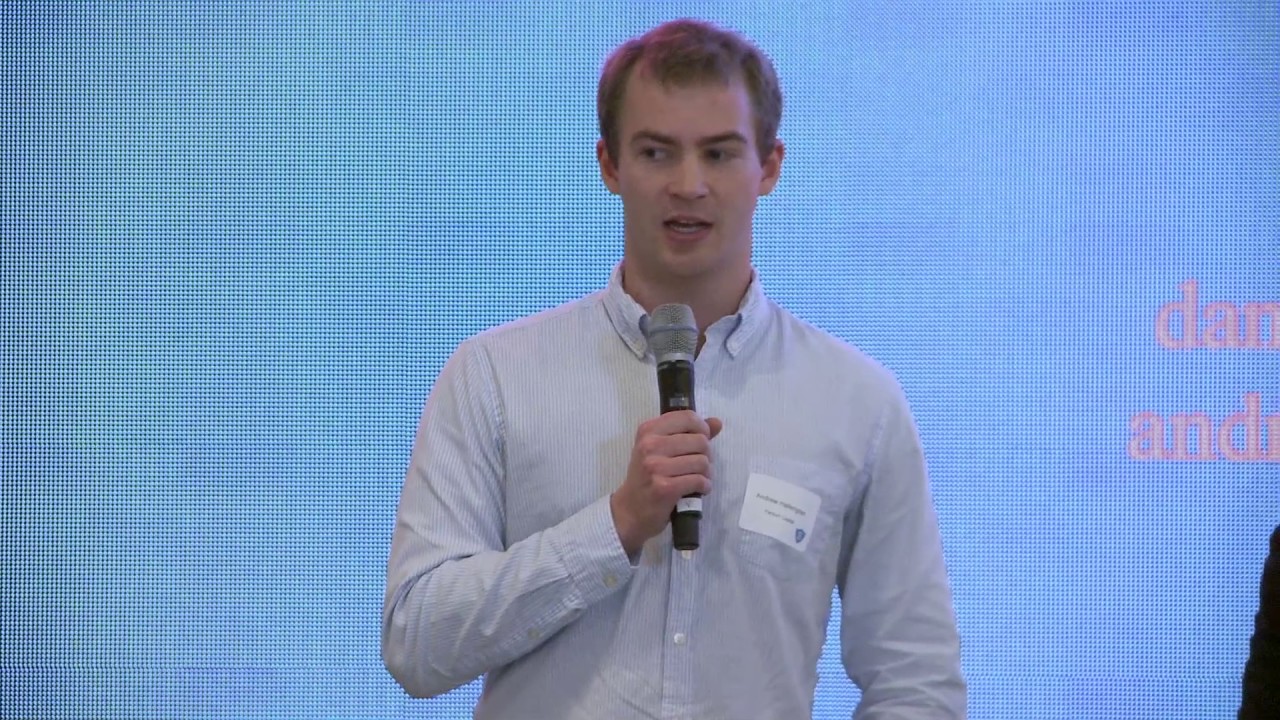
Daniel Cawrey pitches Pactum, an OTC-derivatives platform for managing blockchain asset price and counterparty risk. The team is raising seed funding in Bitcoin, and faces questions from the panel about security, execution speed, and exchange selection.
Chapters
All right, good afternoon everyone. So first I actually want to give my friend Brett, uh, let's give him a round of applause for setting this up. Brett, in the email you didn't say this was going to be a Chardonnay competition, so now I'm going to work a little bit harder. So good afternoon ladies and gentlemen, my name is Daniel Kari, uh, our company is called Pactum and we are managing blockchain risk. I want to ask You guys, how many of you own blockchain-based digital assets like Bitcoin or Ethereum? All right, great. You guys are the way of the future. But I have been in this industry, starting with writing for CoinDesk since 2013, and I've noticed a huge problem for companies that want to actually own blockchain-based digital assets. First off, financial services companies, family offices, huge investors that want to get into this. Tim, you wouldn't be included. But many of them, for compliance reasons, don't want to actually deal with the security and custody issues of owning digital assets. And there are many stakeholders, Bitcoin businesses like wallets, exchanges, Bitcoin ATM operators, that have problems looking at price certainty. Bitcoin today is not going to be worth the same in the future. It could be worth more. but it also can be world-class. So that's what Pactum does. We offer over-the-counter derivatives. For financial services companies, that means that they can access new digital asset investments. Stakeholders like these blockchain companies, startups, those that are holding these digital assets, can better manage cash flow using these instruments. And this at the same time allows them to better define risks in what is a wavy environment. We do have validation for this. Since we started this in late 2016, we started a fund that does arbitrage in the industry, and we have pretty strong average return, and we have a good number committed. We also have a startup that hasn't launched yet that needs to have price certainty for their consumer app. The market size for derivatives in the traditional financial industry is huge, $1.2 quadrillion. The top 10 digital assets in blockchain don't have any derivatives at all. So our product again is over-the-counter derivatives, and this allows people to manage risk, gives them the ability to invest, and gives them better security. How do we make money? We make money from a spread. We also help to advise companies on how to deal with this risk. And also our arbitrage fund. What's the competition right now? Derivatives are extremely retail in this industry. Bitcoin Investment Trust, which is largely overpriced, the Bitcoin ETF that was rejected by the SEC, which did say that derivatives are really needed in this market along with surveillance, and also Crypto Facilities, which is a great platform for retail derivatives and a great company that we'll work with, but still it's not institutional. We have a great team. My co-founder Andrew, he has a background in money management, and I have a background in IT security and working in this industry. And we are raising a seed round to move this forward, and we also accept Bitcoin.
Thank you very much. So the risks The people see, you're saying, are all based on the price of the digital asset, and you're saying that you're hedging against the price of the digital asset, but are you also insuring their digital assets themselves?
Yeah, so—
And which one is a bigger issue for people to hold?
Yeah, so I think it depends on the customer because there's 2 sides to a trade, right?
There's people who want to short and then there's people who want to be long.
People who are shorting are typically hedgers hedging risk, and then there's people who are looking to invest— financial institutions, mutual funds, that kind of thing. So, you know, the security management and compliance aspect of it is huge for financial services and investment companies, whereas, you know, the managing price risk is more So that's useful for the companies that are actually using the digital assets.
So I don't know a lot about derivatives. Are you basically creating third-party contracts to hedge the risk?
Yeah, yeah. So there, there's derivatives for pretty much every commodity out there in traditional financial markets, and we're just applying those concepts, swaps and forwards, and applying that to digital assets.
And then how do I know that guys are going to go broke? Do you guarantee that?
Who's going to deal with it?
The person that I have the contract with.
So the contract— yeah, counterparty risk. Yeah, so the counterparty risk is always with us. We are derivative dealers, so we don't match 2 separate institutions. We take the counterparty risk and we manage that. We're the counterparty risk and we manage that, uh, our counterparty risk with, you know, with you, for example, uh, by having collateral requirements And also being able to monitor assets held on the blockchain using some proprietary technology.
I was gonna cede my question to Bitcoin Gandhi here.
Okay, so just to understand this correctly, if I called you up and said, like, I want to do a long or a short, okay, how long does it take you guys to process that, get a quote back, and like, what's the And then you obviously have to source it also, right?
So you have to get the other party to the table.
How do you balance that out?
Yeah, so we start by having basically an agreement with the company, and then once we have that kind of set up, then we can trade. It could be in as little as 10 to 15 minutes. The way that we never have— it's never going to have a balanced book when you're derivative to dealer. You never have a perfectly balanced book, so you would have to go out on the spot market. Or the exchange-traded market and hedge out that risk until you find basically an equal and opposing side.
But what about the exchange risk, right? So, using, for example, Bitfinex to pocket money out, what happens then?
Yep, so one of the things we've been very careful about is making sure that we work with only the most in-compliance and regulated exchanges out there. So, not working with the Bitfinexes and OKCoins of the world. Not saying they're not OKCoin.
So, um, do you feel like this is just something that people are going to gamble with, or are they going to have bots running trades back and forth, or you think this is just going to create more liquidity in the market? What's your goal? What do you care—
why do you care about this? This is, uh, only focused on institutional and high net worth individuals. We actually can't, uh, for compliance reasons, work with US retail investors. So it's really made for institutions that are looking to either hedge risk or take pricing risk. So the idea isn't to have bots trading or anything like that. The idea is for people to have actual use cases for hedging or taking pricing risk.
Well, but kind of back to that though, why is this an awesome problem for you?
So my background was I worked at a hedge fund, long-short equity, and I Really love trading, and honestly, I don't think that hedge funds necessarily long-term, you know, typical hedge funds are the future. I think those are in the past, and I think that digital assets are the future. And this is kind of for me, it's an exciting thing to do because it kind of blends my passion for trading with with the future of fintech.
Great answer.
Thank you guys very much. Thank you. Our next panelist will be Kasha.