Pressure Hits DIFFERENT | Meet the Drapers S9: Semifinals II
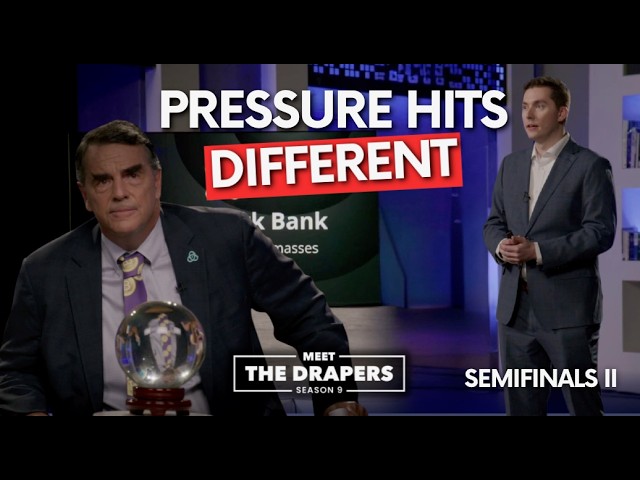
In this episode of Tim Draper's reality series "Meet the Drapers," the host travels the globe to showcase five semifinalist startups competing for a $1 million investment. The show blends high‑energy on‑stage pitches, behind‑the‑scenes physical challenges, and judges’ Q&A. The entrepreneurs present: (1) Juliette’s non‑invasive menstrual‑blood stem‑cell banking platform aiming to cut therapy costs from $100k to $1k; (2) Victoria’s biosynthesized psychedelic drug pipeline (psilocybin, DMT, 5‑MeO‑DMT) targeting depression, addiction, and other mental‑health disorders, with a software tool for clinicians; (3) Max’s open‑source AI drug‑discovery platform that aggregates curated drug‑property data to accelerate clinical‑trial readiness; (4) Kyle’s Orbital High‑Throughput Drug Screening (OATS) system that miniaturizes space‑based disease models to speed drug testing; (5) Kenneth’s crypto‑enabled banking infrastructure built in special economic zones and Native‑American tribal charters to serve the under‑banked. Judges Andy Tang, James Walker, and Crypto Megan probe market size, regulatory pathways, revenue models, and competitive moats. The episode also features team‑building challenges (robotic combat, air‑squat contests, a rapid‑draw art session) used to assess founder resilience and teamwork. After deliberation, the judges rank the startups, selecting Muse, Aiwa, and Exo Biosphere (Kyle’s company) as the finalists. The episode highlights themes of innovative biotech, decentralized finance, AI‑driven drug discovery, and the role of high‑risk venture capital in scaling frontier technologies.
Chapters
If you had a choice, Nobel Prize or billionaire, which would you take? We've been all over the world. We have found these entrepreneurs to be in the semifinals.
Look at the hands of the robot. Out of the blue, he goes like—
Whoa!
I wasn't expecting that at all.
This is a pleasure. The semifinals, this is a big bet on your career.
It's going to be extremely tough, so I'm going to have to bring my A-game.
I'm Tim Draper. I'm traveling the globe to find game-changing entrepreneurs with world-transforming ideas. Thousands applied, but only top entrepreneurs have made the cut for a chance to win an investment of $1 million. It's a journey packed with unforgettable moments.
Yeah!
Welcome, everybody, to Meet the Drapers. This is our second semifinals. It is a really special one because the first semifinals competed with a second group. 3 of these 5 will be moving on to the semifinals. To my immediate right, this woman's extraordinary. This is Crypto Megan. Megan is a leading Web3 strategic advisor and the host of Crypto Megan Podcast. Welcome to the show.
Thank you.
We're bringing 3 of these forward to the finale. I brought in 2 of my partners. On my left, we have Andy Tang, 30 years in the venture capital business. And James, tell them a little bit about yourself.
James Walker. I've been with Tim for 5 years. I am a reformed attorney.
That's, that's reformed and informed.
Yeah.
Megan was here for the first episode. of our semifinals. Tell us what you're gonna be looking for.
The bar is high. That's all I can say. And I'm so impressed at the caliber of these companies and the problems that they're solving, the impact they're gonna have on the world.
My team had a competition between today's semifinals and the, the other semifinals. So just keep that in mind.
Wow, okay.
Let's bring in our first entrepreneur. But before we do, let's see what's going on behind the scenes.
Welcome everyone to the robotics floor. I'm Xenia. So at U of B, we're building a humanoid robot fighting league. Tetsuya will demonstrate us behind the riot shield.
It's a human punching bag.
So the goal will be to get 3 hits, and so whoever goes through the obstacle course and makes 3 punches first, that person wins.
Right, and then he comes here, put it in his body.
So now, you gotta catch up.
Let's do it.
Start!
1, 2, 3! 1 minute, 33 seconds.
I hadn't controlled a robot since I was in high school.
my robotics team. I told that to my team and they're like, all right, you control the robot, Ken.
Luis, you got this, Daniel.
Okay, there you go.
I was like looking at the hands of the robot. Out of the blue, he goes like—
I wasn't expecting that at all.
And I think all of us at first were like, oh my gosh, is he okay? And then he was okay and it was just really Sorry about that.
That was hilarious.
I had no idea the robot could kick, but the buttons are right next to each other, and I accidentally held the wrong button on the controller. So that was a, I don't know, happy accident.
That was not great.
And stop.
All right.
It's only 2 minutes, and so there's only so much information that I can kind of relay across. I'm Juliette, and when I was 23, I was immobilized by a severe spine injury. For years, I was in constant pain. I could barely get out of bed. I even had to walk with a cane, and I was given only one option, and that was aggressive surgery every 5 years for the rest of my life. Can you imagine? I had to find a better option, and I found one that could bypass all of those surgeries: stem cell therapy. The catch was that it was $250,000. And then I learned that there were stem cells in menstrual blood, and women are releasing millions of these cells every month, and they're actually superior to our current sources of stem cells. Our tech captures these stem cells noninvasively in the privacy of your own home. And we're aiming to reduce the cost of cells from $100,000 to just $1,000. Since last I saw you, we have raised $1.1 million. We've set up our collection sites. We've built our lab and stem cell bank. We've built our community of muses, our donors. And we have commercial traction now with our first buyers for a product we're launching this month.
So You get the menstrual blood. Can you store it indefinitely? You freeze it, or what do you do?
Yeah, the cryopreservation allows us to store it pretty much indefinitely.
How do I get that menstrual blood into my bloodstream? Do I just shoot it in?
There are many ways that that's administered and how that's applied, and it's depending on the process and the need, right?
So your process is different from the other kinds of stem cell therapy where they take your blood and then they run it through centrifuge and then they do It's a similar process, but some back-of-the-napkin math is indicating it's somewhere between 300,000 and 600,000 times more stem cells in menstrual blood.
Ours is noninvasive. You don't have to go through any of that pain. You don't have to go through the procurement costs, hospital stays, surgeons, any of that.
How do they get it to you?
Right now they're coming into Frontier Tower where we will—
Oh, we're doing it right here in San Francisco.
Yeah.
But eventually you're going to want to have them send it through the mail, right?
Yes, and we have those in hand now.
How do you market this to the donors?
So we have a reimbursement process, so we want to be able to give to our donors for the value that they're giving to us.
I mean, it's brilliant. It seems genius to me. I mean, you're gonna have your menstrual session every, every month. A lot of them already use menstrual cups.
One period collection can yield over 500 million cells. Every day there are approximately 800 million women menstruating.
Your parents are backstage. Do you want to bring them out?
Here they are!
Her parents are here, all the way from Napa.
Hi, Jenny.
Are you proud of her?
Well, we're incredibly proud. There weren't TV shows around entrepreneurship when they were starting their business.
What is that first sort of killer app, that big market for stem cell therapy?
The core biology and the infrastructure engine all feeds into the therapeutic applications.
So what is the problem you're gonna solve first?
We're bringing it full circle, and this next year I am going to be treating myself with my stem cells, treating my spine.
Cool.
Very cool.
As much as it seems like, oh my God, this has never been done before, it's really not. It's just that I don't know if anyone's given it the right platform yet. The woman who discovered those cells struggled to get funding to continue her research.
Thank you very much for being with the Drapers.
Thank you, Tim.
Gosh, I want some of that menstrual blood.
That's impressive. She said they could even get it from pads and tampons. That makes her target audience much bigger.
I liked it. I mean, it's novel. I want to know more about what the products are going to be.
If you think about it, like, what's more resilient than the human reproductive system? Right.
The cells.
And like, that makes a lot of sense to me.
It's the beginning of life.
Yeah.
I think the price is right. Single-digit valuation. So you are trying things. So it's just at the right stage.
Terrific.
Well, let's bring on our next entrepreneur, but before we do, let's see what's going on Behind the Eyebrows.
Welcome to the 4th challenge. We are now on the longevity You have a combination of practical and theoretical challenges ahead of you.
The air squat phase of the challenge. You go down.
Oh my.
And you jump.
I love it.
Each team will do as many air squats as it can do in 1 minute.
Well, I'm still feeling the squat challenge. You know, I tried to do perfect squats.
I said, like, okay, 60 seconds of squats. When I got to 30, okay, Victoria, you're on TV. Don't die.
Let's go!
I'm so sore still. I'm really sore.
And the main part of the challenge. A billionaire wants to maximally extend their longevity. You need to pitch this billionaire for health now, for biohacking, and for longevity for the future.
Um, what? You're morning?
The squats got me all messed up.
I'm not a biomedical hacker thing, so I was operating out of pure ignorance.
3 minutes, go!
Aging, it's what brings more suffering and death than any other thing on Earth.
The best solutions already live within us, so our strategy is to go for something that has been proven. In order to get strong, live longer, you need to sleep well, you need to gain muscle, and slightly risk Thanks for the great pitches. We disagreed a bit, but ultimately we put together our scores, so which Adam will present.
Team 1, 24, and Team 2, 23 points.
However, we still have the results We recounted the jumps on the camera.
Team 1 reported 296, and Team 2, 261. But upon recount, Team 1 was found to have done 234, and Team 2, 238.
No way!
Which means Team 2 is the winner with 27 points!
The judges, they thought this is just a game.
They didn't know the stakes.
So we didn't specifically ask for a recount.
I think what happened was people just didn't keep track in their mind.
We did give it our all, and we were honest, by the way, about how many we actually did.
I can't believe I get the chance to keep on speaking about this on TV, to lower stigma, to Push people to speak more about mental health. Today, more people die from suicide than war, terrorism, and natural disasters combined. For 30 years, we haven't seen improvements in mental health treatments. 40% of the people are treatment resistant and 75% quit. Luckily, effective treatments like psychedelic-assisted therapy with psilocybin are changing people's lives in just 1 or 2 sessions enhancing their brain's neuroplasticity. The FDA designated this therapy for depression to be a breakthrough therapy, and just a month ago, they announced a fast track for approval 12 months from now. The science is ready, but the supply is not. Today, no one can combine pharma-grade IP, scale, precision, and access all together. But with biotechnology, we can do this. From Latin America to the world, We engineered our own microorganisms with biosynthesis and bioinformatics to produce psilocybin, DMT, and 5-MeO-DMT at scale. Since our investment, we have done amazing progress. Thank you, Tim. We did a 20x on our psilocybin yield.
Will you be able to sell your psilocybin 12 months from now in the US?
Yes.
Wow.
Well, that's exciting.
If we raise $1 more million.
Will it be doctor prescribed or will it be on the shelf?
It will be doctor prescribed and directly to clinics or distributors, depending on the state.
How are you gonna focus on your marketing?
We are designing a software right now that is a tool for psychiatrists and psychologists.
What gives us the confidence that psilocybin will solve this problem?
Regular antidepressants act curating the symptoms. What people feel under a psilocybin dose is more avenues, of solutions for their problems. This is why this is used not just for depression, but also for alcohol addiction, eating disorders.
What are the side effects of psilocybin versus— I know the traditional side effects of antidepressants could be feeling numb or like you're not yourself.
Psilocybin does not hit the reward system, so you don't get addicted. In fact, when you do a macrodose of psilocybin, it's not like you want to do it again, like, the next week. Your brain is working a lot, Have you used it yourself?
What's kind of— how'd you get into this?
I did use it myself, and I've seen amazing progress in terms of anxiety, in terms of creativity, and in terms of being grateful for the little things in life. Well, my mother suffered from depression many years. She's here. She felt better, but she also quit smoking. One day she suddenly woke up and said, I don't want to smoke anymore. My body doesn't need this.
Hey, your mother's here. Fantastic. What do you think of your daughter doing all this?
I'm so proud.
Fantastic. I love seeing supportive parents out here because entrepreneurs need as much support as they possibly can get.
Yes.
She was part of the first episode. She's now like kind of a lucky charm.
Do you grow it in the lab or do you synthesize it?
We biosynthesize it in our 2-liter bioreactor.
Do you need a brand or is this just all the same?
Our strategy is to go vertical. We are going to do this software. As I mentioned, this software is going to give us the data to make better drug discovery in the future. The idea is to go directly to the clinic or to the distributors.
Terrific, Victoria. Great to see you. Thank you so much.
Thank you, Tim.
James, you've got a skeptical look on your face.
No, not skeptical. I know people who've been using it without depression. I think a lot of our questions are around the tailwinds of the market generally. The commodification The last thing that Andy asked at the end is my concern. You know, no one wants to be— even when medical cannabis became a thing, terrible business to be in. Just race to the bottom.
I think the marijuana, it was the wrong time because we didn't have the right regulations. There's a lot of hurdles. I envision her being kind of like the MedMen of marijuana where people are comfortable trying it. They feel like it's this nice place where they could be safe, and that's what MedMen tried to do. I think the timing was wrong.
Let's bring on our next entrepreneur. But before we do, what do we do? See what's going on behind the scenes. Or behind the eyeballs. Viewers, usually I'm pretty easy to reach. I mean, there are only 300 million of you. I'm making it a lot easier for you to contact me. I have downloaded my brain into this digital twin, and you can scan this QR code. You can pitch me your ideas. You can talk about your business, anything, and I'll answer it 24/7. Enjoy it. It's great. It's a new feature of Meet the Drapers and Draper TV. I think you're going to have some fun.
The stage itself went super quickly. I felt like I was out there for like a minute. Today it costs around $2 billion to bring a single drug to the market. On top of that, scientists spend around 5 years or so to iterate ever so slightly over individual drug ideas before even dosing the first patient. And once you dose the first patient, 90% of these drug ideas ultimately fail. Over the last decade, many companies have used AI for designing novel drug ideas. You basically run experiments on the computer instead of running them in the lab, which is obviously cheaper. You can select more effectively the most important experiment, and that helped these companies. We're talking not years anymore, but now we're talking months. The more you optimize these drugs before putting them in the first patient, the more likely you actually also have clinical success. However, there's a big problem here, which is that most companies do not have enough data to build powerful AI models, nor do they have the expertise. What we built is a co-aviation platform on which AI model builders have access to curated data on drug properties and can build powerful AI models by mixing that data with their own in-house data. And on top of that, something we started also very recently is to pool their data across different organizations. It's because one company doesn't have enough data, right? But 10, 20, 100, if they work together, can build really powerful AI models.
So you're helping pharma get FDA approval faster. That's your sort of goal?
It's primarily about getting to the clinical trials faster and having higher success rate in phase 1.
A big idea of yours is to share data By helping your competitors speed up their process, isn't that kind of hurting you?
The most sensitive element of this data is the structure of the drug, right? So that's the thing that is patented. That cannot enter the public domain.
Does that become your library or theirs?
It is never— we never own that data. We just have the rights to deploy models to other users.
What incentive do they have To opt in, right?
Yeah, like what is the business model exactly on all fronts?
If they contribute that, they know other people might contribute similar stuff, and then everybody gets better predictions, right?
It's like open source for bio drug discovery.
I feel like it was a lot of excitement about the concept, but the judges didn't feel like we're actually doing what they thought we were doing, if that makes sense. Yeah, and it's actually something that is really new. Like I think 5 years ago people would have thought you're crazy. Even pharma doesn't have that much data internally, right? I have seen some of these datasets, maybe 100,000 measurements or so. That's not like on the scale of like ChatGPT's training data, right? So you still have to pool your data.
Are you going to potentially ask for a royalty on any of these discoveries?
The closest you would come to that is by having a milestone payment if you go towards like hit the clinical trial, right? Again, I don't want to go into the royalty regime. Then I would have to read a lot about that company. Try to understand if I put my bet on them, which made me more like a venture capitalist almost, which I don't want to go down.
Yeah, yeah, yeah.
Overrated.
If you had a choice, Nobel Prize or billionaire, which would you take?
I'm a scientist originally, right? So, and I left science because science is quite a solitary endeavor. And in the end, that doesn't feel very fulfilling. Whereas having a company, having a team, all kind of working together on the same thing to build something big, it's much more fulfilling. So let's go for the billionaire.
Terrific. Max, thanks for being on the show.
Thanks for having me.
My answer would be billionaire so fast.
But we don't have a shot at the Nobel Prize though.
It's like it felt gut-wrenching to him.
How about the idea?
I think it's interesting enough. Open source is—
I like the analogy of open source.
See, that I can understand.
Open source is— But he wasn't jumping on that.
So I probably got it wrong.
Let's move on to our next entrepreneur. But before we do, you know what we have to do? We have to go back behind the scenes where all the action is.
We are here at the Arts and Music floor. Fun fact, this floor and 3 other floors used to be Burning Man headquarters.
What we're here to do is a portrait contest.
I'd like to see if someone who is drawing can really understand their subject, understand their customer. Each team should pick a person.
I volunteered to do the art one. I love charcoal, so I was like, please, can I do it? I would really like to do it.
I was like, I draw all the time. And then I went on my phone and I showed him I drew King Kong with a fade.
I really like canvas.
Let's do it.
Why don't you do it?
No, I don't know.
We got to win. You got to win for us, you know?
10-minute drawing session, begin.
I can't draw at all. I'm more a writer.
I like that artist that he recommended, Kandinsky. That kind of style, I And that's it.
I looked at the person in his natural form and everything around him, and it just came to me, and I just, just went with it.
I thought I was going to be an artist before I went into the sciences. All my art was experiments, and then I realized that there were more tools than just the fine arts. And so I've always grown up drawing, and I love that.
I felt like this was an opportunity to draw something, and I haven't done that for a You know, art is a feeling and it's not a product, and that's how I felt. I felt compelled to do it.
Now we're at the point where you need to sell it to the model.
We'll be rating you on how well you understood the model, your creative abilities, and ultimately who wins the sale.
We had the chance to speak a little bit with you, and I think our whole team tried to, like, sense your energy. How you are answering.
And how I thought maybe you would like to be represented in, like, there's chaos, but it's also things that you can offer and what you give.
What I tried to capture was strength. As you sat there, I felt, you know, the strong power, but it was shadowed by humbleness. I looked at your environment, it seemed like the wind was behind you, so you embodied earth, wind, as well as the light that came underneath you. So you have A shadow of a light that comes up and then is imbued into your face.
Whoa.
These are both really great.
I love that you didn't ask me anything about how I want the thing to go. And that is the winning play.
Totally went about it the, like, entrepreneurial customer discovery way. We were asking our buyer what he liked and what he wanted, which didn't end up being at all what he wanted in the end.
I mean, I feel like I got to be my complete self. I was grateful that my team let me, you know, shine the way I did. Comrades.
Tim said he wants to go to space, he wants to go to the moon, so he wants to understand how his body is going to react in that kind of environment. We are a space company that's developing the next-generation drug screening platform to do something that's never been done before: to find cures from space. Over the last 30 years, we've discovered something incredible On the research of the International Space Station. Biology is accelerated in microgravity. Cancer grows up to 100 times faster. Hearts and muscles age 20 times faster. And neurodegeneration— one month in space is equivalent to one decade on Earth. Now, this allows us to see disease progression and the therapeutic responses in days and weeks instead of years and decades. But the platforms, they're stuck in the past, used by astronauts by their hand and only run in dozens of experiments. But on Earth, as you know, pharmaceutical companies have fully automated the drug discovery process. And that's why we developed OATS, the Orbital High-Throughput Drug Screening Platform. Now, it is about the size of a carry-on suitcase and are able to do the entire drug screening process autonomously without astronauts. We can do 20 times more experiments than our closest competitor, and we've patented this technology. We are launching next year, and I'm happy to say that we have sold already over half of the slots that we have. What you see here is one of the tests that they're going to be doing, testing cancer drugs against these heart organoids.
So they're watching diseases grow faster, but you're trying to make drugs grow faster, right?
What we're trying to do is to find the drugs faster.
Oh, so you'll have more of that disease so then you can figure out how to— what to apply to it.
Exactly.
And how it'll adjust more quickly to different drugs.
That's right. When you're trying to do tests on Parkinson's or Alzheimer's, it's very hard to see that because it takes We have portfolio companies making Z-blend cables, for instance, in space.
There are already companies doing that. Can they easily just tack this on and say, hey, you know, in addition to making high-quality optical cables, I can also run experiments for you?
No, no way. This type of laboratory does not exist even on Earth. It's, it's about this size.
I see.
It took a decade just to build this. Then you have the robotic actuators, the microscopes, everything's miniaturized, patented in this small laboratory. So there is no way that a company can just turn around and do this.
So the $4.5 million in revenues, that's people prepaying to put stuff into space?
That's correct.
You said you're profitable from the first mission. What do the numbers look like and how is that possible?
Maybe profitable isn't the right word. I should say that We are earning positive revenue from the first mission because of the cost that we have to pay to conduct the mission.
Are there terrestrial applications?
To our surprise, this system doesn't exist in a miniaturized format anywhere on Earth. We're about to announce tomorrow that we've done the first sale already to Notre Dame, who is going to be testing it on Earth.
Terrific. Kyle, thank you so much for coming and being on Meet the Drapers. For humanity, if this guy is successful, I would feel terrible if I turned him down. I'd bet on him.
I really liked the feedback from Bill. He's such a sweetheart.
Both for humanity and for our limited partners, if he was successful and we turned him down, I would feel badly too.
He said it was half full, so I was thinking that they send various missions up at once and they take advantage of all of that space. So it's one mission that costs him, what, $700,000?
Yeah.
And he charges $1.5 million.
Right.
I'm a little worried about anything so dependent on hitching a ride. That's why I wanted to understand what people were using it for down on Earth. They have more shots on goal to actually make money from customers.
All right, well, let's bring on our next entrepreneur. But before we do, let's see what's going on behind the scenes. Quite an eventful day.
What a race!
Yeah, so as you knew, the stakes were high, so we had an extra finalist.
I would love to give you both that third spot on the final, but we had a winning team, Team 2, with a score of 5-3.
I had a lot of fun, and at the same time, um, I could learn a lot. They never asked Why and what and like complained, and that's a real founder mentality.
As mentioned, we have one prize on the table: one month free of lease office.
More than a competition or the third spot, I think we all have a great time here.
Amazing.
It's awesome to get to work with such highly skilled and passionate people.
Comrades.
I think that's a day that I'm going to remember the rest of my life. I felt pretty good about it walking out there. Very confident. Had a solid pitch. I know my business. I know what I'm building. Now imagine this. You're building in a frontier industry like crypto, and one day out of the blue, due to no fault of your own, you're debanked. That's what happened to me in 2023. Imagine this. You're one of the billions of people around the world that lacked access to quality US dollar banking. Imagine you are building the next big fintech, but you lack access to the financial rails that you need to build your dream. We are targeting the fastest growing market segments that are clamoring for banking options, accounts, wires, payments, everything that you'd normally expect. And we're giving them exactly that. But this isn't just another banking application. Everything we deliver directly through the application, we also deliver via API. So you can build your fintech, your AI, your network state on top of our infrastructure. We are chartering a series of banks in special economic zones around the world. We started in Prospera and we are on path to be the first bank in U.S. history to be chartered by a Native American tribe. Our board of directors is comprised of former bank CEOs, U.S. federal regulators, and the preeminent expert in the United States on Native American finance.
Do you have to be regulated as a bank here in the US? And isn't it really a bad idea for a startup to try to do it?
Normally, yes. The strategy that we've taken is to work in special economic zones where the cost is significantly less and the time to market is significantly less.
That's going to be your way to be, in effect, regulated as a US bank.
One of our board members said something awesome that I love. You want to pick your regulator, and that's what we're able to do by selecting the Native American tribe.
Now, the existing banks are now allowed to hold Bitcoin. If they can do all that, isn't your business a little bit more marginalized?
One perspective that I have is that the United States has entered a new world where the pendulum may swing back the other way. While things may be very favorable under this administration, We don't know what the future holds.
I just have 3 needs. I have deposit, payment, and maybe credit. Credit aside, if I just want deposit and payment, do we need regulators?
Sure. A world without regulators where everything was on-chain really sounds fantastic. But I think for the foreseeable future, we're going to have regulators, we're going to have banks. You're going to have to interact with the rest of the system that's still centralized, still antiquated. Andy seemed really into the crypto aspect, but he wanted it to go even further. Like, why have a bank? Why be regulated? As much as I sympathize with that idea, I just don't think that's realistic right now.
Why'd the, uh, Catawba partnership fall apart specifically? And what do you think is going to be different about this next time?
Catawba ended their special economic zone that they were building. And that's the regulatory framework under which we were planning to operate.
They were working on that for years and years. So why did they stop? And why is another tribe going to take it across the finish line?
I don't know how much I can say about that.
Whatever you're allowed to.
Politics.
What do you see as your biggest challenge right now?
This is all novel legal territory, which personally to me, I think is quite exciting. Our ultimate goal is that we want to get Hooked into the Federal Reserve. We want a Fed master account.
It was terrific.
Great.
Thank you so much. Thanks so much.
Appreciate it.
This is where I can't totally shed my lawyer background. It's a very, very complicated way to solve the problem. And I just don't love loopholes. The relationship with the, you know, the sovereign states of Indian tribes, I would not want to build my company on that as the backbone.
I see both sides of validity, but I would agree with you. The crypto cowboy in me maybe really thinks that's appealing to go through loopholes and to allow this to be accessible to people who are debanked.
Just Uberize this and say we offer this new bank to the teenager underbanked.
Dad, what do you think? Put it this way. I would have put money into the first 3 that we did. I wouldn't put any money in this one. All right, so let's bring out the entrepreneurs. I might have another question or 2 for each of them. We have the semifinal lined up right here, and these entrepreneurs are doing extraordinary things, and our world is going to be so much better for all of you. I've got a few questions. Juliette, love what you're doing. Everything's great. Having the first shot go into you, can we make it like The second or third going into you? We don't want to lose the entrepreneur.
Safety is the first priority, and that's also a reason why we're going for this first aesthetic product, because that allows us to build all the data that we need.
The first product is going to be like a scanner?
It's the same core biology.
You're going to administer it with a needle or with just topical?
Topical is first. This allows us to generate revenue as an early-stage biotech startup. And that puts us in that 1% of early-stage biotechs generating revenue.
Victoria, you talked about psilocybin and then you talked about DMT. Is this gonna be an ongoing thing, producing new drugs, experimenting with them until you get each type of depression solved?
These psychedelics have different profiles, intensity profiles, neuroplasticity profiles. Not every psychedelic is for every indication. And that is what clinical studies are studying right now. Being able to biosynthesize these compounds give us precision for this medicine, but also scalability, world access, pricing, etc.
So Max, coming from the science world and becoming an entrepreneur, I'm just wondering if you've got that killer instinct to go after this no matter what.
I single-handedly scaled that company from zero to half a million in revenue, and now we have 2 million contracts open. I raised $4 million for this company. I was an academic before, sure, but I negotiate all the contracts with the investors, with the customers. I think I have left the science world behind.
Exo Biosphere, it takes a long time before you've actually got a drug, so make me more comfortable that this business is going to survive.
When I started this company, that was the first thought. Is it too early? Getting up to space is not a problem. It's going to get really cheap. From that perspective, I think the launch risk is basically gone. There are some other issues with space stations, but I believe that we're going to grow with this market. We already found our innovative customers who are going to join us at the beginning. We're going to get more customers engaged, and we're going to be able to grow so that that second potential risk is already burnt down.
Kenneth, I like the mission— decentralize everything. You've got 2 things sort of going against you. One is James's side. He's saying, how do you skirt regulations and still stay in business? And on Andy's side, he's saying, why don't you completely transform the entire economic ecosystem? You seem to be stuck in the middle of all that.
Reality is always messier than what we'd like it to be. And while I'd love to live in this amazing decentralized world, it's hard to predict The future. It hasn't happened as fast as most people have thought. We can take what people are just dying for right now, which is high-quality banking services. We get them in and over time we get people being more decentralized. We get them into Bitcoin. I always say that stablecoins are the gateway drug to Bitcoin. That's how you onboard customers right away.
Fortunately, you, you did win the competition. By winning, 3 of you rather than 2 of you will Why don't we start with you, James, and you tell us who are the top 3?
It takes a lot of guts to be standing where you are. Third for me, Muse. You have something we always look for, which is founder mission alignment. Exo Biosphere, you've got customers, you got traction, and I like that there's also terrestrial applications. Aiwa, you are catching a tailwind at, you know, hopefully a perfect time.
Megan, what do you think?
Congrats to everybody. All you're doing really impactful things in the world, and just the caliber and the scale of what you're doing is just incredible. I guess it's the stage that we're at. We're in the semifinals, right? You were stunning, and for Muse, I think you absolutely knocked it out of the park. It's so innovative. Just such a great idea to take advantage of something that would go to waste like that. Ehwa! I love what you're doing for mental health. I loved all of the others, and it was really tough to choose a third viability right now. I would have to go with Exo Biosphere. The fact that you've also built a revenue structure already.
Andy?
It was both entertaining and educational for me. I always get educated by our entrepreneurs, so I appreciate that. Top 3, not in specific order, were Muse, Aiwa, and Exo Bio.
Dad? I liked, uh, all of you. You're probably the best team we've seen. A little applause for you. Yeah.
Me too.
I'm struggling here too. Okay, everybody focus very hard on the crystal ball and let's figure out who goes forward. One, go.
Ah!
Okay, I got it. Muse, Iowa, you pick some bio, you go forward.
Like that. I just can't believe psychedelics for mental health are being this validated by amazing investors like Tim Draper. And breaking those barriers for me is really special.
I mean, I'm stoked that we have this opportunity to like get to continue to showcase what we're building. I don't know, it's kind of a blur now.
I feel good, energized, happy. Competing against those girls again for, for the last shot is gonna be extremely tough, so I'm gonna have to bring my A-game if I'm gonna win.
So we'll see you next time on Meet the Drapers!
More from Tim


He Sold His Car to Build This Startup, Then Pitched It for $1M 😳 #Startups #AI

This Startup Moves Your Crypto BEFORE Hackers Can Steal It 😳 #Crypto #Cybersecurity




15 Months Without Refrigeration?! This Startup Thinks It Can Go Global 🥥 #FoodTech #Startups



