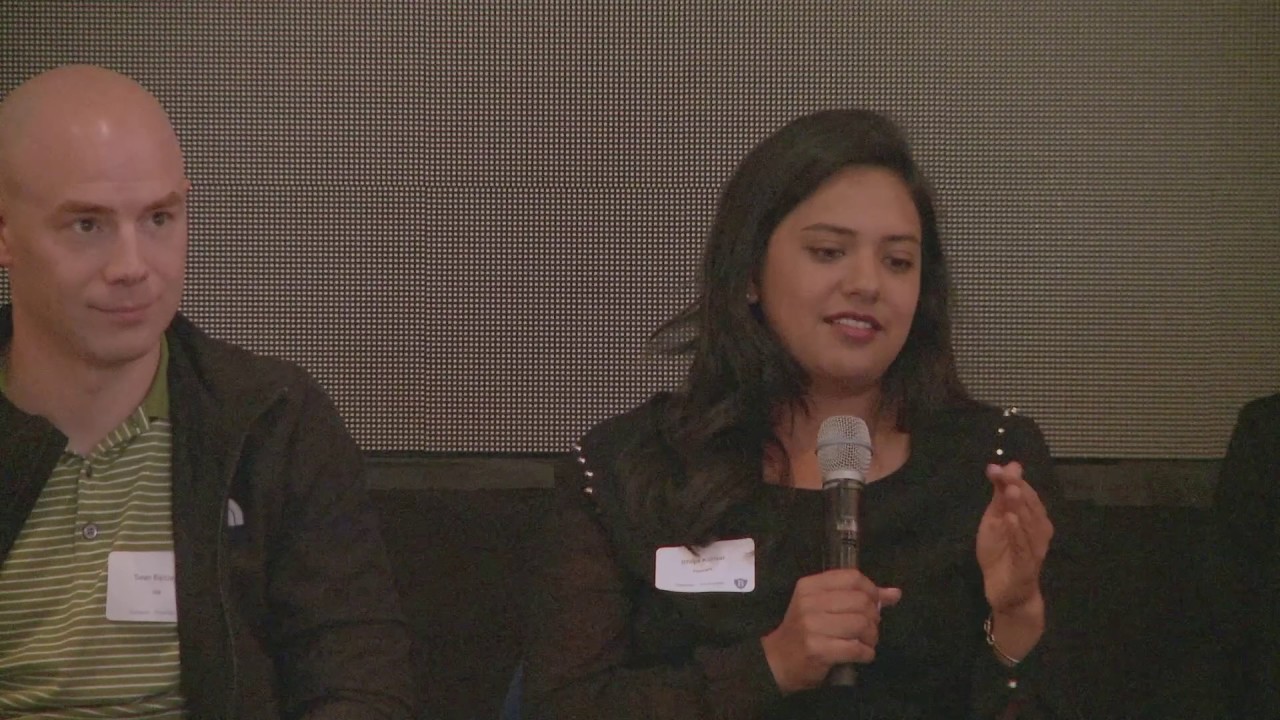
A panel compares cryptocurrencies to loyalty points and explores where tokens fit on public versus permissioned blockchains. Bitcoin takes roughly 10 minutes to confirm a transaction, Ethereum about 12 seconds. Business owners report that accepting Bitcoin cuts fraud and chargebacks, though regulatory checks and internet reliability remain obstacles.
Chapters
Catherine, I don't know if you're going to accuse me of using another loaded word, but the way we all got here to this point is through something called cryptocurrencies. So I'll start with you, and then we'll just go down the thoughts on cryptocurrencies, where we're at today, those markets, maybe the use cases, just your opinions to that. I'm sure we have very different opinions here. On that, for perspective.
So it is a loaded word, cryptocurrency.
I knew you were going to say that.
The connotation—
you brought it up, didn't you? You know, we can never be on a panel together without controversy. So cryptocurrency, it's a loaded word in a way. Sometimes it has a somewhat bad connotation because it's associated with Bitcoin, and Bitcoin was the first. Okay, let's give credit where credit is due. It was the first cryptocurrency that set off the whole domino effect of Hyperledger, of Ethereum, of Dash, of Litecoin, Dogecoin, etc., etc. Cryptocurrency though, let's just step back for a second. How many of you use some form of loyalty point? Whether it's mileage, whether it's Starbucks points, whether it's something or other, okay? So those are tokens and they have a value associated with them. And the organizations that utilize them or let you utilize them to carry them on their balance sheets because they are a liability and they can be an asset as well. All right, so a cryptocurrency is essentially a token. It does have a value because as long as people are willing to exchange them for other forms of goods, then for all intents and purposes, it is a, a, a not quite fungible, but it can be exchanged for something else. So I think that the word cryptocurrency Is a token that represents some value of interacting with that blockchain, be it a permissioned one in which a token can be issued, or be it a cryptocurrency in which it's an open token, if you will.
Yes, sorry. So the cryptocurrency you're talking about I'm from the UK originally. I've been here 17, 18 years. I am constantly exacerbated that we never joined the euro. I always believed that this, you know, the friction of moving money across borders— and as someone who, you know, growing up traveled to Europe and got screwed over every time I wanted to change into French francs.
etc.
The euro is great, a step in the right direction. And then to also have a way, you know, Bitcoin, it's hard to— that's why we're all here. It is amazing what it's done. It's really given us this token, as you say, that has value and we can transfer safely. And we should not underestimate that. Now, the technology can be used for lots of other things, and I'm very interested in that, but I think, you know, What happens with cryptocurrencies and the tokens is very interesting, but the fact of the matter is, you know, banks need to know who their customers are because governments force them to do that so they're not laundering money, enabling terrorism, etc., etc. I don't see that piece changing. So I think that's the bit that the cryptocurrency community has to solve, and I think it'll be fascinating. Where that goes over the next year, 2, 3, 4, whatever year is going to happen.
I don't know what's going to happen with cryptocurrency. I've been watching pretty closely, and I think there's actually a new rise of cryptocurrencies and thinking about redistribution of wealth and universal basic income and some of these principle-based tokens that have different incentives than the hedging is becoming more popular. So there might just be a whole financial game that's played on tokens. In terms of the way that we look at cryptocurrency, it's really a machine-to-machine transactive clearinghouse. So a use case that's, I think, really cool is we have, you know, a use case where we connect vending machines. And vending machines are often in parking garages and, you know, rural areas. There aren't— there isn't cellular Wi-Fi available, so they want to connect their vending machines. And They also can't have cellular deals to do ACH or credit card on those vending machines because there's no internet available. The idea of having a token that you can seamlessly pay for a vending machine, it's a really gimmicky concept, but it, you know, the large sugar water company has like 14 million vending machines, right? So like it's a big deal for them to be able to do that.
Yeah, I totally agree. I have $5 worth of quarters in my pocket right now because I just had to pay the parking machine and one of them was broken, right? So I had to go find the other one.
I mean, it's not connected to Filament?
It's not connected to Filament. Come on, Filament, get on it! Except you wouldn't be able to use Bitcoin in 25-cent increments because then you'd be trolling. Right.
Well, the idea of like tokenizing And creating these— abstracting the value transfer and what the value transfer is, but then letting the machines talk in hash to run that transaction is actually, like, I think the user experience challenge. Like, that's the design challenge that we're put in a position to leverage this architecture to do something useful.
So despite the fact that I work for IBM, My personal opinion on cryptocurrency is really cool. I mean, I have tested Bitcoin, I have tested Ethereum. That's how I had to learn for Hyperledger Fabric when we were building that. I admire the technology quite a bit. And I think, you know, when you think about cryptocurrency and using it, it's what are you using it for? And I think when you use it, there's certain limitations that you should know about right off the bat. I think that's where it makes it interesting in terms of using it for whether you're using it for Personal use or for business use alone. And so if you go and you can plan ahead and you can architect things in a more efficient and elegant way. So if you don't mind waiting 10 minutes for a settlement with Bitcoin, you're cool. If you want to do thousands of transactions per second, not so cool. You might be waiting around for a long time. Or especially during the holidays, if you're doing a lot of transactions in your business, you're going to be waiting a long time. So cryptocurrency might not be your way of doing things.
Well, again, it depends, right? There's never a— it's never black and white. So yes, I mean, as many of you know, in Bitcoin the average time is a 10-minute confirmation. It's because it's somewhat of an arbitrary number that's set based on the protocol itself. Ethereum has approximately 12-13-second confirmation time. On a permission chain, It's limitless. Whatever TPS that you want, transaction per second, you can set. So again, it depends on your use case. As a business owner, right, we accept both credit card payments, wire transfer, and Bitcoin for our services, for use of our API services. And I got to tell you, I mean, we ask in regards to the business, we know who our customers are. We have them sign a contract. They have to testify who they are. They have to provide an address irrespective of whether or not they're paying us in Bitcoin or they're using a credit card. Having said that, I deal with so much more fraud and chargebacks with credit card, even using Stripe, than I do with Bitcoin. Because let's make no mistake here, there's folks that are still using credit cards and using Stripe and supposedly are validated customers. They're not. They create personas, they've stolen credit cards, they charge something and then they utilize something and then you have to go through Stripe to argue as to whether or not it was a service that was provided and therefore, you know, they don't reserve— deserve the refund back. I don't deal with any of that with Bitcoin. So as a business owner, small business owner, I certainly see the value of accepting a cryptocurrency because it's definitively, you know, I determine whether or not I want to refund by issuing another transaction. But I don't have to deal with all this fraud on a monthly basis.