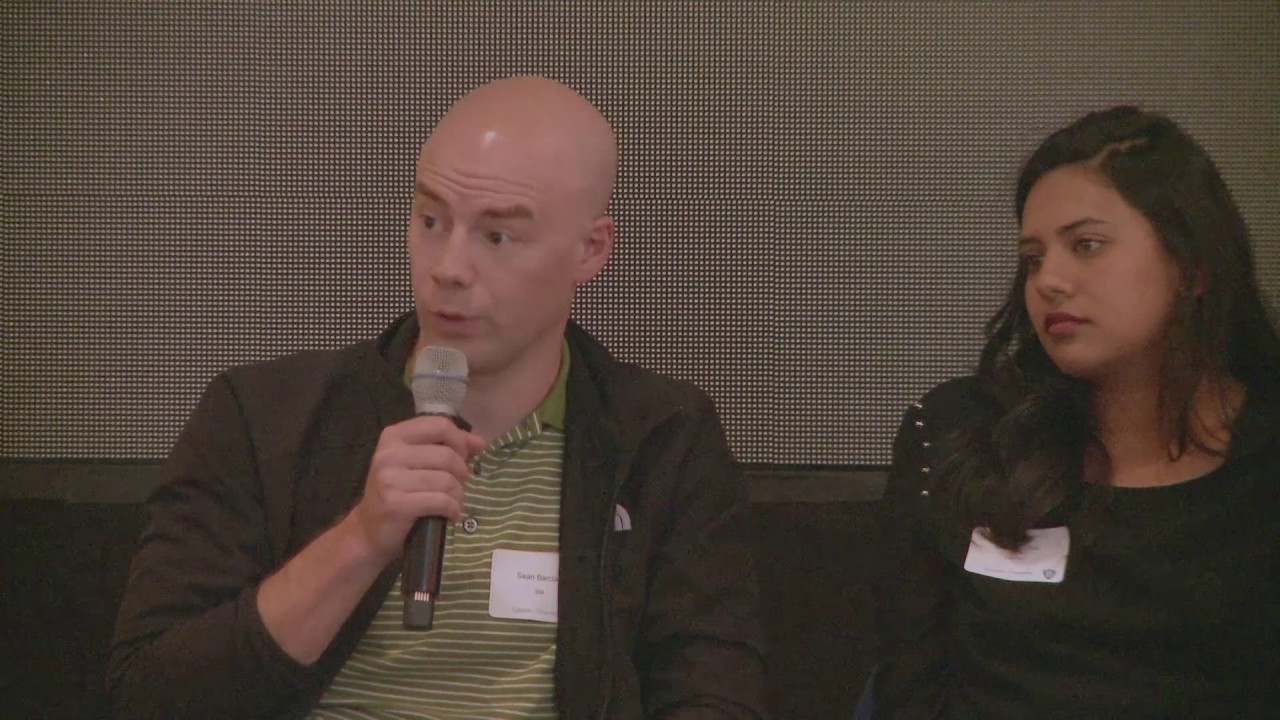
Tim Draper hosts a panel Q&A on public versus permissioned blockchains with representatives from IBM and Oracle. They discuss Hyperledger Fabric, the Enterprise Ethereum Alliance, smart contract maturity, and enterprise use cases like trade finance and supply chain. The panelists debate consensus models, interoperability, and how major tech companies are positioning their blockchain efforts.
Chapters
Do we want to open up to questions? Yeah, we've got time for 4 questions or so. Okay, you gonna run the mic then?
Okay.
Actually, I have a question for Sean, IBM.
I mean, since Oracle and IBM are pretty big enterprises over here, so why not Microsoft? Microsoft are also getting into blockchain, providing it as a blockchain as a service.
With Ethereum, right?
Okay, so they didn't come up with the Blockchain 1.0, which is Bitcoin, and then smart contracts of Ethereum as Blockchain 2.0. And Microsoft recently came up with a term called triplets. It's like a call of third-party API calls for third-party information. What do you think? Do you really think that would be Blockchain 3.0, or that we accepted as the next roadmap of developing the blockchain framework structure moving forward?
I mean, personally, I don't see it as like a 3.0. I just see it as an evolution of blockchain technology. I mean, that's my take on it.
What Microsoft are interfacing and dev—
I mean, I don't even look at Hyperledger Fabric as Blockchain 2.0. I just look at it as, you know, there were some great ideas that were borrowing from other technologies that are out there to create the Hyperledger Fabric. And it was done as an open project, trying to create a standard for business for blockchain.
I had a question. I worked for UBS for many years and I understand the technical difficulties of systems speaking to each other and also knowing the identifier of the They had a huge case with the US government many years ago also. And I'm wondering, Sean, with your Hyperledger involvement, which use cases do you see the banks going towards in the nearer future?
Sorry, the question was like, what do banks— what use cases are banks like, you know, focusing on right now? See here, trade finance would be one. Private securities would be another.
Can I just chip in and go on your way? So the thing that the banks really like, and you know a lot of moral customers we talk to, what banks do is they give. Their own records. They deal with other banks, and then at the end of every day or every month, one bank says to another bank or to its customers, I think you owe me $1 million, and they say, no, I think it's $1 million more. And then they have literally floors full of people who trawl through the records to try and figure out who's right, and usually it's neither of them. And that is a massive expense, and they have that because of the way the system is set systems up. So, are built today, that they keep separate ledgers. And I think the sure, agreed, immutable, non-reputable ledger— those fundamentals— so they can trade with each other and eliminate that cost and friction. I think that's where they are. Because if they don't— and banks have a big problem at the moment— they can't grow. They're not growing the revenue. They've got these massive costs from this type of stuff, old systems, all the manual reconciliation. And that means people. And that's why they're super interested in this.
In the back.
Thank you.
I guess 2 questions. How familiar are you with the Enterprise Ethereum Alliance? And the second one is, are any of you guys on the panel looking to get actively involved with that alliance as it pertains to addressing enterprise customer needs?
I'm reviewing the documents right now.
Yeah, myself and a few other people in Oracle took a look at them. I don't feel like it addresses a lot of the problems. I don't want to get into too much detail, but it's the— yeah, I think there's more hope with a pluggable consensus model like Hyperledger or some other things, because I think that's where we need to make improvements in the consensus model.
It seems like the companies are coalescing around it that are working on that technology, but still, I just don't think personally that the smart contract technology is mature enough.
I mean, the exciting thing is that it's pushing it forward as a technology, and it's making other companies take interest in it and get together and work on it as a problem.
It makes it more organized.
Yeah, I think that's where I look at it as an exciting thing to see in the whole—
Yeah, there's an organization, there's also a push towards standards, right? Because fundamentally standards are important for enterprise and institutional adoption. We have a device-level smart contract framework that theoretically could send information to an Ethereum contract, so it would be consensus on both the device level and the blockchain level. And we said that we would build that integration as soon as a customer mentions that they want to use Ethereum contracts, but it hasn't happened yet. So I just, I think that it's good momentum, but just in terms of prioritization, it's like waiting for someone to want it.
Okay, so we have 2 more questions. I think they've been selected already.
Where is the mic?
Yeah, go ahead.
So the question was, what is IBM's interest in blockchain?
We're very interested.
You showed up, right?
Yeah, I mean, so we've been experimenting with it for a while, obviously. We did experiments with Bitcoin and Ethereum that morphed into reaching out to the Linux Foundation and other like-minded parties to help create and collaborate on the Hyperledger Fabric. And that powers IBM Blockchain and all the products and services and solutions that we're building for customers and for IBM, I guess you could say. We're essentially eating our own dog food by using it for things like IGF or Financial Global Finance to basically deal with dispute resolutions on transactions.
There's one last question back here.
Yeah, so I think some of us are definitely going to stick around and we'd love to have conversations, but hope this one's a good one.
I hope, I hope so. So I have 2 questions.
Oh great.
This goes to the gentleman from IBM and Oracle. So I guess the gentleman from IBM already answered partially. So my first one would be, what's your current application or applications within your organization? And the second one is, what's your immediate attempt of using blockchain technology for developing So, applications is a sweet spot for me.
I've spent almost 20 years building applications at Oracle. So, what do we do? Oracle's a huge corporation. I can't comment on everything they're doing because some of it isn't announced yet. But we have people in our labs who are doing— writing white papers and You know, coming up with ways to scale, some really interesting stuff around sharding and coming up with, you know, low-level and also in the hardware space, identity on chip and all of that kind of stuff. So there's a bunch of work going on at that, I'd say, you know, pure research level in the applications space. But also we are happy to sell you cloud storage and compute power if you want to run your blockchain. For me personally, it's hard for me to be honest to convince people around my organization, although that's one of the big jobs, is that this you know this ability to transfer trust with technology, which is what we get, can be massive for businesses. It could redefine our application, but I don't think it's going to happen because our applications are massive. Complex. So the way we— the way I see it, I don't want to speak entirely for Oracle, but what we're looking at now is how can I transfer the bits of my current applications, my supply chain or whatever it is, transfer what's of value, the value and the shared view of that with the trading partner network and That's where it's— there's real value. I don't necessarily need to have all my internal processes and approvals and everything out on the blockchain, but wherever I'm interacting with other parties and we need a shared view of the world and to trust it, then that goes on a blockchain. So we're really looking at this kind of coexistence of some of my data being on a blockchain and some of it being on my traditional applications, at least in the medium term. Longer term, Who knows?
So with IBM, I mentioned the IGF example. So we're actually using that. I think it's in production right now. We're— our research division is constantly playing with it. During one of the keynotes in Vegas a couple weeks back, they're playing with blockchain and cognitive, basically doing predictive analytics, using the data for more meaningful things, which I think is very I think it provides a lot of value. In terms of like where we're going, we're in this kind of phase where we're building networks with, you know, supply chain networks, healthcare networks, identity networks. We're working with some really cool customers on how to do that and helping them and learning from them and working together with them to create these things. It's a partnership, you could say, in a lot of ways where we're just a piece in that. We're just helping facilitate some of these conversations and bringing parties together to help create these things.
these So you're not building the network?
new business networks to do more efficient things, create accountability, and have some transparency in what people are— businesses are trying to do themselves.
Okay, everybody, I think we're out of time, but I want to thank our panelists, and I thank you all for great questions. And we'll hand over to Jack. All right, so we have