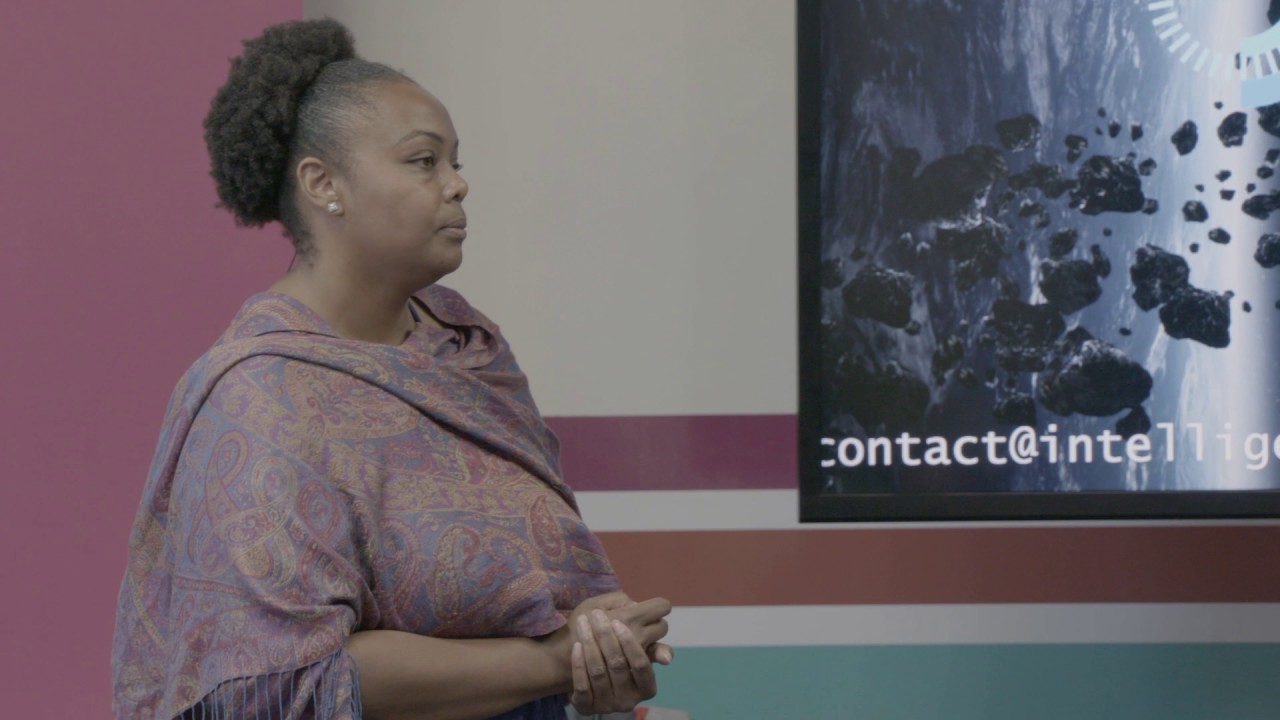
This content was created by Tim Draper. This content was uploaded by Tim Draper. This is a YouTube Q&A video titled "Q&A Part 1 | Christianna Taylor" (posted 2017-08-03) in which Christianna Taylor (Speaker A) fields questions from multiple audience members (Speakers B–E). The session covers space-industry topics — hiring and citizenship requirements for NASA and startups, orbital debris risks, and companies/technologies working on debris mitigation (mentions Astroscale, Tethers Unlimited, Surrey Satellite, nets/tethers, robotics/VBNs) — and also moves into technical discussion of AI: differences between machine learning and deep learning, reinforcement learning, decision trees/optimization, and ethical concerns about bias in datasets. The excerpt appears to be a live Q&A/panel-style discussion with several attendees asking follow-up questions.
Chapters
Any questions I can answer?
Do you have any friends that tell you about how all this faith stuff is fake? Like, they have all these— Not that they're my friends, so no. People that you've come across, I guess. Maybe not colleagues.
No, no.
You haven't heard about the whole wave online of all these people who are like—
I'm sure they exist. They don't talk to me.
I—
no, sorry. I don't have a better answer for you.
Sorry.
So for most, like, to get a job in space, you need to be a US citizen. To get a job at NASA, you need to be a citizen. So what about your space company? Do you need to be a citizen?
So I'm still in startup mode. And at the moment, I'm not at the point where I'm hiring. I'm not doing any type of— I'm not doing any type of defense contracts at the moment. So at the moment, I don't have an answer for you. That said, NASA actually does have a pretty good program where you can actually work as a foreign national. I know a few people from different countries that do work as foreign nationals. You basically have to have a different badge type. I actually have friends that have international companies as well, so it's not just a— it's becoming, what's the word, more democratized, and there's definitely much more cooperation, but it is very hard for international people, so I won't deny that.
You have a lot of experience in data understanding all of the different I was reading a while back an article that basically said if we continue discarding the satellites at the rate that we are, that actual manned spaceflight will be too dangerous in 10 years. I was wondering, is that a correct statistic?
What do you think about that? Yes and no. So yes, because as I saw— as I showed you those graphs about where the debris fields are and what they call PESO simulating using access to space? Absolutely. That is a major issue. And that's not— that's human spaceflight as well as commercial spaceflight. So absolutely, that is a major issue. I know it's only because where the ISS is is much lower than those debris fields. And even for that matter, where the— where Bigelow has some really great innovations when it comes to human habitats, where they literally have expanding habitats. But even my understanding is that those are actually lower below those debris fields. those debris fields. So if we go further out, which I hope we do— Lord, please let us do it. I think we all want to be astronauts. Well, I want to be an astronaut. Um, then it is going to be a major problem. But if we stay at the levels that we're at, especially since we have the ISS through 2028, it'll probably get extended at some point, then we're talking, um, it's not as— it's not as big of a problem. Now that said, ISS has a couple of dings in it. There's a really great photo of a micrometeorite hitting it and leaving a leaving a crack in one of the windows, and that's the major issue you see.
So then a follow-up question, are there any companies right now that are focused on alleviating this problem?
Yeah, the problem with orbital debris is that— okay, short answer, yes. There's like Pocket Space that was looking at this problem. I was looking at this problem a few years ago, and I just switched my I've since switched— since pivoted. Astroscale, they just received huge funding from— they're a Singapore company, but they received funding from Japan, I believe it was. And so they're actually looking at— East Technology, Surrey Satellite Company— Surrey Satellite, they do small satellite manufacturing. They're actually looking at about 5 different experiments to do some deorbiting, I believe. SS L'Oréal, Tethys Unlimited, Stars Incorporated, they're all looking at different technologies. So people are aware of this problem and looking at how— what they can do about it. It's just a thing of figuring out how.
Anyhow catch your eye?
Me personally, I'm betting on the robotics side. I'm betting on the robotics and VBNs for Personally, I think that there's been a lot of things like Tethers Unlimited has some really great technology when it comes to tethers. There's a lot of things when it comes to nets. The Orbital Debris Office is actually run out of Johnson Space Center down in Texas. So they actually have an entire assessment of different technologies that are out there. The— oh, it's kind of driving us now. How we're actually looking at deflecting asteroids, the Asteroid Deflection Center, I believe, is right out of Marshall in Alabama. They're actually looking at a lot of different technologies as well. Every major space agency has a debris office. The military side, we're looking, we're talking Aerospace Corporation. The Roscosmos, I know, is looking at this problem. The Swiss are looking at this problem. Everyone's looking at this problem trying to figure out what they can do and where they want to place their bets. Hard questions. All right, now for me, deep learning is what I use to do identification. So I think of it as like identifying cars, identifying faces, identifying people, because you're able to zoom different layers as to what the person is. Machine learning I think of as a way to say, is this— is it blue or is it red? So that's, that's how I kind of differentiate them. I see mostly deep learning applied to video and pictures versus machine learning applies to specific statistical data. That's, that's how I differentiate it, at least.
That when we code using any language, we have if-else statements, right?
Do we—
we don't consider that as a kind of machine learning thing, but in terms of machine learning, it's about huge dataset. And how do you then differentiate AI with machine learning where still you have a large set of data? And my next question is, how is that AI is able to predict those scenarios for which dataset is not available?
All right, let's unpack that. So your first question is how is machine learning and deep learning and basically AI field separate from our basic if-else statement? If-then, if-else statement. Trying to think how we can go into this without being too technical. Basically, when you're looking at your neural nets, neural networks are basically what they— what you utilize when it comes to machine learning, deep learning. The way neural networks are set up, you have a huge amount of data where you actually already have your labels set up, and you have what's called your training set as well as your regular data. You train on a small set of data And then from there, you then based on that training, you then put it on the untrained data and you say, "All right, how well did you do?" And then keep another set of data just for for testing purposes. And so the difference is when you do if else, if then or if else statements, you are in general applying it to all of your data. Most of machine or most of AI means that you're differentiating your data, so you have these training sets, these untrained sets. These training datasets, these regular sets, and then you have an actual test set. To your second question, I believe you're asking how do you then make a decision for what you don't know, what you haven't trained on. So that's where I think reinforcement learning is so interesting because in the Google Go case, you have to think like 4 or 5 moves ahead and figure out all the probabilities of what the other player's doing. And so that's where I think it's going, so that you have what you call unsupervised versus supervised learning sets. And that unsupervised set— again, I'm oversimplifying, so excuse me if I'm offending any of my computer scientists in the room— you're able to start thinking about those probabilities going forward. And when you're actually looking at what we call design— Give me a moment. A point design plane. A design plane, then you can then do what we call optimization searches to figure out what does that look like and make these decisions. Those are called decision trees. I think that'll answer— I think that answers your question. I think that where reinforcement learning is going, being able to think, you know, 5, 6, 7 moves ahead in particular is going to allow us to start thinking, well, what happens when you don't have gravity? In my specific case, I think it'll allow us to say, start thinking when it comes, especially the medical field is doing an amazing job when it comes to AI. What happens if we do, if we run these experiments and test these scenarios? That said, as I said before, there's some ethical implications when it comes to AI. The only junk in is going to be junk out. So if you have inherent biases in your work, in your datasets, you're going to have, you're going to propagate those inherent biases as you go forward. And that's an ethical conversation, a little bit separate, but I think that answers your question of what you're asking me.