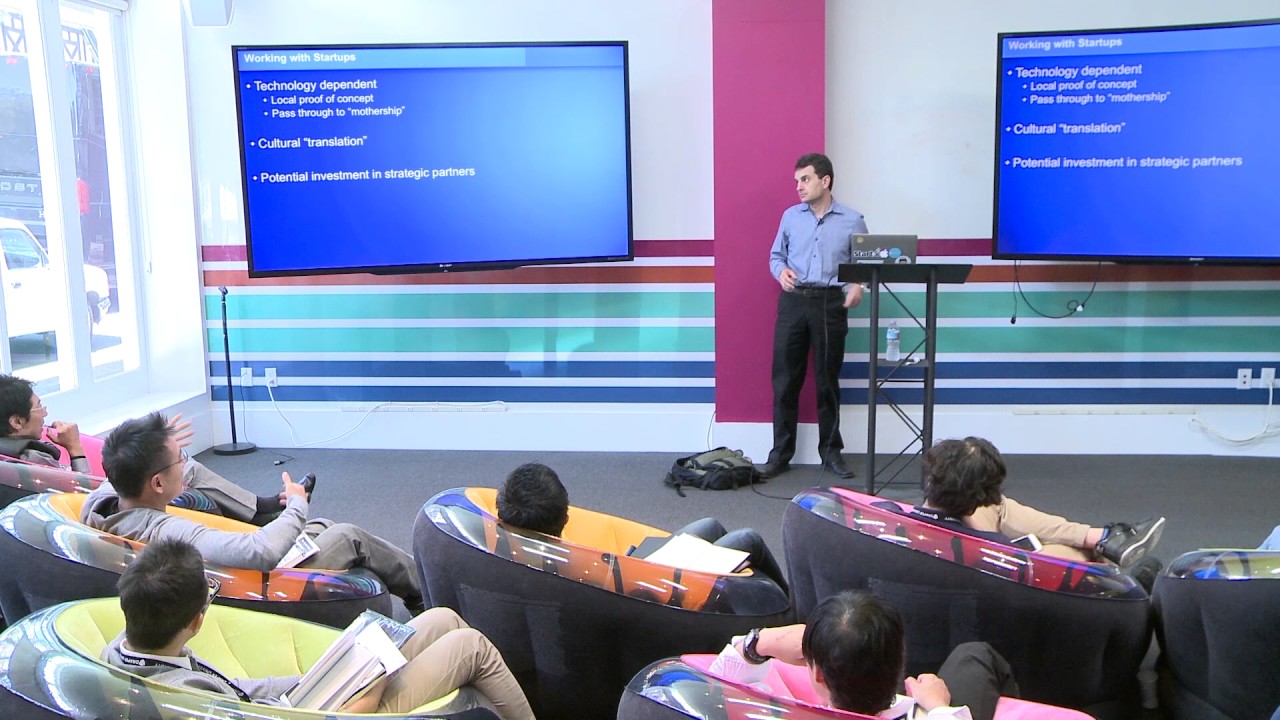
Dragos Maciuca explains Ford's strategy of investing in seed and Series A startups to stay ahead of emerging tech. He contrasts Detroit's fear of failure with Silicon Valley's embrace of it, and discusses the unresolved legal and ethical questions around autonomous vehicles. Success, he says, means startup ideas reaching production cars within five years.
Chapters
200 startups, and what kind of stage do you collaborate? Seed startups, Series A company, or Series B company? Typically pretty early stage, especially from here, yeah. From here it's seed and Series A typically. Yeah, so we're looking at them in pretty early stage for 2 reasons. One is Because they are more hungry, so they have more interest in talking with us. 2, because it gives us an edge, because by the time they are at Series B and C, everybody knows about them.
Yeah.
So it's better to get in early and give us an exclusivity. And also frankly because they are— it's also a lot cheaper to invest at that stage. So, yes, it's riskier, but it's also a whole lot cheaper. So, in fact, when I was talking to our strategy group when we set it up, I asked them the same question. I'm like, what stage are you looking for? And they said, well, roughly C or D, because it takes them just as much effort to invest $100 million as it takes them to invest $1 million. But we brought them a whole bunch of companies that were seed or Series A that were so strategic, that we've made very early-stage investments in them because it was— we saw the path being very strategic. Of course, there are risks in doing that. A, the company may fold, it may go in a different direction. The next day there may be another competitor that comes along that's even better and psychologically people would want to work with the company that they invested in. It's very hard to Convince them that that's sunk cost and you just need to look forward and don't worry about that investment. Even VCs have a pretty bad track record. Only 10% of the companies really make it. So getting that mentality in, that's, I think, is going to be a bit harder, especially when the concept of failure, it's viewed very differently there. than in Silicon Valley. So here it's almost a badge of honor or at least you learn from your failures and it's treated differently. When you talk about failure in Dearborn, you talk about a recall, you talk about wheels falling off. So they think very differently about that. And that's what we're trying to change is that it's okay in a research environment to fail, it's okay to— To look at technologies that may never make it. But the other thing that I think is really important is by having this very broad view is you may decide today that technology is not needed or it's not worth it or some team is not ready, but a year from now when someone comes to us with a problem, we can always go like, oh yeah, there was a company we talked to a year ago, they had this technology or things have changed, let's go talk to those guys again. Or all of a sudden they change direction and now we like them. So it's very important to maintain that relationship, to know what's there. My biggest fear is that some other car company finds some technology that I'm not aware of and they put it in their cars and they announce it and we didn't even know about it. If we knew about it and we decided not to pursue it, because of one reason or another that we knew at the time, I'm OK with that. I'm not OK with seeing it in someone else's car and we didn't even know about it.
I have a question. It's related to autonomous vehicles. Because it's a hot topic, and I think overall speaking, long-term, when all vehicles are being autonomous, then there'll be less chance for Cars, then so my rating will drop because it's human make mistakes much more than cars in most cases. And then that brings the topic about like I call it an ethical dilemma. For example, let's say for the car autonomous drive is gonna because of something some some reason is going to crash into this classroom. A lot of people got injured. Well, the other way is the car can decide to. Turn the other around, while the driver might get injured. So no one would want to buy a car that doesn't put the driver as the first priority when it comes to safety. However, if that accident happens while people are enjoying this room, definitely that person wouldn't pay for all the injuries happening here. So it will be easier for them to just say it's the responsibility of Ford, demanding them to assist them. So how do you think about it? I know it's a tough question, but I want to know opinions. I think it's I a tough question. was wondering from you, like, how will you see this kind of issue be resolved, or what's the story behind it?
So yeah, the issue has not been resolved yet. So we're still looking at regulations, we're still looking at the legal implications, at the insurance implications. From a technical point of view, we're looking at this concept of ethical programming. So it's not really an The car itself is not ethical because it's a thing.
Yeah.
So it's the people behind that program it, they need to program it ethically. And the thinking right now is basically, look, we have this set of rules that we as a society agree with. This is what we've implemented. We can open the set of instructions or rules to everybody to understand what's going on. Understand that as a whole, as a society, we will have fewer deaths. And as a society, we need to come together and accept that risk will never be exactly zero, but that we're going to reduce the risk a lot. And the risk that we accept— I mean, today we accept a risk of killing 30,000 people each year in the U.S. in order to have mobility, in order to go to work, in order to travel and enjoy this. So we've made this unwritten pact with each other that it's okay to kill 30,000 people in order to move the economy. Otherwise, we can make everybody drive 20 miles an hour and you still have mobility, but— and you'll probably still kill 1,000 people a year anyway. So we have this unwritten agreement. The idea with autonomous vehicles would be that it's more of a set of rules that people are aware of, that it's discussed, and it's an ethical set of rules that we all agree on. But it's not a solved issue as of today.
Thank you.
Yeah, sure. So I have a question about your program in general. So Ford's innovation program as it is now, the balance between very autonomy and your collaborative efforts with headquarters, I'm assuming, is, you know, a result of trial and error to, you know, get to that balance that you have now. So I was wondering if, you know, there were any previous attempts at including innovative technology or startup technology within Ford and how that turned out and how you eventually, you know, Got to the sweet spot where you're an effective part of the ecosystem that's working for your company as well?
Yeah, no, that's an excellent point because that's what happened to us at BMW and because BMW was only the second car company here, we didn't have a precedent. So we were trying to figure out our place and we kind of got bounced around a lot in the first couple of years until we figured out where exactly we belong and what technology we're going to deal with. And I'm still seeing that pendulum swing, like when I was there we were a bit more diversified. Now it seems that they're focusing mostly on apps, at least that's what I'm seeing from the outside. So— and they may still move along the way. That's why we made this conscious decision of having this portfolio to make sure we have a bit of everything so that we maintain a nice balance. That doesn't mean that we're not going to get bounced around a bit until we find out exactly where we belong. And yeah, you have to deal with— just the fact that we are the shiny toy on the block, clearly it makes some people jealous, right? So you need to handle that. carefully. And at the same time, you find people who are really open-minded and they love to work with us. And that in itself to some extent may push us in one direction or another. But no, honestly, there are actually quite a bit of bruises that Ford had from, what, the late '90s when they did make some weird acquisitions that didn't pan out well. And that's why for a while we didn't make any acquisitions at all. So this is somewhat new, or let's say for the newer generation it's a new endeavor, and we'll see how it works out. I mean, to me a measure of success right now is just that people within Ford want to work with us and we have interesting projects. To me the real, you know, real metric is how many things I'm going to see in cars that came from our office. But in order to do that, we need at least probably 5 years before we have something where I can go in a car and go, that's mine. Although then again, we work with software, so it would be hard to go, that's mine.