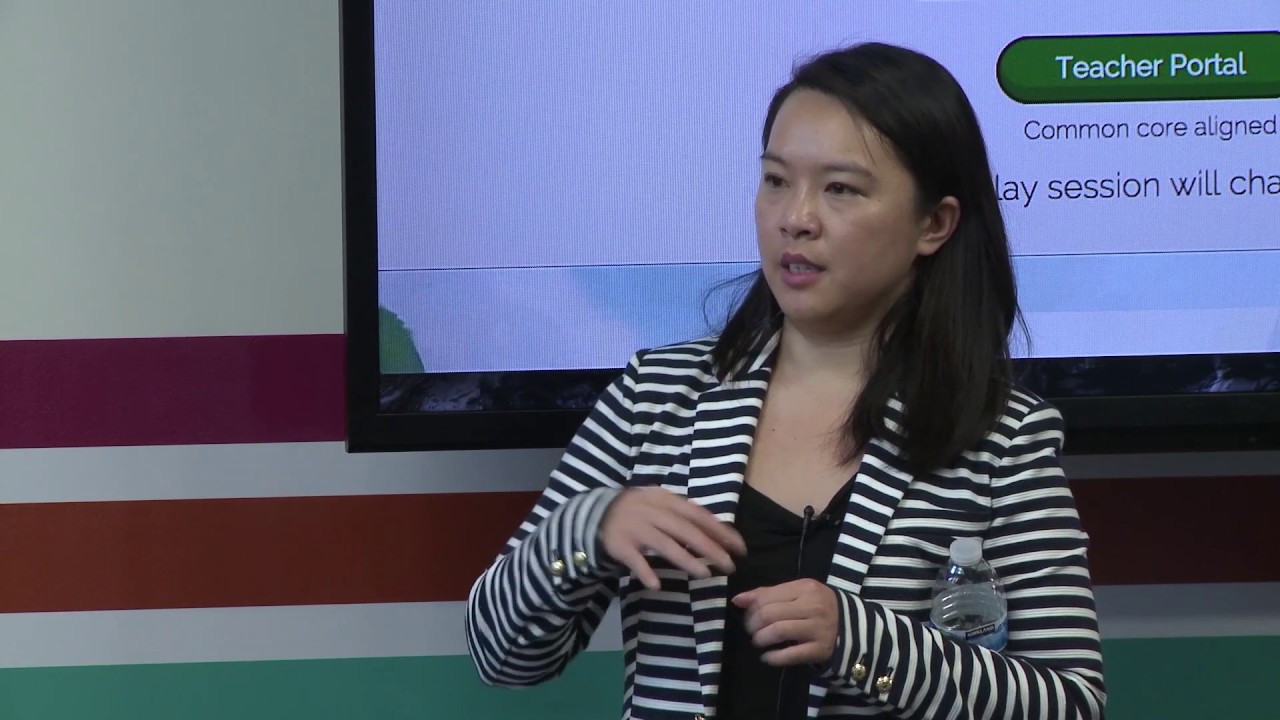
Vivian Tan built an educational math game with a small team, turning arithmetic into gameplay mechanics like "division swords." She cold-called schools to test it, found advantages in being outsiders to education, and plans to expand the framework to chemistry, biology, and physics.
Chapters
I skipped over you enough.
I have a question about the content creation. So how did you go from 1+1 equals 2 to a game? Did you bring in any third-party content creators, or did you guys just do all of it yourselves?
We developed most of this completely in-house, and even all the artwork and everything. Pretty much, we had a very small core team of 3 founders who were all working full-time. And then other than our educational advisors from Stanford and also Synapse School in Menlo Park, who would validate a lot of our approaches, other than that, everything was built in-house. Like I said, the very core concept is 1 1, and then that's— or 1 -1, and that's how you obliterate things in the game. You neutralize it by By reducing it to 0. So that forms the foundation and as you move on, you start realizing, hey, you don't— the world is not gonna give you the number you need to destroy this obstacle. So you start picking up all the different gadgets like division swords and things and you use that to create the number you need. But again, this comes back to how it was really convenient to have the curriculum as a guide. Because you just move through that. It's like, okay, now we got addition, now we have multiplication. What's the next thing we have to teach, and what tool or spell do we invent to augment the numbers in a way that would align to the standard? Sure.
How did you go about, I guess I'll say, how did you contact the schools to test? How did you meet with the ILC?
We called up a lot of people. We would just go through, in the very beginning, we would just make a list of all the schools in the area and call them up one by one. We tried the door-to-door salesman technique. Pretty much just anything to get our foot in through the door. And eventually, you start finding teachers. Teacher advocates were great because they start introducing you to the district and it just ripples outwards like that.
Thank you.
Sure, no problem.
A lot of us are biting off more than we can chew on purpose, just like you did.
Yeah.
So what would you say is the biggest advantage and disadvantage of not knowing the industry and like the full landscape of what you're going into? Because I imagine there are some advantages to that as well.
Biggest advantage, I'd say, is that you look at everything with a very, very fresh eye. I'm sure you've heard of this already, but it actually is true. You don't get stuck into the old way of doing things because that's just how it's always done. You're really building something that you know and you love. And not only was our team outsiders to education, none of us were parents. So most people I know that are in education and technology, if you hear the story of their inspiration, it's very most often something like, my child was struggling with this, my child loves that, and that's how we went about it. We're like, oh, no kids. But we have— Something working in our favor is that I still feel like our team has the mindset of a 12-year-old, which is great for designing games. Could be sometimes horrible when it comes to executing parts of the business that's not game-related. So there was a lot to learn, but ultimately, coming at it with a fresh eye was the greatest benefit. The biggest drawback, of course, is that you have to relearn things that everyone else in the industry already knows. But it's incredible validation when you think of something on your own with your team and then you take it out to your users and they're thrilled. They're like, this is something we've always been looking for. It was also really thrilling when we found our advisors through Stanford that they see this, they say, hey, This is something we've always been looking for, but we tried to work with industry experts and they couldn't create something like this. And I think it's all because of too much of the in-the-box thinking. But as for dealing with biting off more than you can chew, I think that's always— that's gonna be your life from now on. There's no going back.
It's—
I deal with it by setting a lot of personal goals like, OK, I have a very strange skill set. I'm gonna see where they intersect. Where are the holes in these skill sets that I need to fill in? And then I set goals, say, every year like, OK, I need to raise my knowledge in this area up to at least here until I can hire someone else who's better at it to do it for me. So. Here.
How do you maintain balance between you and your team with product design and then also all the other aspects of business? Selling the product, PR, marketing?
It's difficult because it's so divergent, the things you're trying to do. And we're weird in that all of us work on product. And almost all of us work on PR, marketing, and business aspects as well. So, in terms of the design flow, coming back to the question we had a little earlier, trying to fit creation into— and marketing into the same timeline is something that constantly requires adjusting. So, what we try to do is focus purely on product for set period of time. And being part of the incubator, that was really helpful because they're a product-focused incubator. So that was 4 or 5 solid months on product and thinking about marketing and making plans, but not having to distract yourself from that. So during the product phase, it's all building and testing, building and testing. There's some back and forth between me and my team. It's weird because I'm I'm the artist and also the marketing and business lead. So that's like 2 very different sides of my brain, and you have to flip that switch really quickly sometimes. It freaks my team out sometimes too when I'm the happy-go-lucky game designer one moment, and the next moment I'm like super hardcore marketing milestones person. But I think it's helpful when you set aside blocks of time. dedicated to product or dedicated pure to business development. There's gonna be a lot of overlap, but you just don't wanna carve up your day too much so you're constantly bouncing back and forth between the two. Okay. Ooh, lots of hands. I haven't called on you before. Never. Go ahead.
Thank you for sharing.
I really like it.
You see, my country, Taiwan, they still have a lot of— A lot of teams are working on similar things like that.
Oh, great.
This is the first talk, so interesting, so really impressive. So my question is, like, do you ever plan to do on some other subject, like science or physics? Because in those teams that are working on those, like, history of science, and they're using, like, questions. You have to answer those questions to go to the next level. Which makes it not that interesting as yours because it's very intuitive, like you're actually playing the game. So I was wondering, do you have any plans to go into the art subject?
Absolutely, yes. We started with math just because it forms the building blocks to the rest of the STEM subjects. So once we start off with math and then get a solid foundation on that, you can easily see how This format could evolve to accommodate teaching a lot of other sciences, say chemistry would be great for this, biology, physics, you can run physics simulations in here, so yeah, short answer to that is yes, and we're definitely trying to stay away from the whole Q&A model. We had, I think we encountered a different math game that was also 3D immersive and we were all really psyched about playing it, And once we started playing, we realized you run around in a 3D world and a math question would pop up. And you answer it and you go on, which really defeats the purpose of having that sort of interaction. So what we're hoping here is to lay out the foundation and then add on to that.