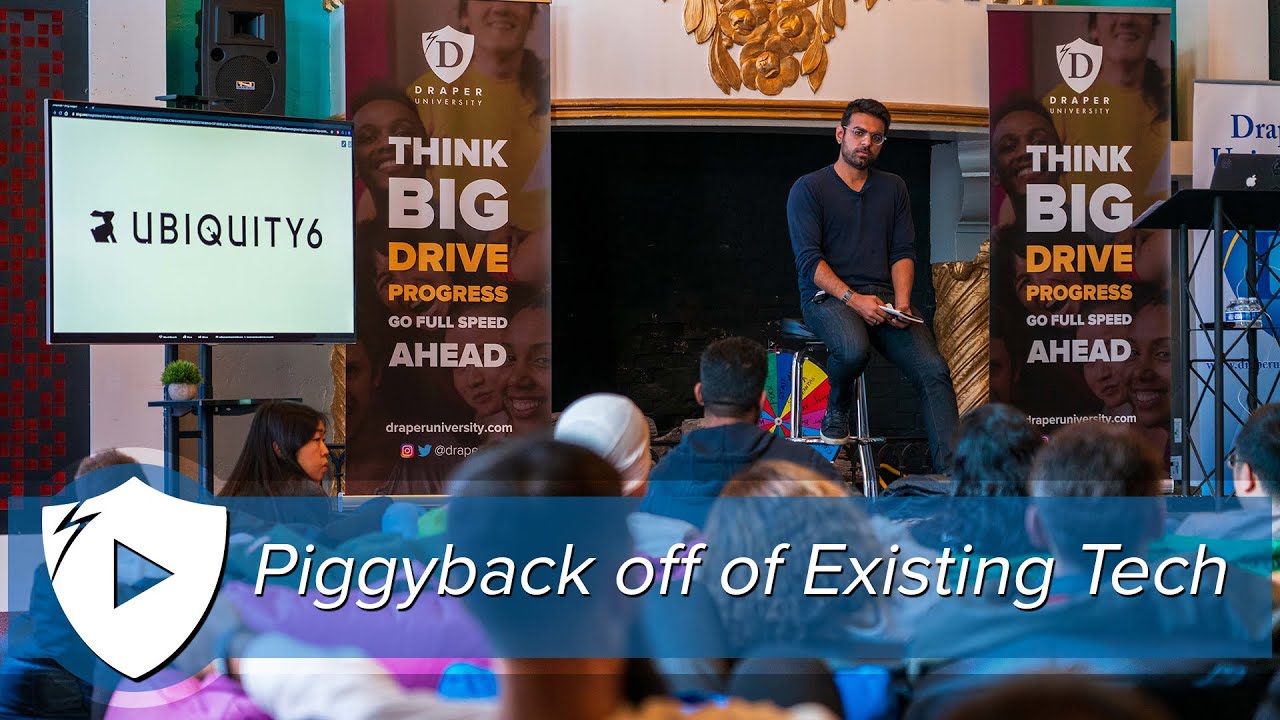
This content was created by Tim Draper. This content was uploaded by Tim Draper. This is a YouTube Q&A titled "Q&A - Piggyback off of Existing Tech | Ubiquity 6 Co-founder Anjney Midha" (published 2020-05-04) featuring Anjney Midha (Ubiquity6 co-founder) answering audience questions about startup strategy and augmented reality. Topics covered include advice on competing with limited capital (piggybacking on existing infrastructure like Apple/AWS/Twilio), sequencing product risk (Elon Musk example), a 2018 SFMOMA AR proof-of-concept where 150 people concurrently painted a museum ceiling, the company’s $27.5M Series B, and the concept of creating shareable, persistent digital twins and AR content without special hardware. The participants are Midha and multiple audience/questioning speakers (labeled Speaker B and Speaker C).
Chapters
Snapchat is a perfect example of this, right? They went from basically zero to complete market dominance on mobile messaging in a matter of 24 months. And it wasn't because Evan and the Snapchat guys had a ton of funding. They leveraged a ton of infrastructure that another company had built for them, which was Apple. They said, somebody else has built the infrastructure. How do we piggyback on this infrastructure before anybody else can to deliver a great consumer experience?
So I want to bring you to another perspective. where you don't have all these resources, because you talk about M-Pesa, but in Africa, most of the time, you don't have VCs that are ready to invest in your company. You say that you need to be fast, and that's so true, but the thing is, like, VR is very expensive, or was very expensive, and also sometimes you need very skilled people, like, I mean, engineers that know how to deal with that, but the technology wasn't ready. And when it's ready, they test it in market as the US. And when they arrive here, even if you are able to build something, it's— I won't say obsolete, but they are in something new. You know what I mean? Mm-hmm. So what will be your point of view about being innovative because there is a market? Like, the tourist is a very big market in Africa because there is some places maybe people won't be able to do. If you are able to build even if just a platform where someone from Kenya or South Africa can visit some places in Senegal that are very important for the story. It's a big market, but being fast and not having the resources, the good developers want to be in the good companies because they need more money, will be very complicated for us. And that's the thing we are facing.
Right. So I'm going to make sure— I want to make sure I understand your question correctly. You're saying, how do you compete in a space that requires a ton of upfront investment?
Tougher switch.
Right. So this is where your creativity as a founder is really important. And I would argue some of those constraints are actually really important for success because if you don't have those constraints, people end up spending a lot of time and energy on wasteful efforts. So in the case of, let's say, an example, Snapchat is a perfect example of this, right? They went from basically zero to complete market dominance on mobile messaging in a matter of 24 months. And it wasn't because Evan and the Snapchat guys had a ton of funding. It wasn't because they were better engineers anyway, I can tell you that. But it was because they leveraged a ton of infrastructure that another company had built for them, which was Apple, right? Apple had spent billions of dollars building and marketing a camera to the world. And so they said, well, what— it was all about speed actually in their case. They said somebody else has built the infrastructure. How do we piggyback on this infrastructure before anybody else can to deliver a great consumer experience? And I find if you find yourself in such a scenario where you don't have, let's say, a ton of capital at your disposal, you don't have like some crazy tech background, then I would be looking for opportunities where you can piggyback on infrastructure that other large companies have built that have not been combined in a unique way. I think sometimes we get told as founders to pursue really big visions, and that's not always enough. That can often be misleading in and of itself. I think the full statement should be pursue a really big vision, that you can execute on, right? Because lacking that, you could go years, and I've met so many founders when I was at Kleiner who'd gone for years and years just chasing their first round of funding or their first few customers or their first product to market because their vision was basically too far off and required too high upfront of an investment. Somebody who's actually really good at this obviously is Elon Musk because he has really big visions, but then he sequences his visions in these layered steps of product and market risk, where the first step is much more manageable and within his execution before he goes for the final goal, right? So if his end goal is to save us all and take us to like Mars, he started off basically with a much, much more constrained problem, which was, I'm going to put one satellite in low Earth orbit for less than $1 million, right? That was within his scope, did not require like essentially convincing multiple government agencies that he should get the rights to multiple different parts of satellite infrastructure and space infrastructure that had been reserved for defense industries, 'cause he didn't have that credibility. He knew the upfront investment would take a little time. So what I'm arguing for is that you've got, you know, there's a problem you wanna attack and you think it's worthy of building a business there. The right question is, what is the V0 of that? within your resources, within your execution that sets you up for success that compounds. And usually the starting point is like piggyback on infrastructure someone else has built. And it's a good thing in software that there's this really important benefit we all get of being a developer because there are huge companies in the world today trying to build products for you as a developer, whether that's Twilio or that's AWS and whether that's Unity or Apple or Google, right? They're all trying to make it easier and faster and cheaper for people like you and me who have visions to get started and to prove that we're on the on-ramp to building really big businesses without having to roll all that infrastructure ourselves. I hope that helps. It's sometimes hard. Like I said, all startup advice is overfitting. So it's hard to generalize this for an audience this big, but if there's specific industries and so on, then I'm happy to talk to you after.
So Forbes describes you, Ubiquiti 6, as Anj and Ankit want to paint this world with AR data. So my first part of the question is, what do they mean by that? What do you mean by that? And the second one is, 2018, you ran a test in San Francisco in Museum of Modern Art. If you can give us a little bit insight into that, because a lot of startups here are at validation phase. So that will be very insightful in terms of AR, VR, MR, and the role of content there.
Yeah, yeah, that's a great question. So what you're referring to is a proof of concept we did at the SFMOMA last year where 150 people showed up and were able to concurrently paint the ceiling of the museum together from their phones. So it was a simple experience. Basically, you'd look through your phone, you'd see the entire ceiling, kind of like a Minecraft-style voxel field, and you could put up your own colored blocks or you could put up a selfie. And when you would put it up, everybody else in the room would see that block being put up in that physical coordinate, precise to a few centimeters. Now we thought it would be cute, right? It would be a 3 to 4 minute proof of concept. People would come, try it out, and leave. It would just show off that our technology worked. The average session length there ended up being 45 minutes. And these were 18 to 65-year-olds with no interest in gaming, going bonkers doing this because they just never experienced the kind of agency that you feel that way when you take your phone and put something up in space and a bunch of other strangers have to deal with it as if it was physical reality. So that was a moment for us when, you know, this was at a time when, I won't name names, but the biggest companies in AR were showing off that they could have 5 people do something in a space and they were really excited and we just came in as a group of 12 people and showed that you could do this with 150 people. So what that unlocked for us was we ended up raising a $27.5 million Series B. I can tell you the tech was not pretty. It was really hacky. It was really brittle. But it showed off that we had the right architecture in place, that we could pull it off given the right resources. It's kind of like, to his question, we just chewed off the first part that we could prove we were credible enough at doing to then unlock more capital. And what we mean for— the press always writes about you in interesting ways, but what I think they're referring to with the paint the world with data is technically what we allow you to do is anybody here who has a smartphone can in a few minutes capture any physical space like this auditorium we're in. It could be the park outside, dorm room, living room, and then we recreate that as a one-for-one at metric scale. as a 3D space. So we create a digital twin of any space. You don't need any hardware. And then we built a way for people to author any digital information in those spaces precise to a few centimeters. So whether you want to create an indoor navigation guide or you want to create a full-on multiplayer, massively multiplayer game, it's up to you. But we made those tools really, really simple to use. And lastly, we allow you to share that with anybody with a simple URL. So what we did is We built a way for people to create these shared persistent AR experiences that have only been possible in the world of video games, but now in physical real-world spaces without needing any new hardware, without needing decades of experiences as an interactive game developer, and without needing to publish anything as a standalone app ever again. May I ask a follow-up question?