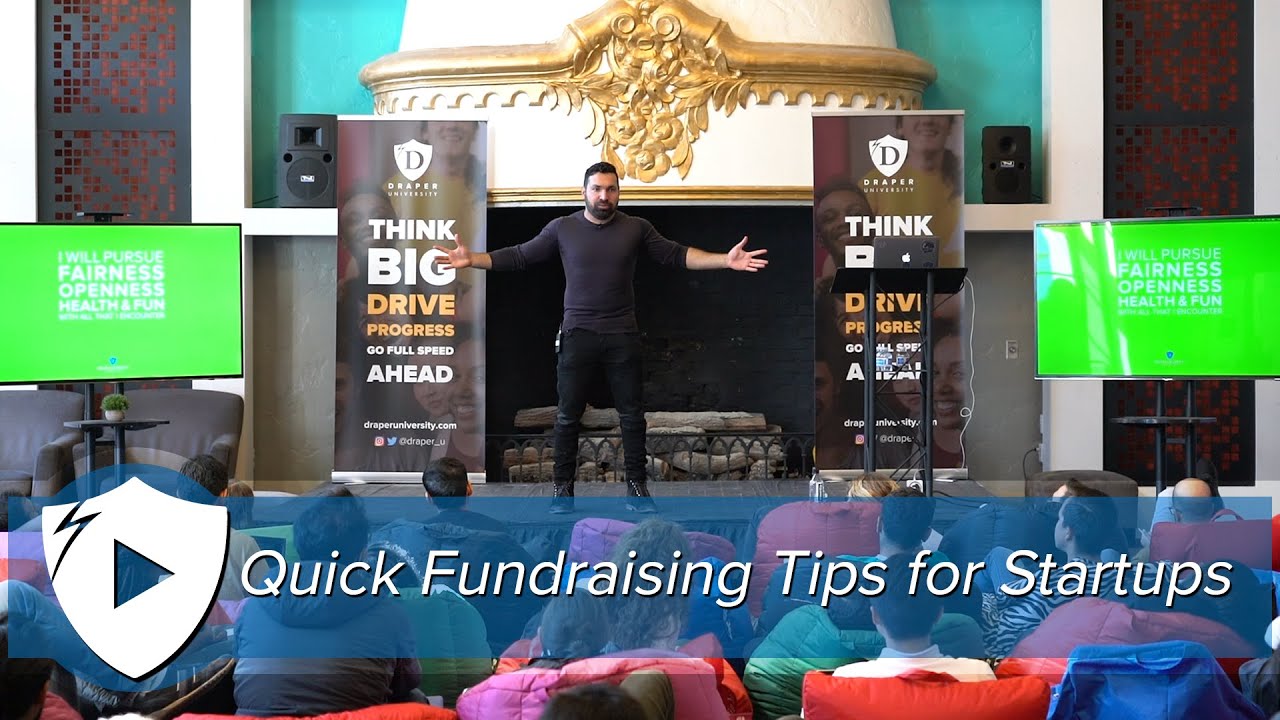
This content was created by Tim Draper. This content was uploaded by Tim Draper. This is a YouTube presentation titled "Quick Fundraising Tips for Startups | Zoosk & Mentorbox Founder Alex Mehr" (published 2020-05-08) featuring Alex Mehr delivering a solo talk on fundraising strategies. In the excerpt Mehr gives practical advice and anecdotes—e.g., running a business at $80/day and deliberately making companies temporarily cash-flow positive—emphasizing pitching from a position of strength, selling big/unreasonable ideas, using persuasive settings (citing Robert Cialdini's Pre-Suasion), meeting investors on neutral ground, and treating fundraising as a numbers game (pitching to many investors). The content_type and timestamp come from the provided metadata.
Chapters
$80 a day. All right. So it's $2,400 a month. So I had the audacity to get in front of investors and tell them, look, I'm making— I'm cash flow positive. It is. It pays more than my server costs. I don't need you. You want to invest? Come in. But I'm cash flow positive. It was in hindsight, it was pretty stupid. But guess what? It worked. Does that make sense? So let's talk about fundraising a little bit. I think it's useful. So I tell you guys, I raised for Zillow Skyrest $63 million. Okay. So the way I— this is my experience. When you go pitch your company, always come from a position of strength, never from a position of need. Okay. Let me actually talk about this because I think it's so important. And I get pitched all the time for people who want me to invest in their companies. And I promise you what I'm about to tell you is super important. Basically, when you need the money and you signal that you need the money, you will not get the money. It's just like, it's not even a little bit true. It's like massively true. So it's a little bit like dating. If you come across as desperate, nobody dates you. You guys understand that, right? So it's the same with fundraising. If you are super clingy and you are like, oh, what happened? Can you give me an update of your thought process? Doesn't work. All right. The first thing is attitude. All right. The second thing is people only get excited about massive ideas. All right. I had the author of a great book called Pre-Suasion by Robert Cialdini. He's the father of influence. All right. And he said the setting where you pitch— he actually has a theory that you increase the persuasion persuasiveness of your pitch just by changing the setting. All right, so he says, for example, this is interesting, he says if you pitch an idea, a big idea, in a room with tall ceilings like this, it's more likely for people to buy in and invest in you than if you do it in a small conference room. So it's a great— it's actually, there's science around this. So he's a professor of psychology and he's literally done studies on that. He did actually a blind study where he— it was completely randomized and he picked match entrepreneurs with like fake entrepreneurs and fake investors, right? And put them in different settings, room settings, and just the impact of the room makes the mind expand more. I mean, just simple things like that. So I tell you another thing right now, for example, a lot of times I try to not go to investors' office. I actually never go to investors' offices at all. Because why? It's their turf. Starbucks. Starbucks. Or in this case, sometimes I invite them to my house. I have a good house. So, but try to go into mutual ground. I kid you not, it is important. It's like the attitude that you go in. And funny enough, I had that Not intentionally, but I had it. Give you an example. So the first time I pitched the market research idea, the company was making $80 a day, $80 a day. All right. So it's $2,400 a month. So I had the audacity to get in front of investors and tell them, look, I'm making— I'm cash flow positive. It pays more than my salary. Server costs. I don't need you. You want to invest, come in, but I'm cash flow positive. It was in hindsight, it was pretty stupid. But guess what? It worked. Does that make sense? And then every time at any point that I raised Series A, Series B, Series C, I made the company at least temporarily cash flow positive. And what is the reason I did that? Because my— I myself as a newbie entrepreneur, I had more confidence when I was pitching knowing that if I don't get this guy's money, my company doesn't go down. Does that make sense? So it's like one kind of ninja trick is try to not be— try not to need the money. Then money comes to you. The second thing is big ideas, massive ideas. The bigger the better. Don't hold back. Don't try to make it reasonable. In fact, make it unreasonable. Why do you think WeWork— why do you think he was able to raise money? He sold a $100 billion idea. He sold a ginormous idea. He said, this is going to be the biggest company in the world and I'll be the first trillionaire. Right? So you walk in with that attitude. I'm so— listen, I'm not advocating hubris. I'm not advocating false confidence. But I'm telling you that is a successful strat, like a successful tactic. So take that, learn from it, and make it real. What's the best way? So you go pitch. How many of you guys have pitched to investors? Raise your hand. Okay. Not a lot of you guys. How many people on average, how many people have you pitched to? 10. 10. 10. Yeah, about 10. 10. Okay. 3. So think about it this way. You pitch to 1 or 2 or 3 or 4 or 5 and you hear no 4 or 5 times. Okay. And actually the most likely scenario is, which is what I hate about it, is that they don't even say no. They just keep you hanging. Is that what you guys experience? So what is the first psychological reaction? You feel sad, right? What is the perfect react— but what is the right reaction to that? What is the next thing you should do? Fuck you. No, well, that doesn't help. That doesn't help. So the best way to do is to go pitch to 10 other people. Whatever negativity you feel, Channel it to change to pitching to more people and keep going. It's a game of numbers. You should be pitching to hundreds to the point where you can't even remember who you pitched to. I tell you guys, for Series A of Zeus, I had this thing, this routine. I set up basically the entire Silicon Valley. I set up a pitch with them every morning. I would wake up with my co-founder, we were roommates at that time. My mom would send me these cookies. So I would have like 2 cookies and a Red Bull, get in the car, go to Menlo Park, pitch, pitch, lunch break, pitch, pitch, home. Next day, 2 cookies and a Red Bull, pitch, pitch, lunch break, pitch, pitch. I did that for weeks. So it's a game of numbers. And you find the right person. And like I said, Don't let that feeling, that negative feeling— because I've been there, I understand what you guys might go through— don't let that hold you back and make you less active. In fact, I have this saying that when life pushes you down, rage back up 10 times harder. Like literally, when life pushes you down, feel like you're rising up and pushing up 10 times harder, right? So investor says no or ignores you or whatever. Talk to 10 more investors. That's like the correct reaction. Like, be a spring. Push down, come back. Except spring, 1 unit of force down, 1 unit of force up. Be even better than a spring. So 1 unit of force down, 10 units of force up. Like, do you guys get the feeling? You know what I'm talking about? I'm trying to use it with my— demonstrate with my hands. But that's actually how I feel. I'm like, okay, got punched down, gonna rise up 10 times harder. In this case, you got— you got— you heard a no from one investor, you pitch to 10 new investors as revenge.