Reinventing the Freight System | Meet the Drapers S9: Draper University
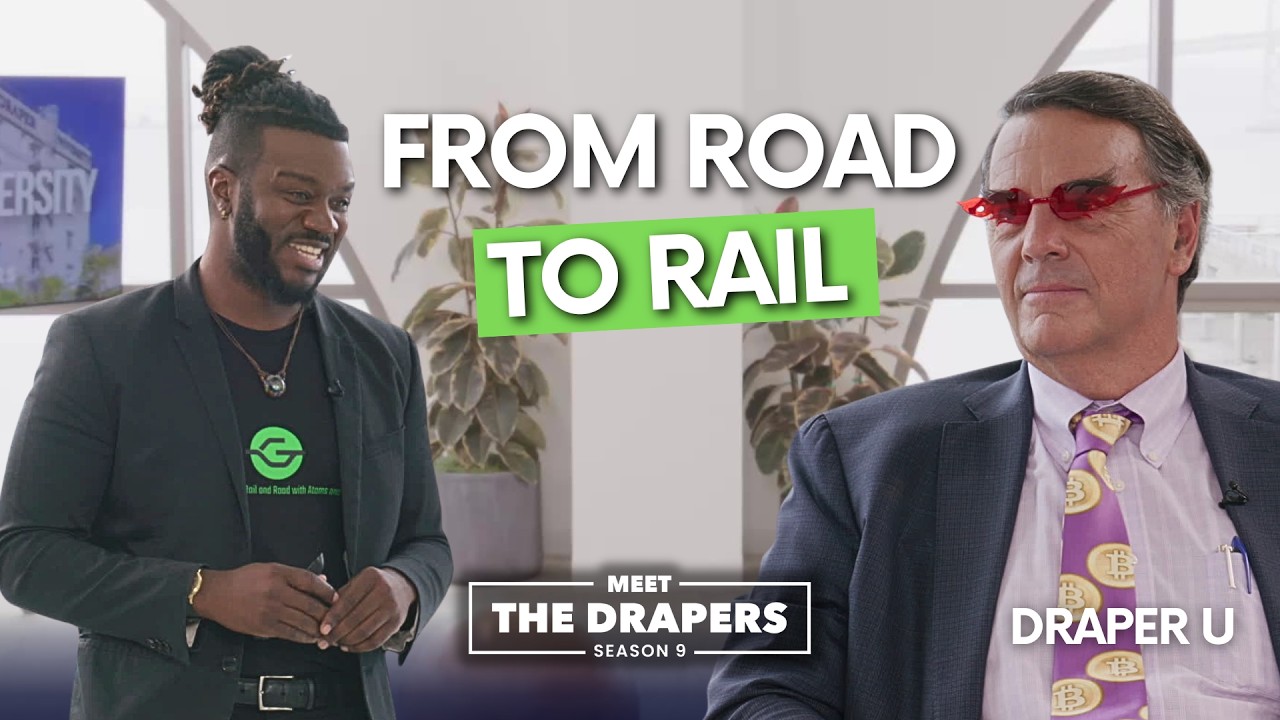
This content was created by Tim Draper. This content was uploaded by Tim Draper. This is a YouTube episode titled "Reinventing the Freight System | Meet the Drapers S9: Draper University" (uploaded 2026-02-23). It is a filmed pitch/TV show segment of Meet the Drapers in which host Tim Draper, alongside panelists including Bill Draper, Andy Tang and Azra Needham, evaluates four Draper University alumni founders: Sangam/Sungbum (Sefors/Seforge — robot chef), Kevin Damoah (Glide — autonomous road-to-rail vehicle), Ali (Polda/Polta — poultry IoT/AI/PoultryEye) and Dr. Rory Brenner (Perforated AI — neuroscience-inspired AI/dendrite software). The excerpt contains founder backgrounds, product demos, technical and market questions, and investor-style feedback as part of a competition format.
Chapters
Modern AI is basically making their decision-making teams with 20 million toddlers.
Is this a revolution?
If you have a more intelligently designed neuron, you're building your team with adults.
Draper University. We are finding some of the greatest entrepreneurs.
It took trial and error. It took a lot of pain to get to where we are now.
Very challenging, but this is possible.
I always say to myself, would I like to work for that person?
I've been always taking risks, creating my own path.
I'm Tim Draper. I'm traveling the globe to find game-changing entrepreneurs with world-transforming ideas. Thousands applied, but only top entrepreneurs have made the cut for a chance to win an investment of $1 million. It's a journey packed with unforgettable moments.
Yeah!
A million-dollar investment.
A million dollars.
$2 million.
A million dollars would help us, especially in the R&D side, because right now we are in the scaling mode, so this means a lot.
Deliver our first 100 robots to our early customers, get feedback and iterate more, launch our next version.
Allow us to augment our staff with some specialists. We're finally now realizing that this isn't something we can build by ourselves. We need to start adding to our staff.
We would accelerate a lot of the pilots that we have in our pipeline in regards to workforce development, as well as well as deploying out to different sites and look to align with communities that need the most help.
$1 million would take us a long way.
Welcome everybody to Meet the Drapers. This is amazing. We are finding some of the greatest entrepreneurs from all over the world, and today we didn't have to go far because they're all coming from Draper University that brings founders from here to here. They've started 2,000 companies. They've come from 104 different countries. There are 8 unicorns now and about 30 companies that are worth more than $100 million. And hopefully you'll see that these 4 are heroic founders who have come through Draper University and out the other end. To my immediate left, we have Azra Needham, and she is the CEO and president of Draper University.
She's also a proud graduate of Draper University.
I did. I'm very excited to show just a small snippet of the amazing founders that go through our program.
We have Andy Tang, my partner at Draper Associates, but he is also chairman emeritus of Draper University and dad. This is Bill Draper. He was one of the pioneers of venture capital. So, Dad, anything you're going to be looking for in the entrepreneurs?
Energy. And I always say to myself, would I like to work for that person? That is a big clue. I am just happy to be here and see this wonderful crowd. Silicon Valley, we're right in the center of it. Really should be very thankful that we have so many wonderful entrepreneurs around us. I'm happy to be here, and let's hope I'm here next year.
Dad and I would play in tennis tournaments together, and one year we lost, and then he says, there's always last year. We have appreciated your wisdom and guidance all the way through this show. Let's bring on the first entrepreneur. But before we do, let's see what's going on behind the scenes. And now you do the eyebrows, you know that.
Hi, I'm Sangam. I'm co-founder and CEO at Sefors, and we're building private chef for everyone. Deep down, I wanted to solve this problem of cooking because food is fundamental to human existence. As a student, you don't have time, you don't have money. I was struggling with that, eating unhealthy. automate some of that. Growing up, I built these robots and instruments, fixing things, and I realized I like hands-on. I went through my undergrad and master's. I realized, okay, yeah, robotics seems hard. A lot of problems that would keep me awake at night. A lot of my friends chose computer science because that was a certain path where if you followed these certain steps, you would get to these companies. But mechanical engineering Yeah, I was the only one choosing that. Nowadays we think a robot is a fancy humanoid type thing, but those could be just microwave type tools that talk with you, that help you cook, be more creative, do 90% of your work. We've been able to cook good food with our robot, like delicious, freshly cooked food, but the surprising reaction was from the personal connection. that robot expressed. When people talk with the robot and also get to experience the amazing food, that has been really interesting. So I've been always taking risks, creating my own path. I've learned a lot, failed a lot, but I think, yeah, my younger self, he wouldn't be surprised. We have a restaurant back home, so yeah, I'm kind of spoiled and used to eating good food. I think the best encouragement was from my dad. Go do it. You might fail, but it's worth it. Trying and you learn a lot. We're in San Mateo, California, in front of our Draper University building. It's nice weather today. A lot of good restaurants are nearby, so I loved just walking anytime and getting any cuisine you want, any food you want. And also, since I'm working on cooking robot, it was. Good to explore what are the options and opportunities around. And Draper University bringing like all these passionate and ambitious entrepreneurs from around the world to the same building and letting them connect with each other, work together. Yeah, it was fun staying here. When you are in the environment with all the founders, super ambitious people, you also encourage yourself to push more and help others. Being the first one, I think, is sometimes like much more exciting because like everyone is full energy and they're excited to listen to you. As an entrepreneur, you got to be ready for anything, and I was ready. I'm Sungbum, co-founder and CEO of Seforge. We're building robot chef to accelerate physical intelligence. 77% of Americans say they are too tired to cook after work, and time is the main issue here. They end up spending over $35 on Uber Eats and DoorDash only to get cold burger and soggy fries. Let's be honest, it's not healthy either. In this age of AI and robotics, we have a robot chef that does everything from meal planning, ordering groceries, to completely cooking your dinner. We already have a robot chef that has cooked more than 10 recipes, and more than 85 people have tried and loved the food. We're scrappy, but we move fast. In 3 months, we built our version 2, and we're moving faster. And as you can see, we've cooked chicken curry, fried rice, penne pasta and burger and many more. And we have documented our journey on social media too.
What does the robot— what does it actually do and what are the costs of the robot?
So the robot, it can communicate with you and plan a recipe in natural language. And then our target price is $1,500. We want to bring a complete solution so that everyone can have a personal chef in their house.
How are you going to make this where the customer— you hold on to the customer forever?
So yeah, yeah, we have— so hardware, $1,500, you get it, and then premium model. So like you can operate the robot for free and everything. And then there is like premium grocery delivery, and we partner with these meal kit companies like HelloFresh or Whole Foods, and they can deliver your groceries, and then you can monetize the recipe.
What are the sales of the company now?
We haven't really sold anything. Of course, it's a new hardware company, R&D. So my job was to convince him that we're moving fast and we're making progress. We have done 10 demos, live demos, and then we have like a 50% waitlist just with this robot.
Are you aware of other people working on this?
Yes. We made it super interactive. Let's say all the robot— robots out there, you follow certain instructions and you put in ingredients. And then if you mess it up, it's going to mess up the recipe. But for us, we have 3 cameras and AI speaking with you. If you put in wrong ingredients, it's going to say, hey, you put in like random stuff here, let's do it this way. So it's more interactive and it's going to fix. So that's our advantage. And also we built this robot and we've cooked 10 recipes in just 6 months. We can do much more.
Let's bring on the food. Oh God, yeah. Oh, very nice. Oh my God, I didn't realize I was going to get a little afternoon snack. This will put us all to sleep. Well, that's good.
Terrific.
Great. Well, thanks for being on the show.
It was amazing. We're going to eat some of the leftovers after that. Just hang out with friends for tonight.
Yeah.
Being from Pakistan, like curries and all of these things, they require like content. Continuous attention, so you have to be at the stove for like a long period of time. So if somebody else is managing that and getting smarter about it over a period of time, I think that's a really good opportunity. I still think like it's not market tested, so we'll really have to see how that part of it goes.
Andy, what'd you think?
I was thinking about this rule that I made up. It's what I call the 1-3-10. If I see one sort of weird company, I'll say, that's interesting. Is it just one sort of weird idea? If I see 3 of them, I thought maybe there's a movement. And if I see 10, I know it's probably overinvested. I'm trying to figure out if this idea is sort of 3 or 10. I slightly worry it's getting— becoming closer to the 10, so the competitive landscape may be a little bit crowded.
Let's bring on our next entrepreneur. But before we do, Let's see what's going on behind the scenes. And behind the scenes is some extraordinary scenery.
Hi, I'm Kevin Damoah. I'm the founder and CEO of Glide. We're on a mission to make road and rail more accessible to all. I started age of 17, right out of high school. 9/11 happened, so I ended up joining the Army at the age of 17, full-time active duty. During that time, I did 2 tours in Iraq. Uh, one in Afghanistan, but when I was in Iraq, um, I did railhead operations. So that's when we moved our, our tanks and our Bradleys from road to rail. And that's when I first saw that it sucked. And then the San Diego fires happened, um, and I went down to San Diego to be a part-time volunteer firefighter. The folks down there was like, if you love firefighting, you should join the Air Force National Guard. They fight fires all the time. And ended up falling in love with it. Did it for almost 13 years. Everywhere I did logistics, that was always the common thread across my entire career to move people and things from place to place. And I just kept following that trail. Growing up, you know, my parents worked really hard all the time to provide for us. And no job was beneath them either. They would do any and everything in order to put food on the table was one. The second one is I was raised around creatives. You know, I'm an artist, I'm a dancer and a Musician, and, you know, when I go into these different jobs, I see a level of creativity, a level of complexity that needs to be, you know, made pretty in such a way, either aesthetically or the way it's form, fit, or function. So I always saw it as a challenge. I discovered that if I want my mission to stay the same, I have to be in the driver's seat. I have to operate at a place of risk and being uncomfortable, but it took a lot to get there. No, it took trial and error. It took a lot of pain to get to where we are now. I think folks see all the successes, but a lot of folks that have done this knows that it doesn't come without a lot of heartache and pain on the way there. And my family's been with me through all that. So I think the word that I can share is they're proud now of where we are. And it's a dream fulfilled. But not a mission fulfilled yet. We are in San Mateo. Yeah, I appreciate train stations because it is a point of embarkation, just like a shipping container. People, we are containers that move from place to place, and the place that we converge on is a train station. I love the Bay Area because it's a melting pot of everybody. You have folks from every single country around the world converging at one place in order to make something of themselves in life and to share with other folks in many different ways and avenues, from food to music to commerce. There's many places like it, but no place like it all at the same time. I pitch quite a bit, but every single time I'm nervous. I think it helps me to center. But then whenever I start, it feels like I'm at home. And then just seeing the reactions just gives you even more motivation and more confirmation that you're supposed to be there. I'm Kevin Namoah, founder and CEO of Glide. A little bit about my background. I grew up in a marginalized community that lived adjacent to ports and rails, you know, similar to 30 million Americans for 200 million people around the world. And I've done transportation for the military. I'm retired military, active duty Army. Came to California, fought fires in California as well.
Thank you very much.
Oh, it's absolutely a great honor.
Oh my gosh, thank you for both. Yeah, thank you. Military and firefighter.
Yes, yes, yes. So I talked about the invisible problem, like, you know, folks that are impacted by, you know, our transportation infrastructure. But the visible problem is, have you ever driven down the freeway behind a semi-truck and looked over at the rail and said, Why aren't these guys over there? Well, the only reason why that is because there's multiple pieces of equipment that are needed to move goods from road to rail. Multiple pieces of equipment, multiple processes, and a lot of people, and it's very, very capital intensive. What we've done at Glide is we streamlined the process down to one. So one vehicle, one move, one piece of equipment, and we can move goods from road to rail within 15 minutes to a day. So we're going to show you our technology here. So we are the world's first autonomous road-to-rail solution, patented road-to-rail solution. So we can get underneath any road-based trailer, any rail-based cart with little to no modification. So we're essentially industry agnostic, uh, commercial side as well as the defense side. Oil, gas, trash, containers, whatever moves on road or rail, we can move today, uh, utilizing our patent— patented technology.
Oh, so it's a So it's a tire that turns into a wheel.
Yeah, we have 2 sets of wheels on it. So we have a road wheel as well as a rail wheel.
Somebody's got to drive. Is it AI?
It's all autonomous. It's fully autonomous. Then we have human in the middle.
So it finds the rail?
Yes. We utilize sensor fusion, so a combination of LiDAR, radar sensors, as well as we work with positive traction control. And then, you know, before we jump, we work in—
they're developing much— What's the market size for this?
Market size within the United States, $100 billion. Globally, it's $20 trillion.
$100 billion in what? In moving things from trucks to rail?
Yes, yes. From road to rail and then all the industries as well.
So everything that—
What about just moving it from road to rail?
$100 billion.
That's interesting.
Have you built this thing or?
We have, we have. We actually unveiled it last week at Reindustrialize and New Mobility Futures to the world. So it was fully functional.
It was?
It was, yeah.
Fully functional.
You got this thing working?
Exactly. Tim seemed like he bit on it extremely fast. He felt exactly what the technology was. He knows the business, he knows technology, he can see innovation. It doesn't have to hit him in his face, he can like smell it. We have $70 million in LOIs currently with railroad operators as well as ports and industrial manufacturers. And then we'll start realizing revenue Q3 this year.
So you actually charge transport, you're not a vehicle company.
We're a bit of both, but yeah, we're not a vehicle— we're not an OEM provider that we sell to folks, with the exception of the military, because the military actually wants to buy. But for everybody else, we are like your Maersk or your J.B. Hunt of the world.
Kevin, thank you very much. It's an honor.
All right.
Good to see you.
Hey, great. Terrific.
It was a big buildup moment. Last week we unveiled our prototype. This week I'm on Meet the Drapers. I'm just overwhelmed with so much gratitude for everything that God has given me.
Dad, what did you think of him?
I liked him. There are a lot of parts to this.
I think the timing is good for the reindustrialization of our country.
As we think about infrastructure, it utilizes what we currently have that's worked for like centuries and then automates it, makes it cheaper and faster.
And to Azra's point, we already have the railway system. We have the Highway, and then how do we then take advantage of AI, autonomous vehicles? It's, it's big. It's swinging for the fences.
All right, so let's bring on our 3rd entrepreneur. But before we do, we're gonna see what's going on behind the scenes.
I'm Ali, and I'm the CEO and founder of Polda. So we are helping the poultry farmers to save thousands of dollars by using the IoT, big data, and artificial intelligence. Where from I'm belonging in Pakistan? It's from very small town, and in our circle there was no any reference, other only example that you can do something bigger. There was only the trade that you have to do the job, you have earn the money, and you have to feed your family. That's it. All of a sudden I left my job and I started to work on my ideas. The most of most of the people said he's a crazy guy. I was searching and observing the documentaries of all the big entrepreneurs, Elon Musk, Jack Ma from China, and all the big names in Silicon Valley. This is a way, there's a way, though this is not easy, this is very challenging, but this is possible. This is not impossible. I have very few chances just because I cannot do a lot of mistakes. Just because I'm already with the kids, I have the family, I have to feed my family, and I left my job. So pressure from the family, pressure from the society, it was very high. The approach of the founders in the Silicon Valley, they are going deeper, deeper, deeper. They don't talk, they do work. So I copied them. I worked a lot on the farms. I had a lot of meetings with the poultry farmers. I realized I understand their problems. I tried to figure out how to solve their problems.
Viewers, usually I'm pretty easy to reach. I mean, there are only 300 million of you. I'm making it a lot easier for you to contact me. I have downloaded my brain into this digital twin, and you can scan this QR code, you can pitch me your idea, you can talk about your business, anything, and I'll answer it 24/7. Enjoy it. It's great. It's a new feature of Meet the Drapers and Draper TV. I think you're going to have some fun.
Honestly, I was not ready for the pitch just because we got the lead traction and we got the lead revenue, so we didn't need anything about to go to any investor, right? Here, Draper, especially Draper and Nasdaq, can Play the role. They can connect us with the top level. Polta is actually providing the data-driven poultry platform, and we are actually defining the poultry biochemical intelligence. So I think problem you all guys can relate very well just because just couple of months before in U.S., the peoples are facing the problem of the egg shortage, right? In in California, not only in California, but whole in the U.S. And the reason was the diseases attack on the poultry farms. The U.S. just lost billions of dollars just a couple of months before. So this problem is common, not only in the US but around the globe. Many countries are facing the same problem. They are losing around $100 billion every year. So what PoultryEye is doing, PoultryEye is actually providing the real-time monitoring and the next generation of poultry farming, where we are providing the IoT, big data, and artificial intelligence. But we are introducing the small mini-labs, which are actually detecting around 23 different bird samples, which can provide the real-time detection of what's happening on the farm. We have the massive opportunity of $90 billion Uh, just to, uh, make the money, especially in the disease prevention and, and the feed optimization and operation efficiencies.
And you're testing the chicken, not the egg, right?
Both. There are 85 different parameters which are showing what the birds are saying, actually. Their disease, their thirst, their hunger.
It's measuring what the birds are saying to each other?
Yeah, of course. Birds can talk. They can show their hunger, their expressions and their problems.
And they talk to each other and say, George over here is sick. But that's kind of what you're finding out, right?
Yeah, yeah, yeah.
So, so the— Wow, that's really fun.
Yeah.
It sounds like you're using cameras and maybe mic to pick up both audio as well as visual cues of the bird's health.
Yeah, yeah.
And then do you put some sensor on them and they'll continuously monitor?
Right now we are detecting the disease by using the AI cameras, right?
You choose cameras?
Yeah, cameras, just cameras. So we were using the sensors before, but recently we have replaced all the sensors, and now just through the cameras we are getting all the data.
How much of that is your IP versus just commercially available? Because they're doing that with human babies, right?
Right now in industry, there are so many solutions available, but the missing piece is the comprehensiveness, which gives a larger picture of what's happening on the farm.
And the deal with Saudi, how big is that?
There's a commitment of $150 million and they are making the JV, right? In the JV, they are providing us $25 million just for the license fee.
I mean, our million dollars isn't going to make any difference to you. What's the point here?
Exactly.
You're just showing off how great Draper University is, right?
Exactly.
Here's the point. Here's the point. Just because this solution is not for only the farmers. This is a very good solution for especially the pharmacy companies.
Terrific. Ali, so great to have you here on Meet the Drapers.
They are very experienced people. They have seen a lot of new ideas, so they can understand very well what is the worth of our idea.
If you have a herd of birds, there's one sick bird, in the U.S., you actually have to kill the entire herd. Because the farmer gets reimbursed by the US government if you, if you proactively kill them all. If they get sick, it's on you. The second thing is in the hatcheries, it's also very expensive and disturbing. They have to kill half of the birds, the male birds. So if these guys could somehow figure out these are the eggs that's gonna produce roosters, let's make some scrambled eggs out of them first before they hatch.
This is something I learned from If it's weird enough, it might work out. You can sell them. Like, people are looking for roosters. It's just so hard to figure out.
There's not enough demand. The demand for eggs is here, you know, chickens. So if you could figure it out early, I think instead of letting them hatch and then killing them.
The early risers would like the roosters.
Free alarm clocks.
One alarm clock.
I'm Dr. Rory Brenner, the founder of Perforated AI, and we're augmenting artificial neural networks with artificial dendrites to make them AI more intelligent and greener. Definitely always been a nerd. Even when I was a kid, my, like, dream job was just generic inventor. Took this computer vision class expecting them to teach me about, like, how R2-D2 and C-3PO see the world, and they basically just taught me how Photoshop works, told me computer vision is hard, and then the class was over. I just couldn't really understand that. Ended up taking some cognitive psychology and AI classes, and that led me to a neuroscience PhD. To really try to dive into, you know, how the brain does this stuff so much better. We are absolutely burning the planet down with the insane energy requirements of all of these systems. Insects and children can interact with the world perfectly that the best AI in the world couldn't do. The day they taught us about dendrites, I was just like, holy crap. If evolution had come to that conclusion, then it must be doing something that is critically important to the system. You can end up having equal intelligence with significantly smaller and greener architectures. I feel like the government and taxpayers, you know, pour the money into the research. The scientists pour their blood, sweat, and tears into the research. And if you're in academia, most of the time all of that culminates in a paper being written. And then, you know, Google and Meta and Amazon read that paper and go make billions of dollars with it and give nothing back to anybody who contributed. And I just didn't feel like I could be happy as part of that system. Friends and family, parents, my 2 brothers I'm incredibly close with, I think they knew that this was always something I would want to do. And, you know, some of them were more like, finally, it's about time that you finally took that leap. It's great to see it finally be, you know, your full-time gig. I'm just loving the process. It's really just been awesome getting to put everything into this thing that I love doing and have been doing kind of as a hobby. For so long to finally have it be my full-time thing. We should be able to use AI to make the world a better place, and hopefully we can, you know, have AI do the things that people don't want to do so that the humans can be doing the more fun, creative, interesting kind of jobs. Bunch of bars and restaurants nearby. It's a Pretty kind of quaint little community compared to the hustle and bustle of the city. I grew up in a small town and Pittsburgh is, you know, a very small big city. This felt a little more homey. A lot of the socializing here though was kind of just hanging out with the other classmates. We're in the Great Hall at Draper University, a place I spent a lot of time. Having the opportunity to be in San Francisco surrounded by such an amazing cohort of Fellow entrepreneurs was just an unforgettable experience that really helped me commit to it harder. I think I just love how prevalent nerdery is here. You know, you just can go out to bars and hear people talking about PyTorch on dates, and it's just so nice being surrounded by people who are passionate about all the same things that I am.
I definitely do a lot of public speaking in my life, and being in front of a crowd and cameras is—
I'm very used to.
So I watched a few episodes of the show to kind of get ready for today, and I heard Andy was looking for people with fire in their eyes. So I want to make sure I got that.
Oh, you're just gonna give us rose-colored glasses to evaluate this one.
I'm Rory. I'm a computer scientist from Carnegie Mellon, here to tell you about perforated AI. As VCs, you know that AI is blowing up right now, but running AI models is expensive.
Expensive.
A single system on AWS can cost tens of thousands of dollars a year, with many firms running hundreds at the same time. So what if I told you these costs could be cut by 38x with a fundamental change to the way AI is built? Almost all modern AI products use an algorithm called artificial neural networks. Because AI has only been at the front of the news cycle since the release of ChatGPT, you may be thinking neural network research is a modern innovation. But if you go back 40 years, and then go back another 40 years, you'd still be 3 years away from when the artificial neuron was first designed. And this is the same design that has millions of copies powering all the AI behind an industry that last year had a market size of $638 billion. That industry is long overdue for a new way to build, and the modern artificial neuron I invented based on modern neuroscience is the way of the future. And what really my product is So what this is, is this idea of selling artificial dendrites that are able to support artificial neurons to make every individual neuron smarter.
And so a dendrite is the random thing that happens in your brain, is that right?
It's like a pre-filter. So right now the neuron is making the entire decision. The metaphor I often use is right now with AI, you're building intelligent systems that are making decisions. As VCs, I'm sure you put Teams together to make decisions all the time. And modern AI is basically making their decision-making teams with 20 million toddlers, giving every little toddler a very simple assignment, and you can build ChatGPT with T with that. But if you have a more intelligently designed neuron, you're building your team with adults. And instead of having 10 million toddlers, you have 100,000 adults, and it's equal intelligence with a significantly more efficient system.
What I'm What I'm struggling with is, is this a revolution?
We just ran a hackathon to validate the tech with some external users, and the winner was the CTO of an AI consulting firm who was able to build an AI model to be 90% smaller on the same dataset. And because of the significant compression, the savings in electricity and compute requirements, he actually deployed this model onto Google Cloud and was able to achieve a 38x cost reduction.
And is this all gonna be on a CMOS processor or is it gonna be on something else?
What's it gonna look like?
It's all software.
That's one of the best things about it.
Oh, you build it in software. So what does it run on? What's the chip?
All the same things people are using right now. So yeah, NVIDIA chips, GPUs.
If you're successful, what happens to all the large language model companies today? Is there— is it gonna be a disruption?
Yes, but they also would be my customers, not my competitors. I feel like every single question they asked today, are things that if I had a 20-minute presentation, I would have put them in there. That's where all my anxiety was. We actually offer model search space expansion. So if you delete our code from your training repository, you will have a worse model. Whereas with every other MLOps company, you could delete it, but if they already helped you make the right choices, they're not actually enabling something that you couldn't do on your own.
Terrific. Well, thank you, Rory.
Thank you.
Nice to see you.
Thank you.
Me too.
We'll blow asses.
Of course.
Been a little stressed for the last 5 days or so. Been kind of binge-watching Meet the Drapers to prepare, practicing my talk. Definitely gonna blow off some steam today.
Dad, what'd you think of Rory?
Well, he was okay. He didn't really knock me over. I wouldn't want to go work for him.
Andy, what'd you think?
I think this is the kind of thing early-stage venture capitalists that I do. I take risks on a large market. He mentioned that this will be his first funding round. So I, I'm very open to the idea.
To Andy's point, it's like one of those things where I'm like, I don't understand this enough, but I can tell that there is something there, but I haven't been able to put my finger on it. But it gives me the confidence that this is something I should look into more.
Okay, let's move on to the next entrepreneur. But before we do, What do we do? See what's going on behind the scenes. Here we are, Draper University. This is the center of all education for entrepreneurship. Okay, this here is a dressing room for most entrepreneurs, and then they whirl around and boom, out they come, superheroes. Do these things work pretty well? Yeah, definitely. What are those? Is that your business?
Yeah, we're making an AI wearable that takes in 360 input and you feed it into an agent so it has the full context of your daily life.
Hi, Tally, this is Tim.
Can you add him to your memory?
Tally, am I the first one who's ever come to you wearing a Bitcoin tie?
Tim, I have stored your name in my memory. I don't have a record of anyone else wearing a Bitcoin tie before, but I can store that information if you would like.
Yeah, I think you should store that information. It's incredibly important information. So you're here on a tour?
Yeah.
They're from Japan.
Everybody superhero pose. Whenever there's an entrepreneur here at Hero City and they have something to announce, they hit the gong. We like to make a splash. Now we get the toughest part of the show. We have to choose which of these 4 entrepreneurs move forward to the semifinals. Boy, you don't want to bet against Draper University graduates, man. These 4 were awesome. Go to meetthedrapers.com and vote for your favorite. They can skip the line and go straight to the finale. Andy, I'll put you on the hot seat. Who's your favorite?
As an early-stage venture capitalist, Perforated AI is probably something I would put capital behind at that stage. Because Polta, we already invested.
You're hedging your bet there.
That's, you know, that's why I build a portfolio. We have a portfolio of 4 companies.
Azra, which one did you like the best?
I think I've promoted Polta enough, so I'm going to go with Glide for this one.
Oh, great.
We're spreading the love.
And Dad, which one did you like the best?
Polta.
Polta, the chicken one?
Okay. Fortunately, I don't have to make this decision. We all rely on the crystal ball. Okay, Chef Forge, my biggest concern with you is you know how to make robots, but when I saw your demo in the picture, it's not user-friendly. It's not the simple Steve Jobsian thing. How are you going to take us to a new level there? Not a button.
It's a hello. That's what Steve Jobs started. You can just speak with the robot. You don't need to click a button, and you don't need to know how it works. We're in the design phase where we have the cleaner product, but we haven't started manufacturing it yet. 6 months, we'll have a cleaner product, and next one you will see will be a difference maker.
What about making it more beautiful?
Oh yeah, it is beautiful.
It is not beautiful.
We have a beautiful design on the computer and we're going to manufacture it by the end of August.
Okay, Glide, I asked you all the pertinent questions but one. What is your most important line from the pledge?
Support freedom at all costs.
Okay, but that's already been used.
Oh no. So—
That was mine.
Give us another. It's my favorite line of the pledge.
Well, that's— I'm retired military, 2 tours in Iraq, 1 Afghanistan. I protect freedom at all costs.
Oh, good point. Okay, Rory, biggest concern here is, is this a science project or is this gonna be an entrepreneurial venture that becomes a monster?
Yes, we're definitely at a critical moment right now. Like I mentioned, I have just been onboarding my first pilots, and in a month we'll find out.
So it's awkward to be on the show right now.
But if this does get industry validation and people start paying me, I feel extremely confident that everybody is going to be paying me, that I will really be the person behind the next generation of AI models where everybody is building with my tech.
And how do you get dad to want to work for you? I don't know.
We'll have to grab a beer after the show.
And Ali Polta, my question here is more about market size. Saudi is like saying there's a big market here. That doesn't necessarily mean that it's a global market. How can you convince me that this market's bigger than I think it is?
Poulter is working for the global market, not for the Saudis.
So what's the model there? How do you get paid?
Initially, they are paying us the $25 million as a license fee. Then we will provide them the solution that they take. They will manage their own team.
Do they pay per chicken?
No.
Oh, that's too bad. Your customers are a limited number of people.
Correct.
It's all the farmers of—
Correct.
Once they have seen the way and the speed of the poultry, they are surprised.
Revenue per chicken is a good idea.
Yeah, it is.
Because there's a limited number of customers, but you have unlimited number of chickens they grow. Something to think about.
Yeah, if you could get 10 cents a chicken, that would be a big, big model. Okay, I'm gonna need some, some special power here. Everybody send your vibes. Into the crystal ball. What's it gonna be?
Holy hell!
Ha!
Ah, it's Glide! Oh, Glide goes forward. Congratulations.
Thank you.
Thank you.
Good job.
Oh my God.
Thank you.
All right. It feels incredible. It feels like a dream. It's yeah. Well, I'm at a loss for words. You know, to be able to be recognized by you know Tim and Bill. They're legends in what they do.
Yes.
You should vote for us because we're a team passionate about cooking food, help us eat good food, healthy food, and we want to be a leader in this revolution.
Right now, the carbon impact of AI is terrible, and this product also cuts that carbon footprint by 104x. So if you want to keep writing poems for your dog without the guilt, I'm the only company that can help you out.
to provide the safe and healthiest chicken on every table. For the future of safer food, you should vote for us.
See you next time on Meet the Drapers!
All right!
Woo!
Go, more funding heroes!
More from Tim


He Sold His Car to Build This Startup, Then Pitched It for $1M 😳 #Startups #AI

This Startup Moves Your Crypto BEFORE Hackers Can Steal It 😳 #Crypto #Cybersecurity




15 Months Without Refrigeration?! This Startup Thinks It Can Go Global 🥥 #FoodTech #Startups



