Shared Mobility Q&A | GetAround Founder & CEO Sam Zaid
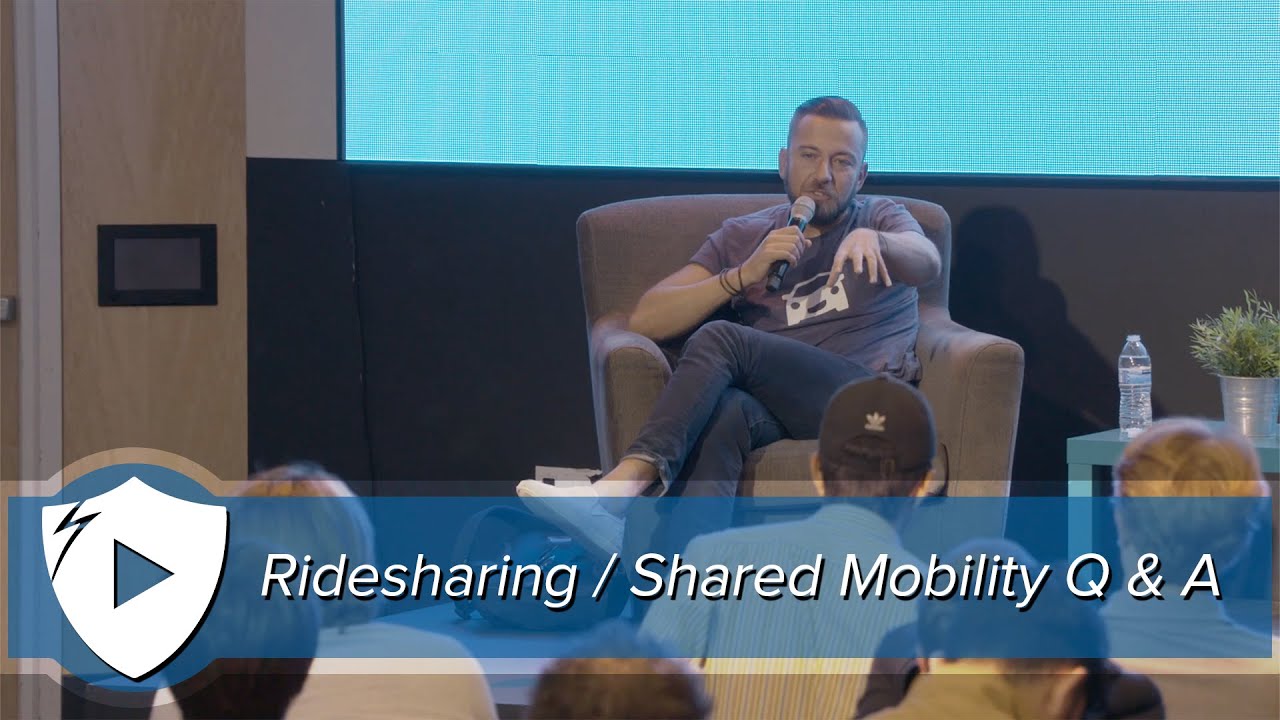
Sam Zaid, Getaround's founder and CEO, answers audience questions about competing with Uber and Lyft, the impact of autonomous vehicles, and how the car-sharing platform solves the chicken-and-egg problem by building supply first in localized markets.
Chapters
So with that, thank you. You guys have any questions? You guys want to hand around a mic for them? He's got a mic already.
Okay. Yeah, they stole it. Well, thank you for your time. Amazing product, Getaround.
Thank you.
I think what my understanding is that Getaround business model and Lyft and Uber business model right now, it's kind of different. But in the end, it's moving people around. With autonomous vehicles, they will maybe be the same, moving people around autonomously. First, do you think that they're going to be your competition in the near future? And second, if that's yes, what are you doing to get over— they're very big. They're working very hard on autonomous.
Yeah, it's a great question. So I think certainly mobility is about moving people around. So in that regard, we're all in the same market. I think in the end, it is also different, though. So my belief is that as you start to move towards highest and best use and specialization, you will see different form factors of cars that are optimized for things like point-to-point ridesharing in a city where you're going. You know, maybe a couple miles versus, hey, I am planning a trip with friends to Tahoe. So the use cases are very different. The form factors today happen to be very similar. That's just because the cars are like a crappy trade-off, right? Like, you know, if you ask why like a Toyota Camry is one of the best-selling cars, it's because it does everything you might want to do sort of okay, right? Like you can take it camping, you can take it to work. You can go shopping, you can go on a family trip with it. It's not gonna be the best at any of those, but it'll get the job done. As you start to drive higher utilization, higher specialization, then you sort of form factor, like those single use case vehicles will start to achieve, start to arrive. I don't know when that happens. So I also, so basically what I'm saying is I think it's like a, it's a very complex problem. So there's still use cases that, The ones we optimize for are very different than the Uber and Lyft ridesharing ones. The other answer is we have a partnership with Uber. We work very closely with those guys. So there's a high complementarity there. I don't know ultimately in the long run what things look like. I guess the way I think about it is, much like anything else, we just have to focus on building our product, continue innovating, taking advantage of opportunities as they come out. Is both a threat and an opportunity, and that's how we look at it. We want to look at it as an opportunity, not as a threat, but you can look at it either way.
I also have a question. Talking about opportunities that come up and taking them, have you thought about using the blockchain as a validator for the car sharing?
Yeah.
I'm sorry.
Yeah, yeah.
We'll go into specifics on that, but we have spent a fair amount of time looking at blockchain. I personally have, because I have probably 30 different coins and altcoins and stuff. So the answer is yes. I think there's quite a few opportunities in there, and there's definitely a security benefit in the long run as cars become more cloud-based and centralized and things. Thank you.
So you talk about how you always work harder when it gets hard. You never give up. I kind of resonate with that. So I'm wondering, is there a moment where it's very close to giving up, and how did you behave? And my second question is that you mentioned you always expect your teammate— sometimes you expect your team members to make the decisions. the decision for you. So I'm wondering what— how would you describe yourself as a leader? Like, what are you good at and what are you still improving? Like, 2 questions.
2 questions. What was the first one?
What's the closest moment of giving up and how do you behave?
Yeah, so the thing about giving up is first, if you accept the outcome that you can fail, then you have nothing to be afraid of.
Right.
So you just need to get to that point where you're like, you know what? This can happen. And then you behave accordingly. So that's— the example I gave was one of the closest moments. And once they sort of accepted that as an outcome, I literally was talking to one of my investors who actually told me we should give up. And what I told him was, look— pardon the analogy, but this is what I told him. I said, look, we're in a car. You're in the passenger seat. I'm in the driver's seat. There's a tight turn we're coming up on. You're saying I should stop. I'm going to make the turn. I'm going to try to make the turn. One of two things happen. I make the turn, we keep going. Or I don't make the turn, we go off the cliff, and we're toast. I'm fine with either outcome, but I'm not just going to stop. And so he's like, OK. But that was after I'd already gone through 2 months of this sort of thinking through, OK, well, I've got to that place where I'm comfortable not knowing how this is going to end, or if we're going to be successful, or if we're going to fail. And it's stressful, don't get me wrong, and you're trying to think through things, but being comfortable with the outcome, being comfortable with failure is part of it. The other thing, when I say about not giving up, it's like, It's like if you go to the gym and you're working out, you're going to fail. You're going to hurt yourself. You're going to take injuries. It's like anything else. There are going to be setbacks. You can choose to accept the setback as the end of the road or just a setback that you need to overcome to keep going. And sometimes that means going backwards to go forwards. That's what entrepreneurship is, right? We fail at stuff all the time. It's not like we're— Everything we do works. I guarantee you that's not the case. But it's really whether you've got a direction you're going and you're willing to just keep trying. As far as describing myself as a leader, I don't think I'm a great manager. I don't think I'm a terrible manager. But I don't aspire to be a superstar manager. So I enjoy working with people, but I want people to just— especially on my team as executives, I want them to be able to just run things independently and not need a lot of guidance from me. But then I'll provide whatever guidance is necessary. And I just try to take a bit more— personally, I try to take more of a player-coach approach. So I'll coach where necessary. I'm happy to roll up my sleeves and do stuff and just try and be helpful so that as a team we win. And that works really good early stage, and it's harder to do later stage. I think we have time for one more.
OK, so Getaround is one of those companies that have the chicken and egg problem. So you have to get 2 types of customers, and the platform only seems valuable, only gets value when you have a lot of people in. So I wanted to know a little bit more about your marketing strategy to get that first group of customers. Disperse users into your platform, and how did you manage to do that?
Yeah, that's a great question. So 100% true with us. One advantage and disadvantage we have is that we're very localized. So the disadvantage is we're very localized. So you can build up one city, and the other cities don't even know about you. The advantage is we can build up supply in a single neighborhood or zip code. and build up users there. And there's value to those people. It's localized, but there's value. So the way we think about launching markets and expanding— and we've got a large number of markets that are either launched or in the process of launching right now— is we really focus on a narrow geography, and we build supply first there, and then we start building demand, and then we sort of adjust based on what the metrics are. For example, we recently launched LA. We've been getting supply very, very fast. In that particular market, supply's growing faster than demand. In other markets, we have the reverse, where demand is growing faster than supply. And so we've gotta change strategies. It's also why we have a GM for every market, so that one person and one team can really— have a singular focus on that area and do what's necessary for, say, that part of the country, which might be different than somewhere else. Which is a lesson we learned. We tried to do non-GM, very lightweight, virtual, lower cost, lower burn type of approach, which had its advantages. You spend less money. On the other hand, it's really hard because you don't have constant focus on on the challenges of that particular market. And each one might be slightly different depending on phase and stage and where it's located. And you also don't have that local effect. And so we ultimately felt like we needed to have more regional teams. But that's how we solve the chicken and egg. And then we do stuff like we'll offer parking incentives or other things to car owners early.
We haven't—
And we can dial that up or down depending on the balance. So certainly going into the summers, we try to dial it up because there's a lot, just a lot of latent demand out there.
All right.
I think we've got to get Sam out of here. Thank you guys. Thanks, Sam, for coming. Really appreciate it.
More from Tim


He Sold His Car to Build This Startup, Then Pitched It for $1M 😳 #Startups #AI

This Startup Moves Your Crypto BEFORE Hackers Can Steal It 😳 #Crypto #Cybersecurity




15 Months Without Refrigeration?! This Startup Thinks It Can Go Global 🥥 #FoodTech #Startups



