She's Leading the Psychedelic Revolution | Meet the Drapers S9: Buenos Aires
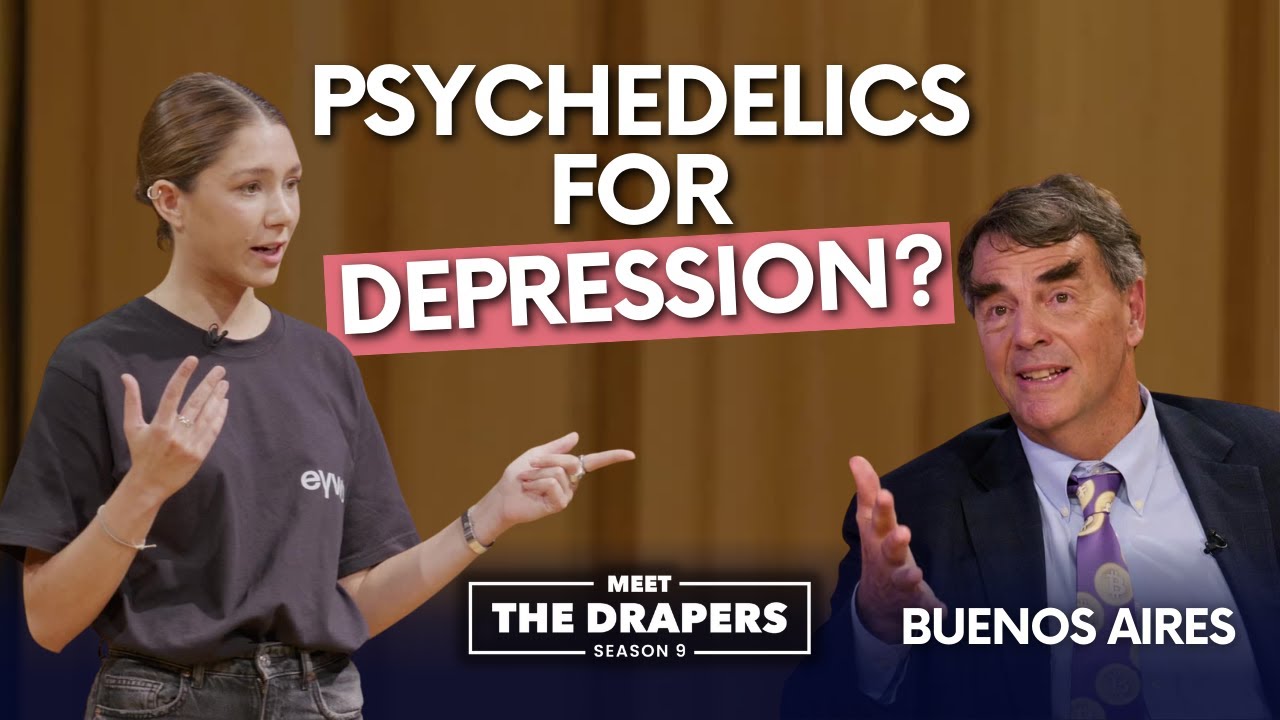
In this episode of Meet the Drapers filmed in Buenos Aires, host Tim Draper and his family members (Adam Draper, Gaby Sibylis Draper, and media entrepreneur Mario Pergolini) judge four Latin‑American startups competing for a $1 million investment. Julia presents Nunatak Biotech, a microbial bio‑input platform that harvests extremophile microbes from Antarctica to create biofertilizers and synthetic microbiomes for degraded soils. Franco pitches Satellites on Fire, a wildfire‑early‑detection system that fuses satellite imagery, tower‑mounted cameras, and AI to spot fires minutes after ignition, aiming to protect forests and lives. Victoria Costapaz introduces Eiwa, a biotech company that scales pharmaceutical‑grade psilocybin and other psychedelics through a biosynthetic process to treat mental‑health disorders, emphasizing safety, scalability, and stigma reduction. Sebastián describes Sky Blue Analytics, a SaaS/transaction‑based fintech infrastructure that provides white‑label robo‑advisor and analytics tools for Latin‑American financial institutions, addressing the region’s lack of modern investment platforms. Throughout the show the judges discuss themes of “funding the rebels” versus licensing to the “empire,” scalability, regulatory hurdles, and market competition. After a playful deliberation involving a crystal‑ball metaphor, the judges announce Satellites on Fire as the winner. The episode blends English and Spanish banter, cultural references to Buenos Aires, and the Drapers’ characteristic humor.
Chapters
We're funding the rebels. You seem to be working with the Empire. Meet the Drapers, Buenos Aires!
Being entrepreneurs, you have freedom to, to act.
We're all family. Mis hermanos!
Your Spanish is great!
Our minds is the biggest platform you can invest.
I am super curious about lots of things. Gold medal in gymnastics to gold medal in Math Olympiads.
Franco, can you do gymnastics?
Ah! Ha ha ha!
I hate Franco.
I'm Tim Draper. I'm traveling the globe to find game-changing entrepreneurs with world-transforming ideas. Thousands applied, but only top entrepreneurs have made the cut for a chance to win an investment of $1 million. It's a journey packed with unforgettable moments.
Yeah!
$1 million.
$1 million.
$1 million.
$1 million investment will help Nunatak to protect our technologies, but also keep developing new solutions.
AI development to keep improving our system and to keep scaling the impact that we are generating.
Help us to scale psilocybin into a pharmaceutical-grade quality, and that would allow us to do our first sales.
We already have the infrastructure. We want to expand really quickly. $1 million, you know, would All right.
Welcome, everybody, to Meet the Drapers. We are here in Buenos Aires, Argentina. So exciting to be here. Entrepreneurs are everywhere. Freedom reigns in Argentina, and entrepreneurs are as creative and excited as I've ever seen anywhere in the world. On my right—
How do you say right in Spanish?
Uh, derecho.
Derecho.
Derecha.
Derecha. Oh, derecho is straight ahead.
Derecha.
Derecha.
Izquierda.
That's right. Very good. My son, who did learn something in Spanish class, Adam Draper, who runs Boost VC. You know him very well.
Thanks for having me back, Dad. It's really great to be invited to Buenos Aires.
This is one of the Drapers I don't have to adopt. But on my left, in the izquierda, this is Mario Pergolini. He is an extraordinary man, a media entrepreneur. He's a radio and TV host, well known to all of you, right? Everybody's heard his show, right?
My people. Thank you, Buenos Aires.
They used to say I have a face for radio, but you have a face for television. You look good.
First radio, 20 years television.
So you got better looking as time went on. Is that anything you're going to be looking for?
Eh, sí, lo que Sí, le voy a decir. Yo le voy a hablar en español a la gente. Van a tener que leer los subtítulos.
We try everything on this show.
La verdad que es un gusto estar acá, ver nueva gente, escuchar lo que van a hacer. Ojalá que los podamos ayudar.
Tomamos todos. Tomamos todos. Este television show.
Okay.
Your Spanish is great. Welcome to the family, Mario. On my left, we have Gaby Sibylis Draper, who is a hero, graduate of Draper University of Heroes, and now she is a major venture capitalist in Paraguay. Are you the first female venture capitalist from Paraguay?
Ah, the second as well, 'cause my mom is also a VC.
Oh!
My mom and my dad. But if I'm a Draper now, I'm a what generation?
Fourth.
Fourth? Well, it depends.
You could add yours, you could be sixth.
Which one works better?
Many generations. Welcome to the show. We are really clearly enjoying our time here in Argentina. This is a part of the world that is going to take off. Let's bring on our first entrepreneur. But before we do, let's see what's going on behind the scenes.
I am Julia, the CEO of Nunatak Biotech. Nunatak is a mountain surrounded by ice. There are a lot of nunataks around the world. World, but there is one known attack in Carlini Antarctic Island where our team spent 20 years doing science there. We are developing microbial solutions for soil and plant health inspired by resilient nature from Antarctica and other extreme places. When I was studying international relations, I realized that I wanted to address environmental challenges, and I thought that institutions or global international— yeah, international organization was the way to do that. And with time, I realized that it was not enough. You need another type of organization such as startups, VCs, like, I mean, the ecosystem is huge. But then I realized that to solve the problems that I want to solve, I need science, technology, and business money investment. So I put all my efforts to start working with companies, leading tech teams, and then I changed my career. And I become an entrepreneur because I want it. And what I found beautiful being an entrepreneur is like you have liberty, like you have freedom to act, to do, to make choices. Maybe you have mistakes, but then you can, I don't know, okay, you keep going. And then I think that this journey is like it helps you to develop as a person, but also as a professional solving something that is complex with others. I don't need a title to do something, like, oh, it's what I believe. So I want to put, like, nature in the center of the scene, not me. I mean, I am just a vehicle to be as a CEO, but in my case at Nunatak, microbes are the, I don't know, the main actors or the main, yeah. Some weeks ago I was in a summit where they put the question is, what if the global leaders of today were friends 20 years ago, like how the world looks like. So like, and I found that question beautiful because when I see other entrepreneurs that are doing cool things and I'm friends with them and all of us, we are building great things, I think that we are shaping the world in the way we want. We are in Lago Regatas in Palermo. I love the water. It's a calm place. Being here, it's like just have a walk to the lake. Actually, it's very humid Buenos Aires, so that's why we have so many trees and plants. I work for nature, actually. Like, my startup is related to nature, so I have to be in contact with nature to be inspired. You have a lot of trees and huge trees. You can find different types and spend some time in nature in the middle of this huge city. I was nervous, but at the same time confident. I believe what we are building and I use this experience to learn. I love nature. I believe it has superpowers. Life on Earth has billions of years of experience and adaptations. What if we could find the answers to our biggest challenges by learning from nature? Well, this is Nunatak. We are building the extreme bioinput powerhouse inspired by resilient nature from Antarctica. The first problem that we are addressing is soil degradation. One-third of agricultural land is degraded, and up to 50% of irrigated land is salt-affected and growing. Current solutions are limited because they are not addressing microbiome complexity. That's why comes Nunatak. With 20 years of scientific experience in Antarctica, we decode how this grass could survive in very harsh conditions because of the help of its microbiome. We are building a symbiosis platform focusing on the plant-soil microbiome interactions. In only 6 months, we launched our first product, a biofertilizer that increases yield performance and helps plants to establish better in salinity conditions. We got extraordinary results and diverse companies will be testing this product this year. But this is just the beginning. Nunatak has built a unique bank of extremophiles, transforming microbes into business with speed to market. We are enhancing current portfolio companies with building microbial teams, enhancing the best functionalities, pushing the limits to reach our visions, create synthetic microbiomes that will create a new paradigm in soil and plant health.
So who pays? Is the farmer buying this?
No, but in our case—
Is it carbon credits?
We are charging fertilizer, chemicals, and biological companies with royalty fees, Adam has come up with this concept of funding the rebels.
You seem to be working with the empire. You're basically just licensing it out to the empire. You're not challenging them.
Yeah.
I'm concerned that if it's a licensed product, that over time the importance of it will go down relative to whatever the Next time I'm going to explain in another way, and I use this experience to learn.
We want to achieve this goal of build synthetic microbiomes, at the same time making money, monetizing the whole— the different bioinputs that we can produce.
What's the grand vision?
It's put nature in the center of the scene. If we understand how microbes and the microbiome functions, we can really, like, restore the soils, but the focus is on the microbiome. So you're not just making synthetic microbiomes, Learn from resilience in nature, and I think that is a very powerful thing.
Terrific. Well, Julia, very nice meeting you. Thanks for being on Meet the Drapers.
Thank you. I feel great. It's a huge opportunity that we got to meet Tim, Adam, and all the jury.
Gabby, what'd you think?
Yeah, I love how she knows her stuff. I'd like to know more about how can she protect her technology from these other companies or the companies that she works with, but I loved her enthusiasm. I feel like that's going to drive her forward. Adam, what'd you think?
I love the idea of just like taking the best stuff from like Antarctica, deep sea, wherever, and like doing it, like making our soils better or making, you know, I think it'd be awesome.
I thought it was really cool, and I feel like she should go to Draper University because she'll come out of there realizing that she can go ahead and take on the empire.
As a startup, sometimes you, you want to please the Soil providers, fertilizer companies. But if you're gonna win, you kind of want to piss them off.
Me parece que tiene algo super interesante. Es complicado lo de las licencias. Tal vez ahí coincido un poco con ustedes, pero creo que es el momento para este tipo de tecnologías que el mundo está buscando este tipo de tecnologías y ella está muy entusiasmada, ¿no? Estudiante de ciencias políticas está haciendo esto. Si no está entusiasmada, está loca.
Let's move on to our next entrepreneur. But before we do, let's see what's going on behind the scenes.
So my mother told me she knew I would never finish university because I'm super curious. I like to learn a lot of things from gymnastics to making magic tricks in parks at 11 years old to bartender, surfing, acting, everything. When the project on Satellites on Fire started to grow, I really wanted to spend the next years being on my mission to try to preserve the forest biodiversity and the people that live in our world. So at the beginning, it was because we wanted to do something with satellite imagery, AI, and I had family friends losing their homes. So it not only affects the forest that I was really connected to, it saves people's lives. We were in a technical high school where every year you had to do like a technical project. We started developing for 4 months the solution, and after that we started speaking with the people who work with wildfires, and we saw that the solution wasn't useful for anybody. After that, we started speaking with hundreds of firefighters, forest rangers, and experts to try to understand why these fires weren't being stopped in time, and that's when we started developing what nowadays is Satellites on Fire. Today, organizations in Latin America use NASA's system which often is delayed by several hours or even days. And that's why basically we are combining several types of technology like satellites, cameras and towers, and AI so we can detect the fires in the first few minutes. In the northern parts of Argentina, wildfires are a huge problem, having wildfires every month of the year. And 95% of the wildfires in Latin America are generated by humans. In the State of Mexico last year, we have been able to reduce to zero the mortality rate of fire brigades because of giving them more information on how the fire was behaving. I think it's difficult. We will depend also on climate change because if climate change keeps getting worse, wildfires will keep getting worse, and the technologies that we will have to develop We'll have to always evolve to be on that kind of world that we will be living in.
Viewers, usually I'm pretty easy to reach. I mean, there are only 300 million of you. I'm making it a lot easier for you to contact me. I have downloaded my brain into this It's digital twin, and you can scan this QR code. You can pitch me your idea, you can talk about your business, anything, and I'll answer it 24/7. Enjoy it, it's great. It's a new feature of Meet the Drapers and Draper TV. I think you're gonna have some fun. Thank you.
Cheers!
So here we are in Palermo, in Plaza Italia, where we usually get together with friends to drink mates. That is a local beverage, like a tea that we share together. And we really like to, to get together and to meet up with friends and talk about life, be in a coffee shop, be in a park, or in Argentina, an asado, a barbecue. So mate is like a cultural beverage, like a green tea, but it's also like a more cultural thing where we get together with friends and really share like a round of hot beverage and talk about our lives, the country, and etc. Usually 5 minutes before going to pitch, my heart starts pumping really hard, but once I start speaking, I think the nerves In 2020, when I was 16 years old, I saw the tragedy of family friends losing their homes to wildfires in Argentina. I had to do something, so I spent months speaking with firefighters, forest rangers, and experts trying to understand why these fires weren't being stopped in time.
The key?
Early detection. And we built Satellites on Fire, which is a deforestation and wildfire early alert system that combines satellite imagery every 5 minutes tower-mounted cameras, and proprietary AI models, helping organizations save their lands, their biodiversity, and their people. Today, companies in Europe are launching satellites to detect fires. In the US, Latin America, and South Africa are installing cameras for the same purpose. What we do is we combine both technologies, but also on a software-based strategy that makes us faster, more scalable, and 100% focused on AI, enabling us to detect fires several hours faster than NASA, which is the most used system in Latin America, and helped tackle more than 400 wildfires in just the last quarter. And we are backed by Techstars, MIT, the United Nations, the founder of Reddit, and Draper Cygnus VC. We're not just detecting wildfires, we are preventing disasters.
This is really close to home. My daughter and her husband and their 3 kids all live— lived in Los Angeles. Her office burned down and everything burned around her school and around her house. The whole neighborhood was burned, and they now live with us.
I got surprised to hear that, but I think that personal connection that I had of family friends losing their homes is something that connected us in our pitch.
You're not the first You're not the first person to come to me who detect fires. How are you going to rise above the rest of them?
Sorry to hear that. What we do is we have a lot of users, more than 35,000 users, giving us data on validating real wildfires. So we have a premium model where we have all that data that is coming to our models. We increase the resolution of the satellite imagery, combine it with that data, combine it with weather, And topography data. And in that integral solution is that we are able to detect fire faster, monitor them, and predict their behavior.
Are these sensors yours from your company?
No, that's our differentiator. We are software-based, so we connect to satellites, we connect to cameras, but we don't give them. So basically, companies that have the hardware, we just connect to those cameras. We can connect to almost any camera, and if not, We help with partners that install those that hardware for them.
By my calculations, you're about twenty or twenty-one years old.
Twenty-one.
How do we know you're that one?
So yeah, I am super curious, as I suppose any entrepreneur. I have done lots of things from gold medal in gymnastics to gold medal in math Olympics. But I I really casual.
Of course. Well, Franco. Thank you so much for being on Meet the Drapers. Thank you. Oh, wait a second. Can you do like some like acrobatic thing here?
My mic is gonna—
Really excited.
I think they make a really warm environment to be in. I feel Confident in this moment.
Twenty-one years old.
Oh my God!
Oh yeah. It's only the age.
Yeah, of course. No, you're when you were twenty-one, you could do that twice.
I hate Franco. It's very brilliant. Me alienta su edad y las ganas que tiene de hacer cosas, ¿no? Su su mente. Creo que tiene va a tener muchos competidores en las compañías de data para este tipo de cosas.
Adam, what'd you think?
I mean, I truly think that if he figures out how to essentially become an insurance company here, this is a money printing device. He's doing ways. He's like combining all these different signals. So I don't know. It's awesome.
So two great, really interesting companies. Thank you, Buenos Aires. Wow. Okay, let's bring on another one. Let's bring in our next entrepreneur. But before we do. It's all about the eyebrow.
I'm Victoria Costapaz. I am co-founder and CEO at Eiwa. What we do in Eiwa is trying to bring psychedelics in a safe, measured, and prescribed way. I'm from Buenos Aires. I was working for Sprite and Fanta. It was a really amazing job. I mean, it was super, super fun. Like, working in marketing in Coca-Cola is It was practically Disneyland. But somehow when I was in the briefing tables, I always would be curious about the innovation teams, the business teams, what were they cooking.
So what did the people in your life think when you made the shift into entrepreneurship?
They admire you, but at the same time they are like, what's going on with this girl? I met Paola, my co-founder. She introduced me to the world of psychedelics and how they could change Mental health. I grew up with someone that had depression. Antidepressants don't act in 40% of the people that will be resistant to them. They have severe side effects like taking your personality away. Psychedelics bring to you a more genuine way of healing. You're literally creating new paths in your mind to generate new habits that are good for you or breaking negative ones. So this person I'm talking about is my mother, and I didn't realize that this kind of like made me also put in a role that wasn't the role I was supposed to occupy at that age. After 10 years of treating herself with medication, she still didn't have motivation, or she didn't feel like she could do things So when she started microdosing, I saw this, this plus on her. Like, she was not depressed, but she was feeling meaningful. She was going out from bed. You don't have to be super, super, super depressed to not be, like, enjoying life. And that was the first idea of Ewa. Our minds are like the The engine of our economies, our societies, our families, our couples. It's the biggest platform you can invest. So people in Buenos Aires are really warm. They're really generous, like to go out, like to party. Probably if there's a foreigner, invite them a barbecue or how we say asado. That I think is a really, really nice part of of our culture. It has like really nice culture in terms of arts. So you have Malva Museum, you have Museo de Bellas Artes, you have Fundación Proa in La Boca or Caminito y. So right now we are at the Naciones Unidas Park. United Nations Park, right next to the Floralis Generica. This was a gift from an Argentine architect. I was really nervous until I started interacting with the judges. So from my 7 years old to my 18 years old, I grew up with someone really special to me having depression. It doesn't have to be so tough. It doesn't have to last for so long. Did you know that 1 out of 4 people suffer or will suffer from a diagnosed mental illness? And we all know how this affects couples, families, even economies. We need our brains to work, to operate. So clearly, today's treatments are not enough. Antidepressants— weeks to act, and they have severe side effects. Psychedelics are here to change the game. They demonstrated to work immediately, 4 times better than antidepressants, And with half of the relapse rate, they turn off our default mode network, allowing us to generate more neuroplasticity in our brains and generating new pathways to break negative loops of thought in depression, in addictions, in eating disorders, in PTSD. But we cannot scale them. They're not pharmaceutical grade. And those pharmas out there doing total chemical synthesis are too expensive. They put a lot of waste into the sea. That's why Ewa exists. We're doing a platform to produce all of these compounds in a scalable way with the best yield possible that can be pharmaceutically prescribed. Tim, when I met you in 2023, you told me to aim for the stars but to prioritize traction. And that's what we did. We already have 5 LOIs with different pharmas that want to get our active ingredients. And we also have a partnership with Albert Einstein in Brazil. to have our own formulation into the market. So Brazil is going to be our first sandbox, and then we want to take this to all of the world. At Eiwa, we don't really replicate the world as it is. We model the world as it could be. Thank you.
This is great. That is the best pitch I have ever heard of anybody who's ever done a mental health deal. That was really good. And not even in your primary language, and it was as clear as a bell.
Can you do a backflip?
What's special about you? I guess it's that you're bringing it to pharma and working within the system.
So probably if you're struggling with mental health problems and you want to commit suicide, and the psychiatrist will give you an antidepressant. We want psychedelics to be safe, as scalable as possible, and legal. You don't know how frustrated scientists are today because they want to do research with psychedelics They are the ones that are going to teach us how to take them, in which doses, for which indications.
Have you taken psilocybin yourself?
Yes, I did.
And what happened to you?
For me, it has been transformative, but from learning how to thank what I have and what I have already done. It's that, like, being present.
Psychedelics have been banned for I don't know how many years.
We tackle stigma with data. To generate data, you need active ingredients that can be measurable. And taking to clinical trials.
A diferencia de ellos, no creo que esto ya sea un tabú. Creo que creo que rápidamente lo único que está esperando es que se habilite la droga para que pueda ser usada. ¿Cuál va a ser tu diferencia para que sea tu ibuprofeno favorito?
Our differentiation is mainly in our biosynthetic process, massively scalable, and scalable translates in prices, scalable translates in how fast we can get to the market.
What does this look like if you win?
Prescribed and safe psychedelics are approved in many locations.
Great, Victoria. Thanks so much for being on Meet the Drapers.
Thank you, Tim.
Thank you.
You're welcome. I'm feeling so good.
So, Mario, what did you think?
Creo que es un lugar donde hay mucha competencia en este momento. No se me ocurre exactamente. Quién va a hacer la diferencia o cómo va a hacer la diferencia en este terreno en donde las Big Pharma no no sé cuánto van a permitir.
I am biased, I have to admit, because I love this. So I just want it to work.
I'm pretty sure it does work. I am concerned as you are about competition and Big Pharma. Adam, what do you think?
She was different. I'm sure she being the difference will make the difference in this business.
Argentina, who knew? Let's bring on our next entrepreneur. But before we do, I want everybody out there doing the eyebrows. Let's see what's going on behind the scenes.
I was the only one of my friends who studied economics, but everyone wanted to invest in the capital markets and they relied on me. The problem with Latin America is basically our currencies are really bad. You know about Argentina, if you save in Argentinian pesos, even despite the fact that you do everything great, you are going to fail and you are not going to get out of poverty. There are different ways of democratizing and making people free economically. The way that we want to do is basically to provide this technology to the institution that they already are saving and that they are already working. We are not asking them, hey, take your money to another B2C company that you don't rely on. Because that happened to me. I got financially, you know, scammed because of that. And in Latin America, that happens a lot. I'm originally from Uruguay, from Montevideo. There I met Martin, who is my co-founder, who is the CTO. We both studied the same degree. I immigrated to Australia. I stayed there 2 and a half years. I worked as an actuarial in the derivatives markets for a huge Company called A&P. Meanwhile, Martin at the same time was studying computer science. But I created Sky Blue Analytics actually at the end of part of the pandemic. We didn't call it at that time Sky Blue Analytics. It was me with Martin, but we started working in the financial sector and technology. The national team of Uruguay, we call it La Celeste, Sky Blue. So when I was in Australia and I got fired, I was with my friend and, hey, analytics is something that you do and it's something that you, that, you know, it's your core business. You should put something in front of analytics. And I say, okay, Sky Blue. You know, I went to Draper University and there are like 10 important phrases. Short-term sacrifice for long-term success. I have met many people that sometimes, you know, they have their family. I don't have a family right now. You know, I don't have children. So it's really important for me to focus because in 2, 3, 4 years I will have them. I am from Uruguay, so we always like to come to Argentina. We always try to find an excuse to come here. We love going out, but particularly having dinner here is It's special. It's a different mood, atmosphere. You know, there is much more people, different places to go. You never get bored. I really enjoy gastronomy here. There is a lot of Spanish and Italian background and food, so it combines the best of Italian and Spanish. Right now we are in Draper House in Buenos Aires, a beautiful place. It's just been recently opened to the public. We do networking events. Yeah, and I have been friends of the, of the guys here. They have been always amazing. At the beginning, I was a little nervous because it's giving the gift. You get unfocused from the pitch, and then you have to return to give the pitch. I have here a present for you.
I always appreciate when they're bribing the judges. It's Malay.
The chainsaw represents cutting excess of expenditure from the government. I really enjoy giving these gifts. So 10 years ago, when I was 20, I was the only one from my group of friends who studied economics, and we all wanted to invest our first money. I was kind of the guru, so I did my market research and I tried to find an investment platform or infrastructure that would allow me to do this in Uruguay. Unfortunately, I couldn't find one, so I went to Google. Hey Google, I want to buy some Tesla shares like Tim did. Apple, whatever, whatever. And I found a place. I thought that place was trustful, so we put our money, but unfortunately it was a scam and we lost the money. So I didn't understand why my local bank or even the broker where my father invested his money wouldn't allow me to buy some Tesla share or Google or whatever. And then I realized that investment infrastructure in Latin America is 20 years behind the US. Which limits the capacity of the people to invest and save for economic freedom. The way we have solved this, Tim, is totally different from a B2C perspective of creating a platform and going to market. We have developed the infrastructure and the platform technology that allows for established players to modernize extremely quickly, and also creating the ecosystem so millions of new fintech will develop solutions very fast on our infrastructure. Thank you very much.
So, so, so there was a brokerage that was fake that just took your money?
Yeah, basically it was a CFD and forex brokerage that you send the money, they give you a paper, and they give you— if you put $3,000, you will have $10,000 in a bonus. You sign the bonus and then they tell you, hey, you cannot withdraw the money because you have to reach this amount of transactions. And it's almost impossible. And there is leverage in the middle. And I cried a lot. But it is what it is. Wow. And Martin, my co-founder, also lost money.
Where does your revenue come from?
Is that from brokerage companies that see into portfolio?
Is all that's all transaction?
No, right now. That's a great question. Right now, it's a SaaS model business, but we are changing to transaction right now.
Sure.
Y la plataforma la tienes que adaptar para cada cliente o la tienes The infrastructure that we have developed in the backend makes that all the widgets are 100% personalized.
And following up on that, where does the responsibility lie? Like if a brokerage uses your robo-advisor and then for some reason your robo-advisor gives some super crazy advice, whose responsibility is it?
So I can create 100,000 robo-advisors, to say it in some way, but you choose the portfolio that is conservative, you choose the portfolio that is moderate, you choose the portfolio that is aggressive. We just do all the backend. And we have front-end solutions.
Is there a reason that you didn't just go after like the Robinhood?
I didn't go B2C because it was a headache. In each country you need regulation, which I hated. If you try to go to each country B2C, the regulation is going to kill you because you have to be compliant in each country.
All right, Sebastian, thank you very much, and thank you for the Pleasure having you on Meet the Drapers.
I really controlled the adrenaline and I took the— it took the best of me. So I'm really happy that I gave 100%.
I think he should just go after building an institution. Just trade some stocks. And that's coming from someone who was a broker-dealer at one point and it's a pain, but he's kind of doing this thing, you know.
If you're in the US, maybe you're not super used to thinking about these things, but if you're in LATAM, like every country has its own set of You know, regulations and laws. When I went to the U.S., like a lot of my Latin American friends, you know, they were using Robinhood and investing for the first time because yeah, there's like no such thing in Latam. You can't even think about it. It's like super broken.
Fascinating.
So where did where did you think, Mario?
Hemos visto cuatro casos y es el único que habló del sistema financiero, que está proponiendo algo para el sistema financiero, para modernizar el sistema financiero. Me gusta el caso de Sebastián. Es interesante. De hecho, me pareció que fue el que más le preguntábamos porque es para hacer más plata.
This present is quite special.
How many people?
We don't have rooms here, or we're not sure if we're gonna have rooms.
Oh, okay.
Oh, the 2 smart groups are in here. This is nice. They got a pool out here. But you teach for Draper? Oh, well, thank you. And you guys know what You know what the first step is in running a business, right? It's to take the first step. That was really fun. But now the hard part comes. These were 4 really great companies.
There's actually a positive correlation between success and being able to do a backflip.
You gotta bring them all back in.
I was gonna ask, how on earth do we choose?
Does anyone have a coin?
We're gonna all rely on the crystal ball with a chainsaw.
Motosierra in Spanish.
Motosierra. And what's this in Spanish?
Bola de cristal.
Oh, that's easy.
Now say chainsaw. This is your show.
Our show.
It's our show.
We're all family.
I'm your brother. You're seeing me. Yeah, our father.
Mis hermanos! Bring out our entrepreneurs. Nunatak Biotech. Seems like you found some major breakthrough in the way we grow plants, but the concern is that are you building a trillion-dollar business, or maybe we'll sell it off and not have to do much work?
We are selling products, not, not our technology. Companies are asking for solutions. We understand what strategies they have to solve the problem they need. So we are selling products, but not our technologies.
I'd be like Colossal, but for plants. I'd be like Jurassic Park plants. And then everyone goes, what?
That's my pitch. I don't know. I don't know. I'm not so sure. Satellites on fire. Awesome backflip.
I can't believe you did it. Wait, how long has it been since you've done your last backflip?
A bimonthly thing.
That's a little risky.
I save it for pitching competitions.
Good. I like the risk profile.
¿Cómo le contaste que viniste a buscar plata y te dijo, no, destaque como gimnasta?
Yeah. It's exciting. There's a lot of competition, but as Adam said, it could be a real money machine. Something really to throw yourself into, but make sure you're Oh, that's great advice. Aiwa, this is really cool. I mean, I'm pretty convinced that it does work, and I think you're going after something really important. I was a little concerned when it sounded like you were ready to sell your business to Big Pharma.
The enemy.
And Big Pharma is like, they are who we are totally going after.
I will do browse for Not selling leverage.
To do what?
My empire.
To build your empire.
Yeah.
Dun dun da dun dun da dun dun.
As long as it's her empire and not Big Pharma's empire, we're good. Sky Blue Analytics. Since we're not familiar with how awful it is here to buy. It's harder for us to judge this. I think you can sell ice to Eskimos and fires to sheiks. I'm a little uncertain as to what the future holds here. It is true Robinhood hit it just right. Somebody's gonna hit it just right down here. We were a little concerned that you were going after the banks and not the end consumer with your own brand. Interestingly, in these 3 cases, You were kind of working with the empire, and and we're kind of looking for the rebel judges. What did you think?
De alguna forma, para mí, el caso más disruptivo, el que en una competencia complicada, o yo creo que en un ataque biotech es es super interesante. Vamos a ir por el lado de la psilocibina. Vamos a ir que el mundo va a ir un poco por acá. La verdad que tengo la decisión ahí media mezclada. Pero se la voy a dar a Nunatak Biotech. Igual la plata es de él, ¿no? Pero it's your money, no it's my money. Nunatak.
It's because of the Jurassic Park thing.
Yeah, definitely.
Ya veo.
Iowa, because I feel like if somebody's not feeling well, then they'll put those people back on track. And for everybody who's already on track, it's kind of— it might enhance people's potential, and the entire world will be better if everybody's on their superpower potential path, my vote goes with you.
Adam?
I'm starting a fund in Buenos Aires.
All 4 of you are really, really good.
No, I don't want to choose. They're good, and I'm normally very decisive.
I know.
But—
and I liked your rebellion thing.
Yeah.
And I'm still indecisive.
Me too.
No, you know what? I mean, I am I'm gonna pick because at the end of the day, if everyone's equal, you judge based on the company name.
Of course.
And Satellites on Fire is the best company name.
Okay, the crystal ball is gonna have some trouble here. I'm stumped. Crystal ball, you gotta give it to me, man, because this is a really tough one. Now the spirits are coming, and the winner is ah! It's torn two satellites on fire in Iowa.
Thought there was a probability, but then suddenly he was like satellites and they were ah!
What?
I'm super excited to go to the semifinals. I think it's going to be a great experience.
And honestly, for us, it's really important. Because there's a lot of stigma in mental health and with psychedelics. This can be safe, this can be scalable.
Vote for Sky Blue Analytics because it allows fintech to go to market faster. This is global, not just Latin America.
With your vote, I think that we can put the core of biotech industry from South America in the center of Silicon Valley.
Hey, welcome to the family. We're going to have to—
Oh, no.
Welcome. It's so good to be with all the Drapers.
High five.
See you next time on Meet the Drapers!
More from Tim


He Sold His Car to Build This Startup, Then Pitched It for $1M 😳 #Startups #AI

This Startup Moves Your Crypto BEFORE Hackers Can Steal It 😳 #Crypto #Cybersecurity




15 Months Without Refrigeration?! This Startup Thinks It Can Go Global 🥥 #FoodTech #Startups



