This content was created by Tim Draper. This content was uploaded by Tim Draper. This is a YouTube video titled "Social Media Presence | Margot Micallef" (created 2017-02-22) consisting of a presentation with audience Q&A by Margot Micallef. She discusses corporate social responsibility, social media channels (Twitter, Instagram, Facebook, Pinterest, LinkedIn, YouTube), marketing tactics (food truck, PR, brand ambassadors including Olympians), metrics and challenges in measuring sales attribution, packaging and merchandising decisions, and retail distribution (direct retail vs. distributor). Participants are Margot Micallef and audience members (labeled Speaker B and Speaker C).
Chapters
This is some of the corporate social responsibility. I really highly recommend that if you're not involved with charitable organizations, that you become involved with charitable organizations. It's a way of telling your story that is not about you and not about your story. It's a way of sharing, it's a way of getting support from other people who can relate to the charities that you support. These are just some of the charities that we've supported in addition to Stem for Life. And it's a great way to interact with the community and really Be relevant and present. Social media, you know, you guys are probably even more informed about social media than I am. We we are in on Twitter. We're we have an Instagram account. We're all over Facebook. We've got Pinterest. We're on LinkedIn. We're on YouTube. We're on things that I don't even know about. And when I finally learn how to use one, we you know add another one that I have to figure out. But we've had a lot of success delivering our message one on one to the consumers.
And this is about you know.
Having a major impact with a small budget and really delivering to the consumer one message at a time. So we've gotten quite a bit of success. And you can follow us on Skinny Pasta on Facebook and on Twitter. We're GK Skinny Pasta on Instagram and Pinterest. These are just some of the examples, some of the successes we've had. Last year we had 225,000 impressions. I think that was with one on 3 platforms and 2.3 million over the last year. So you guys probably know what that means even better than I do, but we're quite pleased with that. One of the other things that we do is we relate to our consumers through recipe development, and that's a really great tool that we use through Instagram. And it also is a way to give people ideas of how to interact with our product and how to enjoy our product. It beats just talking about the attributes You can actually make it into something that they can relate to.
Can I ask something?
Yes, of course.
How do you measure which of these marketing channels are effective to actually generate sales?
You know, it's really tough.
PR and the others.
Yeah. It's tough to identify which one is most effective. I think that it depends on what consumer you're trying to relate to, or whether it's a retailer you're trying to get attention of. It also depends on what stage of the company's development you're at. So I think the food truck was a really powerful way to get noticed, way more than social media would have been, where we would have just been noise. Social media could support the food truck, and the food truck actually got us a lot of followers on social media because they could relate to what we were doing. It was a great story. It's really hard. I wish I could identify exactly what worked when, and I ask our marketing people that all of the time.
The only thing that really measures success So how do you measure the correlation between posting on Facebook or having a food truck or getting a piece on Huffington Post or the Oscars? Do you have any type of mechanism to understand where you should spend more in terms of marketing?
We have metrics that we look at from all of those channels to the degree we can. So we know how many people interact with our food truck on a regular basis. We know how many people follow us, we know how many interactions we've had through any of our posts or our photos or our recipes. We can often see a spike to our website or even our online store when we've done something or we've been in the media. It's really kind of indirect ways of measuring. We can see what the metrics say in terms of how many eyeballs, we can see how many interactions we've had, but we can't— we do not yet have a way of identifying how much of that has actually transferred into a sale.
We do.
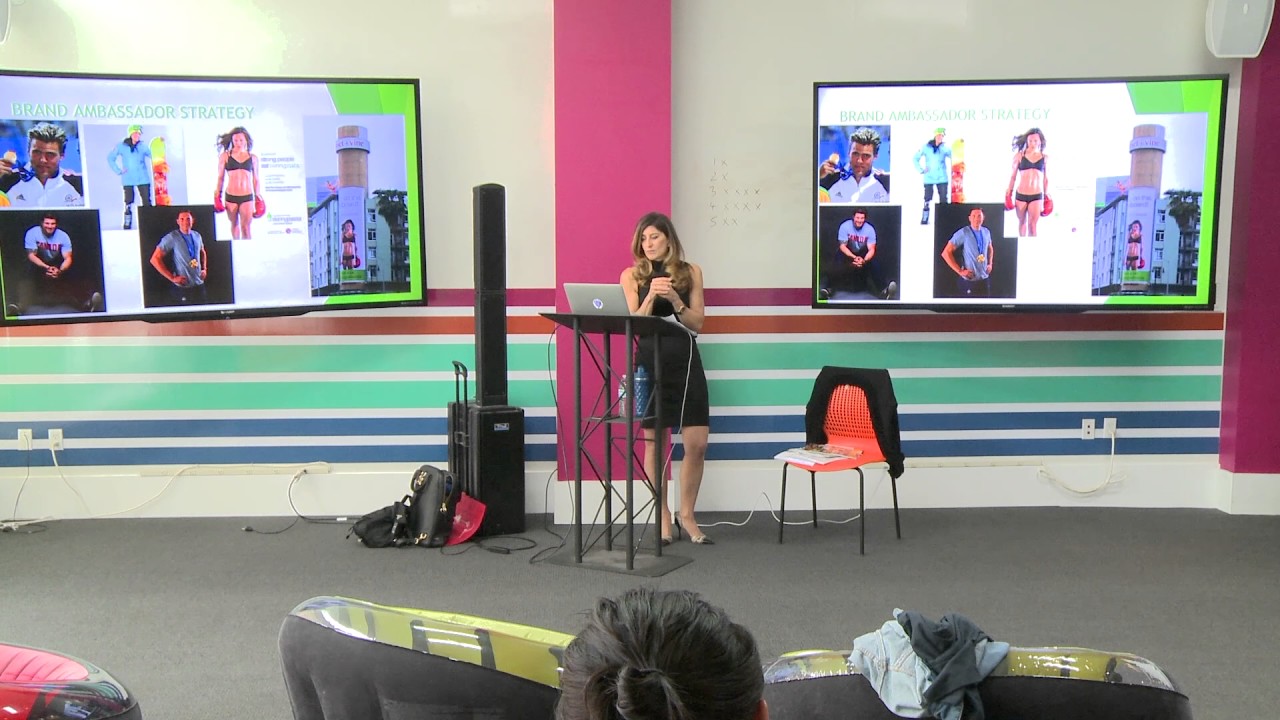
we haven't been able to identify that. It's a lot of it is subjective. If you figure it out, I'm all over it. The other tactic that we use is brand ambassadors. So these are various Olympians and athletes. So we were able to attract a lot of athletes to our brand because it is such a healthy brand, and of course they have a vested interest in eating well and they want food that tastes good. So you might know Gary Hallgren, Junior gold medalist in the United States, multi-Olympian, multi-medalist. He is a diabetic and he was told when he— before his first Olympics that he was never going to be able to compete because he was just diagnosed with diabetes. And he showed the world that it is possible to be an athlete and compete with diabetes. And he's a big supporter of ours. Underneath him is Jesse Lunsden. Jesse is a bobsledder, former NFLer, former CFLer, and a really big supporter. I don't know if any of you have heard of Curling, this is Johnny Morris, the gentleman with the medal around his neck. He was the skip on the Canadian curling team who won gold in Vancouver in 2010. And these are some other athletes and Olympians from Canada. One of the things that we did was we put our ambassadors on billboards when we first went into the Los Angeles market. So we had some really high-profile billboards. That's on Sunset and Vine, the billboard that you're seeing there. Another way that we got a lot of attention. Again, really tough to measure how successful that was. The last tactic that is a marketing tactic which might not appear as a marketing tactic is your packaging. So our packaging is a way that we interact with our consumers. Once we get our product on shelf, we lose contact with the consumer and we're heavily reliant on the retailer to advocate for our product. So the best way to advocate is the product itself, is the packaging. packaging itself. So we evolved. This was the start of our packaging, which was an evolution from the original packaging which you might have seen 2 years ago when we did the Dragon's Den. It was a sleeve over a tray. We went from this packaging to this packaging. So we changed the coloration of our products. So we've got 3 different lines of products. This is our high protein, low calorie, low carb line. And so we branded it with that silver steel color. These are frozen entrees that we make using that high protein, low-calorie, low-carb noodle. So they're branded with the same coloration. This is our superfood. It's made from a grass from Ethiopia called teff, which is very high in micronutrients— calcium, zinc, copper, magnesium, manganese, etc. And it's also high in protein, and it's gluten-free because it's a grass. So that's the colors that we use for that product. And these are the prepared meals that we make using those noodles. And then these are our gluten-free frozen entrees that we use— that we make using We're using a potato starch, which is a resistant starch, which is really healthy for you. It provides blood sugar metabolism and is also gluten-free, and they're delicious. And I brought a bunch of these for you guys to try and to distribute amongst yourselves. This is our last line, which we just launched this year. It's called Gabby Pasta, and these are kids' meals.
Can I ask, because you're on the section which is very interesting for me, where can I find it in the supermarket when I come to buy the pasta? Not the prepared food, which I know in what section it will be, but the regular pasta. What will be on the shelf? Is it in the superfood section or in the regular pasta?
So this pasta, the cut noodles and the shaped noodles, will be in the fridge. Some retailers, smaller retailers, will sell it in the freezer. But these are fresh pastas, and you cook them like you would cook regular pasta, except it cooks in 2 minutes. The frozen entrees will be in the freezer. And that's a really interesting question that you ask, because this is an example of how we lose control of the process once we get into the retail stores, because we negotiate with them as to placement. So we want to be eye level, we want to be next to the gluten-free meals, and we want to be, you know, facing forward. Every time I'm in the retail store, I go check out our products and I end up merchandising it, right, because the stock boys and stock girls don't care about the product the way I care about it. Sometimes we'll be laying this way, so you can't see the product. Sometimes we won't be with the gluten-free. Sometimes we'll be too low on the shelf from where we negotiated. And we pay listing fees, slotting fees, to get on shelves. So we're very fussy about where we get placed.
How do you interact? What is the agreement between you and the retail stores? Is it a consignment, or do they buy the product from you?
They buy the product. So there's 2 ways that we get product to the retailers. One is direct to the retailer, like Safeway, for example, will buy our products direct from us, and the other way is through a distributor. So Acme, which is a retailer in the Midwest, 160 stores, they buy the product through a distributor. So the distributor buys our products and then redistributes it to a number of different retail customers that they have. And this is our kids line. And that's it. Yes, healthy magnitude.