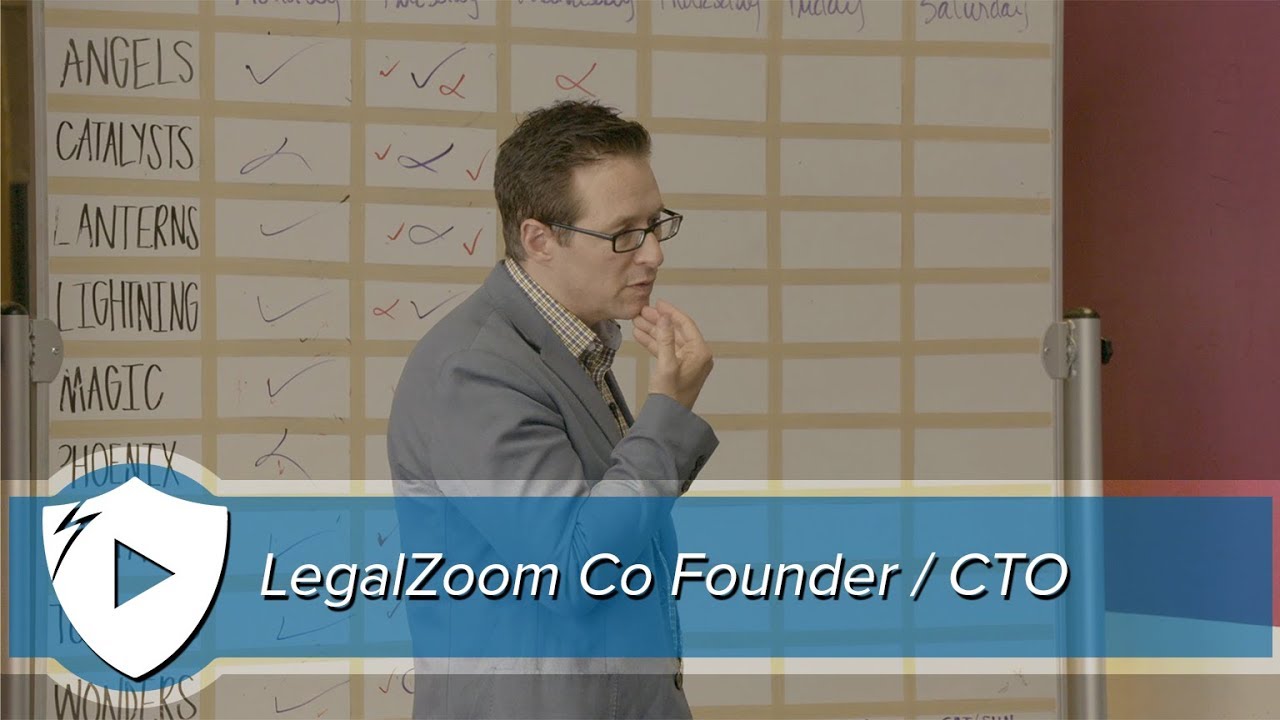
This content was created by Tim Draper. This content was uploaded by Tim Draper. This is a YouTube Q&A titled "Start Up Law - Q&A | LegalZoom CTO Eddie Hartman" (published August 13, 2018). It features LegalZoom CTO Eddie Hartman leading a live audience session where multiple attendees ask questions about startup legal issues, pricing and monetization (especially B2B hotel pricing), product-market-price fit, reasons startups fail (reputational failure, people), entity structure and liability (e.g., LLC vs. corporate structures, Good Samaritan questions), and LegalZoom services and advisory offerings.
Chapters
We should do some quick Q&A because that's it for me, guys. All I want to know is how you are applying this in your own world, how you're thinking about, yes, legal fees, but also monetization yourself. I would love to hear about it. Please tell me.
Hi. So we are currently exactly in the phase where we're trying to figure out what to charge for the product we're going to build. And it's going to be B2B for hotels. And it's kind of difficult because we think that the If we go to the Bay Area and ask hotels how much they would charge, it would be a different metric than what a mid-state hotel would charge.
Sure.
If we are living in the Bay Area.
Right.
So how do you think you can get a working price metric based off what you have? Is it just prediction? Is it gut feeling? What do you think? Is there like— you can look at models existing?
I think many people will do one of two things. They'll look at competitors. Or they'll use their gut feel, and that is a path to very, very low odds of success. I would urge you to find a way to get on the phone with 10 people who actually run hotels. Go to a convention, or I'm not saying lie, but find a way to get on the phone with them if you can. You can even be blunt. You can say, this is what I'm doing. You can offer them a $20 Starbucks gift card, you know, anything. But if you're, if you're actually investing not just your, your money but your time— I mean, there's definitely nothing more precious than these days, weeks, and years that you have right now. If you're investing that and you don't know these people firsthand and you have no way of understanding what they're going to pay you, you owe it to yourself and you owe it to your future to take that additional step, in my opinion. No other questions? I know we ranged over a lot of material.
Hi. Oftentimes, yeah.
Yeah, so lawyers are like business owners. All of you, I'm sure, would prefer not to set a price. You prefer to say something like, well, let's see I'll see what people are willing to pay me for the thing when I release it to market. The problem is, of course, that's way too late. By the time you release it in market, 2 things have happened. One, you can't then— or it's very difficult to go back and change it. And the second thing is, once the price is out, people have an idea of what the price should be. So the right time to do it is early, but no one ever wants to. Usually when I'm called in to engage with consultation, people say, hey, we're about to launch. We're going to launch next week. We just want to know how much to charge for this. It's like, okay. Or I'm talking to a law firm and they just have no idea really how much to discount. They don't know what to do. They know that they're having problems, you know, because all law firms are right now, and they know that people are asking for changes, but they don't know how to implement these changes. So yes, people are very reluctant to talk about price, and I think that's really one of the big drivers on why so many people fail. Hi.
So sometimes I saw Google Inc. on the website, and sometimes I saw Google LLC.
You see Google LLC?
Yes.
That's very interesting. Where are you seeing Google LLC?
YouTube Inc.
I'll look into that. That's very interesting. Google, of course, is no longer Google, right? They're Alphabet, and they have a number of subsidiaries. something might be going on there, but it'd be very unusual to structure something as large as a publicly held company subsidiary as an LLC. I'll look into that. I'll get you an answer.
Hi.
What's the number 2 reason for failure? Reputational failure, typically. You couldn't deliver. You know, you just, you, you, you couldn't deliver, you couldn't sell, you weren't actually Overpromising.
Sorry?
Overpromising.
Overpromising, right. It failed. You had a few potential customers and you failed them, and then your reputation was gone. Number 3 is, of course, people. You didn't get the right people on board. In the pre-Instagram era, everybody would tell you people number 1. Instagram had what, 12 people when they sold for $1 billion? People are incredibly important, but making sure you have product-market-price fit Yes.
Do you have a card or a contact detail we can—
Yeah, no, absolutely. And I think we're giving that out. So yeah, sure. And absolutely, look, this is me on Twitter. If you just— at the bottom there— if you just want to follow me and then we'll DM.
Cool.
Anything else from anybody? One more? Hi.
Hi, so actually I'm a customer of the LegalZoom.
Okay.
And I buy some package and I just don't know like what they use for. So I have some package called Essential Companies Tax Preparation Package.
Okay.
And Advisory Services. I don't know what's the use to.
Well, we can certainly talk about both those, but essentially it's going to be doing the tax prep and things like you'll need certain regulatory requirements cleared. You'll need, for example, a state tax ID in order to pay your taxes and apply for certain things. So, sure, we can talk about it. Great. Yeah, and the advisory service is that idea of being able to talk to people on an ongoing basis. But again, I'm not here to sell LegalZoom. I just wanted to talk to you about law.
Hi. What about public liability And say, for example, the Good Samaritan law. I'm trying to launch a bilingual first aid app.
You're trying to launch— I'm sorry, what?
A bilingual first aid app.
OK.
So people try to use it, and something happens. Say, for example, don't use it correctly or whatnot. Will I be still covered under something like that? Good Samaritan act.
So not a Good Samaritan act, because you're not acting, right? A Good Samaritan act covers you acting or failing to act, right? The idea is that the company is the one doing the acting, and so therefore anyone's recourse is against the company, not against you. Unless, of course, you did something— if you stabbed them while they were trying to use the app, they're coming after you. But if you did not stab them, did not poison them, did not cut the brake line on their trucks or something like that, you didn't hit them over the head with a club, but merely ran a company, the company did the acting, and therefore the company is the one that they would go after. Could they go after you? Well, if you're the whole— if you're the sole owner of the business and all of your money is in the business, they could take all of that, but they can't take any money that isn't the property of the business. So if you funded the business to $100 and you still have another $100, They can't go after $200; they can go after $100. It's the idea. Unless, of course, you did something extraordinarily criminal, you know. Then, of course, they could go after you. I think we're out of questions. Hi.
Yeah, the last one. I absolutely love the way you pitched LegalZoom, how you guys married human capital.
Sure.
How technology does make it more effective.
Thank you.
Less costly, but it's the marriage.
We like to say where life meets legal.
Right.
So how, for those of us who do have hybrid SaaS, figuring out product market fit with pricing is one thing, but making sure that everyone else knows that technology sort of backs it up, how do you go about marrying those 2? Because you clearly have succeeded with that.
We didn't for a long time. Usually when people think, think about, no, not think about you, but think about your mom possibly. If you tried to convince your mom, go to this law firm because they've got great technology, she might say, well, that's, no, I want great lawyers. Go to this accountancy, they've got great technology. No, I need a good accountant. Convincing people of an older generation or people of our generation or your generation that are not as technically fluent, that even in professional services or SaaS or whatever it might be, the technology is really going to help is a challenge. Usually it comes through in the price.
Did you have to sell 2 different stories to investors and to your customers?
No, to investors it was very straightforward. To customers, I would say the story is still evolving, and more and more people are accepting the idea that technology can be part of their legal solution far more than they did in the past. But yeah, I mean, we have a big faith in humans. We have a big faith in things we can see and touch and interact with. And it's always a challenge. Well, thank you everyone for being here today. I really appreciate it. And please, please do get in touch with me. I used to do a radio show in LA for years. And I'd always say, you know, I am a lawyer. I'm not your lawyer. So if you can keep that in mind, I'd be happy to talk to you about any of this stuff. Just let me know. Thank you.