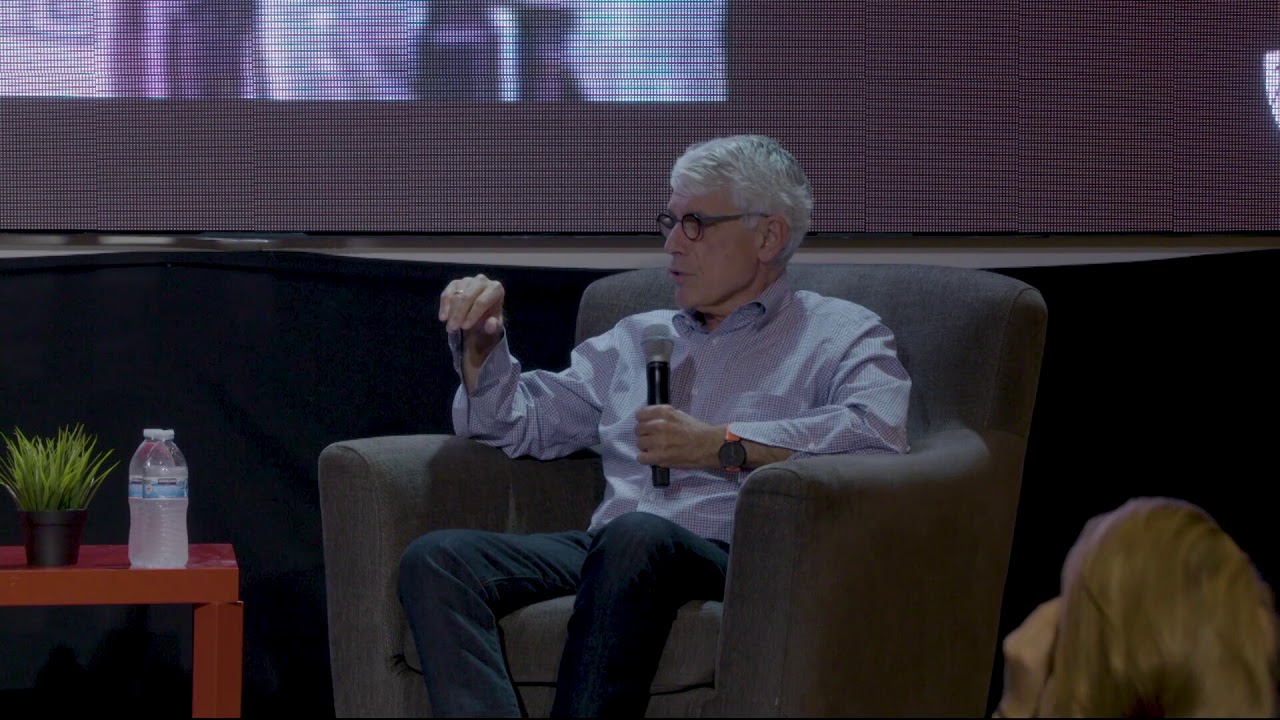
Jerry Baldwin talks about starting Starbucks with complementary co-founders: each put in $1,350 plus a $5,000 bank loan. They learned roasting from Alfred Peet and divided roles as starters, carriers, and finishers to build the business in 1970s Seattle.
Chapters
The business, since we're getting to it. You guys noticed that in, what, I think 1970-ish?
Yeah, that's when we started talking about it.
That there was nowhere to get a good cup of coffee, or Gordon was traveling far to get that good coffee?
Well, that time, it was the beginning of kids born during World War II. almost boomers. But they were coming of college age. It was— and going to Europe, traveling. Icelandicair was one way to get there. You could get there very inexpensively, but you had to spend a night in Reykjavik. In their case, in the early '60s, they both took a boat, Queen Mary or Is that when they fell in love with the strong coffee that they missed? Well, I think Gordon would credit that trip, the Italian part of that trip, to developing a taste for European coffee.
And then when did that taste for European coffee morph into the discussion between you 3, sometimes at loud volumes, into starting a business around it?
Well, we had— I had worked for IBM. I'd worked for Boeing. And the only thing I could say with any certainty was I didn't really want to work for a big company. So I left. Zev taught school. He was tired of that. He'd been a substitute for a while, and he was looking for things. Gordon was already doing a lot of different things.
Yeah.
But we all tried to do other things. Gordon and I and a third guy tried to produce 8 films on American music.
So there was a lot of—
Jazz, blues, so on.
Other failures? Not really failures, but experiments.
Failures? No, please.
Before Starbucks happened?
Unfunded great ideas. Yeah.
I'm very familiar with those.
And Zev and I started a business that had the briefest life to do formatting classical music radio formats. His father was the concertmaster of the Seattle Symphony. So we had classical music connections.
So there was some, a little bit of kind of churning in the '80s.
There were lots of things. Some of them went a little ways. Gordon and Zev wrote screenplays for documentaries, King Screen Productions, and lots of screwing around.
And then when did the Starbucks come into the picture, or the coffee, I guess, as a business?
Well, we were interested in doing other things, obviously. So Gordon proposed the idea of coffee. The 3 of us were there. We liked it. It seemed like a good idea. And our aspiration at that time, really, was to open one store. And, you know, the idea of building a company was just— I mean, I don't think it occurred to very many people at that time anyway. But this is really organic entrepreneurial activity.
And this is in Seattle?
Sorry?
This is in Seattle?
This is in Seattle, right.
And was that over a cup of coffee, or once you have the idea there, How does it become— start to become a reality?
Well, I don't recall. Gordon and I recall it differently. I recall that it was during the summer and we were outside. Zev lived on Puget Sound and, you know, with this not a very wonderful house, but in a wonderful place. And that's where I recall the discussion. But we just started talking about it. Zev was fabulous at research. You know, a friend of mine who worked for Lockheed Shipbuilding in management was introduced to an idea that I've held on to, is that they divided people into 3 categories: starters, carriers, and finishers. Zev was definitely a starter. I am definitely a carrier. You get it going, I'll keep it going. Hmm.
So he started researching Coffee.
We sent him to the Bay Area, went down here. He's the one who found Alfred Peet.
How did he originally find Peet?
Well, he— Which is the last player. Looked at all 2 of the coffee bean roasting businesses at the time. One was— has become Capricorn Coffee, which I believe still exists, and the other was Peet's. And it was clear to Zev, and he was right, that Alfred Peet knew a lot about coffee. He's the one with the credibility, authenticity, knowledge, and if he would agree to supply us.
Yeah, so Zev went over here to the Bay Area to meet him, just on like a cold trip?
Right. Well, so he did this research, came back, reported. We got back in touch with Alfred Peet. And he agreed to supply us. And as part of that, we worked in his store, learned about coffee. Later on, he taught me to roast coffee.
Definitely will come up.
He was a generous mentor. But that, you know, in addition to having complementary skills, hooking up with Alfred Peet, who actually knew what he was doing, mentorship in a way—
Right.
—is the next valuable.
And that just came from a cold— Zev went to the library at that time and looked it up because we didn't have computers.
Well, at that time, I mean, there were no— no, actually librarians, you know, which has turned into information science, were really valuable people. But you would go— I mean, whenever any of us went to another city, we'd go find a telephone book, if any of you have seen any of those, and we'd go to the Yellow Pages and coffee and pull them out and then go visit all the coffee Establishments. You know, this is more true in Europe than the United States because there were very few here. New York, San Francisco, not much else.
And at the time, you guys were thinking that Pete— it was between him and one other guy, and you're thinking that he was the best one?
Well, he had one store. We were all— and he had another one happening here in Menlo Park. That opened in, like, as I recall, 1972.
Yeah.
So it was a pretty small business. I mean, it was really, let's say, an adjustment on existing businesses. But there were— there was one place in Seattle that I can think of where you could buy coffee beans, and actually they were just reprocessed or repackaged beans from a commercial roaster. There's Murchie's in Vancouver, BC. Nothing in Portland, to my knowledge. And then San Francisco.
So now in the timeline, you guys have come together as a group, discussed this coffee, and then Zev went out and found Pete. And now you're going to open up a store. And I'm assuming that needed some sort of capital to get going. Did you guys have something saved up? Or at the time, venture obviously wasn't a super big option.
No, Zev and I borrowed money from our sisters. Gordon had a job.
Generous sisters.
So we each put in $1,350. Sometimes that's described as $1,500, just in round numbers. And then unbelievable— well, and you know, this could never happen now, but one of our other mentors was a an established lawyer in Seattle. And so we had talked to him about our plans, and he called his friend the banker and said, you know, lend these guys some money. And so he lent us $5,000. So we were loaded. I mean, we had almost 10 grand, and that was enough to get going. I mean, what was interesting in that that banking thing is that, you know, it's so different now. But at a certain point, we kept borrowing and borrowing because we kept growing. And the banker said, well, you know, we don't want to lend you any more money because your demands are going to be insatiable. I said, well, you know, later on I said, well, isn't— I thought banks made their money lending money. But, you know, what do I know? So, you know, the lesson for me was always have the next banker The next banking relationship established. So I'd already gone to lunch with the banker at the other bank. So I just called him and boom, the deal was done.
Building those relationships early so when you needed it. Yeah, it's a good lesson. So actually, I did adjustment for inflation earlier, and that would— you would have had to begin Starbucks, I believe, $54,000.
Yeah, today it'd probably take $100,000 in most places. But the barrier to entry is low.