Steve Jurvetson explains how quantum computers scale exponentially, with each added qubit multiplying power. Google, Lockheed Martin, and D-Wave are racing toward 1,000-qubit machines that could outperform classical supercomputers at graph optimization, machine learning, and protein folding. Physicist David Deutsch theorizes quantum computers tap parallel universes for computational resources.
Chapters
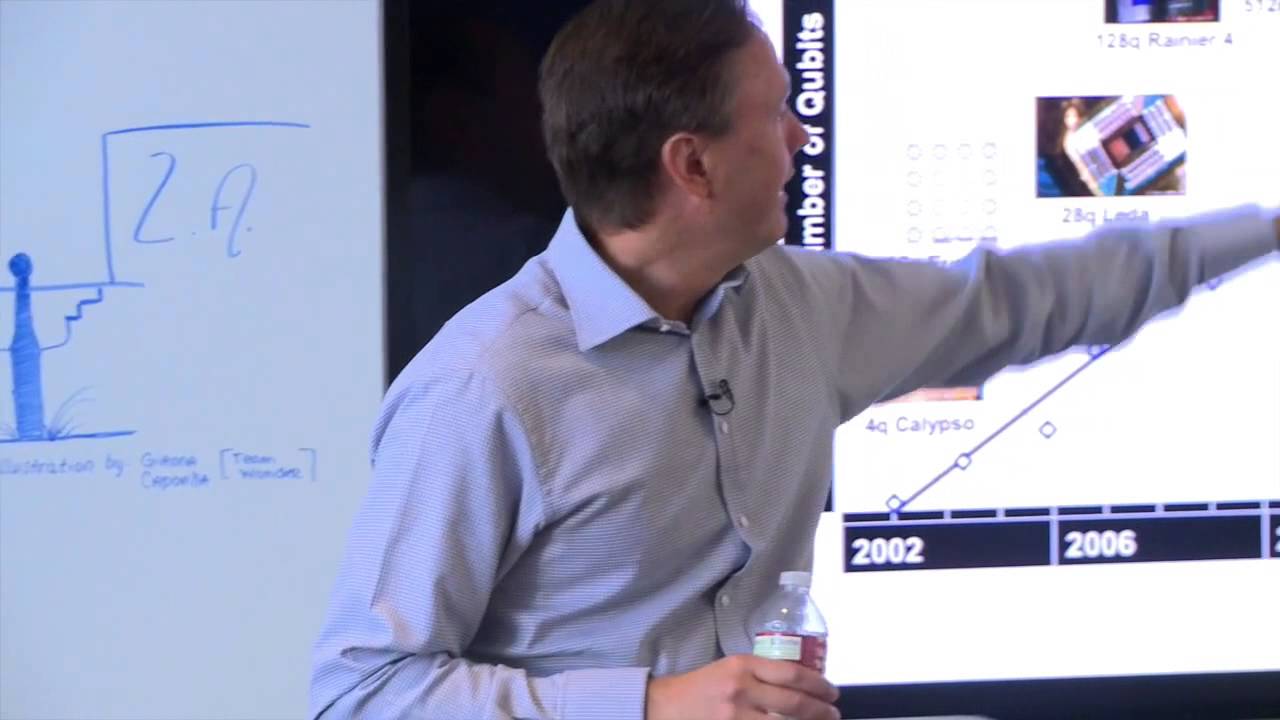
If you think computing is done, there's a really weird experiment going on in quantum computing, which there are, you know, 5 or 6 different efforts that think it's 10 years out, and this one group which says we're ready for primetime and scaling. This weird guy from Canada, Geordie Rose, and Google bought the first one in the Bay Area, and Lockheed Martin in Southern California bought the one before that. But what's astounding is they're applying it to machine learning, which is what Google does across all their new products, and they think it's a path to AI, that this is going to be the best way to do things like image recognition, which they're currently doing, Like, you know, seeing cats on the internet or recognizing cars or recognizing different gestures for Google Glass so that you can be even more weird with your head as you try to use Glass. But more practically, it's going to be just underlies everything that Google is doing. If it seems weird and like autonomous cars under the covers, machine learning and deep learning explains why they're into that industry and they realize they can apply that capability across different sectors. But what gets really weird about quantum computing is if kind of like thinking back to Moore's Law, wrapping this full circle. We first met Geordie Rose and first invested here, he had a 1-qubit machine and he was waiting for the 2-qubit version to come out, but it hadn't yet. Actually, sorry, the 2 would be here and this is, I think, 4 on the log scale. Maybe a 2 on the log scale. Oh, right, that's the 4-qubit there. So the 2-qubit one hadn't come out yet. We invested here and he said, I think it's going to double every year, number of qubits. So again, logarithmic scale, straight line would be an exponential. But when you add qubits, it's very much unlike Moore's Law on that other curve. This is like a Moore's Law on top of Moore's Law. Yeah. It's more like going from a 32-bit architecture in Intel to a 64-bit. It's like a 2 to the n phenomenon, roughly. I mean, there's some derating factors, but it means that it gets pretty, pretty weird pretty quickly, which is if you fast forward a little bit, we currently have machines that they're making that are competitive with classical computers. After all this work, it's finally kind of like a laptop, that big black box you saw. But you fast forward just, you know, a little bit, it becomes faster than all computers on Earth. Now again, they only do one particular type of It's not general purpose computing, but it's graph optimization. It maps to machine learning and Monte Carlo simulations and protein folding and stuff. So it's interesting for supercomputing, but here's where it gets really, really crazy. Go forward just a little bit farther, faster than the universe. Now what the hell does that mean? That means if you took all the matter of the universe and reconstituted it into the best computer that Intel could ever design, giving them the length of the universe to work on the problem, so the best theoretical computer that could be built, and you give that universe-sized computer the length of our universe in terms of history, how many, you know, the 13 billion years that we've been around, it still couldn't solve problems that the quantum computer could solve readily. That's mind-bending. And the only physics explanation for how it works— oh, there was that one for— actually, was that a— oh yeah, it was just David Deutsch saying that summary. is that it basically engages the computational resources of parallel universes. Now that is a point of competitive differentiation you don't often hear in a pitch, to say Intel's just using this inner universe, how could they possibly compete, right? That's where my head explodes, but I think it's pretty exciting if I give it a 10% chance that it doesn't hit some roadblock like noise or something that makes it fall off the rails, and if it just keeps going a couple more, you know, Moore's Law, just a couple more dots on that curve, They currently are bringing up their first 1,000-qubit machine as we speak.