This content was created by Tim Draper. This content was uploaded by Tim Draper. This is a YouTube presentation titled "Steve Jurvetson on Moore's Law & 110 Years of Exponential Computing | Draper University" (published Jan 29, 2015). The excerpt is a lecture by Steve Jurvetson describing the history and interpretation of Moore's Law and a century-long exponential trend in computing price-performance (computational power per $1,000). He references Gordon Moore, Ray Kurzweil, Intel, historical computing machines, and recent semiconductor technologies (e.g., nanoimprint lithography), and frames the trend as a long-term, economy-decoupled increase in human computational capacity. Metadata indicates the video is hosted by Draper University and includes a thumbnail URL.
Chapters
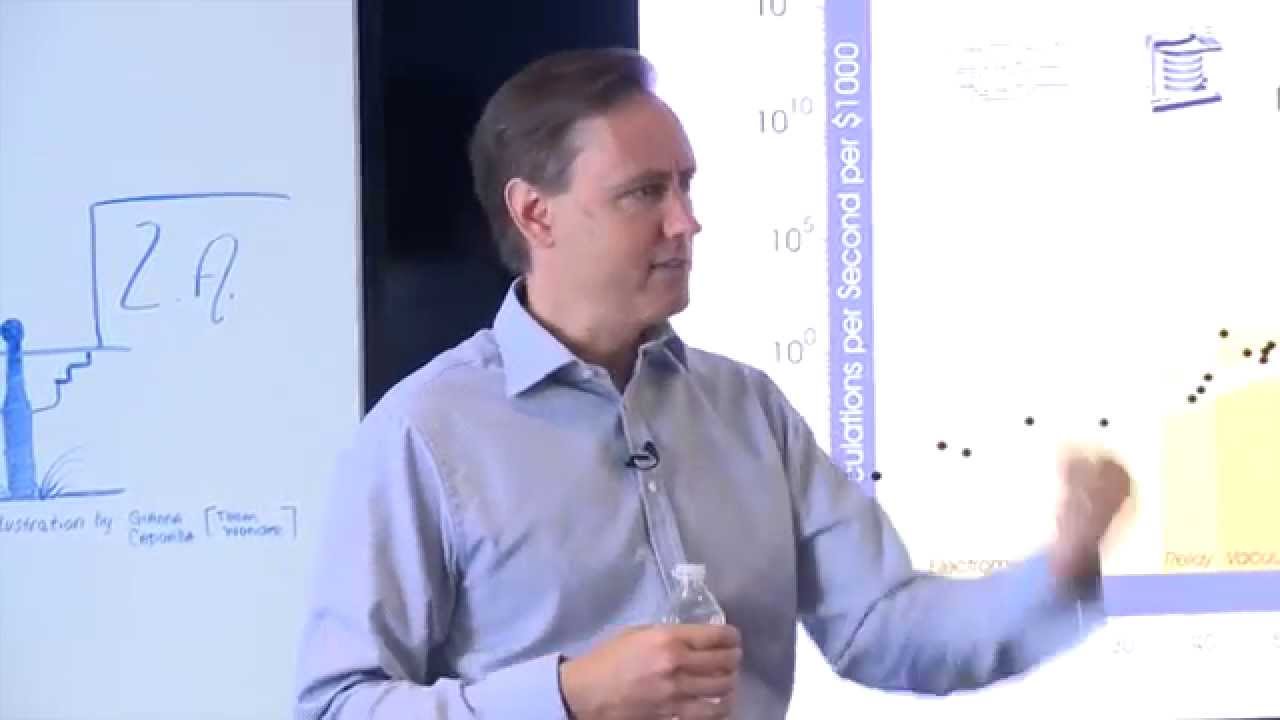
So here's a photo I took of Gordon Moore. He grew up near here, actually right over there in Pescadero, and salmon fishing out here near Half Moon Bay, which he loves. And you've all heard of Moore's Law, right? Everyone's heard of Moore's Law, of course. This is what he actually wrote in 1965. Well, the axis is really geeky. You don't even need to understand this. It's very particular to the semiconductor industry and the sort of optimal number of transistors you'd put on the optimal die size given defect density rates. There was nothing that anybody here would have used as a definition of Moore's Law or anybody in the lay press. But the only reason there is a Moore's Law is that for some strange reason, he just included this dotted line and nowhere in the article explained why he did that. He just said, I got 5 points on a logarithmic scale. They seem to be on a line, so maybe it'll continue out for the next 15 years. No explanation given why it should. And then after the fact, Carver Mead and others called it Moore's Law and explained it as something very unique and particular to the semiconductor industry that because that's where it came from, that says, oh my gosh, this is like the magic of the microcosm. Everything gets better, faster, cheaper, lower power as you shrink it. And therefore, there's something unprecedented in the history of the world going on in this whole semiconductor revolution. And that's what I was taught throughout the '80s and '90s, is that this is something very unique to that industry. And in fact, there are companies we've invested in that are pushing that trend. This is actually the latest wafer using nanoimprint lithography for molecular imprints that Intel's using. with the nice reflection of our president, that's trying to push that traditional Intel-like, Gordon Moore-like framework into the next century. But they admit they're going to hit some problems and there's some issues. But luckily, that's not really what it's all about. I would argue that Moore's Law is, the way everyone knows it today, is a refraction or a reflection of a much longer-term and more important trend. So how many people have seen this version of Moore's Law? I've got to point at this. Why do I even use this? I can just touch this. This version of Moore's Law. It's either Ray Kurzweil— put your hand up if you have seen it— Ray Kurzweil's version or any 100-year version of Moore's Law. About 20%? Oh, no. Hands go up the longer I wait. OK, maybe 30%, 40% of the people. I show this graph no matter what the subject matter because I think it's the most important graph in all of technology business, bar none. I can't think of anything that comes even close. First, it's hard to find anything with predictive power over 100 years in any field. much less in the domain of tumultuous change in semiconductor industry. So let me explain just briefly for the roughly half of the room that haven't seen it. Logarithmic scale, which basically means a straight line is exponential if you plotted it on normal graph paper. And for some reason, no business person uses semi-log paper. And so they always plot them as these knee in the curve, and internet came out of nowhere and exploded on the scene. And that's the way it feels viscerally, but it's not the way scientists will look at it. And what you're plotting here is something that people actually care about, computational power, that $1,000 can buy. So sort of price computation, price performance. You could plot the same thing for storage, like how much digital data can you store for $1,000, and you get an even more compelling curve. Each dot is the best price performance computer of its day. So there are other machines down here that fill the graph, but this is the frontier of humans' capacity to compute across 5 different technology substrates, you know, integrated circuit just being the most recent period of time. Astounding, right? So back in 1890, the machine that took the U.S. Census The relay-based computer that cracked the Nazi Enigma code in World War II, the vacuum tube computer that predicted Eisenhower's win in '56. Nobody knew they were on a curve. It was only around here that people started talking about it and then started to say, well, it's because the semiconductor industry is unique and everyone's planning ahead to fit the forecast, and that's why we have Moore's Law. And Intel would like you to believe that, because otherwise Intel's sort of a bit part in the drama. If Intel is going to be center to the history of humanity, Obviously, it's Intel's hard work that made Moore's Law true. You look at this perspective, you'd say, well, you know, it's nice, but that really isn't the story. The story is what is going on here over 100 years. It's almost cosmological. Why? Why does this happen, right? Decoupled from the economy. World War I, World War II, the Great Depression, no impact on the accumulated capacity to compute or, more metaphorically, the innovation of people at large.