Take Startup Advice with a Grain of Salt | Ubiquity 6 Co-founder Anjney Midha
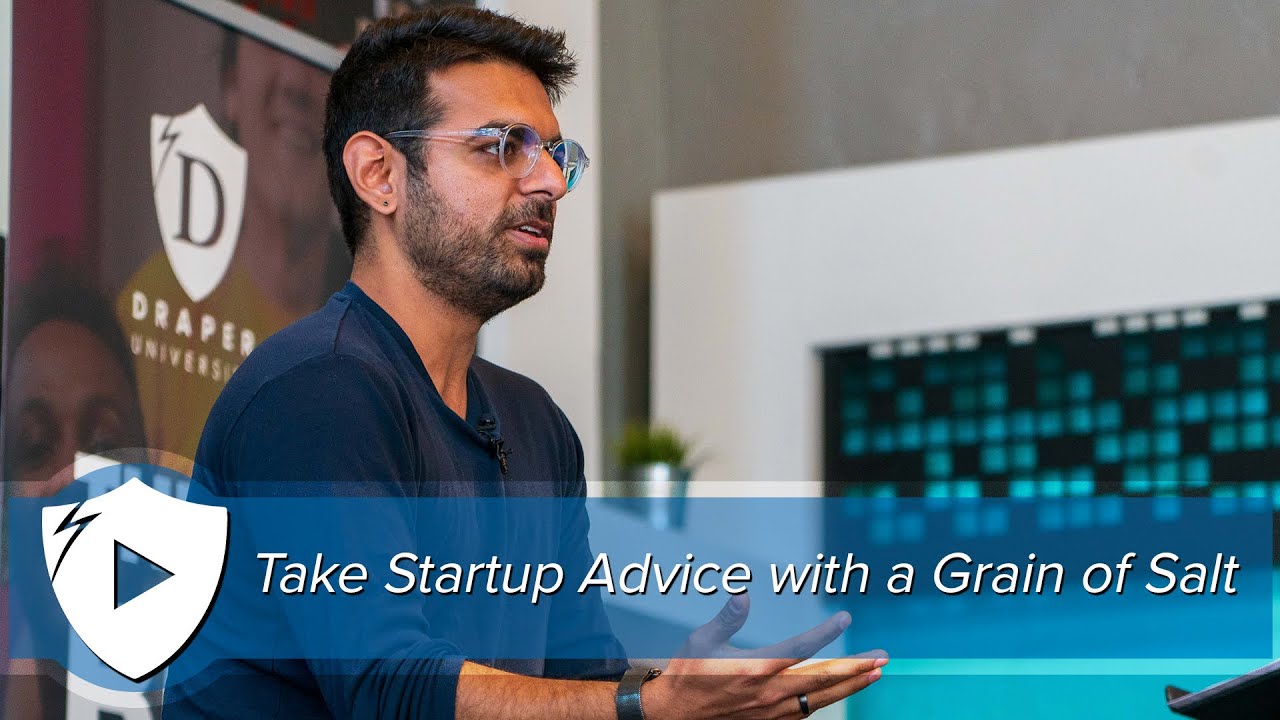
Anjney Midha, Ubiquity 6 co-founder, gives founders three rules: don't wait for external validation, study competitors and move faster, and hire people who've failed before rather than early-career stars.
Chapters
But if you are in your— finding yourself in a situation like bringing a new product to market in AR, VR, crypto, blockchain, AI, then do not tie yourself to somebody else coming in and validating what you're doing. You have to believe in yourself and pretend basically that it's up to you to manufacture your own success. Because if you tie yourself to somebody else, you will find yourself waiting and waiting and waiting for months and months, and you will waste a lot of time that you could otherwise be spending on manufacturing your own success. I've got 3 key takeaways that I would— that I thought might be helpful for you all from the perspective of how I did things as a founder with investing experience. And so what I'm really basically here to tell you is that everything that VCs and investors might tell you as common wisdom is complete garbage. And as a founder, how that it's helped me to know when the most common advice you often hear should be taken with a very heavy pinch of salt. So I'm gonna try to run through these 3 things, and then we'll jump to questions if you have any of those. So the first thing that I think is a mistake that a lot of folks, including myself, make really easily when you're a founder, when you're just 1 or 2 people trying to solve a really big problem, is you tend to fall into this complex I call the savior complex. And you find yourself saying this thing really often, which is, oh, this is great, we've got this great idea, and all we've got to do is go get this one thing to fall into place. All we need is this one investor to write a check. All we need is this one BD partner, this one pilot customer, this one proof of concept, and then everything else will solve itself. And if you find yourself saying that, which almost everyone I know, from the most successful founders to the ones who struggle, everyone falls into this trap early on, you are dead on arrival. So if you find yourself hitching your own fortune to one key event early on in your startup cycle, let's go win this one startup competition, if we could only get into this one program, if we could get this one BD, partner to fall into place. The way to set yourself up for success is to do the opposite. Pretend that that's not going to happen. You have to be the master of your own destiny. And I think this is particularly true— I should caveat all of this. My story is particularly relevant to anybody here working on the cutting edge of any space. This might not be as true if you're working on, let's say, enterprise software where the market is pretty known. The product doesn't need a ton of innovation. And what you might be innovating on is, let's say, distribution or sales. But if you are finding yourself in a situation like bringing a new product to market in AR, VR, crypto, blockchain, AI, pick your buzzword, right? It's the bleeding edge. Then do not tie yourself to somebody else coming in and validating what you're doing. You have to believe in yourself and pretend basically that it's up to you to manufacture your own success. Because if you tie yourself to somebody else, some key event like a startup competition or a pitch or a venture term sheet, you will find yourself waiting and waiting and waiting for months and months. And you will waste a lot of time that you could otherwise be spending on manufacturing your own success. So that's step 1 that I would do differently. And the reason I think this was pretty visceral for me was often when I was an investor, we would have people pitching to us at the seed stage. And they'd say— and we'd pass on them and they'd say, I'm really shocked that you're not investing in us. And I'd say, why are you shocked? They'd say, well, we were told that if you could just get to half a million in ARR, if you could just get to our first 10 pilot customers, that a seed round would be no problem. That if you could get to $1 million in revenue, that of course we could get a Series A. And I'd be like, who told you that? There are no such laws. And often founders would be pretty surprised when they'd say, I've got $1 million in revenue, and you're passing on us for a Series A, and you just wrote a $10 million check to this other company that's just 2 people and an idea. What's going on? Right? And the reality is there are no such rules in the startup world. This is not the SATs. This is not a structured college program, right? You make your own destiny. So you will be setting yourself up for failure if you think there are some magical laws by which investors or BD partners and so on operate. So don't do that. And I can talk more about it if you have questions. I'm happy to go into more detail. But know that the number one predictor of whether you're successful or not is you manufacturing your own success, not assuming that there are some magical laws and expectations that other people will abide by that you have for them, that you may have read on TechCrunch or you may have heard about from a talk like me. I'm actually arguing against myself. Any further advice I give you, Be sure to do— if you fall— if you ever find yourself saying, oh, Anjana said that one thing, so if that one thing lines up for us, we'll be good, that is a key confirmation bias that you should be avoiding as a startup founder. All right, the second thing I would do differently, given that I was a venture capitalist before, is to do the opposite of what most VCs will tell you, which is to ignore your competition. Most investors will tell you, ignore your competition, don't be competitor obsessed, focus on your product, focus on your users. Your users are all that matter. And I think like all extremes, that's really misleading because in a new space like AR and VR and so on, you have very few things going for you. But the one thing you do have is speed. against everybody else you're competing with. So instead, my advice is to actually think exactly like your competition, is to mind meld from a Jedi standpoint as your biggest competitors. And then ask yourself, what do they have to build to win in this space? Take that list of things they have to build and figure out which things you can build faster. Because you're 2 people and you've got 80-hour weeks you can work for, and you don't have to convince some VP inside your company that this is worth pursuing and then go get board approval and so on. Speed is your number one advantage. So instead, if you think like your competition and you ask yourself, what did they have to do that I can do faster, then you will ruthlessly prioritize your roadmap as a startup founder to be tuned towards your strengths, which is the only way you're going to win. Instead, if you start focusing on your users, what I often find is your users are going to tell you the same thing they're telling your competitors. And your competitors might just be better equipped to solve those problems for them because they've got more resources. Right? Okay. That's the second thing. It's pretty counterintuitive, but it was pretty— it was definitely eye-opening for me how many folks even on our own team that we hired would challenge this wisdom. They'd be like, Why are we thinking about how this really big company in this, in the AR space is going to be attacking this problem when we should be talking to our users? Well, because we're not gonna win against those folks unless we ask what can we do better than them? What is on their roadmap that they will take years to get to that we could do right now? All right, the last thing that I think is pretty counterintuitive that VCs tend to lead people like us on to think is good is that hiring celebrities onto your team as early as possible is a good thing. Oh, you're a 2-person founding team, but if you could just land this amazing VP of biz dev from Google or hire this star celebrity from Facebook, then you'll look more legit, more credible. That is completely false. In fact, what you want to do is hire people who have failed as quickly as possible. Because when you get people who have failed on your team but are smart, are motivated and talented, and might have failed for reasons outside their control, they are far more resilient and useful in helping you get your— I'm assuming you're going from zero to launch, right, as founders. For that phase of your life, find team members who don't have celebrity pasts and are used to being sheltered. Within the confines of really successful companies. Instead, find people who've actually had to hustle on the street. And there's tons of them, especially in the Bay Area. So while you're here, you know, get out, go to networking events, meet people. There's tons of people who have tried and they failed for reasons outside their control, but that doesn't mean they're not talented. And resist the urge to try to go talk to, you know, the first 10 people who worked at Instagram and Facebook who might like lend you an air of credibility. Because most of those folks actually don't understand how lucky they were, and they often mistake their company's success for being at the right place at the right time for their own talent. And this is coming from somebody who invested in a lot of early founders who came with that pedigree but failed miserably because they just didn't know what failure was like and what hustling meant.
More from Tim


He Sold His Car to Build This Startup, Then Pitched It for $1M 😳 #Startups #AI

This Startup Moves Your Crypto BEFORE Hackers Can Steal It 😳 #Crypto #Cybersecurity




15 Months Without Refrigeration?! This Startup Thinks It Can Go Global 🥥 #FoodTech #Startups



