Tech Development & Funding | Jetlore Founder & CEO Eldar Sadikov
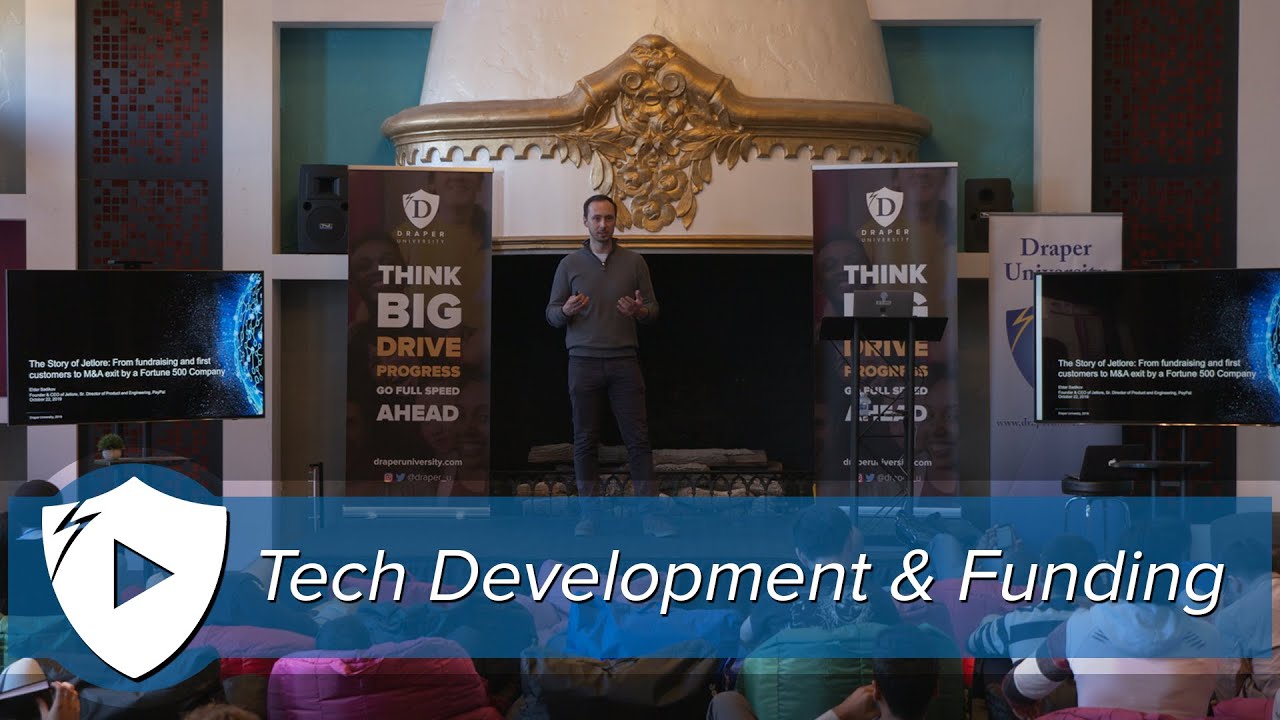
Eldar Sadikov founded Jetlore in 2011 with a failed Q&A product, pivoted to B2B, and raised $1.3M in seed funding. He built an NLP engine that landed enterprise customers like Uniqlo and eBay, earned Gartner Cool Vendor status in 2016, and sold the company in 2018.
Chapters
When we started this company in 2011, like I said, we had no idea. I mean, none of us started a business before. None of us raised money before. None of us built a B2B company before. And we just were people that were fascinated with a specific concept in mind. And that concept was actually— sounded very cool. Like, I was so convinced that this is going to work. This is the idea. So anyways, So what is Jetlore? You know, probably most of you have never heard of Jetlore because, and you know, it would be weird if you've actually heard because first of all, it's a B2B company. It works with other businesses. It's not a consumer brand. Second of all, it's, it's not a big company, but it's, you know, I think like any B2B company, you're proud of the customers that you work with, and we're very lucky to work with some of the top ecommerce companies in the world, and specifically Uniqlo, eBay, Nordstrom are some of the customers that we work with and privileged to work with. We've also been recognized externally. Before we got acquired, we, we got recognized by Gartner as one of the cool vendors of 2016, and also have been recognized by San Francisco Business Times in 2017, I think it was, as one of the top 100. I think we're number— I can't remember— top 20 fastest growing business in the Bay Area, essentially. They look at the growth in the past like 2 years or something like that, and based on your revenue growth, that's how they decide whether you're one of the fastest businesses. Now, let me tell you a little bit. Let me take you through the journey. The company was founded in 2011. We actually were just a bunch of tech geeks. We had no idea what it's like to build a company. I had, like I said, before we started this business, I had an iPhone app that I launched and, you know, when the App Store was not as competitive and yeah, it had a few million downloads, a few million users, but, you know, I didn't really have any clue on how to build a business, to be honest with you. And maybe because, you know, you know, you kind of, when you're so young and so foolish, maybe it helps you. It helps you to be naive. And I think that because nowadays, if I was, if I had, you know, if I had the, you know, if I was in the same position now, I would have not probably started a company with so little validation and so little information. But I was at the time was very foolish and we were foolish as founders and we started this company. And I'll tell you what the concept was. And we raised actually seed money with that idea, with that concept, with no consumers, no customers, nothing like that. Based, based on the idea and prototype that we built, and based on the profile of founders and the team that we had, we raised $1.3 million seed money, which nowadays doesn't sound like a lot because seed rounds became enormous nowadays. But We again got lucky. I think, you know, one of the, one of the things you're going to hear from me today is, is, you know, we were lucky in many ways. You have to be lucky because that's the only way you can, you know, not the only way, but that's one of the key ingredients of success. You got to get lucky. You got to get certain breaks. And that was one of the breaks. Then we also were lucky later on that we, we followed this with a Series A round of funding. And I'll tell you a little bit about how we raised and what we had by then. And then we got our first clients in 2014. We raised more money and more money, and eventually we got to about 30 enterprise customers in 2016. We had a pretty successful 2017 as well, and just kind of ramping up revenue and And eventually in 2018, we got acquired essentially. And I'll tell you a little bit about the thought process that took place when we decided to go for that acquisition. So that just gives you the timeline. So I'm gonna walk through each stage of this journey. So don't feel like I'm kind of skipping parts, you know, to explain how this all went down. So in the beginning, like I said, I call it the struggle. So I kind of broke this whole story into chapters. And, and, you know, that's the way I want to tell you. And this chapter I want to call The Struggle, which is when we started this company in 2011, like I said, we had no idea. I mean, none of us started the business before. None of us raised money before. None of us built a B2B company before. And, and we just were people that were fascinated with a specific concept in mind. And, and that concept was actually sounded very cool. Like I was so convinced that this is gonna work. This is the idea. The concept was that we wanted to build a Q&A engine where you would pose a question in natural language and then you would connect. And again, remember this was 2011 before pre-Facebook IPO when social media was super hot. Social networks were becoming very popular. And the concept was that you connect to your social network, Facebook, Twitter, LinkedIn at the time, and then the system would analyze the content of your question, analyze everything that it knows about your friends, and then suggest to you who in your social network would be able to answer the question that you're posing to the system. So imagine I could say, I'd like to find a dentist. Um, and, you know, that's a simple question. And then the system would analyze and then try to find who might be able to, to provide an answer to you. You could say things like, I want to take my kid to, uh, uh, daycare, and I need to know who, you know, where would be a good— which daycare would be great in San Mateo, for example. Anything like that. You could say, I'm looking for a plumber. You know, any, anything like that. Any question you're going to pose, we're going to extract certain concepts out of that. Okay. Out of that question and then try to match you to people. It was actually a cool concept. We were convinced that it's going to work because we thought search is big, and if we can find a way to basically do people-based search, it will be huge because that would, you know, the natural models to monetize would be very easy. Turned out that it didn't work, and the reason it didn't work is because people did not feel comfortable coming from outside that have never seen, uh, that have never seen, and the company was called Quisper at the time. So this, this was actually the, you know, the, the name sounds weird now, especially for B2B companies, but we thought it's a, it's a, it's a catchy consumer, uh, consumer name. Um, um, and so the, the reason why it didn't work is because people would come to the system and they would be like, what is this system Quisper and why should I, plugging my social credentials into it and then I don't trust it and like, is this really my friend that's asking that question and why wouldn't he email me to ask that question? And those are all the things that were going through their head and there was so much mistrust that we couldn't bootstrap it essentially. But as part of this exercise, we built a pretty cool NLP engine that was basically analyzing uh, short text like questions and was able to extract, um, salient terms, uh, whether it's a dentist or it's a, uh, plumbing or, you know, whatever that might be. And, and, and basically pick up those salient terms and figure out what that question was roughly about, at least based on the high-level semantics. And so we co— we showed this, uh, technology to, uh, uh, to a few investors and, um, Not like we took it, we didn't take it on a full rodeo to all the VC firms, but we were mostly looking at angels and maybe a couple of VC firms. And, um, and we quickly, you know, got a lot of traction. It wasn't, it didn't happen right away, but we got a couple of key investors. Thank you. And then they got interested and they said, okay, I'll write a check. You know, I'll invest in this company. I don't know what you're going to do with this technology, but it sounds very cool. A bunch of Stanford PhDs, like they know what they're doing. domain experts, technology seems to work, let's give them money. That's, that's what happened in 2011. And that's how we got our seed money. But seed money doesn't take you— the lesson here is that if you take that seed money, you have to be very clear on where you're going to take it. And one of the— when the consumer concept failed, we kind of struggled. Like, what are we going to do? Like, how can we like, Okay, so like we have the money, we have some runway, and it wasn't a big team. It was like maybe, I can't remember now, maybe 7 people at the time working. But like, okay, it's gonna last us, maybe we can stretch it to like, I don't know, 18 months or maybe 12 to 18 months. But like, where do we take it? So,
More from Tim


He Sold His Car to Build This Startup, Then Pitched It for $1M 😳 #Startups #AI

This Startup Moves Your Crypto BEFORE Hackers Can Steal It 😳 #Crypto #Cybersecurity




15 Months Without Refrigeration?! This Startup Thinks It Can Go Global 🥥 #FoodTech #Startups



