The Age of Convergence | Frugal Innovation Author Navi Radjou
In this talk, Navi Radjou presents frugal innovation as a catalyst for the emerging "age of convergence," where solutions for low‑resource contexts become globally relevant. He showcases concrete low‑cost technologies—CellScope (smartphone otoscope), G‑Drive soil sensors, a digital radiator that harvests server heat, and a prepaid‑card banking system for the unbanked—illustrating how affordable, high‑impact products can address pressing problems in healthcare, agriculture, energy, and finance. Radjou then highlights university‑driven programs that train a new breed of engineers and entrepreneurs to think frugally, including Stanford’s Entrepreneurial Design for Extreme Affordability, Manu Prakash’s 50‑cent foldable microscope, the Tata Center for Technology Design, Santa Clara’s Frugal Innovation Lab, and a France‑based student documentary project. He argues that today’s younger generation is inherently frugal, prefers on‑demand access over ownership, and is motivated to create purpose‑driven ventures. The talk introduces the circular economy—designing products for material recovery and reuse—as a massive market opportunity, and stresses the convergence of first‑world and third‑world challenges (e.g., water scarcity, chronic disease) that demand borderless collaboration. Radjou concludes with a call for “enlightened entrepreneurs” who combine compassion with innovation to build a sustainable, inclusive global economy.
Chapters
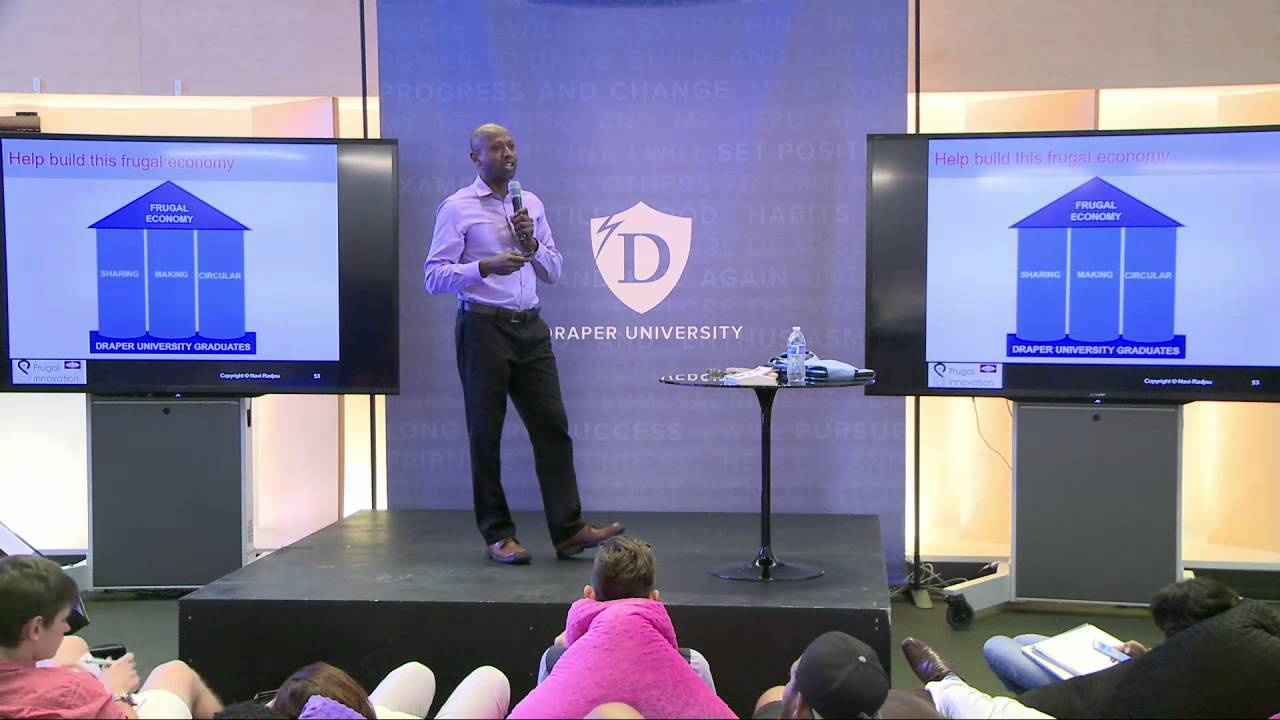
So I want to kind of quickly close with some actual examples of entrepreneurs. Maybe some of you will join this list of, you know, young people who are leading this frugal revolution in the West by actually taking advantage of the fact that some of these building blocks, as I said, are becoming more affordable. And you have these venues like TechShop and Fab Labs where you can actually prototype things in a cheaper way and faster way. And they now are using these solutions to start— I don't like the term disrupting, but let's say bring more value at lower cost in very important sectors like farming, healthcare, education, etc. So let's look at some of them. This is CellScope. You might have heard about them. This is a spinoff of Berkeley University. They invented this attachment, accessory to your cell phone that converts it into an otoscope, so a mother can insert that into daughter's ear and see if there's an ear infection. Saves the mother both in time and money as well, right? Instead of going physically to see a doctor. And down the road, they could replace that accessory with another accessory that can convert the smartphone into a dermoscope as well, so you can check skin conditions as well. So that's in the healthcare sector. This is my neighbor who invented this. It's called G-Drive. These are actually wireless sensors. Designed like a plastic ruler that a farmer can stick in different parts of the field and you start collecting detailed data on soil conditions, humidity, and salinity of the soil, which enables essentially the farmers to reduce use of water, fertilizer, and energy while improving the crop quality and the yield as well. Okay? So again, as I said, this is the kind of solution we desperately need in California given, you know, the water shortage. And the solution pays for itself within 11 to 13 months, okay? And farmers, trust me, they are a very tough bunch of customers to convince. But if you can convince one farmer, that's viral marketing. They become your best friend. So they spent 5 years just going one pilot after pilot to one other pilot. Now they have conducted about 20 pilot projects. And these farmers, if you go to the website, offer, you know, glowing testimonials which are becoming the, you know, the marketing, you know, material. to go convince other farmers. So this is the kind of solution I, you know, to be blunt, excites me personally because, you know, there's a real need, you know, right? I mean, water scarcity, you know, we're going to all face it in this state. And so helping farmers, which is maybe like not a sexy industry, but yet, as I say, you know, you can live without iPhone for probably several weeks, but without food and water, you die within 3 to 5 days, right? So we always have to think about the basics and think about, you know, how to use technology, you know, to address things like, you know, food shortage. This is in the computing sector, another great example. Today, 2% of the global electricity consumption is used in data centers, right? The big stuff that Google, Facebook operate. And out of the 2%, 1% is used to cool off the servers that overheat. So we use 1% to heat the servers first, then 1.4% to cool them down, which is a kind of aberration. So Paul Benoit, who is an engineer in France, came up with this very interesting idea, which is a digital radiator. And essentially what it does is that it actually takes the same idea of centralized processing and distributes that across multiple computers. And these computers actually happen to be processors that are embedded in a radiator. So the system actually collects the heat generated by the processors to then heat houses and offices for free. And the money they get is paid by the people who need high-end computation power for scientific calculations and things like that. So this is a very clever way, essentially, in order to reuse heat, which engineers think is a waste that you need to get rid of. So the idea, again, going back to the first slide I said, Think about wasting nothing, right? How do you reuse every type of waste you can find and turn it into gold, right? Like an alchemist. And this is called circular economy that we'll talk about later as well, which is going to be a huge idea with a huge market potential as well coming behind it. And then finally, in the financial service sector, I told you about millions of people being unbanked. So in France also, this is an entrepreneur who launched this system which enables any low-income person to walk into a mom-and-pop store and in 5 minutes activate the system that gives them 2 products, a prepaid debit card and then a bank account so they can send and receive money as well, which is hard to get in traditional banks because they always look at how much you earn in order to open an account. Here, no questions asked. And they actually charge a flat fee of €20, which is nothing compared to, you know, the hefty banking fees that big banks charge. So that's for entrepreneurs. Then to conclude, I'd like to kind of talk about how universities— and hopefully Draper is part of this list of universities when I come back to present next year— who are actually leading this frugal innovation by actually training a new breed of entrepreneurs, engineers, scientists who think in a frugal way. This is in Stanford. This product actually comes from students who took this class that is 10, 11 years old now in Stanford. It's called the Entrepreneurial Design for Extreme Affordability. And it's a multidisciplinary program where students from business school, engineering school, law school come together to co-create solutions that are extremely affordable. Like, for example, 1% of the cost of existing solutions, right? So they are tackling big issues in energy, health, transportation, with this kind of multidisciplinary approach. This is actually a professor from Stanford, Manu Prakash, who has been promoting this idea of frugal science I talked about earlier. He came up with, for example, a 50-cent microscope, which is like origami that can be folded like paper. 50,000 beta users are testing it right now. And what is amazing is that this microscope, foldable microscope, was initially developed to diagnose diseases in poor countries. But interestingly, it is now being hacked, or, you know, hacked in a way, to be used as a scientific tool, because a microscope is the basis for scientific experimentation. So you have 50,000 citizen scientists around the world who are using this low-cost microscope to conduct scientific experimentation. This is at MIT. There is a big project that was funded by the Tata Group, which is India's leading industrial firm. It's called the Tata Center for Technology Design. It's the same idea, which is to say, instead of learning engineering in a classroom, a boring classroom, we send you to India or Africa, spend 6 months to identify the nails in those markets, then you come back, develop a hammer, right? Don't start developing hammer first, then look for nails. Go identify the nails first, then develop the hammer. Okay? And the hammer has to be very cost-effective, frugal, because they can't afford it otherwise back, you know, in those regions, right? So this is a program that has been 5 years old. Very interesting solutions they've been developing as well to deal with people, you know, who are amputated and, you know, issues in agriculture, energy, and urbanization, etc., in developing countries. This is close to us in Santa Clara University. For the last 4 years, they've been running something called the Frugal Innovation Lab, which also trains engineers to come up with these frugal solutions that are going to be affordable, simple, sustainable, and still of good quality for emerging markets. And emerging markets don't have to be in Africa or in India. There are emerging markets right here at home. So they also deal with things like homeless people and figure out how to use mobile phone to give them the right information for finding a shelter or even some jobs potentially for them. So this is very close to us here in Silicon Valley, which is also focusing on building a new generation of engineers. This is another program in France which I am mentoring. This is actually 3 students in farming sector. They're going to crisscross around the world to actually document using small films these frugal solutions in the area of food and water and how essentially entrepreneurs around the world are able to find better ways to grow food using fewer resources. So this is actually now a growing movement happening as well around the world. So to conclude and then maybe have a Q&A with you as well, a couple of messages for you if I may. I think you are the frugal generation. When I talk about this, you know, to people above 40, you know, it's a new concept for them. But you are going to be the frugal generation, as you can see from some of the statistics, right? I mean, you are very frugal in terms of, you know, looking for the, you know, the cheapest whenever possible, are very cost-conscious, like me actually. Second point, you know, you don't want to own products, but you want to have access to a product on demand as a service. You are going to be the on-demand generation, right? You are not anti-consumerist. You just want to have flexibility, right, in having access to what you want, when you want it, at the price you want, which is very different, flexible generation, right? And then the third one is that many of you, like, that's why you're here, want to be an entrepreneur. You know, when I was your age, the only thing I wanted is have a safe, stable job, right? You are not that generation, right? So clearly, I think that, you know, the frugality is kind of baked in into your DNA, which is advantage. So I think you are going to be the best positioned to actually help build what I call this frugal economy. So I talked about the 2 dimensions, as you know. I talked about the sharing. I talked about the making. But I want to add this 3rd pillar, which is not well known yet in the United States, but I think within 3 years it's going to explode as an idea. It's huge in Europe, huge. China has created a big policy around this. So it's called circle economy. So what is circle economy is that if you look at the way products are designed today, right? You essentially extract raw materials, you design iPhone, use it for 2 years, and then you get rid of it. It goes in some landfill, you know, probably in Africa, which is the world capital for e-waste, electronic waste. What if you come up with a new way of designing products So that essentially at the end of the use, not life cycle, you can actually recover the materials inside and reuse it again and again. So this is things like Levi Strauss, which is now making jeans using recycled plastic bottles and using much less water. And the list goes on. This is going to be momentous because the World Economic Forum estimates that if you adopt these principles of circular economy, you can actually create a new value of $1 trillion in the global economy. And if you want to learn more about it, there is a TED Talk by Ellen MacArthur, who is a British sailor who conceptualized this notion of circular economy. It just went live. I want you to take a look at it. This is very important. For example, in this country, only 20% of food waste is recycled. Imagine what happens if you start— you know, this is a very wasteful nation, as you know. Imagine we can recover everything, right? Every waste possible and turn it into value. This is called the circular economy. There's immense entrepreneurial opportunities in this space. So think about that as well. And I really invite you to debunk this article that came out in Mercury News by Michelle Quinn, who essentially— I really invite you to read this article, which was for me, it really touched my heart. Essentially, she complains the fact that it is not for San Mateo, it's not in San Francisco, but she said that at least in San Francisco, a lot of the tech firms are focused on solving problems for the first world elite without really dealing with basic problems that we face, both in emerging markets but even right here back at home. So I think she's on something, and I really invite you to think about the fact that there are emerging markets, as I said, right here in mature economies. For example, the 50 million poor people I said in Europe collectively represent a 220 million— sorry, it's actually billion, I should have changed it— 220 billion euro market. So there is a market to be tapped into, it's just that existing products and services are not designed to address their needs, right? Similarly, the 70 million underbanked I talked about in America, They have a disposable income of $1 trillion, $1 trillion. And the products today are not designed to serve that market yet, right? So think about also right now, how can you adapt your business model to come up with these frugal solutions to tap the needs of these people? But beyond that, I have been preaching this idea of convergence, which is that, you know, we talk about first world, third world. I really hate that term. You know, I'm Indian, I'm French, I'm American, so for me, I don't really understand what it means. Which part of me is first world? Which part of me is third world? I really don't know. So because what I see is, I call it convergence. All the problems we felt belong to the first world, the rich world's problem, are now appearing in the third world, and the third world problems are appearing in the first world. For example, water, right? This is something I grew up, as I said, when I was in India, a poor country. But now we begin to face it right here in the lands of the richest GDP per capita region, right? California. So you begin to see that, you know, problems have no borders. So solutions also, right, shouldn't have any borders, right? So this is happening in water. Look at the other way around. If you look at diseases, like chronic diseases like diabetes, cardiovascular, these are called the rich man's diseases, but the real people who are going to be affected by it more and more are going to be in emerging markets. 2/3 of the deaths in India by 2030 will be caused by chronic diseases. So you can see that how suddenly if you create a solution to deal with these issues, you have suddenly a global market. You don't have anymore a market in the West and a market in the South. So think about also essentially how you can create these frugal solutions that have global relevance. And the way to do that, I think, is to collaborate. And in the room itself, I heard there are many nationalities. And probably you all come from the dots you see in the map. So think about also, while you are spending time together, not each of you creating your own solution in isolation, but actually how do you put your brains together to co-create these frugal solutions that could be relevant both for somebody, one of you who may live in California, And someone else would be living in China or in India. Because I do think that in the age of convergence, these kind of frugal solutions will have a global impact. And then finally, this is being Indian, I have to talk about the chakras, which are the energy centers we have in our bodies. And I really encourage you to think about becoming what I call enlightened entrepreneurs, because all of you, you have a lot of creativity, I can see in your eyes. But also try to tap into your heart because heart is not just about the seat of passion, it's also the seat of compassion. Essentially, like, you know, have empathy for those who are not lucky enough to make it into this classroom or even worse, who maybe, you know, people who don't have the kind of, you know, enough income to feed their families, you know, for the next few days. So, use that compassion to turn into a passion to find some purpose in life which will be essentially not just to become the next, you know, billionaire, but actually do something, you know, that is quite meaningful, you know, for the world. With that, you can find more about this notion of frugal innovation in a website we set up where we have a lot of case studies and examples and best practices as well. So thank you very much for your attention. Thank you.
More from Tim


He Sold His Car to Build This Startup, Then Pitched It for $1M 😳 #Startups #AI

This Startup Moves Your Crypto BEFORE Hackers Can Steal It 😳 #Crypto #Cybersecurity




15 Months Without Refrigeration?! This Startup Thinks It Can Go Global 🥥 #FoodTech #Startups



