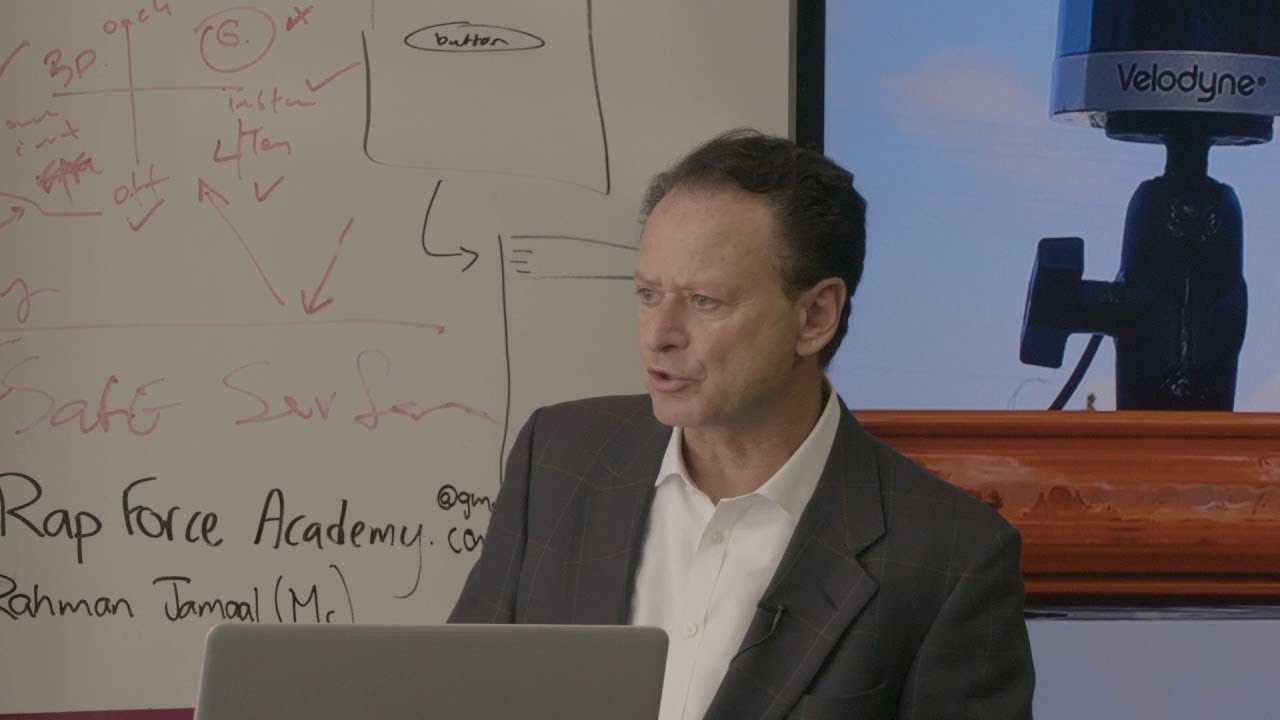
This content was created by Tim Draper. This content was uploaded by Tim Draper. This is a YouTube presentation titled "The First Self Driving Delivery Vehicle | udelv CEO Daniel Laury" (published/recorded Aug 6, 2018). The excerpt is a talk by Daniel Laury, founder/CEO of UDelv, describing the origin of the company, the end-to-end autonomous delivery vehicle and technology stack, operational challenges (power/boot management, routing, loading/docking, and first/last-100-feet behaviors), deployment results (over 300 deliveries in ~2.5 months around San Mateo/Burlingame with 9 customers), market opportunity (last-mile cost and scale), and envisioned future vehicle versions (larger highway-capable platform and a minimal pod-based design). The only other audio in the excerpt is brief, unidentified interjections labeled "SPEAKER B." This is a recorded presentation/demonstration rather than a multi-person conversational transcript.
Chapters
I'm going to introduce you to this company that I created called UDelv that is the first self-driving vehicle ever built on public— for public roads and for delivery. So the origin of the company was research for an investment thesis that I did for my fund on autonomous driving. And I happened to realize that no one was working on delivery and that it was an area that would perhaps make it easier for autonomous driving. We started with an exceptional team foundation. My co-founder and CTO is a former Tesla engineer and Apple engineer. He was the 4th employee in the Autopilot team at Tesla. And we started with exploration of concepts like this one, which you will see soon in the streets. In the street, it's— yes, exactly. And so this is a video of this vehicle. Making an automated delivery.
Drawn in. The world seems small. We can sit together. It's so beautiful. You and me. Meant to be.
The UDelv technology that we created is an end-to-end solution. So what we built is not just A vehicle that is capable of autonomous driving, but we built a solution that is capable of making a delivery. And that implies a lot of things beyond autonomous driving. If you think about it, it means that the machine has to wake up in the morning by itself. It has to be able to gauge its gas level or its battery level. It has to be able to recharge, or it has to be able to go to a gas station. It has to be able to go by itself to a loading zone or a merchant area. Has to be able to tell the merchant how to load stuff, then has to be able to go to customers through an optimized route, and it has to be able to go back to parking at night and turn off the computer by itself. Those are very, very complicated steps. Even booting up a computer remotely in a vehicle has not been done except on Teslas. So, so these are— it implies completely revisiting the power electronics architecture of the vehicle It implies creating a cargo space that is made for automated deliveries. It implies having a stack of technology that enables all those different steps. And I'm not going to go too much into the details of that, but if you have questions, I'll be happy to answer them. But this is what we've built at the company in order to get that vehicle to be able to go on the streets. We also put special emphasis on what we call the first and last 100 feet delivery-specific behaviors. Because this is, contrary to passenger cars, this is an industry where the vehicle needs to be able to maneuver in parking lots, complicated situations, in backing up on driveways by itself. Docking at the back of a Safeway store or a Walmart to load. And so those are areas that may not be necessarily 3D mapped in the US. And so we developed a stack of artificial intelligence that enables us to maneuver at slow speeds with no need for a map. Or park 15 feet away from a curb. find a spot in a parking place and park the vehicle by itself. We've got an unmatched experience. Well, first of all, we're the world's— this is the world's first self-delivery, self-driving delivery vehicle enabled on public roads. But it's also the world's first that has customers, that has made deliveries. We've completed more than 300 deliveries in the last 2.5 months in this area, in the San Mateo area and the Burlingame area, with 9 customers and have a ton of prospects in the pipeline. A lot of the largest retailers in the world have contacted us to get the technology. It's an industry that's ripe for disruption because 75% of the cost of last-mile delivery is the driver and the fuel. So if we can replace that with a vehicle and potentially an electric battery, we are going to be saving a ton of money for the industry. It's also a very, very large industry— 54 million last-mile delivery vehicles in the world, 6 million in the US, and last year 12 billion packages being shipped in the United States. And finally, I want to show you what the future looks like. So I wouldn't show that to a lot of people, but because you're a student in this university, you want to show what the future is going to look like. This is our first version of the vehicle. It's a vehicle that was limited to 25 miles an hour and 3,000 pounds in gross weight. This is done for hyperlocal last-mile delivery within a, say, a radius of maybe 10 miles around a store. The next platform will be a bigger vehicle that's gonna go up to 60 miles an hour, be able to go on highways, and be able to have an unlimited range. And it's gonna look something like this. And still a shape that is well known to you guys because it still has a cab. So that's going to be the version 2 of the UDel Future. The version 3— of the UDel future, if you think about it, an autonomous delivery vehicle can be something extremely simple that we have not seen before. It doesn't need a cab. It doesn't need seats. It doesn't need seat belts. It doesn't need air conditioning. It doesn't need airbags. It doesn't need anything. It will be a powertrain with 4 wheels on top of which we're going to put a swappable pod. And that has— that will be short, medium, and long haul. And that's what the future of the delivery industry is probably going to be. So I want to leave you with those thoughts. And thank you very much for listening.