The Future of Money Starts With Stablecoins | World Liberty Financial | Crypto Megan Podcast
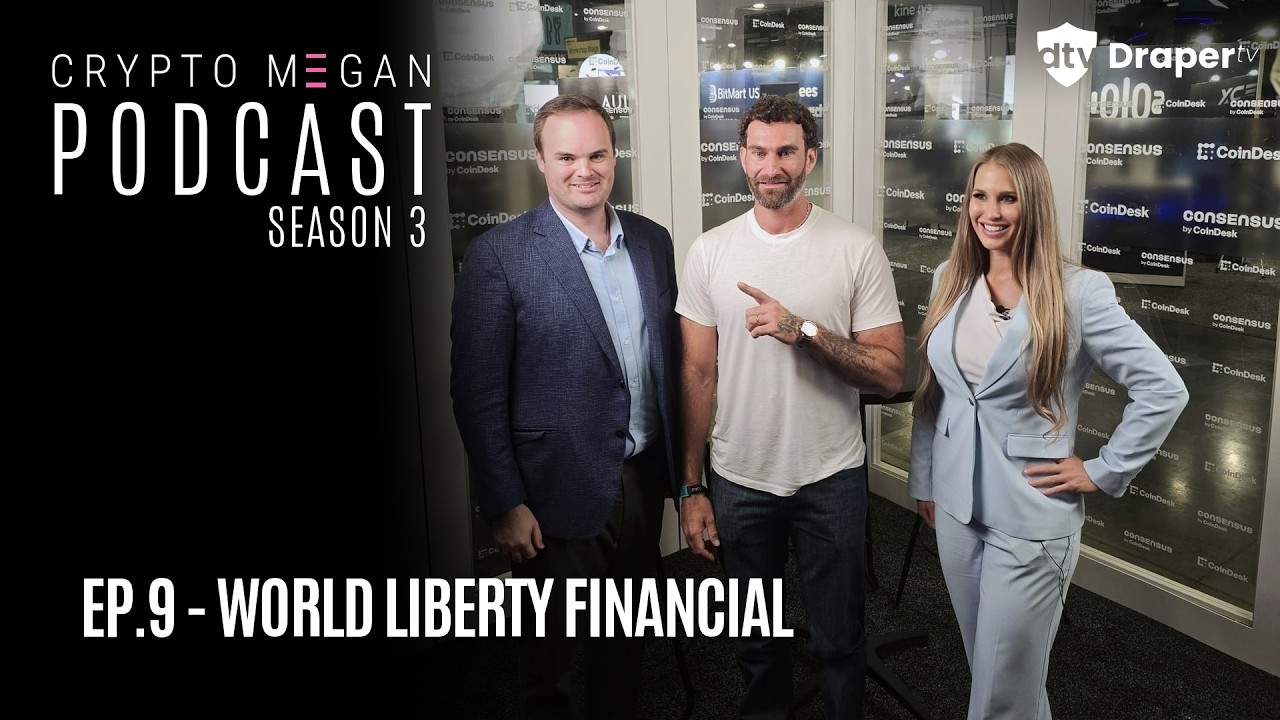
In this Crypto Megan podcast episode recorded at Consensus in Miami, host Megan Nielsen interviews Zach Folkman, co‑founder of World Liberty Financial (WLF), and Eric Hageman, COO and defamation lawyer for WLF. The conversation covers the origin story of WLF as a bridge between traditional finance and crypto, the rapid growth and compliance features of its USD‑1 stablecoin (including a $4.5 billion market cap, Genius compliance, an OCC charter pursuit, and Chainlink proof‑of‑reserves), and the company’s mission to simplify DeFi for mainstream users. They discuss tokenizing real‑world assets, highlighting a partnership with DAR Global and the Trump Organization to tokenize the Trump Maldives development, and assert that all asset classes will eventually move on‑chain. The interview addresses criticism that WLF’s visibility stems from its political connections, countering that product superiority and compliance drive adoption. The discussion shifts to a defamation lawsuit filed against Justin Sun, emphasizing transparency, the on‑chain evidence, and concerns about media bias. Finally, they explore the emerging “agentic economy,” describing AI agents that require a stablecoin for transactions, the AgentPay SDK, and WLF’s positioning of USD‑1 as the preferred token for AI agents. They close with a forward‑looking vision of accelerated blockchain adoption, faster financial cycles, and a more productive, equitable global economy.
Chapters
All right. I'm your host, Megan Nielsen, a.k.a. Crypto Megan. I'm here today to discuss a very interesting topic with the co-founder of World Liberty Financial, Zach Folkman, as well as the COO and the World LibertyFi defamation lawyer, Eric Hageman. Welcome to the show.
Thanks for having us.
How has it been? What's the sensation here on the floor here at Consensus in Miami?
I mean, we love Consensus. Michael and the team do an amazing job producing every event that they do. Absolutely. And I think given that Token2049 this year in Dubai got canceled, the turnout's been incredible. Everyone who was planning on going to Dubai from Asia, Middle East, Europe all came over here. So the turnout's been amazing, right?
Yeah, it's been a lot of energy. There's sort of this undercurrent of this momentum happening despite, you know, the fluctuation in Bitcoin and the volatility. And it's just been incredible to see traditional finance being bridged into this world in such an impactful and important So we just had a— you just had a panel, World LibertyFi, with Donald Trump Jr. and some of the people on the team. What were the sensations from that?
Yeah, I mean, the room was absolutely packed. Zach and Don, the other Zach, my co-founder Zach Wyckoff, they got a lot of applause because at the end of the day, you know, World Liberty Financial has shipped incredible products. We continue to ship incredible products. And I think it really resonates with the audience here and in general in crypto.
Right. So talk to us quickly, for those that aren't familiar, what the origin story was and why World Liberty Financial came to be.
Yeah, I think Don did a really good job of explaining that. You know, they come from a traditional finance world. They're all hard asset guys, and they woke up one day and they were completely debanked by the traditional system. And they realized, hey, if this can happen to us, it could happen to anybody.
Right.
And so that was really the genesis. You know, they asked like, What can we do to basically fix this system? And we had some ideas. They loved it. We have a great relationship with them. And, you know, they trusted us to be the stewards of this company. And they've been incredible partners and they've been alongside us the entire way. It was really cool hearing Don talk about what we're doing in Agentic Payments. And yeah, there's a lot more to come.
That's really fascinating about the Agentic Payments. We'll get there. But I want to actually ask a few questions about the stablecoin. Yeah, right. And how much of a revolution that's been. I know Donald Trump Jr. has spoken a lot about the use of stablecoins and efficiencies and just sort of democratizing the space. So talk to us about your stablecoin.
Yeah. So our stablecoin USD One was launched a little over a year ago. Today we're sitting at a $4.5 billion market cap. We're the fastest growing stablecoin of all time. We're fully Genius compliant. We applied for an OCC charter to be a limited trust company to be able to issue USD-1 ourselves. And, you know, if you look at our competitors, we're the 3rd largest right now. But if you look at our competitors, it took them 3.5 years and 5 years respectively to reach a $2 billion market cap. We've managed to hit a $4.5 billion market cap in a little over a year.
That's massive.
And I think it speaks both to what our team has been able to do, but also the industry as a whole and the adoption of this technology.
Oh, absolutely. Absolutely. And sort of being the bridge essentially between Web2 and Web3, which is one of the goals of World Liberty Financial, correct? And having people introduced to this space in this way, it's been really interesting. What would you say is the main kind of misconception about DeFi out there?
The main misconception about DeFi. I think the main misconception about DeFi is that it's difficult or it's scary when the reality is that It's no different than what's already done in traditional markets. It's just that it's more user-directed. And unfortunately, the technology that has existed until, you know, today and even today, right, has been a little clunky and it's difficult for that Web2 user to be comfortable with it. So one of our biggest goals at World Liberty Financial is stripping away that complexity and making it safer and more available. And more user-friendly.
Right. Yeah. And so we're going to talk about like this. You've got to have this certain trust in this trustless system, right, in order to make that first leap into this space. And you guys have done a great job at sort of bridging that gap. How would you say when— if a critic were to say, well, because of the family name, this is why you're getting more recognition versus the incredible system that you've built, right? When people say that, oh, that's why it's getting so much attention, when actually there's a huge revolution happening here. How would you answer that?
Well, I think at the end of the day, it's not the best product that wins. It's the best product that people know about that wins. And so we've done an incredible job building fantastic products. USD One is a Genius-compliant stablecoin. We focus heavily on KYC, AML, and compliance. And we're the first and only stablecoin to include Chainlink proof of reserves so that not only can you see the underlying assets that back USD One, through monthly attestation reports that we publish on our website. But anybody who wants to can go and look on-chain at any given moment and be able to see real time what those proof of reserves are. So we really have built a better product than what's out there, at least we believe so. And obviously having an amazing partnership with the Trumps has given us that platform to be able to go out and broadcast it to the world. So we have a better product and it's a better product that people know about.
And they know about it because of the name and because of the impact that they're having in the world. And that is actually an attribute that's positive. It's a positive thing in this case to get more eyes on it. And that would be sort of the pushback, right? No, actually, we're getting out there in a big way and we're getting known because of this as well. So it's a wonderful thing to get out there in the masses.
Absolutely.
Yeah. So I'm a big fan of just everything happening and all the innovation in this space. And you talked a little bit about tokenization. today in the panel as well, apart from the agentic economy, which I do want a quick comment on. But what do you think, like, what do you think is the industry most ripe for disruption?
In terms of tokenization, I don't think there's one industry. I think that we're actually going to see all assets end up on-chain eventually. I mean, we've already seen it with stocks. New York Stock Exchange is going to be issuing native, you know, on-chain stocks and securities. We're going to see Following that, I mean, we already have real estate like World Liberty Financial. We announced a partnership with DAR Global and the Trump Org.
Oh, DAR Global. Wow. Yeah. Fantastic.
Yeah. We're doing a project with them to tokenize the Trump Maldives development. So now—
Fantastic company. Yeah. I've had experience with them in Dubai as well. So yeah.
Yeah. No, they're an incredible team. They're very forward-thinking and, you know, they're developers, but they understand that the future is on-chain. And, you know, we've had an amazing partnership with them. And, you know, between real estate, between stock, between securities, I think it's only a matter of time between hedge funds and everything else that exists today in the financial ecosystem is just going to move on-chain because it's better, faster, more compliant, cheaper, and broader access to people that previously haven't had access to those products. You know, previously.
Right. It becomes more equitable, more accessible. You know, previously only institutional investors have had access to these tools. And when you talk a lot about, I know, Donald Trump Jr. talks a lot about freedom, you know, for American people and for people, global citizens, right? And this is sort of that entry point.
Exactly.
And the beginning of that.
Exactly.
And there, so a lot of people think, oh, was this built to replace traditional financial, the traditional financial system that seems to be crumbling around us? Or is it just a parallel rail? What would you say?
I don't think it's built to replace it. And I don't think it's a parallel rail. I think it's going to be a convergence of everything. And I think this is just what the future is going to look like, the same way, you know, debit cards and credit cards evolved from a checkbook. And before that, it was cash settlement. I mean, things evolve, you know?
Right. Yeah. No, it's really been really fun to see, having been part of this space for so long. And now we're here. The institutions have clearly arrived, as you can see here at Consensus. Galaxy has one of the biggest booths and you've got all of the institutional players here. It's very fun to see the bridging of those 2 worlds. So, Eric, I wanted to segue over to you for a minute. Speaking of trust and, you know, the blockchain, this industry has been through so much. We've had so many ups and downs. We've been through so much turmoil and so many different disputes. And now we're here. You guys are actually settling something now and you've filed a complaint with Justin Sun. Walk us through a little bit what's happening there.
Yeah. So as you mentioned, on Monday morning, we filed a lawsuit against Justin Sun. The reason that we did that goes all the way back to what you were saying about John's and Zach Witkoff's words this morning. World Liberty's mission is incredibly patriotic. It's incredibly important. And that means that we have a unique responsibility to protect our community members, to protect our token holders, to protect our employees. And because of that, when we are subject to defamatory attacks—
Right.
And when those attacks start to bear consequences, then we're left with no other choice than to file lawsuits. World Liberty does not want to sue anyone. This was not our goal. Our goal is to stop the defamatory statements and to protect ourselves and those that are holding the view.
Right. I actually admired the level of transparency that was on X. I believe you guys posted the entire complaint there and went through all of the different allegations and things like that. So the process has been pretty transparent about what you're doing.
We have absolutely nothing to hide. And I should say too, it's definitely Defamation lawyer, if you have something to hide, do not file a defamation complaint. Because when you file a defamation complaint, you have to prove that what's in the complaint is actually true. And if if you can't do that, and you know that you can't do that upfront, then you don't file the complaint in the first place. And so the fact that we have a complaint on the docket and that we're very confident in it, say a lot about you know what remains to be proven out.
Right. And can you comment a little bit on the specifics that Justin Sun? had, had claimed. Now, we won't get into that. I know a lot of people are curious. Maybe we'll get to hear more about that later.
Well, what I, what I can say is that I'm extremely confident in the strength of our claims. I think we have the documentation and the logic and the law on our side. And I look forward to a swift resolution of this.
In a world where—
I add something to this. Please kick me under the table if you don't like it. But yeah, the reality is, is that the things that he alleged, you know, typically You know, when you have 2 parties fighting, right, there's side A, there's side B, and then usually the truth is somewhere in between.
Absolutely.
This is, in my opinion, and I'm guessing in, you know, in Eric's opinion, not the case here because this is unique, because everything is all on-chain, right? Everything that just—
You've got receipts.
Exactly. And it's not just for us to know and someone else to find out. Anybody who wants to know or wants to look can take the time and they can go and they can see what he said, and then see on-chain the evidence that is publicly displayed from the beginning. So I believe one of the things that Justin alleged was that we secretly did some backdoor something or other to freeze his tokens.
Right.
That's not accurate. The reality is, and Justin knows this because Justin is a savvy, smart crypto investor and entrepreneur, anybody who wants to know anything about a smart contract can go on the public blockchain and look at the contract. It's right there.
Right.
If you want to see if there's a freeze functionality, It's in there. If you want to see whatever that contract is capable of doing, it's all there published for everybody to see. Is that okay?
Okay. No, I absolutely agree with that. But that is the nature of blockchain. I mean, the transparency is there, the receipts are there. You can go back, you can check what happened. The terms and conditions are all there. So also, it was just alleged that Justin Sun violated some of the investor, you know, terms in that. And so we'll dig deeper into that when you guys can comment more on it. But the fact of the matter is that we've seen is that you've published the public complaint on your X. You've gone through every single allegation and responded to it. And that seems to be the only way to, to function in this space, right? The only way to handle things.
Yeah, we have nothing to hide. You know, World Liberty is an incredibly transparent organization. It's no surprise to me as their lawyer that they wanted this complaint published and that they wanted it out there in an incredibly transparent way.
One thing I do find interesting is I believe you commented on the X post that The New York Times Originally was reporting on Justin Sun's SEC filings and the alleged claims against him from the SEC and the fraud that was going on, alleged fraud, right? And then suddenly they turned and then reported the opposite about World Liberty Financial. So is there some sort of bias happening here?
I mean, I think the reality is that the mainstream media, they have their own agenda, and whenever something suits their purpose, They don't care what the reality is. They don't care what the truth is. They take something that sounds like a salacious headline and they run with it. And the reality is, is in crypto, we're held to a different standard because of who our partners are. And we understand that. And it's, you know, it's just the reality. We don't complain about it. We just continue to build world-class products and ship them and deliver on the promises that we made when we set out to found this company.
I like that. We look forward to staying updated on the case. And thank you so much for being here and updating us on that. But as we wrap this up, I'd just like to end on a note about the agentic economy. I mean, that has been everything that I've been hearing at this conference from so many founders across the board, that there will be more AI agents than humans, billions of AI agents. So what are you guys having a look at within that sector?
Well, I mean, I have 3 kids and I have about 30 agents. So, you know, if you look at it like that, you know, it's just, it's just natural that this is going to be the way that things move. It creates massive efficiency in every single sector of the economy, even in people's personal life.
Right.
And the reality is, is that these agents need a way to transact both with each other, with businesses, with customers, with vendors, etc. And a stablecoin is really the only true way for them to be able to fulfill that need of transacting.
Right.
And so we believe that USD-1 is positioned and going to be the stablecoin of choice for the agentic economy. We believe so much that we have an entire division of our company that's focused on building infrastructure around that. We've joined the X402 Foundation. We've shipped our AgentPay SDK, which is an agentic payment SDK for any agent to be able to use, spin up USD-1 wallets, set parameters around the transaction limits and destination addresses, etc. And as a result, we've seen many other AI companies have started to gravitate towards and choose USD-1 and AgentPay SDK as the foundation for their products. And We think it's going to continue to grow as this takes off more and more.
Yeah, it's a very fascinating topic. I think a lot of people out there, the average user, the average— this is a very traditional financial channel too. They, they're just trying to get their heads around what agents are. And so we're used to maybe the traditional world talking to Siri and having Siri help them with certain things, right? So can you break down like what do your AI agents do for you?
Oh, they do everything. Everything from research to development to marketing to pro— I mean, literally everything.
Right.
Anything that you would want to do in your business, you can have a specific agent that does that. So for people, you know, at home and listening around the world, whatever function that happens in your day-to-day life or in your business, or if you're not a business owner and you're an employee, in your role as that employee, you can have agents that perform a very specific task. They can all be put together and orchestrated to work cohesively. And make you more efficient and have better leverage and speed and, you know, across anything that you would want to do in life.
Right. And it's astounding. It's as if the blockchain, the whole blockchain economy was built for this, pretty much for this purpose, and to tokenize everything because that's how the agents interact through the tokenization on-chain, right? So this is like the inevitable future where we're headed. Sounds like World Liberty Financial is prepared for that future. Very much. And on that note, the final question then. So As we imagine a future where World Liberty succeeds at scale, what changes would you see in the world, want to see in the world in 5 years? What would that look like?
I mean, I think we're already seeing it. I mean, if you look at the way AI has taken off in the last few years, but even more in the last year alone, we're going to see things start iterating much quicker. Cycles are going to be compressed down from months or years into days and weeks.
Right.
And I think it's really difficult based on where we are right now to even predict what 5 years is going to look like when, you know, a company like Anthropic ships an update that changes everything and then they do that again, you know, 4 weeks later.
Yeah.
So I think we're going to see speed of adoption of blockchain technology massively, massively accelerate as agents take off. We're going to see adoption of blockchain technology for, you know, real-world assets or tokenized assets, as people realize that they need better and faster ways to be able to transact and want to do it 24/7 as opposed to when traditional markets are open, right? As companies realize that there's more efficiency and there's more cost savings and more speed to doing things like title registration on-chain. I mean, the list just keeps going on and on.
So the fraud that happens in— if you're talking about real estate now, The title fraud that happens because it's not on-chain. I mean, there's so much of that out in the world, and that improves the efficiencies you're speaking of in just so many ways. So the average person who's listening, I hope what you take away from this is that the world is evolving into a much easier place to exist in, and we're going to have one of the most productive societies in human history.
I think without a doubt.
Due to all these technologies converging, right?
Absolutely.
So thank you guys so much for being here. Zach, Eric, it's been a real pleasure, and we hope to have you on again soon.
Thanks for having us.
Thank you.
More from Tim


He Sold His Car to Build This Startup, Then Pitched It for $1M 😳 #Startups #AI

This Startup Moves Your Crypto BEFORE Hackers Can Steal It 😳 #Crypto #Cybersecurity




15 Months Without Refrigeration?! This Startup Thinks It Can Go Global 🥥 #FoodTech #Startups



