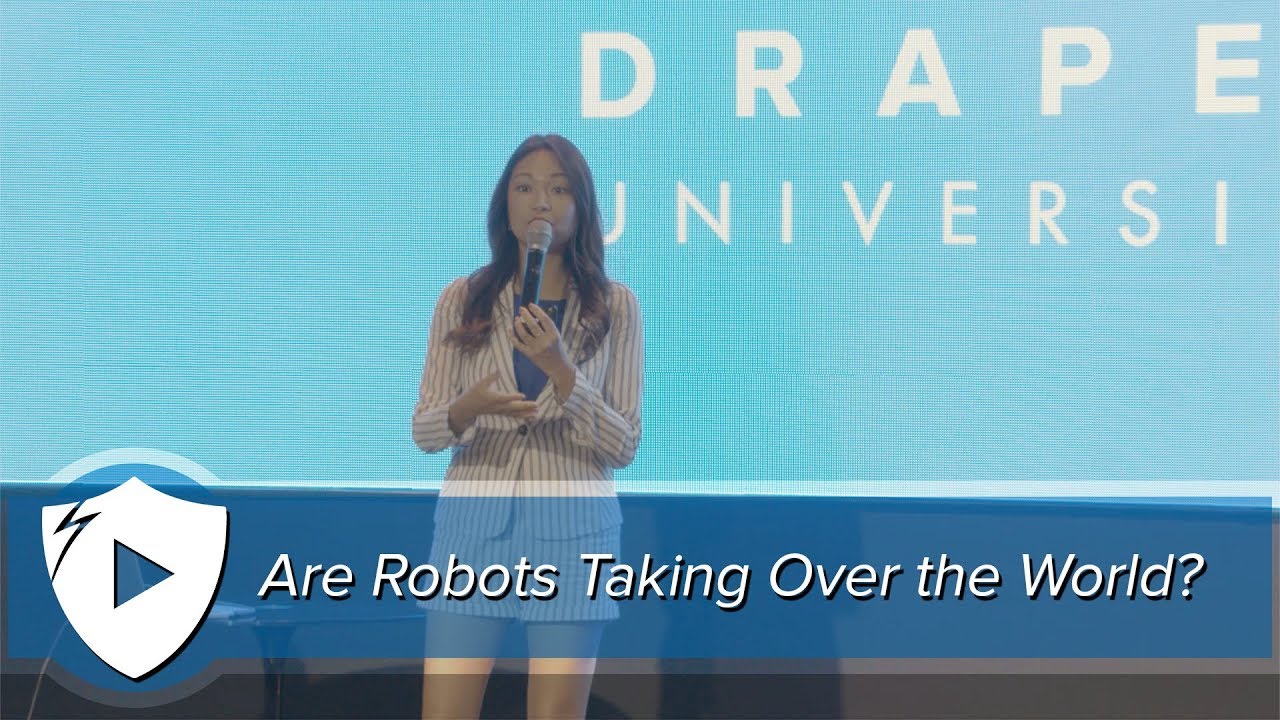
Lisa Yu, CEO of OfficeBook, argues that automation and AI will displace many jobs, making human skills like empathy and communication more valuable. She discusses retraining, education policy, and universal basic income as potential responses to workforce disruption.
Chapters
Yeah.
Okay guys, let's all sit down and listen to this. All right. Okay, so as entrepreneurs, you know, when your company grows up, you know, you will need to have an office, right? And it's hard to find an office around here because all the leases are just, you know, long-term leases, and you need something to just make it easier for you. Lisa, the brilliant person right here, she founded Officebook, and through that, as she's going to talk about later on, You can find these— it's literally like Airbnb for office spaces. Besides that, Lisa is a great program manager. She was called the dream product manager on her LinkedIn account, which I was very impressed. And she also managed programs with Microsoft and Whole Foods Market. So without further ado, let's just say, you rock, to her and get us started. 1, 2, 3.
You rock!
Thank you.
It's such a joy to speak to the fresh batch of entrepreneurs, especially those who are dreamers and builders and movers and shakers, people like me. I imagine being in your shoes years ago. And today I wanted to share with you about the future of work, because there are a lot of people who are thinking about, okay, are robots going to take over the world? How are we going to enter into this new wave of automation, machine learning, and AI? And then I will also be just really sharing with you some tools that you can use as a solo entrepreneur, but as you grow into a team builder, there are some really useful tools on your journey. So are robots taking the world? What do you think?
Yes.
It's gonna be a little bit of interactive session.
Yes.
Okay, so the answer is yes. So I wanted to give you some background on automation. So 40% of today's US workforce is now contingent, meaning they're not full-time. You've got Uber, Lyft, TaskRabbit, Fiverr. These are contract workers that kind of come as needed. Increasingly, you're seeing automation with autonomous cars and trucks, packaging, delivery, and autonomous manufacturing. Right here is a machine on the floor of Amazon doing sorting, picking up stock units, and getting ready to be delivered to your doorstep. Even in technology, you see auto builders. You have these website builders that will just spin up a website for you instantly. You have logo generators. You just type in your word and what you like, some themes, and it'll just generate a logo for you in a matter of seconds. And then now you're even seeing mobile app developers and where they can just kind of clone designs and kind of spin up a prototype for you really quickly. So right now, today, nearly half of jobs are vulnerable to automation. And so that might feel bleak, but if you think about the other side, this actually frees up people to pursue more interesting careers. Who wants to do data entry 8 hours a day? No one. So I wanted to talk about AI and machine learning. Obviously, as you've seen, the wave of artificial intelligence is taking over mundane tasks like voice recognition with Alexa and Echo. You have photo recognition with Facebook and Snapchat. You have sensor technology that can detect your fingerprint. and your presence with beaming. Then you have data and machine learning, deep neural networks starting to become more intelligent than humans. And we predict that in the next 20 years, 47% of jobs will disappear. However, new jobs will get created in its place. Human skills will become more important, traits like empathy. Listening, communication, prioritization. These are the skills of the future. And in order to stay relevant, we have to learn new tools, and we have to continue to reinvent ourselves as the job landscape changes around us. Here's a chart that shows the automation of jobs and the risks of it being automated. So in descending order, food preparation, construction, cleaning, driving, agricultural labor, garment manufacturing, personal service, sales, customer service, business administration, information technology, science and engineering, healthcare, hospitality, retail management, upper management, politics, and teaching. So if any of you are in food preparation or construction, you're in trouble. Might want to consider some of the other industries that are less prone to automation. So I wanted to switch gears and talk about why do we work? What motivates us to work? As you're embarking on your journey of creating the next wave of apps and products and services, why do we do what we do? And just really just take some time to really think about what motivates you. So first, there's the personal impact. Why do we work? Is it for financial freedom? Is it for the challenge? Is it for the joy of it? Is it the team and the people we're working with? There are many reasons. And as you really think about it, how does work fit into our lives? I think it's really important to, at this stage, really decide what's important to you. Because when you embark and dive into a startup and go into the entrepreneurial journey, sometimes you can really lose some of the values and the things that you really treasure in your life. And it's also really important to know How does it contribute to your career growth? As you are either joining a startup or starting a startup, how is that going to impact your current goals and your future goals? And like we talked about, staying relevant, how do we stay current in our skills? As technology changes so rapidly, how can we be open to learning and having this mindset of continuous learning? And is what you're doing giving you meaning and purpose? You know, that's something that a lot of times we get so busy we don't even think about it. But it's really just, you know, are you going to be waking up being excited and, and have joy in what you're doing? Um, second, it's the organizational impact. You think about what type of job do I want to pursue? What type of industries do I want to work in? Do I want to disrupt an industry? Do I want to contribute to a new industry? Or do I want to improve a current industry that's broken? And really think about what roles do people versus machines play? Like we talked about, are robots taking the world? Well, how can we be the ones that are programming the robots to make our lives easier? How can we make them do the mundane tasks so that we can pursue the more interesting challenges? And how do we leverage contingent workers? 40% of today's US workforce is contingent. How do we create a platform that includes them and welcomes them and still helps you grow as a company? And how do you refine jobs as software and automation becomes more powerful? Obviously, our job requirements will change, our job descriptions will change. Instead of being the code monkey, you might be the person that builds the bots, the scripts that automates the tasks. So those are some of the examples of how the organization can change as the team structure changes. And I also want us to think about the societal impact. What are we contributing and bringing to society? How do we educate and prepare people for work? Obviously, education is broken. There's so many improvements that can be made. And how do we transition people when job changes? So for example, when truck drivers get replaced by autonomous trucks and semi, how do we make sure that they get trained so that they can still live?
fulfilling lives.
And how do we support politics? When we think about minimum wage, immigration, work standards, how do we support politics so that those standards are maintained? And as we're building our companies, how do we fix economic problems like income inequality, gender discrimination, unemployment? As we embark on this journey, we're stimulating the economy, creating new jobs. And so there's a lot of ways that we can do that, but how do we make sure that we do it in a way that's fair and equal? And there's also this burning question, should we adopt a basic universal income as robots are taking the world? How do we think about how do we support our workforce so that they can live meaningful lives that contributes to society? Thank you.