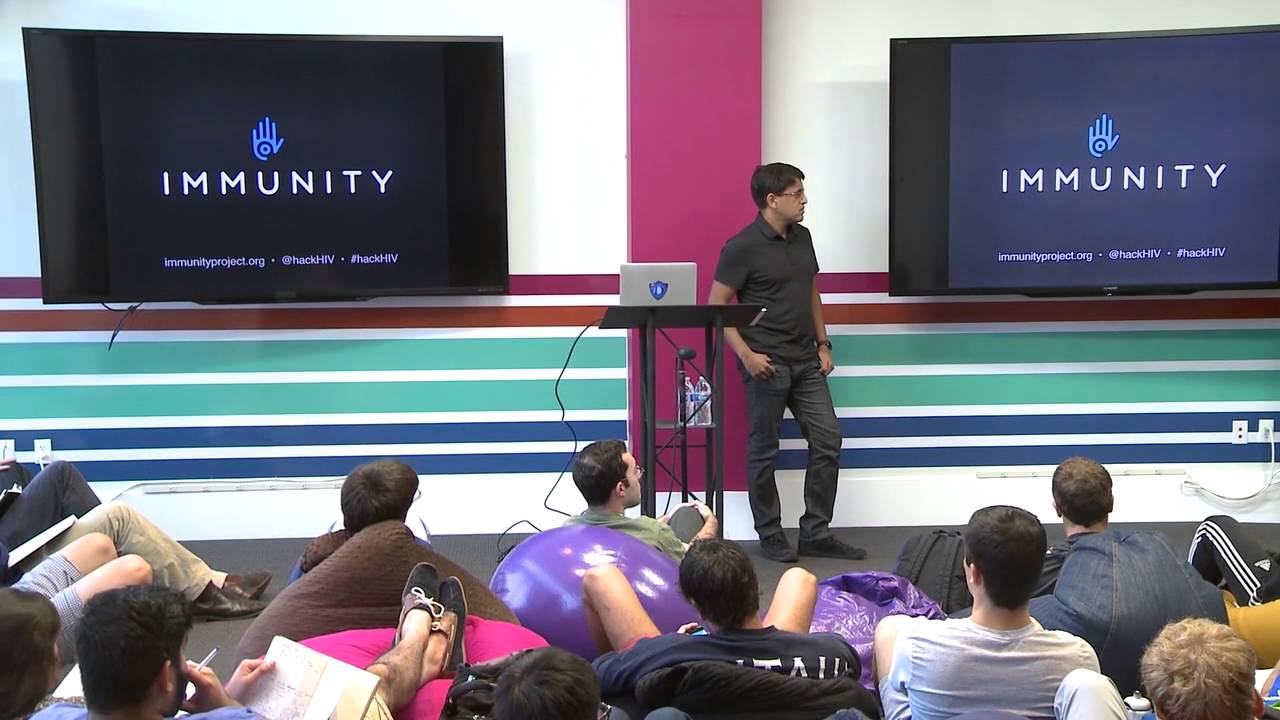
Naveen Jain and Dr. Reid Rubsamen discuss their Immunity Project, which uses computer modeling to design an HIV vaccine they plan to distribute free through a nonprofit, backed by Y Combinator.
Chapters
How are you guys?
Good.
Great. I'm actually not the important guy in the room. My co-founder, Dr. Reed Rubinstein, is the important guy. Yeah, we need to get him a mic.
OK.
So he's actually an MD from Stanford. He has a master's in computer science. He founded a company in the '90s called Aerodyne. He took it public. He has over 60 patents in drug delivery technology. And he is— and he and our science team at Immunity Project are the developers of this novel HIV vaccine that we want to give away to the world for free. So while he's getting mic'd, I'll just give a little bit of background. So we're backed by Y Combinator as a nonprofit. And we started working together approximately 3 or so years ago. And everyone give a round of applause for Reid. And we both come at this project from different points of passion. So Reid, why don't you give a little bit about your background and sort of why you're interested in this project?
Yeah, well, I still practice medicine. I work in a lab. I practice medicine in labs down the street from the hospital where I work in the East Bay in Walnut Creek. And I was an intern in medicine and surgery here in '85, not too far from here in San Francisco at Pacific Medical Center, at the height of the HIV epidemic. And we'll talk more about that later. But I heard about computer modeling activity in Microsoft Research where a team there had figured out how to use a protein folding model to predict weak points on viruses. And they focused on HIV for what's called a killer T-cell attack. And I looked at this very carefully, and the guy doing the work had gone to medical school with me at Stanford, and we both got our computer science at Stanford together in the 1980s. And so I was familiar with this work before they published it. And I said, gee, you know, this is the most amazing information technology immunology or any kind of bioscience interface I'd ever seen. I mean, I had an opportunity to really use a computer model to design an effective drug, in this case a vaccine, using an approach that had never been tried before. So we worked for, with Microsoft Research for a couple of years to design a vaccine platform that could exploit this computer science work and enable us to do precision targeting of a virus in the way predicted to be affected by the computer model. So for me, with a background in computer science and medicine, it was just a great, a great opportunity. And having been here at the height of the AIDS epidemic, seeing the real devastation that that disease caused in this country, which we have now mitigated, with very good, very expensive oral antiviral therapy, recognizing that therapy is not available not only in places like sub-Saharan Africa but also in our own country in people who don't have access to resources, live in the inner city, don't have ready access to medical care. There's an astonishing amount of undertreatment of that population as well. So an HIV vaccine is really going to be required to make a worldwide impact on the disease. So you never— I mean, I think our vaccine's going to work. Of course, if you want a second opinion, ask me again. But it's obviously a challenging problem. But I think it's a shot on goal. It's an interesting shot on goal. So we're going to take it. And we're going to do that hopefully with the help of a lot of different people. Because as Naveen mentioned, it's a free HIV vaccine, meaning that our company, our entity, is not gonna profit from it. We have assigned all the rights to all the patents to a not-for-profit organization right here in Woodside called Until There's a Cure. And so anybody who manufactures, anybody can manufacture and provide the vaccine if they agree to do so at no cost to the end user. So that'll require the participation of governments and NGOs and other entities to make all that happen. But we believe with good clinical testing, With good results, which we're trying to get next year, that we can move that along quickly and hopefully get this in the field as quickly as possible.
So, so my relationship to this project is a little interesting. It's actually all about the power of serendipity. So, so 2 things. So one, the way that I actually met Reed is he was the anesthesiologist for the birth of my daughter.
Aw.
So he gave my wife an epidural. And so I actually met him in the operating room at John Muir in Walnut Creek. And so I started talking to him, literally in the OR. My wife is looking at me like I'm crazy. Like, what are we doing? We're having a baby. What are you doing doing business in the OR? And so I started talking to him. And we just were shooting the breeze. And we took him, took Reid and his wife out to dinner afterwards and just got to know about him and his work. And I had had a personal tragedy. I had actually lost my father. He actually had a heart attack flying from Bangkok to LAX. He actually died on the plane. And so he was a really sick guy. He didn't have HIV, but He had ulcerative colitis and he had all sorts of other medical problems. And what I realized is that in our society, for whatever reason, we tend to focus more on Band-Aids than solutions. And I think that's a general statement that I can make that I think most people would agree with, that that's just for whatever reason how our market has set things up in terms of where the market advantages are for large pharmaceutical companies, et cetera. We don't spend enough time or money or effort on vaccines or other related drug products that can be actual solutions. So that's where my passion for this project comes from, is that as I got to know Reid and our team, I fell in love with this approach. And my background is also in computer engineering. I dropped out. I didn't finish. But I am a recovering programmer. And so for me, I love this idea of using sophisticated computer modeling to figure out what are these targets on a virus that are the Achilles heel. How do you actually conquer a virus that is ever mutating, very quickly by the way, like HIV? And so that's how I got involved in our project. Thank you.