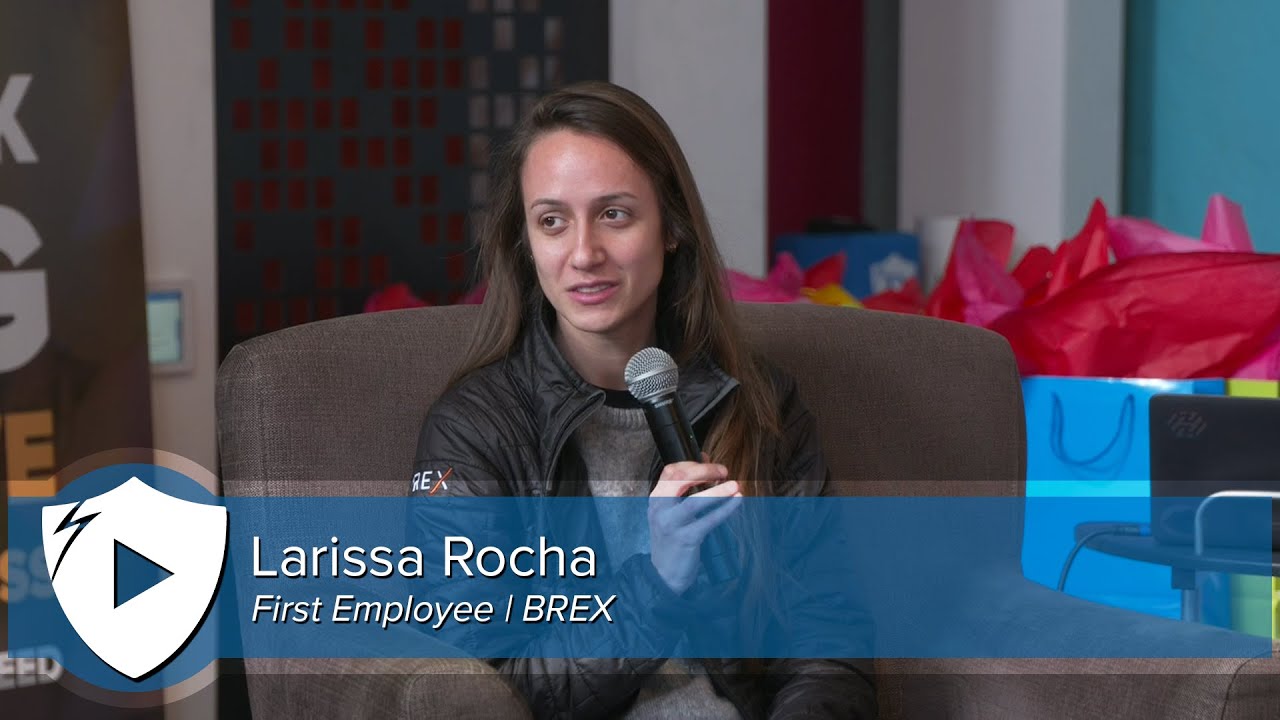
This content was created by Tim Draper. This content was uploaded by Tim Draper. This is a YouTube interview titled "The Origin of BREX | First Employee at BREX, Larissa Rocha" (published May 11, 2020). The excerpt is a recorded conversation between Larissa Rocha (Brex’s first employee) and Siri Shonavas (an investor who references working with Tim at Draper Associates and a $190M fund). They discuss Larissa’s background (growing up in Brazil, attending Harvard), her path to joining Brex, the founders Henrique and Pedro, company diversity, and the early pivot from an augmented-reality startup to building a credit-card/financial product for startups and the challenges startups face getting business credit.
Chapters
They didn't feel they were the right people in the world, out of 7 billion people, to build the next big VR company. And no banks would give them a card because they, you know, as a recently incorporated company, didn't have a financial history. So they said, you know what, this sounds like a problem that we can solve really well and nobody else is focusing on. Okay.
All right, good morning everyone. I just want to make sure you can hear me.
Yes.
All right, wonderful. And my name is Siri Shonavas. Thank you for the very kind introduction. I work with Tim or Adrape Associates. We're investing out of a $190 million fund. We typically write million-dollar checks to startup companies when they're at the seed stage mostly. And I was just telling Larissa that I have read and heard so much about her, but this is the first time I'm meeting her, so I'm super excited. So excited to be talking to her today.
Same here. Thanks for having me.
So I think all of you know about Brex. How many of you have heard of Brex? Oh, wow. Okay, so Brex, I feel like in the last 2 years has been one of the most exciting companies I think that everybody's been talking about. They solve major problems for startups. And it's— and from as an investor, it's one of the most exciting high-growth companies that we've seen in the Valley. And Larissa was employee number 1 at Brex, which is— which I can't even imagine what your journey has been like simply because it seems like the company was a startup 2 years ago and now it's like— how many people does it have?
Almost 400 people.
You have 100 people?
Almost 400.
400. Wow. And that isn't typical, by the way. That's sort of the— that is the sort of magical creature everybody is looking for. So Larissa was employee number 1 at Brex. She grew up in Brazil, moved out here to go to Harvard University, and got a degree in economics. And then she joined Brex.
Yeah.
And which just blew up into one of the biggest companies in the Valley. So she's a bit of a mini celebrity. Let's start off. You grew up in Brazil. What were you like growing up, and why did you decide to move to the US at age 17. Sounds like such a giant challenge to take on.
Yeah. So I heard it's a very international crowd here. I'm from Brazil myself, and so are the founders. Brex is actually 33% first-generation immigrant. So we— and we have over now 29 different nationalities. We put a flag every time someone from, you know, a new country joins. And we also have the— I think— I don't know if the only, but one of the only boards that is also comprised of 100% first-generation immigrants. So that's super cool, super diverse company, and I'm excited to be here talking with you all. So I grew up in Brazil. The boys, Henrique and Pedro, the founders, are from Rio and São Paulo. I'm from the northeast of Brazil, so it's a little bit of a more rural area. And so, you know, most of the activities like sugarcane production, and et cetera. And my family has been involved in producing sugarcane since 1535.
Oh, wow.
Since they first came from Portugal, and et cetera. And so I, you know, I grew up, I liked school a lot. And when I was 9, I had a conversation with my uncle and then with a teacher about Harvard. And that was the first time I heard about it. And I was like, oh, there's like amazing people, it's this, completely like different program. It's super exciting. And from that day on, I decided that that's where I really wanted to go for school. So, you know, I had some challenges. I had to learn English well. We didn't have international schools or American schools in my state. So I kind of had to, you know, find every way I could to kind of learn English as fast as possible. And I did a lot of research, right? Since there was nobody from my state that had ever gone to Harvard, And then in one of the years close to applying, I came across this program that's called the Prep Program in Brazil. And that was like one of the only at the time, and for sure one of, you know, the only one that was free at the time, that helped Brazilian kids prep for the best schools abroad, mostly in the US. And so I joined that program. And it was mostly online. You had mentors and etc. And I met while I was there these two guys, Enrique and Pedro, who were then the became the founders of Brax, and we became friends from there. At the time, they were what nineteen, eighteen, nineteen, and they already had a company in Brazil that they had started when they were sixteen, and it was a kind of the equivalent of Stripe. So an online payments processor in Brazil. So they were second-time founders when they started Brax.
When did you get— and you moved out to Harvard, and you weren't really studying to be in tech.
No, not at all, actually. I was always very interested in the consumer goods industry. So my first summer freshman year, I was in St. Louis working at Budweiser. My sophomore year, I was at Tim Hortons. I don't know if you guys ever heard of Tim Hortons, kind of like the Dunkin' Donuts of Canada. That's where I worked. And I was, you know, I didn't even go through any of the recruiting processes in senior year because I was so sure I wanted to go to Burger King and work there, Burger King corporate in Miami. And that was like the same owners of Tim Hortons and etc. So I was always very driven and very interested in the consumer goods industry. That's what my senior thesis was about when I wrote it senior year. And one month before graduation, I met Henrique and Pedro again. They came for one of a conference that I used to organize called the Brazil Conference at Harvard. And we had dinner and I said, yeah, I heard you guys sold the company, right? You sold Pagami, the old company, and you're starting Stanford. How's it going? Like, how's everything going? And they said, well, it's not really going. You know, we went to Stanford and 3 months later we dropped out and we joined Y Combinator because we had this new idea. And it turns out that it was an idea on augmented reality. So it was a VR idea. It wasn't originally the credit card for startups, which is what Brex does today. And they told me that their plan originally was to sell the company, spend 1 year here in the Valley. You guys have been here for, what, 5 weeks now? It's a super interesting place, right? You see lots of new things that are happening, and their goal was exactly to understand what was the next big thing, what was the next big opportunity, That's what they were going to start their new project and the new company. But 3 months later, they were already at Y Combinator. I don't know if you guys are familiar with Y Combinator. It's also an accelerator program here in the Bay Area. And they joined with this idea on virtual reality. They were developing the technology. It was going to be something like remote offices all around the world can more easily be integrated. Something like that, but they were mostly developing the technology and they were going to decide later. And when they were at Y Combinator, they noticed 2 things, which to me, you know, were very important lessons. One was that they weren't, they didn't feel they were the right people in the world, out of 7 billion people, to build the next big VR company. Because they just didn't really have the expertise. And their competition would be Apple, Facebook, Microsoft, all of these companies that had tons of money and tons of people to throw at this problem. So that brings this sort of lesson that happens even before product-market fit, which is founder-market fit, right? Like founder/team-market fit. So they had the maturity to ask themselves, are we the ones out of everyone in the world who will build the next largest company in VR? Probably not, because they didn't have the expertise. And around the same time that they realized that, they saw that all of these companies at Y Combinator, and for you to have an idea, they were, you know, all funded with at least Some of them more because they were coming in already with some round. They couldn't get a credit card. And you will see, you know, as you're starting a company and et cetera, that you need a credit card, not for credit necessarily, you've just raised, but for travel, subscriptions, for these day-to-day expenses that end up summing up to around 50% of your expenses. corporate expenses. And no banks would give them a card because they, you know, as a recently incorporated company, didn't have a financial history. So then the bank goes after the founder for a personal guarantee, meaning, sure, I can give you a card, but if your company goes under, I will go after your stuff. And Enrique and Pedro, as international founders, which the majority of you guys here are, they didn't even have that option because you don't even have an American credit score. So they said, you know what, this seems like a problem that is way more in our scope of expertise. They already had another company that was payments in Brazil. And this sounds like a problem that we can solve really well and nobody else is focusing on. So that's when, at that time around March 2017, They officially pivoted the company from a virtual reality company to a credit card for startups.