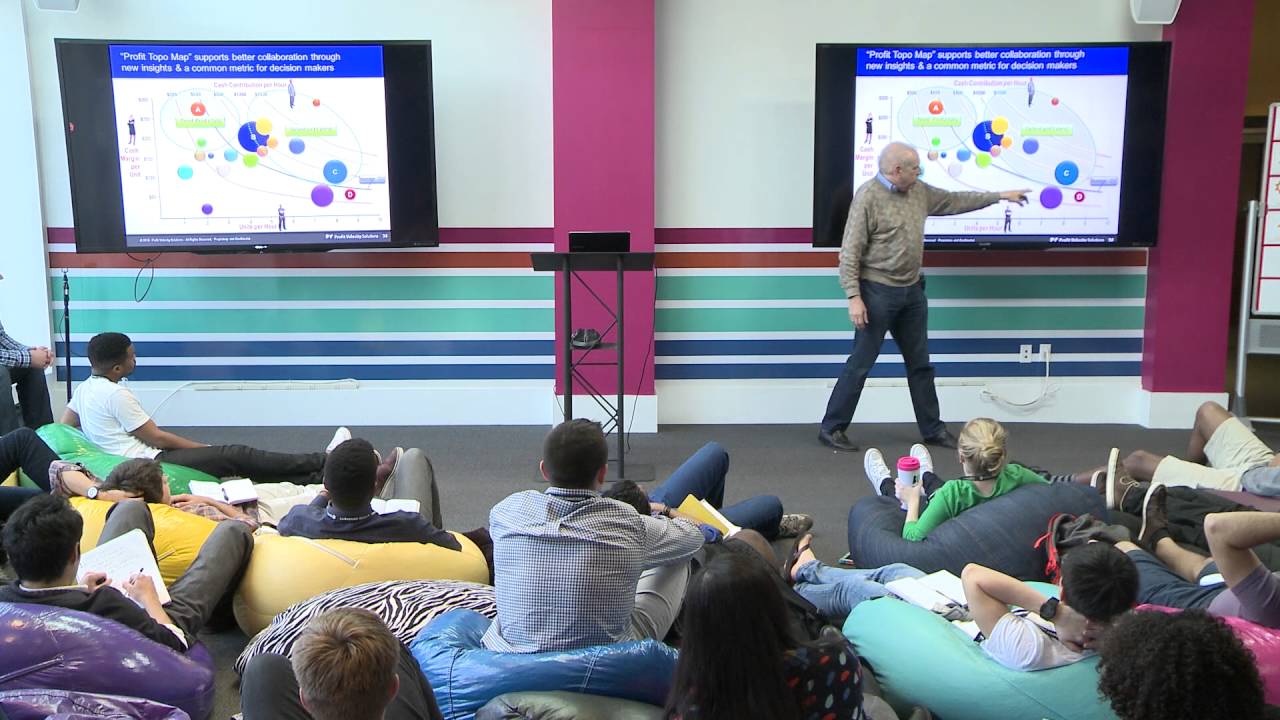
Michael Rothschild presents a profit topo map that plots products by margin and speed to resolve conflicts between marketing, operations, and finance. The tool reveals false profits (slow, high-margin items that waste capacity) and hidden winners (fast, low-margin products worth pricing lower for volume).
Chapters
So as quickly as I can do this, I'm going to show you a graph that we invented to help people in these 3 different groups, sales and marketing, operations, and finance, not have the Tower of Babel crazy non-conversation, but actually get on the same page, understand each other's problems, and make some positive change for the company. So again, this is kind of the way the world works today. Here's the VP of marketing, She loves selling product A, very high margin product. B is good too, a lot of volume on it too, that's why the bubble's bigger. C's okay, D is the proverbial dog product, very low margin. We don't want to sell this product. She's been trying to kill it out of the catalog for several quarters now. However, the head of production, he's got a different view of reality. He says, hey, I like product D. You set it up on the machine, it runs fast, there's no scrap, setup time is easy. I don't understand why she doesn't want to sell it. As a matter of fact, every time she writes an order for A, I go crazy because I know how hard it is for my guys to make it. I only get 2 units an hour when I'm making that, whereas I get 9 units an hour of product B. So naturally, when these people get around the conference table, every week for sales and operations to do their planning, it's basically a fistfight. It's not pretty. So we said, can't we all just get along? Isn't there a way? So we said, now we got our smart guy in the suit there, he's the finance guy, and he says, wait a second. If I get $300 a unit at 2 units an hour, From my standpoint, that's kind of the same as $150 at 4 units an hour, or even $100 at 6 bucks— 6 units an hour. Anywhere along this indifference curve, as economists like to call them, the machine is throwing off $600 an hour. From the machine's point of view, not the product's point of view, but from the machine's point of view, or from the investor's point of view, anywhere along here is I don't really care. I can have a low margin product that runs fast or a high margin product that runs slow. As a shareholder, I don't care. So what we do is we say, hey, if you can draw one curve, you can draw several curves. And then it's like, we call it a profit topo map. If you've ever used a map for going hiking and those curves are on there to give you a sense of how steep the hillside is, this is Death Valley. Low margin, low speed. When I go to China, we call this the top of the gold mountain. High margin, high speed. And you can paint in averages. And let's say we were looking at a dozen different products we sell to XYZ, one of our major customers, and they're coming in 2 weeks from now, and they're gonna beat the bloody hell out of us trying to get our prices down for the next year. And we're trying to set our strategy. What are we gonna do? What we would suggest is, for any product that's up the hillside above the blue curve, which is the average, we wanna defend and extend. We want more of that business. We wanna grow those bubbles. We'll even take price cuts. We'll do whatever we can, but we want that business to bring our average up. Okay. Including, for the moment here, importantly, this product C, which is not so high in margin. It's the kind of thing you'd ignore generally in that kind of— Over here, in this area up here, where the curves get very vertical, if I have a product like this green one, and I want to get it to the blue curve, I gotta raise prices a long way. Guess what? We're gonna lose that business if we raise that price. But if we could just get the ops guys, operations guys, to find a way to make that thing faster, that's the short path to improving profitability. So it gives a focused, operations people can't fix everything in the factory at the same time. What specific things could we make the biggest difference with? So it gives them guidance. And then conversely, down here in the lower right, this purple product, to get it on the blue curve, I'd have to make it a lot faster. Can't do that. It's not going to happen. I need to boost pricing, or at least hold the line, not give in on pricing for those. And then lastly, down here, why are we making these things? Now, if the plant is half empty, which most plants are, Okay, we'll take it. But if my plant is busy or it's gonna get busy, maybe I don't wanna sign a long-term agreement for that. So these are the kinds of things that now we've got people in marketing, in production, and in finance actually having an intelligent conversation about, okay, you guys take care of this, we'll work on that. It's really a new world for them, frankly. And now I'm not quite over with this buildup. We're almost there. If you draw in the averages, you find these interesting shaded areas. We call this area the false profits. Very high margin. Generally, the sales force is tasked with sell more of these, sell more of— some of them though are very slow and hard to make and suck up huge amounts of time and capacity for very little reward. And at the same time, products like Product C here are ignored because it's below average margin, and nobody ever knew it's above average profit velocity because they never calculated profit velocity. That's the kind of product you could actually cut your price on to get more volume, but you wouldn't— if you suggested today cut price on a low margin product, they'd laugh you out of the room. Yeah. Why would we do that? It's already too low. So information, useful information is, to quote one professor who's passed on from MIT, is news that makes a difference. Otherwise, it's just data. Information is something that makes you change your mind or change your action. Otherwise, nothing's going to— there's no difference. So this is news that makes a difference. We're actually going to be aggressive about these products in ways that we never would. Our hidden winners. Okay, so that gives you a very quick tour of our profit topo map.