The Race to $1,000,000 Starts Here | Meet The Drapers Global: Semifinals 1
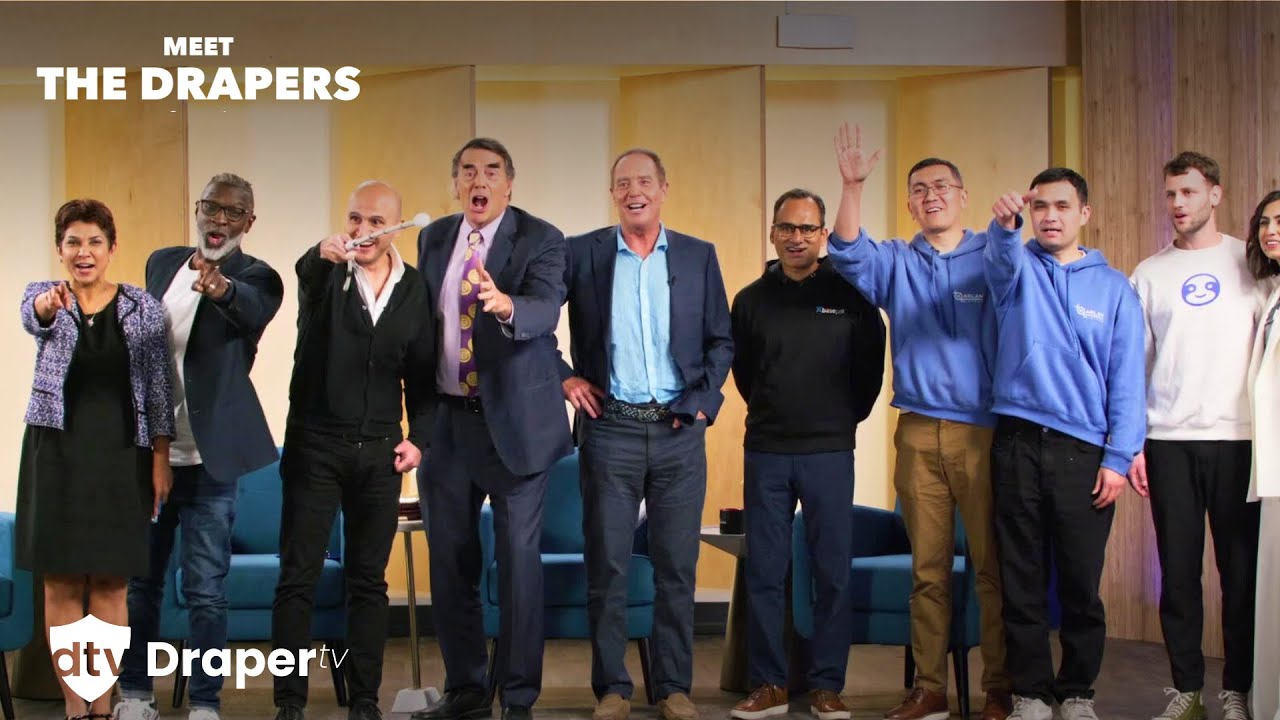
Five entrepreneurs pitch for $1,000,000 and a spot in the finale of Tim Draper's competition. Maha Shahzad presents Buscaro Technologies for safe commutes, Bolat and Daucan pitch Arlan Biotech's antibody discovery AI, Peter Salentine shows Lazy AI, Kursat Celan demonstrates WeWalk's smart cane, and Amit Sinha pitches Basepair for genomic analysis.
Chapters
I'm Tim Draper, and I invest in big ideas before they become the next big thing. I invested in Tesla, SpaceX, Twitch, all when they were just a sparkle in that entrepreneur's eye. This season, I'm traveling the globe to find game-changing entrepreneurs with world-transforming ideas. I'll bring these visionary innovators to Hero City in the heart of Silicon Valley, where they'll compete compete for a million-dollar investment. Here is the twist. You, the viewers, can vote for your favorite entrepreneurs and help them secure a spot in the finale. Who will rise to the challenge and secure the funding to, to turn their dreams into reality? Let's find out together on season 7 of—
The InvenTakers!
Welcome everybody to Meet the Drapers. This is our big semifinal show. We have traveled all over the world for this. And today we are in Silicon Valley. These entrepreneurs have traveled from wherever they came from. We have 5 entrepreneurs you can see today. 2 will move on to the finale. This is going to be awesome. I would like to introduce our new guest judges. On my far right, we have Steve Harris. Steve is an Emmy Award-winning producer. Welcome to the show, Steve Harris Draper. Great to have you. What are you going to be looking for here?
I'm going to be looking for entrepreneurs that are on the cutting edge of innovation and technology.
And on my right, she's a part of my family and I can't really pronounce her name. Karthika Reddy Draper. Beautiful. Karthika is the first managing director of Facebook India and South Asia. She is now the CEO and co-founder of Verix. Tell us what you're going to be looking for today.
I'm going to be looking for the superpower that the entrepreneur brings in terms of what is their differentiated insight into the problem that they're solving.
See, Cree, that's why I put her closer to the crystal ball. She is spiritual.
I'm still upset about that, but okay.
And on my left, this could go any number of different ways. Best man in my wedding, first wedding. My earliest friend, Cree Edwards. He founded 2 extraordinary companies that became unicorns after he sold them. Cree is an author, podcaster, documentary film producer, and creator of the Beyond Einstein digital footprint assets. So what are you looking for here?
I like people who have identified a marketplace that has not yet been identified. So I'm looking for something special.
So let's bring in our first entrepreneur. But before we do, let's see what's going on behind the scenes. And here everybody has to do the eyebrow thing.
Welcome everyone, you made it to the semifinals. Love to have you here. So great job on your journey so far. My name is Eric Wiseman. I'm a communication coach. We teach people To be able to communicate. Really huge part of being an entrepreneur. So we're going to be doing a debate today. You're going to have 1 minute to give your piece, and we're going to have the second entrepreneur be able to give their 1-minute opening. And then you're going to have 30 seconds each to rebuttal. The question today is going to be, what is the most non-technical entrepreneur skill? Are you ready for your challenge?
Yes!
Let's do it.
Let's go.
This is the first time Pakistan has been on the show. Excited to be a part of this.
So this is Maha Shahzad from Buscaro Technologies. Maha, give us your pitch.
We provide safe and affordable commute and ensure the reliability of that commute. Our first market has been Pakistan, which is a country that has a 250 million population, half of which are women. There's a public transportation infrastructure that's completely broken. Sexual harassment cases in public transport are rated at about 90%.
Wait, so you're— are you only allowing women on these buses?
I didn't really get to pitch because I was like 5 seconds in when the Q&A started. Things move pretty quickly. No, I just make more of a difference in women's life. Men use us too, but for women, they just don't have many other options.
Well, how do you know women are safe on your buses?
I'll walk you through that.
Okay.
In the next few seconds. Every judge likes to poke different founders and different entrepreneurs in different ways. A lot of times people will just start asking you questions and you're like, wait, do you want to know what I do first? But— so we have a B2B and a B2B2C model. We use technology to ensure that we can create efficiency around this.
So B2B, who's the Bs?
Schools, universities, offices, anyone who has people that they need to commute back and forth every day. And then we also do B2B2C, which is directly to consumers. But because that's through organizations, Malls, large institutions, what we're able to do is manage utilizations from day one and ensure that it's done in an efficient way. I think I tried to cover most of the information I needed to through those questions, and I think we covered a lot of that material. On the safety front, we've done now 9 million plus bookings, not one incident. Both through technology and operations, we're ensuring safety, whether that's vehicle inspections, the quality of the drivers that come in, their training, gender desensitization training.
So, Maha, I know you're training the bus drivers. The usual harassment comes from the other passengers.
So if you look at the statistics, generally the kind of cases that have been seen have been with ride-hailing, and that's generally because it's one driver and one passenger at a time. And what we're also doing is constantly monitoring every single ride.
So I am going to ask you about this. If it's just for Pakistan, that's probably not good enough.
How are you defining a large market? Because I have a 250 million population in my first market alone. I already have more of a pipeline than I can take on. That's not a large market. I think that's a very good question. Good enough.
And your future markets are KSA, UAE. Those are really safe countries.
So let me give you—
they don't have any incidents. So what's your pitch there?
Sure.
Let me give you a rebuttal to that. First of all, if you look at Pakistan alone, that's $250 million. I think there's a billion-dollar business easily to be built there. When we talk about KSA and UAE, it's not safety that we're trying to solve for. It's going after the children's markets. If you look at school transportation in both of those countries, that's currently very inefficient, and kids are spending close to 2 hours a day just getting to school or coming back.
You deal with a business.
Their employees could be spread out over a large area.
Correct.
Do they stop, stop, stop, stop, stop, then bring them in?
Yes. So what we're going to do is if there's an organization, we're going to get data on where their employees are. We're going to use AI to build the most optimized routes, and then we're going to run those buses on that.
Is your service 24 hours a day, 7 days a week?
It's generally Monday to Friday, in some cases Saturday. And we are today now doing about 35,000 bookings a day.
35,000 a day?
Yes. And that could be scaled 5x, What is your superpower?
Why are you the right founder to solve this problem?
I think from my perspective, it was great to see her there. Just nice to see some female representation every now and then. I moved to Pakistan in 2017 chasing this problem. I went there for Careem. I then went to Swivel when I realized that ride-hailing economics will never work. And when that company shut down globally and fundraising was impossible in my country, I bootstrapped my company, put every penny I have to figure out this model and build it. I was forced to drop out of college just because I couldn't figure out commute, and when I When I started working, I spent close to 90% of my income in my first job commuting. It just shouldn't be that hard for the next person around.
Terrific. Maha, thanks so much for being on Meet the Drapers.
Thank you so much. So Tim's interesting. He's a little bit tougher on me than on a lot of other people around me. I think I was very comfortable today. I think I was quite confident.
What did everybody think of Maha?
She brought back vivid memories of growing up in India and that we used to go on public buses. Literally, we used to carry a safety pin. That's what we had to do to protect ourselves. So this is a very real problem.
There definitely feels like there's a need for it. What's going to give her, like you said, that superpower to really take over that market and that space?
Once you get the business contracts, the school contracts and all that, you can get a track record that sort of differentiates you. Differentiates you from everyone else.
Yeah, the B2B element was like, oh, okay, you've got contracts like the schools, the businesses.
And she had pretty strong retention numbers, which she has.
99% is good.
Yeah.
Well, with that, let's move on to the next entrepreneur. But before we do, let's see what's going on behind the scenes. Eyebrows.
Let's get started in our debate. Again, the question is going to be, what is The most important non-technical skill when it comes to entrepreneurship.
Let's get it started.
I think the single most important trait is clarity. As a leader, when you start a startup, it's not very clear what the product will be, who the buyer is, what the market response, who are the right investors. So as the leader, you need to bring the clarity in the team. What do we do? Why do we do it? Who will benefit from that? And once you set this clear vision, then others can follow. If you have a complex vision, then others struggle to follow that.
I think the most important skill is selecting right people, because it's more important than even your product, because you will build the product with the people you selected. If you are running a startup or if you are building a startup, you cannot find those people by sending a post on LinkedIn and saying, hey, I am hiring a co-founder. It's not easy. What kind of skills they will bring you? So this is the important skill, I believe.
I agree with my friend 100%. Bringing the right people is extremely important, but I think clarity is upstream of the people. If you get the best people together in a room but there's no clarity about the vision and what you're going to do, then you have a very, very messy bunch. So first you need the clarity of what's gonna happen, and then you get the people.
I also totally agree, you know, but as a founder, if you cannot bring the right people into a room, even if they have a clarity in their mind, how you are gonna manage them?
Those are 2 wonderful answers.
Absolutely. Tough battle here.
I think I'm gonna choose WeWalk.
3 clients closed.
The 3 clients are B2C clients.
It's a $15,000 deal.
It's not a $15,000—
They were too squirrely in the numbers.
Okay, a little bit nervous. It's absolutely normal. Sometimes it's good to be a little bit nervous so you have some adrenaline. Fundraising, pitching is a full-time job. You just need to do your job.
This is Arlan Biotech, Bolat and Daucan. Give us your pitch.
Arlan Biotech, we're developing AI which generates single-domain antibody sequences. Antibodies are used everywhere, from diagnostics to therapeutics, but antibody discovery is a very slow and expensive process, and we solve that problem using—
Do individuals have different need for different antibodies?
The pitching was not kind of ordinary pitching.
From the first slides, there were some questions already.
They're interested, which is important. We are creating a platform which allows to big pharma generate antibodies which could be used as a novel drug against cancer for the CAR-T or diagnosing the new upcoming pandemic, for example, if it will come, but do that really, really fast. And we do that using generative AI. So our AI is able to generate antibody sequences within minutes, not months. It saves up to $3 million. We have the unique dataset of synthetic pairs of antibodies and antigens. It's 1 billion. And we have shown that our data is representative, not biased.
This is great because you're being more targeted. But what happens when we move more toward personalized medicine and away from Big Pharma? What happens to you guys?
By this question, Tim actually showed that he's interested and he's thinking about the future.
Can you adjust to become more specific to the individual?
For the personalized, the patient has a cancer and he has the specific mutation which presents the— shows the cancer, and our technology will generate the specific antibody against this mutated protein.
What is your revenue model?
Revenue model is a B2B SaaS.
Do you have to use somebody else's computational biochemistry system in order to apply your AI?
All AI is our own.
You said you have 3 paying customers. Are they paying you that 3 million?
We have B2C clients. They've paid us. But why we actually use them? Because we're a deep tech startup. We need to verify, validate that the market needs it, that researchers need this type of tool.
What are they telling you from those pilots?
They're amazed. They say that this technology, we need that. One thing that we actually give them, it's ability to choose the region, for example, on the target against which they would like to generate antibodies.
How quickly are you going from them saying they love you to saying, okay, let me sign that $3 million contract?
To be honest, the deal was within 25 minutes.
25 minutes?
Yeah, we just had a call, we showed our technologies, and they said, we want to use that.
But actually, they don't have enough money to generate more revenue, but we can use a royalty model if their proteins work out, commercialize.
So I think specifically, how many $3 million contracts have you closed and they deposited $9 million? Like you said, you had 3 clients. 3 clients closed?
The 3 clients are B2C clients. They're not B2B clients.
And what's the bill for that? How much did you charge the B2C clients?
So for the B2C clients, we at least charged $15,000. Most of those B2C was for the validation. The growth of the revenue It's not like, you know, like it's very high. Basically, the market is huge. It's a $200 billion market. Of course, we have competition. We've received results just recently, and we're ahead of the big names.
So how long until you actually book a contract for a $3 million deal? How close is the technology to being able to go to one of the big pharma guys and saying, hey, we want you to use this?
You have zero dollars today, but tomorrow you can get one hundred million contracts. It mostly depends how the deals are done within the firm.
It's a fifteen thousand dollar deal.
It's not a fifteen thousand; it's several hundred thousand U.S. dollars because they they're gonna use that for many of targets. If we charge them thirty thousand U.S. dollars and they give the results to their customers within a week, not twelve months, imagine how many clients they. could work, not 300, but thousands.
Terrific. Bolat, Dawkin, thank you so much for being on Meet the Drapers. Thank you very much.
Thank you. People, they need time to understand. We always educate VCs. Sometimes it's really hard to pitch for the deep tech startups. It's hard to do in 2 minutes. If we were able to pitch till the end, they will see the vision.
What did everybody think?
They were just too squirrely in the numbers. Like, I heard $3 million, I heard $15,000, now it's $700,000. Like, just, okay, what— how much have you made so far? How many contracts have you secured? What have you grossed? How much do you need from us as investors to scale to that next level? I don't know how much they've grossed so far.
We see it a lot as venture capitalists. Cree, what'd you think?
Slightly outside of my expertise. I'm sure they're a lot smarter than I am. I would prefer A company that actually solves a problem rather than cost reducing a service.
You know, it's interesting. In the U.S. now, we continue to spend more and more money, and our lifespans are going down. There is some disconnect there.
That's why they all the way here from Kazakhstan to save the United States.
That's right. They're coming to save us.
Yeah.
That was very thoughtful of them. Let's move on to our next entrepreneur. But before we do. You know what we gotta do. We gotta see what's going on behind the scenes.
All right, round 2. We have our entrepreneurs ready. Good luck, entrepreneurs. We will start with Peter.
Mine is going to be asking questions, because it's the best way to convince someone of what you want them to be convinced of. If you can ask them the right question, they'll pretty much tell you the answer, and then if you repeat it to them, they will quite like you. So that's a good way to hire the right people, get customers, get investors. It's basically the key to success in interpersonal relationships.
While I love that, I think for me personally, if there's one skill that an entrepreneur in a startup needs to have, it is resilience. There are going to be days when you do hire the wrong people and investors do say no to you and the tech you're building doesn't turn out the way you expected. and just everything absolutely goes wrong. When you don't have the resilience to still keep going until you pivot, figure it out, and, and just have that sort of grit, that is the number one thing to make people successful.
The source of resilience is asking yourself the question, why? So if you're good at asking questions, you'll also be asking questions from yourself. Why the hell am I working so hard where I could probably take a job elsewhere and earn a lot more money? Asking the team members why are they doing it every day. And if you can discover a passion for what you do in there, then you'll get the resilience.
I think it's all interlinked, right? I think you absolutely need to ask the right questions, and I think the things we touched upon earlier today, which is what kind of a team that you've built, the clarity of thought that you have, I think all of those things are extremely important. But for me, as a team, if you don't have resilience, I think all of those things alone don't stand their own ground. That's the way that I look at it.
Alright, so now, Eric, let me ask you this question. What did you think of both arguments?
At the end of the day, it is a philosophical, deep question, and I think you can get in your head about it. Being able to fight that uphill battle, being able to get up again when you fall down. I have to go with resilience.
You're moving up to the next round. Congratulations.
Thank you.
What's your acquisition strategy?
I don't even have a marketing department.
Don't they want to just do it themselves? Why do they need you?
You get a bit jittery sometimes with TV and cameras. This time, since it's the second time, I had a little bit of practice. I felt good and calm.
Go ahead, give us your pitch.
Hi everyone, I'm Peter Salentine. I'm the CEO of Lazy AI, and he's wearing very comfortable clothes. We got the little sloth. We're all lazy at the company, and we actually help other companies be lazy as well. Since the invention of the internet, we basically amassed an insane amount of knowledge workers in the market. Just in the U.S. alone, there's over 100 million of them, which means that businesses in America are spending five trillion dollars annually on people sitting at computers, looking at information in one system, analyzing it, and then transporting it into. Lazy AI solves all of these problems simultaneously. The best way to think about us is that we're an AI agent to generate AI agents for companies. So we're one of 4 companies in the world today that have software generation technology, and we wrap that around a platform that helps these companies quickly develop solutions for data processing problems.
Do you have to do everything custom for each new customer, or is there some way— are you building a library?
Great question. Tim loves to cut in after roughly the second slide. I could see him, he was already like— and then I had to say something really quick so he doesn't have the opportunity. One of the beautiful things about GenAI and how to generate code is that we've built a system that you can prompt and it writes the code for you. And so you can iteratively build a solution. Now we have both smaller and larger size businesses with us. Small companies that are not worth it to help, they go the self-service model. And larger companies, we actually have a full-service model where we also provide a team member to build the solution for them.
So with small businesses, aren't they looking for something very ease of use? And big businesses, don't they want to just do it themselves? Why do they need you?
I think it's the most important question. The truth is, for my company, for it to, to make really serious money, we need to work together with large companies. That means if there's not a good answer for the why question, it doesn't make sense to invest in a company like mine. It's actually the other way around. Small businesses prefer to use self-service tools, and large businesses love to work with solutions teams that come and understand their processes and create a solution tailored for them.
Peter, this looks like a lot of different teams and a lot of different industries for a startup. Is there a particular focus? So I only focus on non-sensitive Across all of these different teams, or is there a sweet spot?
It's useful for me to talk to seasoned VCs. We move past the initial sentiment of, is this person for real or not? Do they know what they're talking about or not? We cross that bridge very early on. The sweet spot seems to be actually customer service.
What do you consider a registered user? Is that a seat?
A registered user is someone who has come in and submitted a prompt to start building some sort of an AI tool.
Do you charge by registered users?
Great question. For me, the most important thing is that the questions are sensible. It's always a conversation, even though this is on stage and I'm presenting, and there needs to be information flowing. We have sort of 2 different models. First, we do charge per seat, so we have a pro plan that actually lets you run the software on our hosted solutions, $60 per month. The way that we make money is on these dedicated server costs. So once you generate a piece of software that helps your business, you could take it elsewhere, but it's so easy to run it on our platform that you end up running it on our platform.
So you just kind of get it going, get $10K MRR. How much of that is self-service people? All of it. Oh, okay. So you haven't yet gotten the big—
Yeah. So we had to build the software. We had to start bottom up, and now we're going and selling to large companies.
So you released your beta in December and you have 90,000+ registered users. How did you get those? What's your acquisition strategy?
They came themselves. I don't even have a marketing department. There was an influencer that made a video about our platform. Then we started getting barreled by traffic.
Who's your typical self-service customer?
For smaller customers, you'll have like an e-commerce company that built for themselves a tool where their merchandising team can enter a URL. It pulls all the content from the URL because they buy products from Japan and they resell them in Germany. So before, they would sit, go to the website, Google Translate it, rewrite it manually, take the images, take them off the site, resize them, and then manually go to WooCommerce and import them. Now they have an internal tool that they built on Lazy that does all of this automatically for them and saves them a ton of time.
Peter, thanks so much for being on Meet the Drapers.
Tim's hard to read, right? He's got the eyebrow thing going on.
Tell me what you thought.
The 90,000+ registered users does stand out to me less than a year in. It says something about the value that they're finding. To be honest, I'm still trying to figure out what that value is. From this session, I didn't get that crystal clear.
I thought his presentation was fantastic. He was cool, calm, collect. I feel like I would want to do a deeper dive with. Him and the team. And the reason why we want to talk to the team is, okay, so when you do scale to that next level, what's the infrastructure here? You know, what happens when you 10x that?
You got cool, calm, and collected. I got low energy.
I agree.
You're an energy guy. What did you think?
It felt like he knows he's smarter than we are.
Well, maybe that's it.
I don't care how many conversations I have with them. Their employee, their staff is phenomenally qualified. The viral adoption You get an online little secondhand guy saying, do this, and you end up with that many people interested in it. I mean, Christ, if you market the thing, what is it? It's really impressive.
Okay, we got to move on to our next entrepreneur. But before we do, it's all about the eyebrows. What's going on behind the scenes?
All right, all right, all right. We're hitting the wire. One more round. We have new participants. So you know the drill. Please give us What do you think is the most valuable skill a startup founder can have?
Balancing between action and listening, because usually startup guys have 2 modes: action, it is like hiring, pitching, building, and listening, listening feedback and making other decisions. Having the right balance is important because when you do just action without listening, it can turn out very bad. You lose real-world feedback, and when you just always listen, it's also bad because you can lose your vision.
I think everything that's been mentioned today, I think those are really important traits which are a base level. You've got to have it or you shouldn't be an entrepreneur, you shouldn't be working in a startup. That's just not a journey you should be taking. But at the end of the day, my point remains the same. There are days when the listening goes wrong and the action goes wrong and things just don't work out, and you cry yourself to bed, and you need to wake up in the morning and get back at it. And I think for me, it's entrepreneurs who are able to do that who actually survive.
You can see in her eyes she truly believes in it. Are you able to defend and truly believe?
I think resilience is a part of action part. It's just pushing your ideas, pushing your thoughts. But sometimes resilience also includes listening. If it is just stupid resilience, it is very bad. You can just spend your whole life doing wrong things.
If I could disagree with that real quick, right? You spoke about stupid resilience, and if you're stupidly resilient, you're gonna fail, period, right? Game over. But if you're staying in this game and you keep on going, then you still need that resilience along the way. I stand by that.
This is a tough one.
It's an extremely tough one. Well, so one more time, I'm gonna give it to resilience.
Thank you so much.
We're gonna go to the next round.
Thank you very much.
Only 5% of the market has been penetrated.
What's the gap? Are you pricing people out?
Is there anything like this on the market at all?
As soon as we got closer to pitching, I got super excited.
So our next entrepreneur is Kursat Celan from WeWalk.
There are more than 250 million visually impaired people worldwide. We created patented smart cane technology. To encourage visually impaired people, empower visually impaired people to participate in social life. It detects overhead obstacles and alerts its users with audio or haptic feedback. It gives turn-by-turn navigation, informs you about restaurants, stores, cafes while you are passing by. And it has ultrasonic sensors here and a flashlight to make visually impaired people more visible. We are building an ecosystem around SmartCane with our value-added subscription services for visually impaired people's parents and teachers. We built partnerships with the most prominent blind organizations in the world. We reached more than 5,000 visually impaired people with our technology. We built R&D partnerships with Microsoft and Imperial College London, dedicated budgets of $3 million for R&D studies.
Tell us a little bit more about your business model.
We sell our product for $850.
What are your margins if you just sell the cane?
They already know your product. They mostly focus on understanding your business. It means tougher questions. You know, cost of goods is $150. We have a subscription service for different customers. For B2C, visually impaired people can subscribe for $5 and reach more features and get new updates monthly. We gather data how they are using their white canes, and we provide this data to mobility trainers. Blind agencies purchase our licenses, and our license cost is $1,000 per teacher.
If you walk around with your cane, someone else walks around with their cane, and you both walk down the same street, are you getting the benefit of their walking around in your cane?
Currently, we are using this data to monitor visually impaired people's mobility improvements. We can also use this data to provide information to other users, and even we can share this data with municipalities to improve, to develop their infrastructure.
Does the municipality also pay you?
No. Not right now, but why not?
Why not?
Yeah.
Starting with a positive reaction is always good.
You have different subscription models. What is it? It ranges from $5 a month to what?
If you want to turn your smart cane into a magic wand, and if you want to talk to your cane with our custom-trained voice assistant, you have to subscribe, and then you can simply ask whatever you want. Take me to Starbucks. Where is the closest? bus station instead of those buttons.
Is there anything like this on the market at all?
You might see some SmartCanes, but they mostly focus on obstacle detection. As a blind community, we need more than obstacle detection. I want to integrate with the city, and VWOOC has the patent. We are not just trying to detect obstacles.
We believe that the better you get around, the better Given that it's such an important problem, 5,000 SmartCane users seems to be a very small number of customers. So what's the gap? Are you pricing people out? How do you get that to be 500,000?
Since WeWalk is an impact-driven startup, I like getting that kind of metric-driven questions. She sees a potential. We made all these sales without any reimbursement, and it's a perfect signal from the market. Even people are paying although they have limited purchase power. We are registering our technology into reimbursement systems to reach more visually impaired people and be the trendsetter in the market.
Kursat, thank you so much for coming on Meet the Drapers. We almost got— we almost made connection. By the way, that was my fault, not yours. No, thank you. That we actually missed each other.
Thank you so much.
You know, when you are at the stage, everything is flowing fast. Gone with the winds, you know, so.
I'm loving the diversity of companies and entrepreneurs here. It's just been phenomenal.
This is a great show, huh? How about that?
Yeah.
Way to go, Timmy.
Okay, what did you think?
There's definitely a huge market for it. Of all the smart canes that exist, only 5% of the market has been penetrated. This is definitely an affordable solution.
$850, it should just be automatic.
I love it. I would think the insurance companies would mandate it. You need to have one of these things.
Well, having invested in healthcare in, in this country, the reimbursements, they're just so slow. It's the bane of the medical system here.
The amount of money we spend on, on making handicap-available everything, the amount of infrastructure that goes into it, there's got to be a ton of money to try to help these people out. It's so simple.
With that, let's move on to our next entrepreneur. But before we do, it's all about the eyebrows, and let's see what's going on behind the scenes.
We have the importance of the team and the people versus the resilience you have as A minute each, go over your points.
We're all only as good as our teams are, and so that for me is a given. But I think you and your entire team need to show that resilience when you're going out and building something, which is difficult to do. And so I think that's a trait that needs to run down an organization, you know, top to bottom. And when things get tough, your team sort of also needs to be able to get through those days and keep fighting.
As a blind person, I cannot I disagree being resilient. This is my lifestyle. You know, I have to cope with, deal with all different challenges during my whole life. But once you start building your team and start hiring first team members, you have to find the right people who have the integrity. At some point, only your values will drive the company.
That's a fantastic argument. That being said, I think you You can have that skill and you can be really good at building teams, and on bad days people won't want to work for you. When you don't have money, when you haven't raised funding, when you don't have the right PR, you can have that skill and you still won't get that team in. But if you can just get through those days anyway, the second you turn things around, people are going to come back. They are going to ask for those jobs. They're going to want to work with you.
If the resilience is so important, it means that while you are hiring, You are checking people's resiliency. It should be your first skill that you are looking for in newcomers. If you are not good at evaluating, you cannot find those resilient people.
I think they're both great arguments. I think part of this debate too is the presentation and how it was argued. With that in mind— I might have to go with resilience.
We got a big winner!
Amazing!
Congratulations!
All right, so now that we saw all this, I think we have one thing left to do. We gotta whisper it down to the crystal ball, see if that would make a difference.
I feel great. I thought we were definitely one of the top 2 startups out of the 5.
Okay, we're funding heroes. Amit Sinha from Base Pair, give us your pitch.
We develop software for genomic analysis. The data is messy, but the impact is so high. We are truly democratizing genomics. The physicians, they're not trained in programming. They cannot run complex jobs themselves. So we made the software so easy to use that any physician, any scientist can run complex analyses without any coding. They can go from raw data to insight within a few minutes.
What is this chart showing? What problem are they solving?
This is showing gene expression analysis. So if you're looking at gene expression difference between 2 samples, it is showing which genes are going up on the right side and which genes are going down on the left side. During the pitch, things went in a very different direction, and I began to be concerned.
Explain it to someone who's a novice in that space. What is that used for?
Things did not go on script today as they did in the qualifier. This is used to, let's say you try it, you're trying a new drug and you want to see how gene expression changes. based on the drug, and you can see how the drug is affecting your genes.
You have a curve of a U there.
Yeah.
What does that mean?
For some reason, the judges really wanted to understand the exact figure, and they had even more questions. And it's like a whole scientific discussion, and we have like a few minutes of pitching, and I'm still on slide 2. So this is where the genes are going up, and this is where the genes are going down. It's a whole bunch of statistics in there.
And they're going to understand what genes going up and genes going down means?
Yes, exactly. What does that mean?
Yeah, give us an application.
I love talking about this, but I need more time, and I want to pitch the startup, the business investment, not so much just the scientific parts.
What does genes going up mean? What does genes going down mean?
So all the genes in our body have an activity level, and in different conditions, that activity level goes up or that activity goes down.
I mean, is this helping us solve cancer? Is this helping— what is it?
This is fundamental to biology, so it applies in cancer, applies in everything else as well. So I had to think very quickly on the feet, be respectful to their questions, but also move on. So that's what I tried to do. We are not finding the cure for cancer, but that's what our customers are doing. And they do use Basepair for genomic analysis. So they would do an analysis like that, and their scientists, when they'll try to find those insights—
Is your technology able to project and predict?
So in case of IVF, the challenge is to find which embryo is most likely to lead to a successful pregnancy. So it's a selection problem. You have 8 embryos, you need to pick one. Using genetic analysis, we know which one is most likely than just visually looking in a microscope.
What is your business model?
So we are a SaaS license model. So these customers will buy a license from us. The average subscription is $100,000 a year, which includes about 10,000 samples. And they would pay us, they would use it for all the analysis, and they would do their own unique insight.
Who's out there competing with you and what are What are your benefits over them?
Most often we compete with in-house groups. So companies like this, they'll hire 5 to 10 people, build that infrastructure in-house. So not just that's more expensive, we're talking a few million dollars a year versus $100,000 for Basepair, but in that experience you have an informatics group doing the analysis. So the scientists are now disconnected from the data. With our approach, they upload the data, they see these nice dashboards themselves. There's no gap.
You did a little over a million dollars Yes. In 2023. How does 2024 look?
We are looking to close at $2.1 billion. We have 2 big deals lined up.
And are these customers coming back?
Our enterprise retention is 100% because it truly becomes a platform they use on a daily basis. So very sticky product.
Co-selling partnership with AWS.
Yes.
Fascinating. Tell us more.
It is nice to see that the value connected because I was so afraid that the pitch got derailed with all those questions. So we run the software on of AWS to use their infrastructure, and we are the only provider. Our SaaS runs in our AWS account, but the actual genetic storage and compute happens in the customer's own cloud account. So because of this model, AWS is also getting that market share. They bring us into deals, we sell together, we drive their revenue, they bring us customers.
Terrific. Thanks so much for being on Meet the Drapers. Great to have you on the show.
Ultimately, this the vision and they saw the business and saw the metrics and they appreciated that.
What did everybody think?
Tim, for me, the example that he gave of increasing the success rate of IVF, it makes that whole process that much more successful and that alone is a several billion dollar investment.
That's right, that would save a lot of money. Well, the market is so big and the demand should be so high, there must be competitors out there.
It seems like once the customers are there, it's like the cable guy. Yeah, yeah, you got them forever.
Now, if I was at one of the big pharma companies, I would say we're gonna spend a million bucks, but then we're gonna sell the same thing. We'll build it ourselves. So I would think that that could possibly be—
Well, you think big pharma would sell it to other big pharma? I think they do it in-house and then control their data, control their everything. So I don't think I don't think they're gonna turn that into a business.
But they could set it up as a— as its own little small business and say, if we're gonna pay the million bucks anyway, we could—
Oh, just get 'em, get 'em doing it.
We could go get some other clients too.
Then they'd probably want to buy these guys. I actually don't think that's the outcome though. I think they become a big business all on their own. That's my sense. Now we got to figure this out. Who do we move to the finale? Why don't we bring out the entrepreneurs? I'll start with Arnon. How do you make it so that you can build a strong SaaS business just selling to Big Pharma? And Big Pharma throws their weight around and all of a sudden, boom, you're out of business. Defend yourselves here.
The final game, the final point is to build the next generation pharma. But right now, no one is going to give us money. To build a farmer, to do their own research. That's why we start with the sons.
WeWalk. What happens when these guys solve all the genetic problems and all of a sudden you can see?
We are solving problems of vulnerable groups. That's why we always prepare ourselves for the future.
Lazy AI. Tell me, what does it do for me?
Sell me.
Tell me what it does. Because we, we got like It looked like a consultant's PowerPoint.
Every company has different manual processes that basically require a person typing things and moving them from one system to another on the computer. Those are all ripe for disruption.
Buscaro, is this a technology that can drive forward and become a trillion-dollar business? I mean, how do you beat Uber?
When we talk about a market like Pakistan, it's Tens of years behind. As people need to travel larger distances, there has to be a cheaper, more affordable way of doing that. And that's the technology that we've built.
And Basepair, there are so many applications out there for using data. How do you focus and where do you focus?
The future of medicine is not just genomics, but other omics. That is your proteomics. It's lifestyle data, clinical data. With this foundation in genomics, we are best positioned to add those capabilities with time and have a multimodal solution, which nobody has right now.
Terrific. So I have no idea how to do this, but let's all give all our energy to the crystal ball. If you can really focus here. Where is it?
Whoa!
Oh, it's— this is crazy. I've never seen anything like this. WeWalk, Base Pair, you move forward! Congratulations, WeWalk. And Base Pair, congratulations. You move forward. We'll see you for the finale. This isn't the end. We'll see you next time on Meet the Drapers! All right.
Today is one of those days where I was a little bit surprised. Frankly, I think I— we did well today. Would have been nice to have our name called. I would imagine that I have a pretty good shot at winning anything.
I knew that was going to happen. So I actually heard that this show has quite the following in Brazil. So gente, vota para nós. A gente tem uma empresa brasileira quase. Vote for us because there needs to be more international companies that can compete with Silicon Valley in building really, really To all the geeks around the world, guys, if you love science, if you believe in science, vote for us.
Yeah, vote for us.
I'm really looking forward to the finale. Like, the quality of entrepreneurs even from the qualifier to semifinal was so high, and I can expect that only to go higher in the finale. It's something I'm really looking forward to.
Finale will be the toughest Fingers crossed. And I'm super hopeful.
More from Tim


He Sold His Car to Build This Startup, Then Pitched It for $1M 😳 #Startups #AI

This Startup Moves Your Crypto BEFORE Hackers Can Steal It 😳 #Crypto #Cybersecurity




15 Months Without Refrigeration?! This Startup Thinks It Can Go Global 🥥 #FoodTech #Startups



