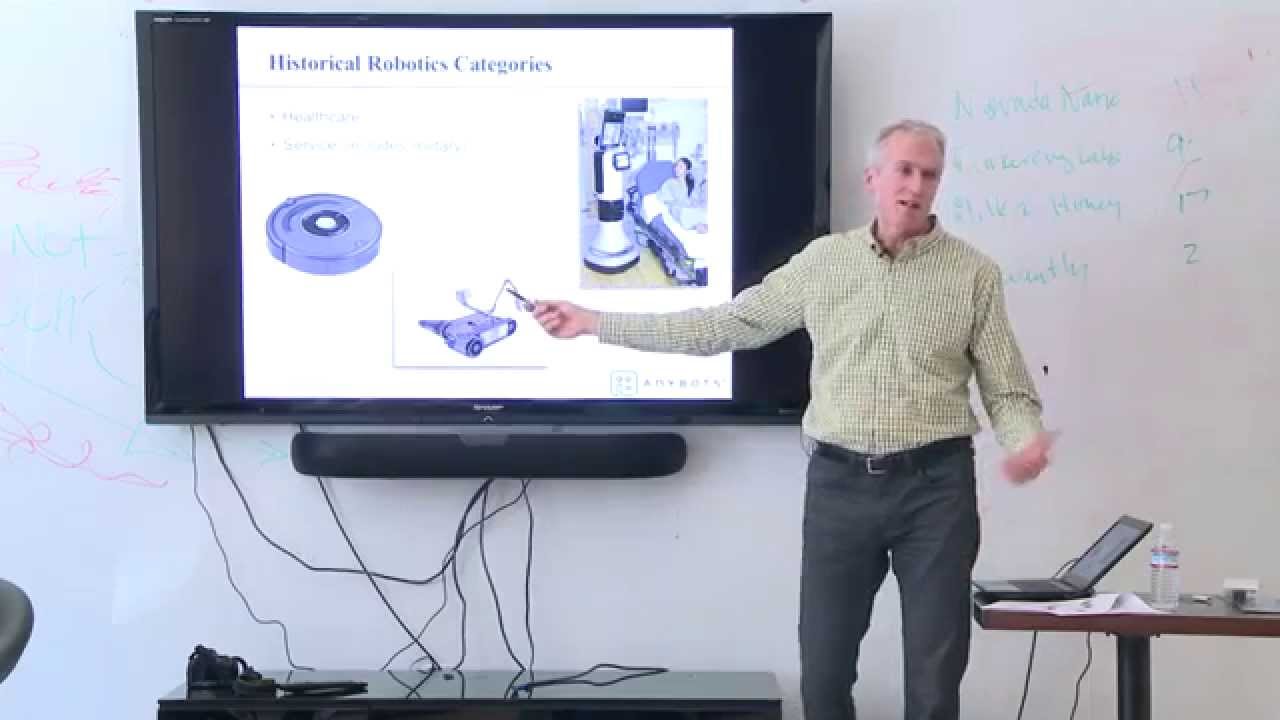
Tim Lenihan traces robotics from repeated false starts to today's working categories: manufacturing robots like Baxter, Amazon's Kiva warehouse systems, Intuitive Surgical's da Vinci for surgery, iRobot's Roomba, and military drones. The field keeps predicting the future wrong, but specific robots are already doing real work.
Chapters
Okay. So I guess kind of the— in the discussion about where robots are in society, one of the things that has happened— I'll kind of give you a little bit of history so that you get an idea. Because we're going to talk about what's happened in robots in the past and what's happening now. And the question is, is it different than what's happened in the past? And if it's different, why is it different? And so, you know, I went back and I grabbed a couple of these kind of interesting articles, and I just noticed the dates on here. So this is in 1996. In a cashless future, robots will cook. Right? So in 1996, you know, there's this kind of, hey, the robots are going to be here, they're going to be everywhere, they're going to be taking over. Right? In 1994, robots were actually kind of a There had been a little bit of a frothiness in the stock market, and if you had robots in your name as a publicly traded company, it was not a good thing. So this company, Precision Robots, changed their name to PRI Automation. And then you go to earlier this year, robots are gonna remake the workplace. So what's been happening, I mean, it's been, I guess, many of these kind of false starts for robotics. Where everyone said, oh yeah, robots will be here in 2 years or 5 years. And that's been going on since probably the mid-'80s. And so really the kind of question is, is that changing? And if it's changing, why is it changing? So just to give you a bit of background, this is kind of the historical perspective of robotics. Robotics have, there's really kind of a couple of key categories. And one of them is the manufacturing robotics. And I'm sure you guys have seen these. I think you're gonna go to the Tesla plant, or have you gone already? No. So maybe you'll go to the Tesla plant. Maybe that's supposed to be a surprise, I don't know. But you'll see this kind of thing, right? You'll see this kind of thing, and I think most of you guys have seen it, right? Which is, you know, you got these big robots and they're manufacturing, they're welding, they're painting, they're doing jobs that are dirty, repetitious, and unsafe. And then this is a kind of a new, form of the manufacturing robot. And actually, if you go up to Tim's office at any point, they have one of these there. It's called Baxter and it's a manufacturing robot as well. But that business has been historically driven by automobile manufacturing and it's large, heavy industrial robots. A couple of other areas of robotics, one is logistics. And if you were to go to the Amazon Amazon warehouse where they fulfill all the orders, you'll see a system like this. This is a company called Kiva, and that's what goes and gets the material off the shelf. So instead of having to send a person out there to get it, they can take one of these robots. It will go grab the material and bring it back. It gives them some flexibility in their workforce. So during slow periods of time, they just don't have as many robots on the floor. You get kind of into the Christmas rush. You just have to put more robots on the floor instead of hiring more people. Then there's medical robotics. There's a company, a local company here called Intuitive Surgical, which makes a robot called da Vinci. I think if you watch like, I don't know what, Grey's Anatomy? House. House, they talk about it. It's probably talked about in a whole bunch of TV shows, right? So any health TV show, you probably, At some point they probably mentioned this. And then you have a couple of other kind of segments. So they're in the healthcare, in the medical robotics. These are devices that actually help doctors perform procedures. That's one category of robotics. And then this category of robotics is really kind of healthcare services. And this is a similar device to what you saw here this morning, right? This is made by a company called InTouch Health. And it is a device where a doctor gets in and runs around the hospital and talks to the patients. It's made in conjunction with the guys who make this. Does anybody know what that is? The Roomba. The Roomba, right? It's made by this company called iRobot. iRobot also makes this. This is a large portion of iRobot's business. These are robots for military use. So it's kind of interesting, the robots for military use, you don't really kind of realize this, but The Department of Defense has been this huge funder up to date of robotics development. And so there's some, I don't know, you can find, this right here is a drone. You can see the size of it, it's pretty small. So that thing can, it flies into a room and it can figure out what's in the room for whoever wants to know. And it's the size of a bug. And then this thing right here is this, And it's the size of like a big cow and it can run around. And these are all things that have been, these are big, expensive R&D projects that have been funded by all sorts of Western governments. So,