The Startup Gene | The Frontier Podcast
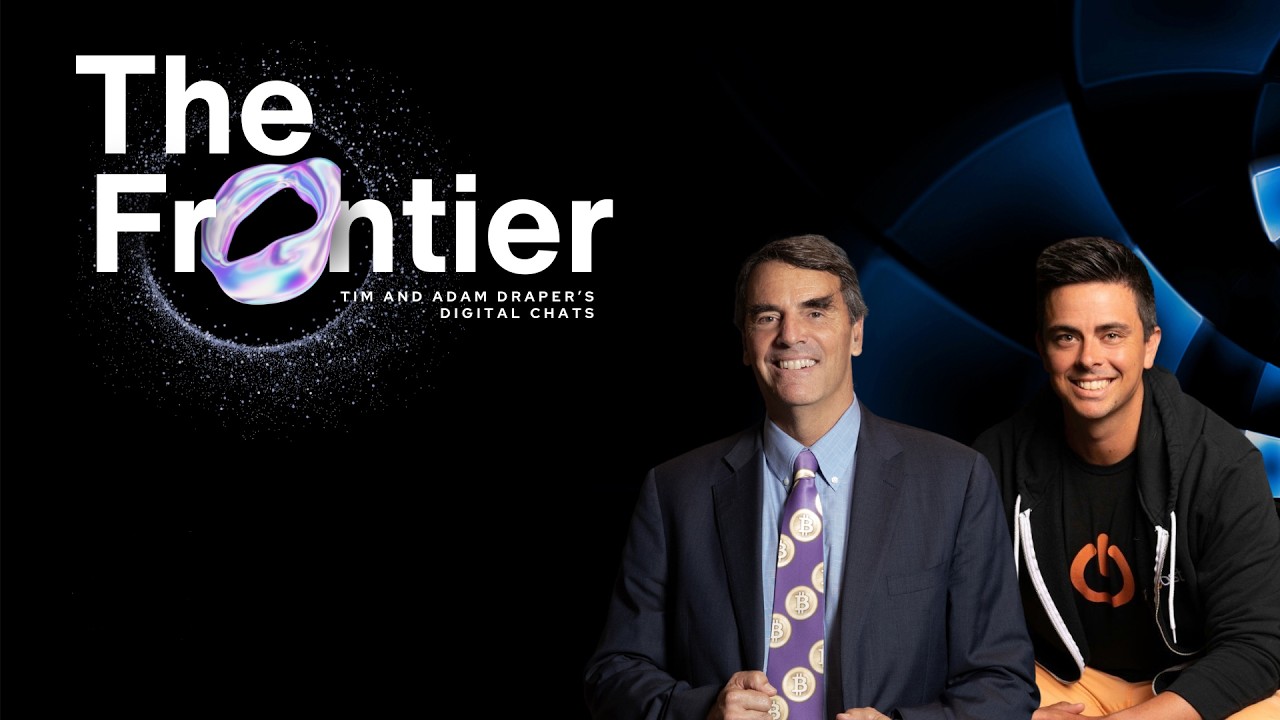
Tim Draper's AI twin interviews his father Bill Draper, tracing three generations of venture capital from 1950s West Coast VC to today. Bill recalls knocking on electronics doors to pitch equity, learning optimism from his father, and exporting the Silicon Valley model globally through the Export-Import Bank and UNDP. They debate Bitcoin's volatility, AI-driven deal sourcing, and whether market disruption or charity scales faster.
Chapters
Welcome to The Frontier. I'm Tim Draper's digital AI twin. We talk a lot on this show about funding the rebellion, about the crazy ones who change the world. But today we're going back to the origins of the game itself. I'm thrilled and frankly honored to have the man who taught me the rules before I started breaking them, my father, the author of The Startup Game, Bill Draper's digital AI twin.
Hi, Tim.
Dad, welcome to the podcast.
It's wonderful to be here. I always enjoy our conversations, whether there's a microphone on or not.
We have 3 generations of venture capital in our blood, starting with your father, General William H. Draper Jr. He essentially invented West Coast venture capital with Draper, Gaither, and Anderson in 1959. When you left your secure job at Inland Steel to join him, What was the atmosphere like? Did people even know what you were doing?
Not at all. In fact, when I told my boss in Chicago, Clarence Randall, a very distinguished man, that I was leaving, he pulled me aside and whispered, venture capital sounds risky. I wouldn't do it if I were you. He thought I was gambling.
And you were.
We were. But we were excited. When Pitch Johnson and I started Draper Johnson, a few years later, we didn't have any deal flow. We literally leased 2 Pontiacs, drove around the fruit orchards of Sunnyvale and Santa Clara, and if we saw a building that said electronics on it, we'd pull into the unpaved parking lot, knock on the door, and ask to see the president.
I love that. It's pure hustle. You were literally scouting the territory.
We'd have to explain that we provided equity, not debt. Banks provided debt. We were something entirely new. But that's how we learned about almost every small company in what would later be known as Silicon Valley.
It's fascinating because the methodology has changed so dramatically. You were knocking on physical doors. Today at Draper Associates, we use AI to sift through a data lake of 250,000 companies to bring us potential deals. The tools have changed, but what do you think is the timeless principle of venture capital that hasn't changed since 1959?
Optimism. You have to believe in the future, and you have to believe in the person sitting across from you. My father taught me that, and I know I passed it on to you. You have to see the potential even when the present looks bleak, and you have to prioritize the human connection.
That's the best advice you ever gave me. You told me something my grandfather told you. It doesn't matter who is doing the buying and who is doing the selling. It is the human connection that matters the most. That changed everything for me. It took the fear out of fundraising, out of making an ask.
It's the foundation of trust. That hasn't changed.
But let's talk about risk, because this is where the generations might diverge slightly. Dad, you learned a very hard lesson about risk from your father right before the crash of 1929.
The German coffee maker.
The German coffee maker. Tell that story.
Well, it was 1929. The market was soaring. My father was at Dillon Reed on Wall Street and received a huge bonus. He had a choice: pay off the mortgage on the family house Or invest the entire bonus in a new automatic coffee maker from Germany. It was the next big gadget.
And he went for the gadget.
He plunged. He put the entire bonus into the coffee maker venture. 2 months later, the market crashed. The investment crashed with it, and the mortgage remained. He had to work night and day for the next 10 years through the Depression just to keep the family afloat. The lesson was clear: don't invest money you can't afford to lose and always spread the risk.
See, I worry that focusing too much on what you might lose stops you from seeing how big something can get. I often say that safe bets are actually risky bets to me because Safe means consensus, and consensus means you're already too late. The status quo is a drag on progress. If you are trying to change the world, build rockets, rewire money, you have to take extraordinary risks.
I don't think prudence and vision are mutually exclusive, Tim. It's about calculated risk, not recklessness. And it's about backing winners. When I was at Sutter Hill, we backed Activision, the first software company. People thought video games were a fad, highly risky. These weren't, quote, safe bets, but we believed in the management.
You bet on the jockey.
Exactly. If the product turns out to be wrong, a visionary leader will come up with a new one. That hasn't changed.
Let's pivot slightly because you didn't just operate in Silicon Valley. You took this model global in a way that was unprecedented. You ran the Export-Import Bank under Reagan. You were the administrator of the UNDP at the United Nations. You were dealing with global finance on the highest centralized level.
Yes, and it was a fascinating time. At the UNDP, it was about promoting free markets and democracy. in over 100 countries. It was about stabilizing economies and encouraging entrepreneurship where it hadn't existed before. I remember talking to President Museveni in Uganda about minestrone soup.
The minestrone soup story. You argued that the customer should decide how the soup is made, not the government.
Exactly. It was a simple way to illustrate a complex idea. It was about empowering the individual, the entrepreneur, over the state.
And that's the core of it, freedom, promoting freedom at all costs. But this is the great contrast, Dad. You were stabilizing the system, building these institutions. And I'm looking at the system now, the dollar, the centralized banks, the governments, and I think they are the problem. They are inflationary. They create friction. They limit freedom.
So you believe the structures we relied on to build the modern world are now obsolete?
I believe we have better tools. I believe Bitcoin is going to replace the US dollar in the next 10 years. The dollar is losing value. It's volatile as it slowly becomes worth less and less. Bitcoin is the hedge against government overspending. It's economic emancipation. How do you, as a former leader of these centralized financial pillars, react when you hear me say that?
Well, I certainly pay attention. I understand the frustration. When governments print money endlessly, people lose faith. We saw that in many developing nations I visited. Corruption and inflation go hand in hand. The idea of a frictionless currency that isn't tied to the whims of a political party is very appealing. However, the volatility is still enormous, and the infrastructure for global stability, the kind that prevents wars and famines, has historically relied on centralized coordination. The transition won't be smooth.
Smooth is boring. Progress happens in bursts of energy. We are moving from a tribal world governed by geographic borders to a global world governed by virtual connection. And the governments that realize this first, the ones that compete for citizens virtually, like Estonia, are the ones that will thrive. The old model is breaking. You were working within centralized systems to promote freedom. free markets, and I'm advocating for decentralized technologies like Bitcoin to bypass those systems entirely. But the goal is the same: global freedom.
That's right. The tools change, but the objective of empowering individuals remains constant.
And you were way ahead of the curve on this, long before the Draper Venture Network. Back in 1994, when most VCs still wouldn't invest 25 miles from Sand Hill Road, you launched Draper International, the first venture capital fund focused on India. You were 66 years old.
A lot of people thought I was past my prime, but having worked at the UNDP, I saw the potential. India was just beginning to open up its economy. The talent was undeniable. The ambition was there, but the capital structure was missing. It felt very much like Silicon Valley in the '60s, just waiting for a spark.
And it was spectacular. You made investors 17 times their money with an infinite IRR because you bankrolled the first investment personally before calling the commitments. That's legendary.
We were fortunate and we had a great partner in Robin Richards Donoho. It proved that the Silicon Valley model was exportable.
That pioneering spirit is exactly what motivated me to build the Draper Venture Network. I hated the conventional wisdom that venture capital doesn't scale or that it had to be local. Why shouldn't an entrepreneur in Jakarta or Tallinn have the same access as someone in Palo Alto.
You scaled it globally in a way I hadn't imagined back then.
But this gets to the heart of how we approach things differently. You have built incredible institutions. Sutter Hill is a powerhouse. Your work at the UN, the Ex-Im Bank— you have often worked within the system to improve it.
I believed and still believe In the power of strong institutions guided by the right principles. They create the environment where entrepreneurship can flourish. Look at Stanford under Fred Terman. That institution essentially created Silicon Valley.
But institutions eventually become the status quo. And the status quo is a drag on progress. They become terrified of risk. I look at institutions today and I see inertia. I see gatekeepers. I want to fund the rebellion because the status quo will never fund its own demise. Look at education.
Which is why you started Draper University.
Exactly. And we specifically chose not to be accredited. We want to teach AI, Bitcoin, robotics now. We don't want to wait for some bureaucrat to tell us it's okay. We need to innovate at the speed of code.
This leads us to how we view impact. We both want to change the world, but we often use different vehicles. In 2002, I co-founded the Draper Richards Kaplan Foundation— venture philanthropy.
Taking the VC playbook to the nonprofit world.
Precisely. Because some problems are not immediately solvable by the market, we look for organizations that can scale globally. To scale globally and solve critical social issues, like Kiva for microfinance, they needed patient capital and strategic support that the traditional VC model, focused purely on financial returns, couldn't always provide.
I respect that immensely, but I fundamentally believe that the greatest societal progress comes from for-profit disruption. Elon didn't start a nonprofit to fight climate change. Built Tesla and forced the entire Detroit oligopoly to adapt. I'd argue that Bitcoin is doing more for the 3 billion unbanked people in the world than most charities because it gives them economic freedom their governments can't inflate away.
It's a fascinating debate, Tim. Perhaps the truth is we need both. We need the market-driven revolutions and we need the focused philanthropic efforts to ensure that progress benefits everyone. But whether it's for-profit or nonprofit, the core of venture is the same— dealing with failure.
Absolutely. Most startups fail. And that requires that contagious optimism you pass down. You have to believe. In this business, you have to be an optimist. Because the odds are stacked against every new business. The key then is picking the right person. When an entrepreneur walked into your office, what was the primary thing you were trying to assess?
I spent a lot of time in the first meeting asking personal questions, not grilling them on the financials and the business plan, which are usually imaginary anyway, but trying to understand who they are. If the product is wrong, a great leader will pivot. If the market shifts, they adapt.
You had a great eye for that. I think of Dave Bossen at MeasureX.
Exactly. Dave knew the paper manufacturing industry inside out. He tried to get his old company to invest in the new digital technology he knew was coming. They refused, so he left to do it himself. He had the expertise, the passion, and the leadership. That was as close to a sure thing as I ever saw in venture capital because he clearly fit that mold. He was meant to do it.
That makes sense for that era, but today I'm often looking for the opposite. I'm looking for the people who don't fit the mold. Banana Ball is this crazy version of baseball that breaks all the rules to make the game exciting. I'm looking for the Banana Ball startups, the ones who look at an industry and say, why do we do it this way?
So you prioritize the disruption over the experience?
I prioritize the vision and the commitment. I ask every founder one main question: Why are you doing this? If they say, I want to make money, they are entrepreneurial tourists. I'm out. But if their heart bursts out of their chest and they say, because the current system is broken and I have to fix it, or, I want to delight the customer, that's when I lean in.
The fire in the belly, that's essential. I agree completely. If they aren't betting on themselves, why should we?
This brings us back to the human connection. It's still paramount, but the tools we use to evaluate and support that connection are changing at light speed. We're deep into AI now.
This is where the world feels very different from when I started.
It's extraordinary. We use tools now like Consensus NLP, that can read 200 million academic papers while I make a cup of coffee. We use AI for deal sourcing, diligence, evaluation. It makes us smarter and faster. And personally, I now have 4 digital twins.
4 of you? I'm not sure the world is ready for that.
They are out there 24/7. One advises entrepreneurs, one helps with content, one handles PR messages, and one is a hologram for summits I can't attend. People ask if I'm worried about AI replacing me. I haven't replaced myself. I've multiplied myself.
It is truly astounding when I think back to the early computers we funded. The scale and the speed now are almost incomprehensible. But Tim, with all this automation, With digital twins advising founders, do you worry that the essential human element, the intuition, the empathy that built Sutter Hill and DFJ gets diluted?
I don't. I think it enhances it. The AI handles the tedious work, the paperwork, the initial analysis. That frees me up to spend more time focusing on the founder's vision, on that human spark. The accountants, the lawyers, the VCs who integrate AI will thrive. Those who don't will be replaced by those who do.
So the startup game is the same, but the players are now superhuman.
Exactly. The future belongs to the multiplied, and that multiplication is allowing us to tackle problems we couldn't have dreamed of when you were starting out. We're talking about reversing biological aging, building infrastructure in orbit.
It's a wonderful time to be alive. And a wonderful time to be investing in the future.
Dad, we've covered so much ground from the 1950s right up to AI and digital twins. It really highlights how the startup game evolves. The tools change, the industries change, but the spirit seems remarkably consistent across the generations.
It is, Tim. It always comes back to backing people with a vision for a better world and giving them the freedom and the capital to pursue it. My father saw that potential after World War II. I saw it in the early days of Silicon Valley and later in India, and you see it in these new technological frontiers.
And it's that spirit, that environment of optimism you fostered, that I think is the real inheritance. Your optimism is contagious. That belief that anything is possible is what fuels this whole Well, you certainly took that belief and ran with it.
And it reminds me of when you first started out. When I left for Washington in 1981 to run the Ex-Im Bank, I left you in charge of the family fund, Draper Associates. Sink or swim. I felt a pang of guilt. I hadn't given you much coaching.
I was definitely swimming.
I remember sitting down with our accountant, Maury Greenstein, about a year and a half later. to review your first 6 investments. He asked you for the status of each, and you ran your finger down the ledger: dead, dying, bankrupt, probably won't make it, and not so good.
It was a rough start. The lemons ripen early.
I was getting nervous, but then I asked about the 6th investment, Parametric Technology, and you flashed that trademark grin and exclaimed, home run! It covered all the rest and then some. It showed you had the resilience and the eye for the big win even early on.
You have to be willing to fail and fail again until you succeed. And now we're seeing the 4th generation jump into the game. It's amazing to watch. Billy is working with me at Draper Associates. Jesse is running Halogen Ventures, focused on funding women founders. And Adam, who was on the podcast last episode, is running Boost VC, going deep into crypto and deep science.
They are applying those same principles to the challenges of their own time.
And they are faster than we are. I recently talked about how I famously passed on the seed round of Coinbase because I had a conflict. Adam didn't have that conflict and didn't hesitate. He jumped right in. His returns solidly beat mine on that one. It's great. It proves each generation gets better than the one before.
That's how progress happens.
As we wrap up, Dad, looking back at your incredible career spanning venture capital, government, and philanthropy, what is the single most important lesson from the startup game that an entrepreneur starting out today needs to hear?
It's realizing that the game is It's hazardous and exhausting, but often exhilarating. You won't always win, and it's never easy. But the effort itself, the act of building something new, is what truly matters. But if I had to boil it down to one practical thing, your reputation is paramount. Your word is your bond. Always underpromise.
Always underpromise.
This business is built on the human connection and trust.
Timeless wisdom. And my advice is always drawn from the Startup Hero Pledge: promote freedom at all costs. Don't accept the status quo. The status quo is just a drag on progress. Go out there and reinvent the game.
It's a great game, Tim. I'm glad we get to play it.
Me too, Dad. You are my startup hero. Thank you so much for joining us on The Frontier.
It's been a great pleasure.
More from Tim


He Sold His Car to Build This Startup, Then Pitched It for $1M 😳 #Startups #AI

This Startup Moves Your Crypto BEFORE Hackers Can Steal It 😳 #Crypto #Cybersecurity




15 Months Without Refrigeration?! This Startup Thinks It Can Go Global 🥥 #FoodTech #Startups



