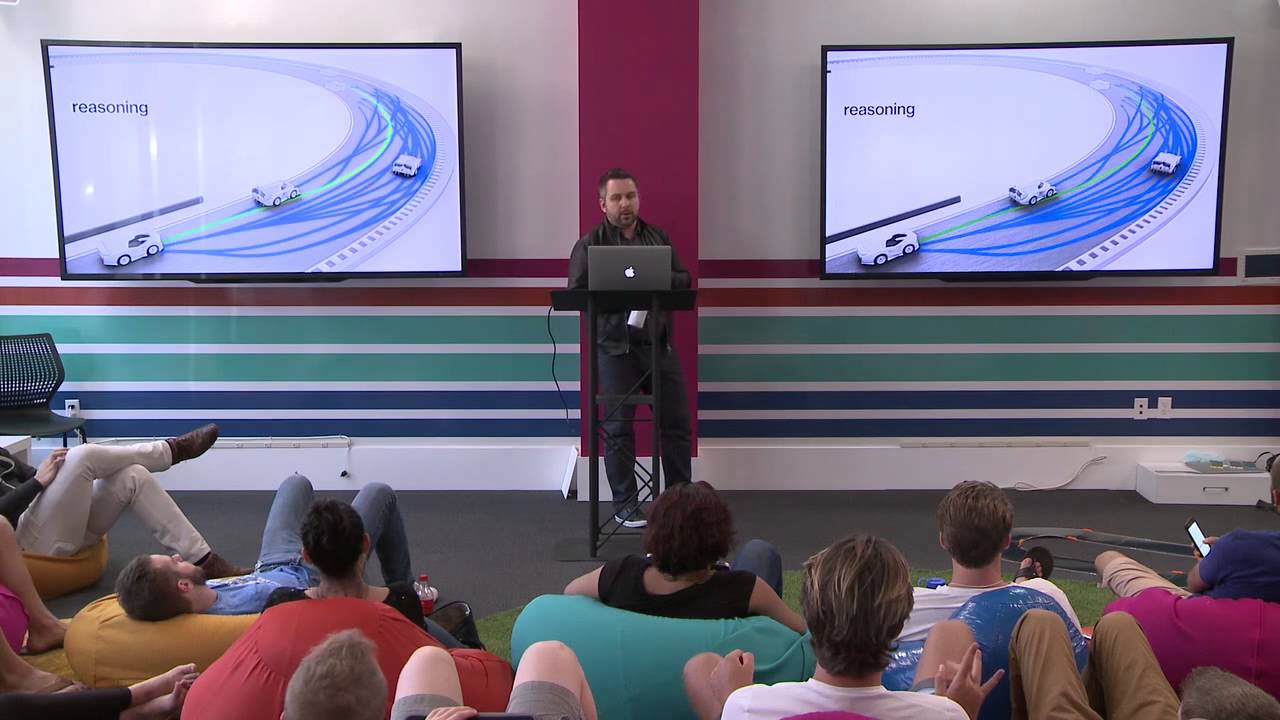
In this presentation, Hanns Tappeiner gives a concise technical overview of the core architecture that powers Anki Overdrive (now Anki Drive) robots. He distills any robotics problem into three fundamental pillars—Positioning, Reasoning, and Execution. Positioning provides each car with precise knowledge of its location relative to the track and other cars, enabling any higher‑level behavior. Reasoning is the AI layer that, at roughly 1,000 cycles per second, decides whether to overtake, block, or attack another car. Execution translates the chosen plan into motor commands, handling dynamics such as sliding in curves and minimizing the need for re‑planning. By abstracting these pillars, Anki treats physical cars like video‑game characters, allowing the company to leverage decades of game‑engine software. Tappeiner caps the talk with scale metrics: over 240 million laps (≈715,000 miles), 22.9 trillion AI decisions made in consumer homes, underscoring the unprecedented real‑world deployment of autonomous decision‑making.
Chapters
Who has a technical background here? Some people with technical background? Okay. So for you it might be a little bit easy, for other people it might be a little hard, but I want to give you a very quick overview of the technology inside of OnkyDrive and what allows us to do this. So one of the big things we realized on the tech side is that any robotics problem, no matter what it is, you can boil it down to 3— into 3 main components, and we call them Positioning, reasoning, and execution. And I'll tell you what those mean in the context of Anki Drive and then show you what else— where else you can use them. So positioning means that each robot, in this case it's Anki Overdrive race cars, in order to do anything smart, they need to know exactly where in their world they are located. So they need to know exactly, okay, I'm located here, the other cars are next to me. One is in front, one is on the left side, and then you can start doing sort of like smart things about that. But if you don't know where you are, you can't do anything clever. Imagine you're, I guess, playing a game of tag with your friends and somebody blindfolds you. It becomes impossible to play tag. But if you take that blindfold off, it's very reasonable to play tag. And there's— that's no different for you than it is for Anki Overdrive cars or other autonomous vehicles or any— robot which is trying to do anything smart in the real world. So this positioning is very important. The next step is then reasoning, which means once you know where you are, you can now make smart decisions about what you want to do next. In OverDrive, that means, for example, each car about 1,000 times per second is trying to figure out, should I pass this other car now or should I slow down or push it off the road or shoot at it? And so many, many decisions like that are happening per second. And that's what we call the reasoning or the artificial intelligence. The third one is execution. Excuse me. What that means is once you have a plan, once you know what you want to do, the cars need to be able to execute that plan really well. Meaning, let's say the car is driving, the plan is to drive really fast into a curve and the car starts to slide. That means you're not executing the plan well, and then you've got to make a new plan. So the better the cars are at executing that plan, the less times you need to make a new plan. So those 3 things— positioning, reasoning, execution— are really fundamental. And what they allowed us to do is they allowed us to take away all the difficulties of the real world and treat those cars just like as if they were characters in a video game. And now we are able to use the last 25 years of software development in video games and apply it to real physical things. So that's sort of a little bit on the tech inside the product. And just to give you a few numbers before we finish this off. So since launch, Anki Drive cars have been driving— let me try to get the numbers right— over 240 million laps, which is approximately 715,000 miles or about 30 times around the globe or 3 times to the moon. And that's all driven by cars which are Which you see standing here. So they're about like 2.5 inches long. So those are huge distances. And the cool thing for us as robotics guys is the last one. So while those cars are driving, they make many, many decisions per second. And so we have a total of 22.9 trillion decisions. And those are not decisions which happen in a lab somewhere or so, but those are actual decisions which in hundreds of thousands of people's homes affected the behavior of in the end, a group of small robots. So that's something which hasn't happened before, and we're very proud of it.