They Called Him Crazy—Now He’s Helping Millions Hear Again | Meet The Drapers India: Mumbai
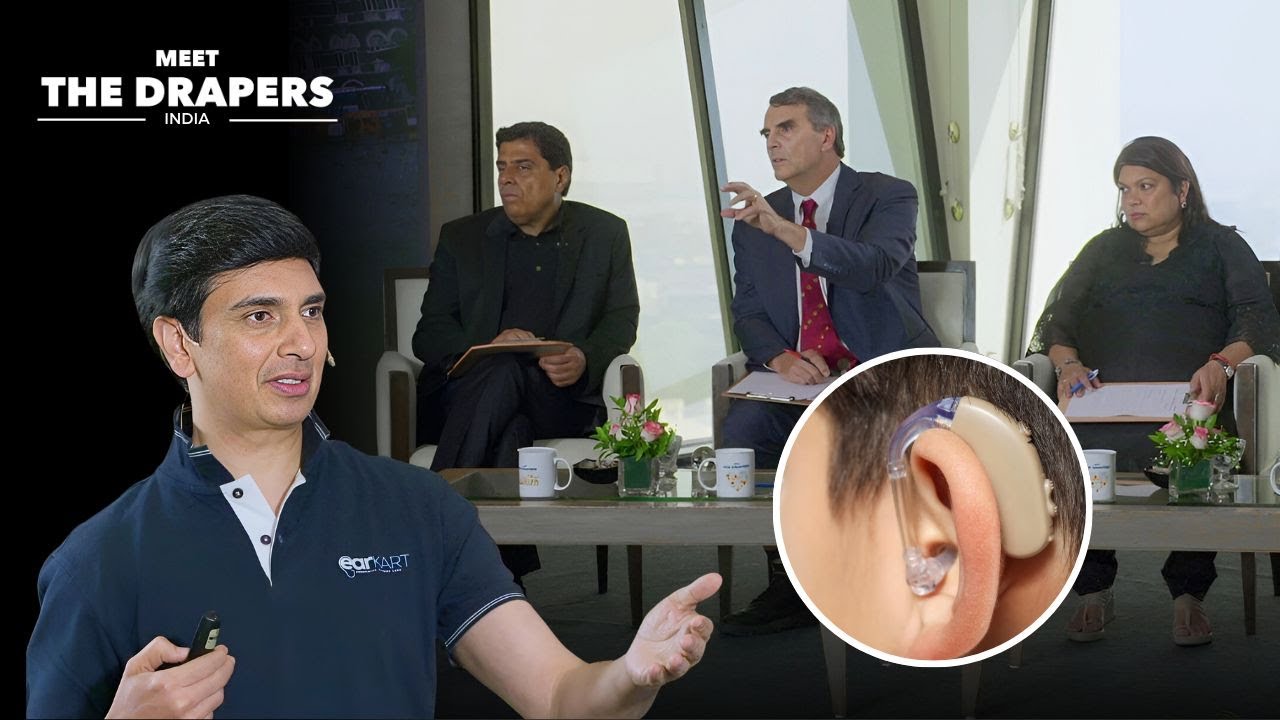
Tim Draper judges startup pitches in Mumbai for a $1 million investment. Rohit and Monica Mishra pitch Earcart, a low-cost remotely programmable hearing solution that helps millions access affordable hearing aids. Thelightbulb.ai wins the round.
Chapters
In 1994, my father was the first Silicon Valley venture capitalist in India. He believed in the spirit of this incredible country. 30 years later, my sister Polly and I are on a mission to find India's next unicorn. I'm Tim Draper. I've invested in game-changing companies. Now we're crisscrossing the We're traveling across an entire subcontinent, meeting the brightest minds in the world's most populous country as we search for the country's top entrepreneurs. Thousands applied, but only 28 companies have made the cut for a chance to win an investment of $1 million and a shot at changing the world. It's a journey packed with adventure, innovation, and unforgettable moments. Who will rise to the challenge? Who will be India's next great entrepreneur? Let the games begin. We're in Mumbai, and this is the Gates of India. This is the most exciting, dynamic city. It's sort of out-New York's New York. The entrepreneurs here are vibrant and We are going to have an amazing show for you here in Mumbai. Mumbai is home to Bollywood. I think it's my big chance to be a Bollywood star. Here we are. We're going to just keep Bollywood dancing. Well, thanks for letting us see the set. Oh, I like this. Who's tough on them and who's just saying, "Hey, whatever you guys do is great." I think we are wonderful.
Everything.
A little bit of everything.
And we need a better set. Look at this.
Yes, thank you. I just want to say that I started my venture career with this VC in Spain called Draper B1.
Oh, they're great. Yeah, I was trained to pick startups there and have been able to use it.
Terrific.
Sure, we'll fund whatever you got.
A million-dollar investment.
This $1 million from Tim could be a great asset.
It would mean ability to scale and, you know, provide employment to even more people faster.
We're really looking for venture partners who can help us land safely and promote our business in such an important geography.
We should be able to certify—
use that money to certify our products, Will take us to at least $50 to $60 million in a very short term.
I think what it would open for us is a ton of opportunity and also insights.
It's a backbone that we need right now.
This is critical for us.
Hey, welcome everybody to Meet the Drapers. Great to have you here. We're in a live audience here at the Oberoi in Mumbai. Very exciting to We have 2 of the most amazing Indian entrepreneurs in our midst, and they are going to be guest judges for us today. On my left, we have Falguni Nair.
Nair.
Draper. Oh, I'm sorry, I didn't tell you. We adopt. All of our guest judges. Happy to be here. Yeah, she is— get this— one of 2 women billionaires self-made in India. I mean, wow, fantastic. And to my right here is Ronnie Screwvala Draper. He's an Indian entrepreneur, investor, and film producer. Been named Esquire's list of 75 most influential people of the 21st century. You're a great entrepreneur. What are you going to be looking for here?
I think it's exciting to see very young entrepreneurs who have got that basic foundation really right and to sort of see how strong their foundation is at that very early stage.
Fantastic. And to my far left, we have Polly Draper, actor, producer, writer, director.
Mother.
Mother of 2 superstars. They are superstars. Let's bring on our first entrepreneur. What do you think? But before we do, let's see what's going on behind the scenes. And here's where the eyebrows come in. You do this.
Hi, my name is Ritu Soni Srivastava, part of the co-founding team at thelightbulb.ai.
Myself, Yogesh.
I'm also the co-founder here at thelightbulb.ai.
We are actually a second-time founding team. We've all been together now for 15 years. Our first startup was in the space of health and weight loss. It was a weight loss coaching app called Obino, which we sold to US-based investors. Post that, when we all got together, we knew we wanted to start up again. We were watching our kids study online, or rather not study online, and that was where the idea for the Lightbulb really came. We wanted to help measure learner engagement in online education, and the only way you could do that was by looking at the expressions of students while they were learning. Well, we've been around for about 18 months now, and I think what we're really happy about is that we've been able to work with over 12 customers across the top market research agencies in India and 11 key enterprise brands. We have very set structures and patterns. We all catch up for scrums in the morning and then everybody delinks to do their own thing, and then they catch up again to review projects. So it's a very relaxed, decentralized, non-startup method way of working. We're not the typical hustle culture with everybody running pillar to post, and I think that's a function of the fact that we're second-time founders. I think I'm an English literature graduate. I never thought I would be building tech products, and I never thought I would be building in the space of AI. I think we're at stages in our life where we know that work is important, but we also know the importance of pacing ourselves. Because startups are like marathons. They're not sprints. If you burn out in the first couple of years, you're not going to be able to consistently deliver value. We're not really tech entrepreneurs from the get-go. We started mid-career in the startup space. So I think every day is as much a surprise to me as it is to the rest of us. It's just, it's a great trajectory to be in.
We are at Gateway of India, the iconic Gateway of India. You talk about Bombay, so it's this.
And it's under renovation, unfortunately. It doesn't matter what time of the day or night you step out, it really doesn't matter where you are in Mumbai, because the city is buzzing even at like 3 AM in the morning. So you basically chill out, have a banta, eat some good food, and you're done. This is Sanjay Gandhi National Park, so there's A literal national park in the middle of the city. I don't think you'd see that anywhere else except Mumbai. I think Mumbai is called the city of dreams for a reason. Because Bollywood is here, everybody really comes here to fulfill their dreams.
Bollywood is here.
For startups, I think it's like the best place to be because you're literally chasing your dreams. So what better place to do it than Mumbai?
It's the business capital of India.
When you raise, every investment pitch is like an onstage pitch. So you're constantly just pitching, pitching, performing, pitching. Gets to you, you do it in your sleep now. What we're essentially trying to do is build an AI-powered insights platform that allows you to gauge unstated responses. We bring forth textual AI, visual AI, conversational AI, and we amplify the effect of it with generative AI. With 3 patents, over 20 million face frames scanned, we have achieved over 80 to 90% accuracy and are building for the consumer insights market globally. Most consumer research today is based on stated responses, but we know that consumers rarely do what they say they will do, and what they actually do reflects what they are feeling at that particular point of time. So whether it's quantitative research from website UX testing to ads testing to content, movie scripts, promos, to whether it's qualitative research, whether you're generating conversational insights, unstated responses, our product cuts across the spectrum of custom research for brands that are large in size.
So Nielsen ratings, they monitor exactly what people do. Correct.
In India, BARC and IMRB do.
So what's the benefit of AI in this world?
Most stated responses today, even surveillance or TRPs, are stated responses that are corroborated with questionnaires. However, when you look at an ad, The way your eyes light up, the way you resonate with a particular tagline, or the way you resonate when a celebrity comes on screen. Those are things that will not come out in stated surveys.
You're using the camera on the computer for this?
We use the camera and the audio.
Do people have to opt in, or you're just watching?
No, we would love to do that. No, we are compliant with all data privacy regulations worldwide, including GDPR, SOC 2, and ISO.
And so Yogesh, you Are you better at doing it or at managing people who are doing it?
Both things.
So we have a team of around 10 engineers, and I myself also do the coding as well as infrastructure.
What is the moat versus Nielsen? What is the moat versus anything?
Excellent question. I think the tech is not difficult to replicate today if you have enough capital. What makes testing truly unique to a company is the fact that the Data that is tested on your platform sets a certain benchmark. Question does come up very often with investors because the ability to detect emotion—it's not a particularly niche skill, right? A lot of people have it. AWS does it. Microsoft does it. Google does it.
But the problem is it stops there. Who has used you so far?
So we've been used not just by the leading market research agencies in the market, whether it's Kantar, Nielsen, IMRB, Quantum—all of the top names in the business work with us. We also We also work directly with their customers, those brands. So whether it's Amazon, Swiggy, Myntra, Streaks, Godrej, they're all using our product as well.
Do you think Google and Meta may come into this space providing this as an add-on ability on their social media platforms?
The reason I don't think they will get into this space is we've built an application layer on top of the base APIs. Now, base APIs can be replicated. but understanding the domain workflows and building benchmarks for every industry is not something a large player like Google will ever get into.
Thank you so much for being on Meet the Drapers.
It was amazing.
Great. Fantastic.
Thank you. I was actually more stressed than I thought I would be, but I think they were very warm and very, very approachable. It was easy to even disagree with them, which is very rare in a pitching competition. So I think It was a great experience.
I love that team. I loved how specific she was about what she wanted to target. When you asked her if you could— if it got into the, you know, Google and the— she said, that's not what we're going for. We're going for this.
I see a lot of use cases for this. I think, like, at Nykaa, we wanted to interview a large group of women all across the country and ask them that are they really independent? How independent are they? And I immediately thought of a use case where if I could have this technology— Would you be a customer? Because that's what consultants do. I would definitely be a customer.
The space is really open for disruption, which is why I think it's an exciting opportunity because it is really open for disruption. So, but you need that mindset.
Okay, let's move on to our next entrepreneur. But before we do, let's see what's going on behind, behind the scenes is beautiful Mumbai.
So I'm Vikram Sharma.
I'm from Wi-Fi. We are a home improvement and home maintenance services company. I left from India. I went and worked and studied in the US. I went from a grad school in the US. That was late '90s. And then I lived and worked overseas for about 10, 15 years. And I realized most of the work I'm doing in the Western world is about eliminating jobs, whereas back home in my own country, I see a lot of unemployment. So that's a problem I felt is a problem I need to solve. So I decided to move back and work towards that. This is the kind of work which will give me satisfaction and also make a change in the world, really make a difference. So we have now more than 200 brands who work with us. We have unlimited demand. We are short on supply. I have so much work. There's a waitlist of companies and products that we need to solve. or work for. So that, I believe, is the thing. There's a recognition for us that these are the people— Wi-Fi is the company who can solve their problem, right? And I don't have enough capacity to solve it. In the office, we have just about 50, 60 people. So my day usually begins in the office but ends in the field. So I, you know, go to our stand-up meetings in the morning, then I'm out in the field every day, a new city sometimes. Like today, I was supposed to be in Bangalore, but I'm here now. I'll go there tomorrow. in the year 2000, I'm sitting and looking at 2025, one thing which would surprise me is like, oh, did it take that long? 25 years to get there? At that time, I couldn't have imagined it'll take so long for me to reach where I am today. I would've imagined at that time it'll take me 10 years to get where I'm today. It had taken me 25. I've been living in Mumbai for about 15 years now. I originally grew up in the north in the Himalayas, and then I lived around the world, but Mumbai is home now. The life is fast yet easy. The energy of people, the quality of people, everything here is great. So Mumbai has some of the best food. It's really an old city, so you'll find here places which are 100 or more years old for food. I would say most people would want to come here where we are right now, the Marine Drive. In the evening, this is buzzing. You could come sit here with a cup of chai or a coffee and do whatever. I think there's a lot of vibrancy. People know there is business to be done here, so no wasting time. Just get to it, right? So there's no laid-back attitude here, which you would see some of the smaller towns. So people just want to get to work. The time constraint and the fact that you gotta do it real quick in front of so many people, that gets to you.
Why is it called Wi-Fi? Yeah, that seems very confusing.
Yeah, when we started the company, our first product or service to the market was installation. So it was we install for you. Then I became imagine, imagine, innovate, implement. So it's like we, I for you.
Give us your pitch.
Home improvement is a very large industry. In India, it's a $300 billion industry. There are more than 50 million workers in it. The biggest problem is a lot of people, but you can't find enough skilled people. Brands also struggle to get their products installed and maintained in the consumers. We have solved global problems earlier. We are serial founders and we love to solve big problems. It's a big problem. How we have solved it? We have an apprenticeship-based skill tech where we skill and upskill traditional tradesmen. And on the other hand, we have a full-stack fulfillment platform for brands and consumers. And we know our solution is working because more than 200 brands have signed up with us. We have actually delivered more than 300,000 services, and we're adding 40,000 new homes every month. We are currently at a run rate of $6.5 million in revenue. We're operationally profitable, and our CAC is zero. Our, our, our business model is highly capital efficient. With less than $4 million of cumulative burn, we have a cumulative revenue of over $15 million.
The company is a skilling company, a services company, a technology company. What would you say first?
What would be first? We are a technology-enabled services company, but skilling is essential for us. Unlike the West, which is Europe or America, where there's a mass pool of skilled professionals available, in India, while we have a lot of people, the skill base is very shallow. So we need to create that supply side. Varun, for example, also asked, are you a skilling company or are you a service company? Right? And I answered him, look, we are a service company first, but we need to be doing skilling to deliver the service. So we are the largest assembler of modular kitchens in the country. We are also the largest provider of smart home solutions like digital door locks and other smart devices inside the home.
And are you going to start using AI to train people to do things and then it just becomes sort of an automatic thing?
We need to take people who are in the trade, Upskill them so they can handle these, you know, highly—
How do you reach your— it's B to B to C. How do you reach C?
So the brands— so we first sign up with the brands. Brands send us to consumers' homes, and these consumers then get to know us. And whenever these consumers are reaching the brand for after-sales service, the brand says, go to Wi-Fi. They are our authorized representative. Like if you go to IKEA's website, you'll find our name listed there and linked to our website. Yeah, I think the AI question I could have answered better. I answered part of it, the first part of it. The second part I didn't get a chance to. AI would have a huge role to play. Technicians could be using AI real-time on-job support. We are the first company in the country to also introduce women technicians. We have women carpenters, electricians, plumbers. Every person who works with us is able to double their income every year.
The customer pays you, or it's either brand pays you or customer?
So 90% of the services, uh, brand has already paid, paid us for this, because when you buy a product from a brand, Your purchase price includes installation.
But if you can charge the customers, you'll probably get more money.
Yes, and we are already doing— beginning to do that because every installation we do—
Then your marketing cost won't be zero.
It will still be zero because our CAC is zero because we don't pay anything to acquire the customer. Customer is automatically reaching us through the brand, or brand is referring the consumer to us.
Well, Vikram, thank you so much for coming, being on Meet the Drapers. Thank you, Tim. Good job. Good job.
Thank you. The judges there had great questions. Some of them I didn't expect. I'm feeling great. Very happy that I had this opportunity.
It's about execution. It's going to be about pace of execution. Just B2B2C has its own limitations.
There's always going to be demand from the consumer To get these services.
Because your competitor is somebody you can just pick up a phone and he's in that 4-kilometer, 2-kilometer radius and can come in and do pretty much the same stuff, but maybe not as institutionalized as some of the companies will do.
I think there is a need for a platform for services where, like TaskRabbit. I've used TaskRabbit in the US and it's so convenient when you don't know who to call, you just get somebody on TaskRabbit and it works. But like Ronnie said, I think A lot of people have been not so successful in the past and these platforms haven't got built.
And respectfully, that's a good investor pitch, but it's not practical in business.
What did everybody think of Wi-Fi and Vikram? All right, let's hear from our next entrepreneur. But before we do, let's see what's going on behind the scenes. We're on an adventure in beautiful Mumbai, headed to this island in the middle of Mumbai where they have a big startup incubator. This is so cool! This is Sish Desai, who runs this incredible think tank, and the building's one of the great incubators there are. The whole This place is a work of art.
So you don't need a receptionist.
Oh my God. Can you show me the way? How do I get there? This is all the papers you've done?
All the papers, yeah.
I love the art here. This is so great. That's great, although I'm I may be a little heavy for it. I'm hearing a creak.
Kenji's arty, you know.
What a great backdrop.
This is a dream too, right?
It would be interesting to see what he actually. Used in each of those. Yeah, like, I mean, the shapes are very different shapes. Yeah, yeah, but they're kind of all hexagons. They're like those water bubbles. Yeah, yeah.
Hi, my name is Rohit Mishra. I'm founder at Earcart. Hi, I'm Monica Mishra.
I'm co-founder at Earcart.
She had one of the best cosmetology practices up north in Delhi, a very, very evolved one. But she gave up that and she said, why don't we start on this journey together? Because 2 is a better team than one.
And actually it came true, and I think it was the right decision for me.
Startup is not an easy journey and for a faint-hearted one. A lot of my friends, a lot of my colleagues, a lot of well-wishers also said it's a very stupid decision. If these big companies have not been able to do it, why are you even going in that direction?
It was like It's the time for you to retire and you are entering the entrepreneur world.
What was more frustrating that I was the managing director of a multinational world's top 5 companies. Being there in 15 years, we did not do significant things. We kept eating market share from one another, but nobody started working on reaching out to the people who need service. We thought this will be not only a service but also become into an expandable business model globally. It will prevent onset of a lot of things like heart stroke, brain stroke, diabetes, dementia, Alzheimer's, and that's made me go in a direction and try to solve a problem myself. Numbers have outlived my expectations, they have outperformed my expectations, and I think together we have created a model which has now become self-sustained on its own. So if I look back, I'm so relieved. I'm so so comforted from the time that I was anxious and nervous.
So if you did win today, who's your first call? Like, who do you share your victories with?
Mom, dad, kids.
Parents.
And of course my team, because they have really, really, really worked hard across these 3 years.
Working with Tim, I think this has come as an opportunity at the right time.
think with his insightful information coming for US, Tim could be a great asset, not in terms only of finances, but in terms of showing us the right way to get into the US market.
Viewers, usually I'm pretty easy to reach. I mean, there are only 300 million of you, I'm making it a lot easier for you to contact me. I have downloaded my brain into this digital twin, and you can scan this QR code, you can pitch me your idea, you can talk about your business, anything, and I'll answer it 24/7. Enjoy it, it's great. It's a new feature of Meet the Drapers and Draper TV. I think you're gonna have some fun.
Mumbai, it was the original Bombay.
Bombay accepts everyone. Bombay never sleeps. Mumbai is the heart of India.
We have got two things that we always do: eat pani puri. You should not leave Bombay without eating pani puri and vada pav. Second, have a stroll on the Marine Drive. That's one of the most relaxing things one can ever do. That building right behind, that Roman architecture, is the Elphinstone Building. This area on the left to us is the St. Thomas's Church, which is more than 300 years old. I want to show the most important part of Bombay. We are sitting right opposite to the Bombay Stock Exchange. Now, as a startup, my dreams are to be seen as a public limited company one day. In the Bombay Stock Exchange, and that's where my dreams are living. Way back in 2007 when I joined this industry, 60% of the global population doesn't have access to an audiologist. 90% of the globe cannot afford a good hearing aid. Out of 100 people who need a hearing aid, only 5 wear it, and the reason being the shortage of audiologists. Imagine, for a country like India, 1.5 billion people, we have just about 7,500 audiologists practicing. For America, it's just about 14,000, where the need in India is about 120,000, and for US, it's about 86,000. So this gap unbelievably has not been filled for last 4 decades.
We have developed a device which is a plug-and-play model. It can be installed anywhere in any part of the world.
It can be Africa, person sitting in Bombay can do the diagnosis part. Now I can also program the hearing aid at Africa.
Anywhere the customer who needs to be diagnosed for the hearing loss, and then the remotely fitting of the hearing aids can be done by an audiologist.
These hearing aids largely are costing about $1,000 to a pair in the US, and in India also, we're trying to make it down to $320, and that too on Deafhood Day.
But are you also making the hearing aids?
Yes, which can be remotely programmed, which can also be programmed by a person's iPhone and Android phone.
And you're saying you've already sold 300,000 of them?
That's right, yes.
You have such a big market, why are you suddenly so excited about the United States other than the fact that you're pitching with the—
Right, and you've sold 300,000 of them at $300 each. You're a $90 million business.
At a different price point, it's starting from $20.
You're the biggest startup we've ever had on the show.
I think they didn't understand fully about the price point. The price point starts from $20, goes not up to It's beyond that. It's only when you keep adding the features to the hearing aid, the prices go up.
Do I have the numbers right?
So it starts from $20 also, goes all the way up to $3,200.
$20 hearing aid?
That's right. The initial minute or so was very jittery. I was fidgety. I was not sure. But then it became easy to get into interactive question and answer mode.
How have you managed to make them so much cheaper?
Hearing aid is just about, say, about $70, $80. for every manufacturer. The only thing that we have done differently is to make this diagnosis thing, which is globally sourced, made it democratized. I can do the diagnosis at every single place. When a person is diagnosed, the adoption rate goes up by 10x.
You diagnose online or do I have— you can diagnose online? Online. You don't have to go anywhere.
You can be sitting at home or an ENT clinic or a church or a temple. The audiologist can be sitting on the other side in India. And the machine can be at your place.
Do you also do regular monitoring of the patients with your remote technology to facilitate and give proactive advice to them on—
Yes. So every time there's a patient who has taken our service is also given free consultations to come and talk to our audiologists. And we do track that, the quality of the calls, the kind of complaints they are coming up with, the solutions, and if we are able to make some improvements to the entire journey of the patient.
We have a strong customer support team. Who gives us regular calls and send messages on WhatsApp also. We give— we offer them free online consultations.
And who are your competitors in India?
Luckily, there is none. Not in India and not in the world.
You're solving the affordability problem and accessing—
and accessibility.
What are you really out there to solve?
Because that's very important. Accessibility problem with affordability also. Both.
Well, Rohit and Monica, thank you so much for coming and being on Meet the Drapers.
Yeah, thank you very much. Sometimes we don't get so many questions in one go, but they were very insightful and they were very deep questions. It actually reflects deep understanding of the business from all the judges.
I think they understood the relationship between the diagnostic and the solution both.
It's a massive, massive, massive market and it hasn't really been catered to, not just in India but in many other developing countries. The second is I know for a fact that the margins are very good in this business. Because actually the ability to manufacture and the price at which people will pay to be able to have that 30% up in your hearing is huge.
There is a need for this service in a much bigger way, and it needs to reach out in a much bigger way, the way blood testing now, or even, you know, the eye care services are now so much widely available so that it stops being a problem for people who have the problem.
I love the fact that In India, a lot of people who thought they couldn't afford to get hearing aids can now get them.
So here we are in Mumbai. Entrepreneurs are everywhere, and let's bring on another one. But before we do, let's see what's going on behind the scenes.
My name is Anil Alex. I'm the founder and CEO of Frontiers Private Limited. I've been an accidental entrepreneur. I've been in the corporate side or corporate world for so long. almost like 25+ years. I was there in the US for about 4-5 years and then came back to India and saw that, you know, there's still a big gap with respect to medical devices and the overall healthcare infrastructure here in India. And it again dates back to when I was born and I was a toddler. I had an accident and it's till today I cannot move my hand. You know, so this entire movement is not there, and that's basically got me going to see, can I do something to solve that problem? Day to day, I mean, we are actually doing a lot of troubleshooting because we are still in that phase to grow, but then a lot of the challenges are still there in terms of solving with respect to operations. You know, whenever you get an order, how easily you can deliver those orders. It's still a challenge because of supply chain. Sometimes it's with respect to the processes that, you know, you're implementing. So those challenges are still there, and it does take a lot of your time today. You have to be really involved with the team on a daily basis to solve these challenges. When you start a company or when you're on this entrepreneurial journey, it's about taking risks, and especially in my case, the risk that I'm taking is, you know, at a very fag end of my career. You know, it's easier when you take risk when you are, let's say, 25 years old, or, you know, with a little bit of experience, and, you know, you still have a lot of runway ahead of you. If you make it and if you are able to, let's say, launch these products, I think as a whole society would benefit, and I think humankind would benefit. People from all different parts of the country are here, so you will have a marriage of cultures, language, a lot of different, you know, religion, and people all live together here. It's very vibrant, and one of the aspects cosmopolitan cities in India, and it's very fast-paced. And you see a lot of people playing cricket here, which is almost like a religion here in India. So there's a vibrant nightlife here in Mumbai, unlike other cities in India, which you can really enjoy. There's a lot of banks if you see around. I mean, a lot of foreign banks, you know, financial centers. So pretty much, yeah, it's, it's a financial center of not just the state, but the country. This was probably the first experience fishing in front of such a large crowd. So today, roughly about 500 people lose their lives in India to accidents. Many more people actually have sports injuries. They go—
wait a second, this says a woman-led organization.
That's right, that is right. What am I missing? The woman. They cut me off in the first 10 seconds asking me a few questions about, you know, the woman-led team, and then women were not there to present. So I'm not sure if I was able to fully communicate what we are doing. People lose their lives in India to accidents, and then a lot of people have sports injuries, but a lot of them don't go to hospitals or they don't reach hospitals. That's because tier 2, tier 3 hospitals in India don't have the medical infrastructure, and that is because most of the times these devices are imported and very expensive, can only be afforded by, you know, tier 1 hospitals or, you know, metro hospitals. Today, India imports 95% of these devices because we don't have the precision motion solutions, control electronics, embedded technologies, all of that.
Is this a large market?
Size is about $5 billion globally, but we are looking at half a billion dollars market to start with in India. So we have also developed our high-speed—
Sorry, what is this thing?
This is basically used for ACL and PCL tear. What does it do? Actually shaves the ACL-PCL tear, takes it out, and then you have to do an implant if you have to continue.
So it's a robot that does surgery? This is not a robot.
This is actually used by a surgeon.
Isn't this available, this technology, anywhere else that you can get here for? Yeah, but why the need to do it here in India?
To solve the problem with respect to cost, and secondly, with respect to cost of ownership, because these devices fail and If you can actually figure out much in advance when it's going to fail, it can be brought back for preventive maintenance, and that's what we are adding. I didn't get enough chance to kind of, you know, prep my pitch deck and kind of do a little bit of practice. Maybe that's something that I need to, you know, prepare more.
How far along are you?
We have done 200+ surgeries. A lot of key opinion leaders or surgeons, they were using it. The overall response is very good.
This is a cheaper way of putting them in the lower-tier hospitals? Is that what you mean?
Yeah, so 2 things. One, we are trying to ensure that this is accessible to all, so tier 2, tier 3. And then the cost of ownership, because they may buy a device which is—
25 sales are to tier 2, tier 3, or are they to tier 1?
Most of them are tier 2, tier 3, because the tier 1 can afford, let's say, $30,000, $40,000 equipment, whereas ours is like $3,000.
And yours does exactly the same thing?
Exactly the same thing, but intelligently in the sense we can predict when the product is going to fail.
So exactly the same thing, only better?
Better and at a much affordable cost.
Good job.
Thank you.
Thanks a lot for that.
Thanks for being on Meet the Drapers.
I think there were a few questions with respect to, one, what exactly are we doing, and a few questions in terms of, you know, how it is made. more economical here in India? Those few questions were there, and I believe I was able to answer some of those questions.
I didn't quite get it.
They're copying it, building it here, and making it much cheaper.
In India, it's called reverse engineering.
Yeah, but that's not a business.
Not a pathbreaking idea or something that they're going to disrupt the market.
As she said, reverse engineering meets niche meets assembly. Just, yeah.
There was nothing original about it, obviously. It was just trying to make it.
I mean, there are not things you can break into foreign markets that easily, right? Because there's going to be layers. I mean, the US market to penetrate in healthcare with insurance companies and everything else is a whole new ballgame.
There's something in me that was saying, you know, healthcare in the US needs to be challenged. So this is kind of a nice challenge to healthcare in the US. All right. What did everybody think of Frontiers? If you had to choose one of these four entrepreneurs to go forward to the semifinals, which would it be?
It's very, very tough to build the businesses that you're in, and full compliments to where you have come to at this particular stage. So I think if I had to choose on the show, I would choose Yerkar. because I think the market is just huge. I don't agree with many of their thought processes yet, but I'd hope I'd be able to be part of it and influence them if I was part of that journey.
Falguni, what do you think?
I would choose Lightbulb AI because I definitely see that they have clarity on their strategy. I do have to also say that I see some very good ideas, but I feel the strategy is not very clear in terms of How the implementation can best help them scale it. So I would definitely lean on Zygbus.
This is good. I like how decisive my judges are.
I would choose EarCarts because I feel like there's so many countries that— third world countries that would need you.
Okay, now is the really serious time that we bring all the entrepreneurs up here. Ritu or Yogesh with a light bulb. How important is it for the customer to get the difference between what people say and what they do?
Any stated communication is barely 7 to 10% of what a human being is trying to convey. You're missing 90% of the point of what a customer is trying to tell you in every interaction. Secondly, AI allows you to Analyze with data at scale. This cannot be replicated by humans. It's a matter of time before all consumer research becomes AI and data-driven led.
Dear Kartik, what's the long-term plan with the business? I mean, right now you've got the low-cost solution. Are you going to move to the high-value solution?
The product that we are offering at $300 is actually a low-cost one, but very high on features and performance. As Ronnie was saying, it has Bluetooth connectivity, it can stream, it is rechargeable, and it has got a rechargeable case also. So in terms of features and functionality, it rivals a product at $3,000.
If you had to choose between the markets of India and US, which would you choose?
We'll choose US because India we have already implemented, tested, tried, and have been successful.
Crystal ball is gonna make some decision as to who moves to the semifinals at Meet the Drapers. So would it be the light bulb or Wi-Fi or Ear Cart, or will it be Frontiers? All of that information has now gone Into the crystal ball, and it's very powerful crystal ball, as you can see. And so, is it hearing? Is it medical devices? Is it where where does it go? It's the light bulb! Wow, the light bulb! Congratulations!
Thank you so much. Thank you so much. When that whole crystal ball thing was happening, I was like, I was practicing my handshake towards Iyerkar, saying, congratulations, it's so good that you won. I was actually really surprised when we won. I genuinely didn't think we'd win.
Meet the Drapers can bring back your favorite founder directly to the finale. Just go to www.meetthedrapers.com and vote on your favorite entrepreneur.
I request the audience to vote for us because I think what we are doing is we're solving a real problem in a very sustainable way, which is also impactful.
You should vote us back on because what we are trying to do is build technologies which will make medical devices affordable. By that, a lot many more people can get access to it, not just in India, but all the emerging markets that is there globally.
Aircat deserves an opportunity to come back. We can bring a lot of meaning to the lives of more than 1.5 billion people. Give us an opportunity to come back in the finals.
See you next time on Meet the Drapers! Here we are in Goa, India. This is where we're going to be pitched. The entrepreneurs are going to be right here on the jetty. It's fun, it's entertaining, it's dynamic, it's creative.
Our belief is that doctors with AI are going to replace doctors without AI.
And there will be times we will fail, but the important thing is that how we rise back from there. We haven't abandoned that.
You got 2 jobs? I have 3 jobs. You got to be very focused to make it work.
More from Tim


He Sold His Car to Build This Startup, Then Pitched It for $1M 😳 #Startups #AI

This Startup Moves Your Crypto BEFORE Hackers Can Steal It 😳 #Crypto #Cybersecurity




15 Months Without Refrigeration?! This Startup Thinks It Can Go Global 🥥 #FoodTech #Startups



