They Stop Hacks Before They Happen! | Meet The Drapers Global: Austin
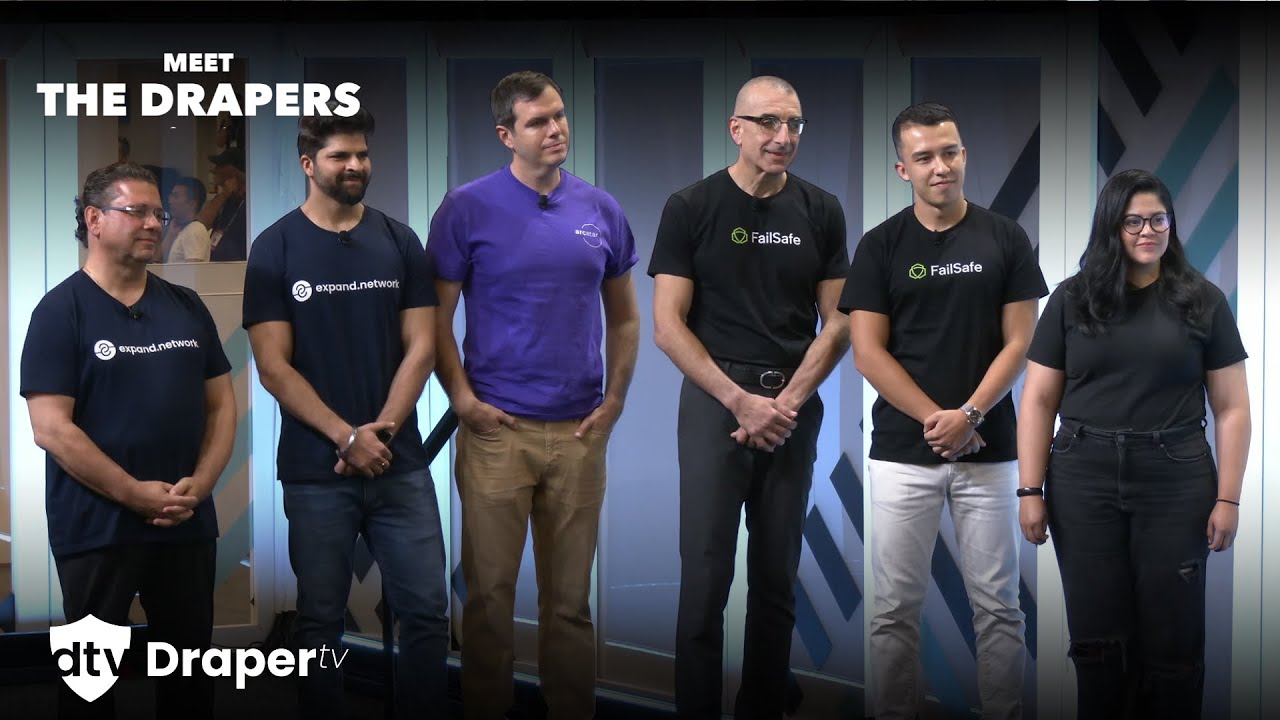
Tim Draper and his son Adam host a $1M pitch competition in Austin featuring crypto and security startups. Founders like Doris Hernandez and Anirudh Sen pitch solutions for Web3 custody and stopping hacks before they happen, with judges including former U.S. Treasurer Rosie Rios.
Chapters
I'm Tim Draper, and I invest in big ideas before they become the next big thing. I invested in Tesla, SpaceX, Twitch, all when they were just a sparkle in that entrepreneur's eye. This season, I'm traveling the globe to find game-changing entrepreneurs with world-transforming ideas. I'll bring these visionary innovators to Hero City in the heart of Silicon Valley, where they'll compete compete for a million-dollar investment. Here is the twist: you, the viewers, can vote for your favorite entrepreneurs and help them secure a spot in the finale. Who will rise to the challenge and secure the funding to, to turn their dreams into reality? Let's find out together on season 7 of—
Meet the Drapers! Welcome to Austin, Texas, where we're doing a Meet the Drapers episode. I put my dad out of commission. Hostile takeover episode of Meet the Drapers at Consensus in Austin, Texas. Consensus in Austin, Texas is the paramount conference for cryptocurrency. Today we are going to see some of the greatest crypto startups. So let's get going. Why are we waiting out here? Changed a lot since I went to the first one, but it's really exciting. This is a good conference.
Nice to meet you, man.
I want to find a founder. There's some founders. Hey, I'm Adam Draper. Pleasure to meet you. What should I ask? Because I just realized he's on the show later. I'm Adam Draper. Nice to meet you guys. You guys got rugs, and you're helping all the boomers not get rugs. I like it. Thank you. I don't know who I don't know whose couch that is, but that is the type of couch I want in my office. It's seen things. When I come to Consensus, the thing that I love so much is how much energy all these founders have. Good to see you. Starting the most ambitious projects. The theme of this is sort of the institutionalization of cryptocurrency, and that's incredibly exciting.
Doris Hernandez from Security Labs, CEO.
My name is Demetrius Skalakotas. I'm the CEO of Expand.network.
Hi, my name is Anirudh Sen. I'm the CEO and co-founder of Failsafe.
I'm Ari Medvinsky. I'm the CTO and co-founder of Failsafe.
Okay, so what will $1 million mean to us?
A million-dollar investment.
A million-dollar investment.
A million-dollar investment for us would basically mean that we can get our first 2 products fully into the market.
It's really about validating that we're going in the right direction.
It would be a life-changing amount for the team.
For us, it would be a huge endorsement of what, you know, of the vision that we have.
The opportunity to work with the Draper team would go a long way Yeah, you know I've got four kids. Their first question would be, since they're all teenagers, do you get the million dollars?
Like a million dollars.
That's what it's about. Welcome to Meet the Drapers. This is a hostile takeover episode where the son takes over for the father. It is a pitch competition. Where the winner of it will get $1 million. I just had to get my dad out of commission to take over. My name is Adam Draper. I'm the founder and managing director of Boost VC, son of Tim, and that's why I'm here today. The relevance to Consensus in Austin— we were the first crypto fund to ever start. I am winged here by 2 incredible guests.
Rosie Rios.
Who has signed more dollar bills than any one single person on the planet. 43rd Treasurer.
Treasurer of the United States for 8 years until 2016. So the joke is no one has made more money than I have, that's for sure.
Here we have Josh Baer, who has created the center of Texas technology startups at Capital Factory.
Texas is where it's at. This is why ConsenSys is here. Visit Capital Factory or email me. My email is really easy to remember. It's josh@quittyourjob.com, and I will plug you in with everything going on in Austin.
Now I'm going to ask you both a very simple question. What's your superpower?
For those who don't know, in my 8 years as Treasurer of the United States, I worked on putting the portrait of a woman on our Federal Reserve notes for the first time in US history. So I say my superpower is that I see the invisible. I know what's missing when it comes to physical space.
I don't notice physical space at all, so this is— so it's a good balance as a team up here.
I love that. You know, empty space is such a powerful concept, brings a whole nother perspective to so many things. My superpower— I'm gonna change my mind. I cannot help but like connect people together, and it's just like if I'm talking to you, I just will immediately somehow in the conversation have to bring up some startup that you have to meet or that connects to what you do.
I experienced this multiple times yesterday. So I just— it's an amazing trade. I met like 3 extra people than I should have.
There you go.
Just because of Josh. Uh, but I didn't even think about what my superpower was other than, uh, bringing the energy. A million dollars! Blind, unthrottled energy. Enthusiasm.
I think it's the hat.
And it's—
yeah, I was saying that the hat wears me. I am not from Texas, but I love Texas.
You have cowboy boots on.
Yeah, I do. I, I set this thing up. If I'm gonna do this, I am going to do this. So with that, let's see what's happening behind the scenes with, with the eyebrows and the hat.
My name is Doris Hernandez. I am building and leading the team at Security Labs. Yeah, I'm a software engineer, and I was born and raised in Honduras, but I went for school in the US for coding. I come from a family of entrepreneurs. My family, the only thing that you talk about at the table at my house is entrepreneurship. You eat, breathe entrepreneurship. My dad wants to understand what we do. Obviously, this is crypto and most people say that their parents don't understand. Actually, my dad sends me news about Web3. So I think that's pretty dope. So I was in the Bay Area for a while, started coding, came back to my home country, Honduras, built the largest ridesharing app of our country, Honduras. We were deployed in 12 cities. Building in a third world country, it's— there are challenges. So it's a blank space. I've seen my dad build his companies, and the struggle, it's part of it, especially if you're coming out of, like, in my case, I had to go outside my country, created a new network. I see life as how it is, and you play with the cards that you're dealt, right? I mean, Security Labs actually started, we were doing a wallet. When we were building it, the question was like, where do we put the private keys of the wallets that we're generating? And then we realized that in a very decentralized way, You know, there was really no established player in the industries. We went viral, basically. If there's something that I wish to any founder, it's to go viral. Like, it's one of the biggest highs in the world. Just like, people actually want what we're building? What? That's amazing. Right? You see? Right? It's just like, what? And I search us, and then I see they're like, 10, 15 videos on YouTube of how to use our product. And I'm just like, this is dope. Yeah, right? I mean, it's free advertisement. It doesn't matter how much money they can give you. Money won't validate that you say, like, we're actually into something. People don't stop coming in. If I win, I'll probably broadcast it so I tell it to a lot of people. So this is my second time in Austin. I came here for Consensus last year. I see Austin as like the place where it really showcases like the US houses, the food, the people. So it's a great experience if you've never come to the US. The reason why I keep coming back to Consensus is I think from all the conferences that I've been, it's the one that is very, again, focused on like blockchain and enterprise. When you go to a conference, it's a lot of energy and a lot of talking and a lot of networking. Everything is huge in Texas. If you're in another conference, it's always limited, but in Austin, it's like there's always space. You don't feel so packed. And the other part is that it's walkable. So most of the events are walking distance from the conference, so that's very convenient. And really, really good barbecue. So like, if you come to Austin, do the barbecue for sure. I love the camera, so that's great. I love the stage. If you like the camera, you'll start liking this. Thank you guys for having me here. My name is Doris, co-founder and CEO of Security Labs. Security Labs is the most secure self-custodial network of private keys and secure data. Think of us as decentralized Fireblocks. We already have 200K unique wallets in our network. We've distributed 2.2 million rewards in the past 6 months, and we've minted 30K composable identities. If you're in Web3, you've heard about not your keys, not your crypto. We truly have a long way to go. We have centralized password managers that have been hacked, hardware wallets, uh, they still have supply chain attacks. This is exactly what we're solving at Security Labs. So what we allow you to do is to store and retrieve your private keys fully custodial way, but we increase the security of it. I try to, you know, keep up with everyone's reaction to make sure that they're understanding the problem. But in general, like, I saw some faces of like, what is going on? And I was just like trying to continue with the pitch without, you know, losing the audience. The security that we provide is 10 to the 50 more secure than any centralized security that you see right now. So 10 to the 50 is the number of atoms in the world.
Not the number of atoms.
Adams?
Adams? Well, I'll see you everywhere. Adam actually led the show fantastically, like the hats, the boots. He actually went in through that whole Texas vibe. But what makes Security Labs extremely interesting as a network is the fact that we're able to address Web2 as well, like the cybersecurity space, AI, healthcare, to name a few. My co-founder Felipe, he's a mathematician and a physicist. With quantum background, and my other co-founder Ata built companies with more than 100 billion in million in transactions. Yesterday, we got a commitment from the CTO of Celestia to be part of our angels as well.
Why are you doing this?
Because of self-custody.
Like we started.
Why you?
Why us?
Why do you care?
So we actually started doing this because we're doing a wallet SDK, and we were building the wallets. We were like, where do we put the private keys of the users? Or we could use multi-party computation, but it was still semi-custodial. So it was still having custody on our end. So we're like, okay, what is the decentralized solution of this? And there was no really big player in the market actually trying to solve this. And that's why we decided to actually build this ourselves.
Doris, I love that you're a female founder and that you're leading the charge here. It's very, very remarkable. Can you explain, are you a direct-to-consumer product or are you a commercial product?
We're a network. That's when I realized that it's like, if they don't understand like the core value of this, it's gonna get even harder for them to understand once you start presenting the solution. Imagine we are a marketplace where you have people sending us data and we have a lot of people providing us for their hardware to store that data. Could be your computer, your phone, that's where the storage is provided. Could be your healthcare data, again, API keys, DNA data, doesn't really matter.
And so who do you foresee being kind of your customers?
So right now we're targeting wallets. For her, I think she understood that we're doing decentralized custody and that we improve security. So it was more understanding like why this is a problem for, for the industry in general. That's why we're talking with Ledger, that's why we're talking with Safe, that's why we're talking with Trust. And then again, let's say that someone is doing like DNA and wants to store your DNA.
I thought my body was a hard wallet for my DNA.
Okay, that's a single point of failure though. Yeah, it's a single point of failure. We remove single points of failure.
So you're trying to kill off single points of failure?
Exactly. That distribution that we bring is what makes us extremely interesting. They clearly saw that people were interested in what we were building. They just didn't understand what exactly it was at the beginning. And then I think after they started making more questions, they were able to grasp the whole idea of what we're doing.
Exactly.
Okay.
And so the 200K wallets that are using it now, like, what are they doing now?
You have a personal signature, you have multiple devices, and you will sign multiple devices to send the transaction. It's the same thing with us. You have multiple devices, and that's how you authenticate, and you send your private key. We distribute it across our network, and that's— it's very simple from a user perspective. It's simple, yet very secure, like Safe.
Got it. Mobile Safe.
And so you focus on crypto now, or not necessarily?
Crypto is right now how we're going to target the market.
But it can have other applications to help Healthcare, cybersecurity.
Cybersecurity is extremely important. Rosy Rias gave me the impression that I really liked their pitch.
The wallets pay you to provide this service?
No, so how our token works is like any Filecoin works, right? Every time you want to send a transaction, you'll have to buy the token, pay for the gas fees. That's basically the purpose of our token.
Well, everyone give a round of applause to Doris.
Thank you, guys. I feel exactly the same, to be honest. Like I'm talking to you, I was talking on stage. Yeah, I, again, I like to pitch. I had so much fun anyways.
What'd you guys think?
Security companies in general are hard enough to understand, you know, if you're not a security expert. And then you think in a crypto security company, pretty high mountain to get over, right? So I think she did a good job of— I think I got it by the end of like, okay, I see where you fit in and I can see why that's important because I think most people that are trying to do stuff in crypto don't want their Things to be centralized to begin with. It doesn't really make a lot of sense.
Feels like a good thing.
Yeah, right, yeah.
I love what she's doing. You know, when she talked about the, the 10 by 50 times stronger than traditional systems, I'm still trying to understand how. How is that different than what's already out there, and why them? How have they cracked that nut?
To me, Doris represents this, like, in-the-weeds obsessive founder who, like, knows what she's doing. But the communication of it is so— it uses those crypto words that it sometimes is difficult to absorb. She knows it. She knows the value. She knows what the network's going to do. But like having us re-pitch that would be difficult.
Yeah.
Okay, so let's see what's behind the scenes. I don't have the eyebrows my dad has, so I'm going to do this.
My name is Matt Harris. I'm the CEO and co-founder of a startup called Arcatar. So my, my career before being an entrepreneur was actually all on the investing side of the table. So I spent about a decade in later-stage private equity, and then I spent the last 3 years investing in pre-seed, seed, and Series A startups, mainly as a deep tech investor.
What was that leap across the line?
Yeah, it was, it was easily the hardest thing I've ever done, and it's the hardest, and it's still the hardest thing I've ever done. You really go from what is really an academic exercise, right? Investing is very academic versus running a company is very real, right? You're operating in, you know, extreme uncertainty where you don't know if you're gonna have the people and the cash that you need to make the Menu of decisions that you need to make even 30, 45, 60 days from now. You know, one thing you learn that I didn't know is the CEO of a pre-seed startup gets paid last. That's part of what you sign up for. I had to sell my car, but I think we're in a great spot. I think, you know, my kids are getting to watch me do something that is hard, but I think very important. The moment that really stuck out to me that I kind of crossed over the threshold was when I was talking to my wife about this. We started dating when we were 14, and we've known each other since we were 10. But I was talking to her and telling her about the opportunity, and, and she basically said—
I'm not going to do it.
One thing that's great about Austin is it's a great place to raise a family and take big risks. I have a bunch of entrepreneur friends and, you know, we meet up at the playground on Saturdays and our kids play together and we talk about, you know, different issues we're having with our businesses. RoadSearch has always been famous, but I think for the startup ecosystem, During COVID a lot of the deals got done here at Mozart's and while walking around Lady Bird Lake. This is Lake Austin behind us, so it's one of the main places to go boating around here. It's becoming too much of an Austin thing, honestly. There's a lot of boats out here in the summer. I think one really cool thing about Austin is there's all these little sort of podunk country towns around Austin that are fun. Like Fredericksburg is one of the main ones, which I call Redneck Napa. It's a wine country town that's, you know, about an hour west of Austin. There's a lot of conferences here, right? So we're at one, Consensus, where you constantly have people from all over the world coming into Austin. So it's almost— you can reach out to almost anybody in the world, let them know you're in Austin, and at some point in the year they're gonna pass through. It's definitely out of my comfort zone, but I think when it's game time, it clicks on that this is a once-in-a-lifetime opportunity to be on a TV show. I rewatched Heavyweights this weekend, and I feel like I missed my opportunity to Maybe do an Uncle Tony entrance. I'm just thinking of that now. Blew that one. And so the heart rate's definitely, you know, 10x higher when you're the one pitching. My name is Matt Harris. I'm the CEO and founder of a startup called Arcatar. The story of Arcatar really started about a year ago when I was watching my 3 beautiful young daughters interact with gaming and the digital world, and I realized that it's gonna be really hard for them to form trusted relationships alongside the rollout of all these new digital laws we're seeing across the world and alongside the proliferation of AI. At Arcatar, we've designed a native digital relationship structure that can actually thrive. We decided to solve the trust problem first in the area where most new digital relationships are being formed today, which is in the creator economy. Creators know next to nothing about even their most beloved and loyal community members. The trust and engagement level inside creator communities is It's super, super low compared to what it could be. And our solution is something that we've spent the last year building alongside 35 other creators. It's a cross-platform relationship and content management system that ports validated relationships and content. Now creator communities can have cross-platform relationships with other human beings. You know, imagine a gaming creator and they say, hey guys, there's this new platform, Arcatar, where if you'll come and follow me on Arcatar, I can actually— we can actually get to know each other. And you can have more input into my streams. So it's really all about just strengthening the communities. And there's a ton of utility and functionality you can get from these kinds of relationships, but creators and game developers are using r/kittar to learn who their superfans are. Who are the human beings that follow me across all the platforms that I'm on?
You said this, something about your daughters at the beginning, and I was like, I'm not sure I understood the link to I tried to open with heartstrings, you know, talking about my kids and how—
and tried to tie that into what we're doing. Usually people like stories, and Adam kind of called me out on that. They're the people that I care about in terms of relationship structure, and I want them and all of us to be able to have trusted relationships.
And who pays for this?
So there's— the opening business model is freemium. It's $10 a year for gamers, $20 for creators, $30 for game developers. And that's one of the ways it's human only, right? Because bots don't pay. There's a couple other ways that it's human only. And then when we bring in brands, it becomes enterprise SaaS. And then we bring in the models, it becomes a transaction fee. So we've got 3 revenue lines. I'm not quite extroverted enough to, to be comfortable, you know, pitching live in front of hundreds of people. But, but you can force yourself to have fun. It's fully there.
What's the user experience of having Arcatar?
If I'm I thought Josh asked a really good question, and I got, I got turned around a little bit because there's 3 different personas in the app today, and the user experience is a little different for each one. Our view of the future is that what's going to happen is what is already happening, is that there's a new platform every 3 or 4 months. So you've got like Bluesky and Threads in just the last year that already have millions of users, and there actually are live streaming platforms in Asia that have millions that of users. nobody's ever heard of that have millions of people on them. So I think what's missing there is something that links everything together. Father of 3 daughters, so I think a lot about Taylor Swift. They all love Taylor Swift. There's no place where you can share just a link and they can just come click the link and go to where everybody is. We're really integrating the platforms together so that people can live, kind of continue to thrive on multiple platforms.
So once you conquer gaming, what's the next industry?
So gaming's huge. Today there are 3 billion gamers. I think healthcare will be next. Part of the reason that we started in gaming is, one, there's a lot less gatekeepers than other industries that need cross-platform validated relationships like healthcare, finance, and education. It's always fun to be around Adam. He's got great energy and just a very encouraging guy to be around. You get a lot of energy when you look out in the crowd and you see someone just nod. Like, you say something and you see someone nod, or when you When you see one of the judges kind of nod and approve, it just opens up the— it takes the conversation to another level. To get people used to this new form of relationship in gaming, they're going to take this new relationship structure out into their jobs. They're going to take it to their doctors, to their financial managers, and they're going to— it's going to change the expectations. And so we're going to take it to every industry.
Well, Matt, thank you so much. Let's give Matt a round of applause.
I think I made it through the pitch all right. I went a little long. I got a little flustered with some of the questions. I'm gonna get back to work. Lots of work to do. No celebration until the money comes in.
What are your thoughts on our guitar?
As he said, it's really ambitious, right? Create a layer over all these other platforms. Everybody would want to be in that position. And it seems like over the course of just the evolution of the internet, there's this swing between Is there going to be kind of one big thing or lots of things, and do you use an aggregator? There are services like text.com that let you kind of interface with all your different messaging systems from one place, and there's always a trade-off to that.
I love the thought that he wants to kind of personalize access to this kind of connection, especially on the internet where, you know, we know a lot of kids don't connect. To monetize that would be huge. I'm still not clear how it works. How do they have to grant access? How does that work? Is there a price to pay on that? I'm not quite sure. Matt's a very, very smart guy. He obviously knows what he's doing, but I'm not sure he is the first person to think about this. If he could scale this and get the buy-in of those other platforms, this could be huge.
The secret thing that he says very trivially throughout his pitch is figure out who your superfans are. It feels like that's the That's the message that I would probably encourage Matt to say. Let's see what's happening behind the scenes. It's a, it's a million-dollar crystal ball.
Hi, my name is Anirudh Flynn. I'm the CEO and co-founder of Failsafe.
Hi, I'm Ari Medvinsky. I'm a CTO and co-founder of Failsafe.
Ari and I met building A company called Ethless. Shout out to that entire team. We found that Web3 is one of the most adversarial environments. Not only were our users getting hacked, but, you know, we were being targeted. I ultimately ended up being a victim of an attack. And it's not enough to make Web3 fun and exciting. We also have to make it safe and secure.
It started with a few conversations to brainstorms to eventually a product line that that we have today.
I've loved tech, been tinkering around ever since I was a wee lad. Either I was refurbishing iPods and selling them to my friends, built my first website at like 11 years old on Microsoft FrontPage. I think my parents knew that I was, I was going to always be an entrepreneur. My life took a bit of a turn when I was called to come back and serve in the military in Singapore. Joined Special Forces for a couple of years, was a Navy intelligence officer. I think I was lucky in the sense that a lot of what I was doing was small team tactics, taking a team and really being surgical in what we were doing. That's what excited me. I think building up small teams, sometimes doing what you needed to, to really push and achieve your objective.
I'm a bit older than Flynn, as you can tell. I've been at it 25, almost 30 years. My background is in computer security. I did a PhD at USC focused on building cryptographic frameworks. I think I've been very fortunate with my wife. She kind of jokes around that she married a permanent graduate student. Well, I've always had a passion for small teams. My truest happiness was in building something off the ground. So I'm based out of Seattle, but I spend quite a bit of time in Singapore. Most of our developers are in Singapore.
Yeah, we sometimes joke, we hop on a call and it's We're in 6 different time zones, so, you know, someone's usually up at 1 or 2 AM all the time.
Is that you? Yeah, it ends up being the gravity is in Singapore, so yeah, I adapt.
My first true love and passion is bringing something from 0 to 1.
Building something from scratch is what gives me purpose.
This is my first time in Texas. I love the people, the community, the culture. Cowboys, barbecues, everything seems a bit bigger than life. Yeah, there's this one place that does tacos next to where we're staying, and that's been a staple.
Since I first got here, I was just thinking about planning our next run together. So this looks like the perfect spot for it. Gorgeous weather, beautiful trees.
Yeah, it looks like a good route. Occasionally Ari and myself, we like to, like to go on these runs. I have a hard time keeping up with Ari.
I think it's the other way around.
But yeah, this is, this is a gorgeous place, a good place for a run. We wanted to maybe do a barbecue but also do some shoe shopping. We are big fans of boots, both Ari and I. We wanted to come to the place to get them.
Yeah, I've been having a Boot envy. Looking over at Lynn's. I love Austin. This has been a long time since I've been here. Super excited about you know about consensus.
We're super excited just to meet the who's who of crypto. Once you start pitching, you just black out. You're going in. You're kind of oblivious to what else is going on.
And I was still absorbing all the like being on stage.
My name is Anirin. I'm the CEO and co-founder of Failsafe. This is Ari, CTO and co-founder of Failsafe, and together we are on a mission to end crypto theft and fraud once and for all. I don't need to convince anyone here that Web3 is a complete cesspool of scammers and attackers. Over the past 2 years, $6 billion has been stolen, and this is precisely because no security tool exists today that stops attacks as they're happening. What we've managed to build is a system, a defense-in-depth security system that protects enterprises and end users on 3 levels. It's a blockchain security protocol that first detects when malicious activity is happening. There's a deep learning module that determines when risk is about to take place. Number 2, we've built Guard. This is smart contract access control. And then lastly, Interceptor, and this is a really cool product. We're able to get in front of the attacker's transaction as it's happening. So even if someone has your private key, we're able to get in front of that transaction and move those assets to safety before an attacker can run off with them. The kicker here as well is that it's fully self-custodial. We never have access to any private keys.
The value prop that we bring, the worst case, addressing the worst case scenario, that resonates with folks.
We're protecting over about $100 million worth of assets, including the official stablecoin of Singapore.
Yes.
Singapore is a customer?
The Singapore dollar stablecoin issuer is our customer.
Got it.
How do you two know each other?
That's a great question. Ari and I met building a company called Ethlus. We're a Web3 gaming platform. So we scaled. Yeah, well, that's exactly it. That's exactly it. Yeah, Adam was fun. I mean, he did not disappoint. He said that he was going to bring energy to the stage and he did. Myself, actually, I became the target of a very similar sophisticated attack, and that was the wake-up call. The first person I go to is Ari, who's the resident genius, and over the weekend we designed on the back of a napkin a system that would protect users and enterprises in worst-case scenarios.
You have some kind of like cybersecurity AI system that's effectively monitoring my wallets and transactions to look for something suspicious going on using AI magic. And when you do that, you move the money out of the way before they actually get to go do it.
Pretty close.
Everyone gets the problem space, but I think what we had to convince the judges was that, you know, we were doing it in a way that was simple enough for essentially the rest of the market to understand and to adopt.
We are monitoring all proposed transactions. Let's say you are phished or somebody steals your private If ahead of time you enrolled in our system, we're monitoring proposed transactions, and then just in time we propose a new transaction, so we're able to move the funds ahead of the attacker. So the attacker's transaction will still get executed, but it'll get reverted because there's nothing— there's no more funds there.
Nuanced question because I have been targeted a couple times as well as like, like 2 days ago I was Called from a shady number in Utah. It feels like social is one of the most targeted. Have you thought about doing monitoring of phone stuff also, or is it just wallet-based?
I think, like, those kind of questions help us to kind of frame Failsafe in a way that's going to be friendlier for the masses as they onboard into crypto.
We already have those capabilities, we just haven't fed that signal in, so it's a great product idea. We're probably going to try to incorporate into our product line down the road. It's an interesting idea. At the end of the day, you still have to enroll with us. From there on, what you're saying is, hey, like, once you're enrolled, can we detect that you're being subjected to some form of fraud, right? The answer to that is yes, we're very interested in that. Some of the craziest stuff you see that's happening every day— I did that over the weekend, something that looked like NOSA Safe, right? Google brought it up. I clicked on it, looked identical, and then all of a All of a sudden, a pop-up appears that says, enter your seed phrase here. I woke up at that point. This is why Web3 is taking like forever to really take off on the scale of Web2.
Have you actually saved any money from being stolen?
We know that the tech would work.
We know the success rate of our— when we submit a countertransaction, we are recognized.
You're protecting all this money?
Yes, yes.
Do you know, like, look right there, we got him!
We see a lot of interceptions that our infrastructure does. Now, it's very possible that you can do your own testing. Like, you guys can go and test it out right now yourselves. You can take on the role of the attacker, turn on the protection, and then do another transaction, and then you'll see interception happen just in time.
Well, you haven't helped me with the sales pitch.
It would be great if you could be like, here's how much money we've saved. You know, like, and I realized that's a timing thing, you know, you have somewhere to get to.
I felt a connection, like he understood exactly what the value prop was. I like the dog too, but yeah.
So you have 6 paying customers and anticipated revenue this year of about $700,000.
We have an annual recurring revenue currently of $80K. I mean, she is the person who has done everything in in Web2 that we're kind of trying to replicate and protect in Web3.
How are you going to grow that next year?
To be honest, in the next 18 months, we're looking at scaling that to about $700K ARR through the projects that are currently in the pipeline.
Thank you so much, Failsafe.
That was fantastic.
Thank you so much. Best of luck.
Thank you.
Saving the world.
Pretty exhilarating experience. I mean, the minute it starts, you kind of just black out and you're in auto Everything goes away.
I love talking to the Fed.
Great questions. Rosie, what did you think? Does the Treasury have anything like this?
Well, you know, I think everyone knows that consumer protection right now is a huge, huge priority for everyone, including the federal government. You know, there are thousands and thousands of attempts constantly, whether it's the federal government, whether it's consumers in general.
I think we should just alert everyone and be like, hey, you should have 2FA, 2-factor authentication.
That is like seriously— someone tried to go create a bank account in my name and then link it to my other bank accounts, and they were successful at doing a whole bunch of it, and the reason they couldn't transfer money out of my account was because of 2-factor authentication.
Definitely the more redundancies, the better. I mean, it sounds like again, they're still kind of getting their feet wet, and obviously that annual recurring revenue is going to be key. You don't want a one-and-done, you want someone who's going to believe in you over time, and that's how you're going to really find that growth. I didn't really hear a strategy on how they're gonna expand that too much, but you know, it sounds like they're off to a start.
Yeah, I mean, I think there's a real need for this type of solution. Today you can get a deepfake where somebody calls you and sounds like it's someone you know, and it's not the person you know. And this would actually put up an alert and be like, this is not the person they say they are, kind of thing. That makes me really interested in this.
It is a very, very interesting opportunity. Seeing the problem firsthand, yeah, I thought the team was smart.
Strong.
I, I liked it. I, I thought it was really fun. So let's see what's happening behind the scenes.
My name is Demetrius Skalkotis. Uh, everybody calls me Demo. It's, it's been a journey growing up, uh, in a Greek household of Greek immigrants. I was taught at a very early age via osmosis, watching my grandparents immigrate from a foreign country and start their own business, and ended up, uh, Running that family business after 45 years, after they retired and my parents retired.
I have the family thing, but Sicilian.
Una fatta, una razza, baby. Same stuff. And then I created my career journey, and that led me to a professional career with working for folks like Nasdaq and New York Stock Exchange. Whether it's running entrepreneurship business within a corporate structure or being in a family business. Starting out, it's kind of always been in what I've done and what I've aspired to do throughout my career. It's always about a progression of, you know, being challenged and moving on to the next challenge. You know, coming in at the very ground level and taking this from zero to a nice decent revenue stream that's growing and a customer base that's growing and momentum that's growing, I think is super, super exciting. It's not for the faint of heart though.
Yeah, tell me about that.
Because it is, it always takes longer than you want it to. I want to spend time with my CTO, with my biz dev folks, with my engineering folks, and just everyone that contributes to the success of Expand and understanding how their journey is going. I saw that at a very early age with my grandparents and my parents running a family business, so I treat it like these are my own personal employees. that, you know, are contributing to the family business, and I want them to feel a part of this entity. Because people want to be treated with dignity, kindness, and respect. You know, it's 9.5 hours currently difference to my CTO and my dev team. It makes for a long day, and it makes for a lot of understanding and patience from my family and from my wife, knowing that Daddy's in his office doing his thing. And we hear him because he's on calls all day, every day. But Yeah, you know, I've got 4 kids. They're all teenagers. They're definitely starting to ask more questions, which is cool. I'm trying to provide by example kind of what I got from my parents and my grandparents and growing up in a family-owned business to show them organically what the commitment is like, what you have to do, how you need to persevere. I think that's what my younger self would say. Look, you've You've persevered and you've done it the right way by treating people kindly. Now, I've been to Consensus pretty much every year since, since I've been in crypto, since '18. Austin is really cool. It's got a great vibe. I think it's very nice and calming and relaxing. See a lot of people getting their exercise in, kind of midday, so I'm jealous. Definitely gonna tap into restaurants, obviously, get my fill of barbecue. Definitely a little bit of a foodie, like to kind of do a little bit of tasting while I'm here. Maybe see a little bit of the music that's quite common here in the Austin area. Yeah, I think, look, Austin is definitely continuing to grow. You see a lot of construction happening in the city, fostering that business ecosystem here where companies have a desire to move to Austin just continues to get more vast, but I see a lot of the same local places that I visited before. They're still here. Well, Texas likes to do everything big and kind of in their own way, and that's kind of cool. It's a great state. It's fun to be able to get on stage and articulate your message and get your point across. But you get that extra rush of adrenaline. You get a little butterfly before you go on. I'm Demetrius, co-founder and CEO.
Excellent.
This is Varun, our CTO.
Having both of us together up over there gives us a lot of broader view.
2 brains are better than one. And we're building Expand.network. The problem in really connecting in Web3 today is the ecosystem is immense. It's very fragmented. It's ever-changing. It's resource constrained, and it's unscalable. So what we've built at Expand is a single integrated abstracted API kind of connector middleware layer that allows you to connect into every ecosystem that you want to within the Web3 world. So, so everyone within the digital asset ecosystem and the institutions that are servicing our digital assets ecosystem can leverage our API and help scaling. So we're an outsourced infrastructure scaling technology company for things that are happening on-chain. The market is very vast, right? We're really working with Web2 companies, converting them into Web3. If you're a believer that things are going to happen more on-chain, you're going to need an outsourced infrastructure provider to help you scale on the back end.
There are so many people watching you and you're pitching your product right away. People are actually judging you whether the product is good or not. So that in itself gives you that nervous feeling inside.
What sets us apart is we support the full trading lifecycle. So from all your pre-trading analysis through your post-trade reconciliation, we cover everything in between. We're up to about 14 different customers. We're revenue positive, generating a quarter of a million in revenue this year.
Your presentation is sort of, we do everything for SKALE. There's lots of different pieces, but is it mostly for trading?
Yes, for trading and sourcing on-chain data.
Both.
Look, I think we provide a complicated service, right? Not a lot of people understand kind of Web3 and the digital asset ecosystem.
Does anyone do what you do now?
Not that we are aware of.
They do components of it, right? Some people provide trading, but even on the trading side, they're just providing the swap capability. They're not providing the connectivity into the staking venues or the lending protocols. And no one's really tackling like the tokenized assets as of yet.
It's a crude analogy, so don't— but like Craigslist. It's like a to-do list, but for like all of the different things you can do with the ownership.
Or more like Zapier.
Yeah, Zapier.
You know, like, right? So is this kind of like one API to write to that then will do that?
Yes, yes, that's a more modern one too.
I like Josh's analogy better, which was about like a Zapier. So I would definitely like to leverage this Zapier analogy going forward.
So we're trying to make it easy for people to scale on the backend, right? Where there's plenty of frontends out there Let us help you scale on the back end and let you offer up what you want to to your customer and diversify your revenue stream.
How do you?
Did I confuse the hell out of you?
No, no, no. I think I get it.
You know, dealing with a lot of technologies and using a lot of buzzwords that we use in the digital asset landscape, and if you're not living, eating it, and breathing it day in and day out, so I just wanted to make sure that they understood exactly kind of what we.
With a lot of other solutions like this, there's a trade-off in using a platform like this. What are the trade-offs?
We're not going to do it all for everybody. We're going to come in and help them scale where they need to ramp up quickly, especially if they don't have the dev team or the resources, because again, to build this, it's massively resource-constrained.
Say you integrate with, for simplicity, 5 different other chains or things I can plug into. If I were to write custom code for each of those, I would have a tighter integration with those.
I think he was alluding to that in some traditional middleware software capabilities, some of the functionality is obstructed. It's the opposite with, with our middleware capability in the Web3 world.
What we are trying to achieve over here is to go to a Web2 route supporting all of the Web3 protocols. Takes away a lot of complexity that is involved further for the Web3 users. Anybody who's already aware of utilizing the API would automatically get direct support onto the entire Web3 ecosystem.
So would it be fair to say that you take Web3 and you turn it into RESTful Web2 calls?
Exactly, exactly. That's how it is? And anything that we've customized for someone, it's reusable for others.
Is it really to save time more than anything?
It's to save time and money, because again, just to do a couple of these components is at least over half a million dollars and takes 6 months to do. The more components you add, the more cost, the more time. Obviously she understands finance, she understands the movement of money. And she understands technology services, so her questions were point on.
And is your special sauce the, like, integrations with everyone? What's the thing that makes you special?
So the special sauce is basically since we are an API, so we are able to reduce a lot of latency. So a lot of people are still actually preparing a lot of trades on-chain. We're reducing all of that by doing completely off-chain preparation and execution on-chain.
Using some of the Tools that are out there now that are smart contract oriented, the smart contracts are very slow, cumbersome, there's still a security issue, and they're adding excessive gas fees for how they calculate pricing. Not that smart contracts are bad, they're needed, but they're very slow and cumbersome and still a security risk.
Thank you, thank you, Expand Network!
It was amazing. I mean, the opportunity that we got and the questions that we had, like Really amazing.
Love the enthusiasm and love the opportunity to participate.
Josh, what did you think about Expand?
I think it makes a lot of sense.
You gave a really good one-liner.
Zapier? Yeah, yeah, yeah, yeah. I could see why people want to go with it.
Take successful company, put it into one line.
These are hard businesses. As much as there's a need for it, like you look at like at the kind of middleware glue space, like there's a— where are the big wins there? Because you're in the middle, you're getting squeezed. Squeezed probably on both ends on your margins and other parts.
Is someone going to own the application? Is someone going to own the technology?
And there's really only room for one. It's not like there's going to be 5 winners in this space, right?
I think there's definitely a market here. The question is, is it enough for one company to really grab the amount of market share that's going to make it sustainable over time? 12 paying customers. This world of integration, which seems to be the operative word today.
I'm going to write a blog post called World of Integration tomorrow, and I'm going to say it was all you, but I'm okay.
I'll send you my bill.
Don't.
Sounds like it's also kind of a shopping model too, right? People can kind of pick and choose?
Yeah, it's sort of— it's like a, what do you do with your crypto through anyway? All the contestants, from Security Labs to Failsafe to Arcatar to Expand Network. Go down the line. Doris with Security Labs. Decentralizing the most important thing, as Josh said, is the most important thing. I think that you're focused in the right place. My feedback is It took a while to get there, and I think you're a great presence on stage. Failsafe, your solution, I think it in some ways is just radiating very heavily in our brains that it's such a topic. I think it was also a very clear pitch. It was simple, to the point. Now, sometimes when people pitch like, I have magic, like, it's tough, right? Our Guitar, you've come a long way. The communication of the integrations makes it like difficult to absorb, and that was the hardest part. But I love finding the superfans. There is a billion dollars there. And then Expand Network is very aptly named. You were trying to scale. You're just scaling everything. Trying to integrate across the entire landscape, I think, is fantastic. Yeah, overall, I just thought this, this was a great set. The world of integration. And this was a perfect representation of consensus in Austin. But it doesn't really matter what us three think. It partially matters what they think. So vote on meetthedrapers.com. But it really matters what the crystal ball says. Real fine Texan form. I'm gonna pull the crystal ball out of my cowboy hat. I need everyone's eyes on the crystal ball, real quick.
Ooh, yeah.
The team that is going to move on to the semifinals is...
Failsafe!
Still sinking in, to be honest. Yeah, it's a bit surreal.
My son was in the audience. There's nothing like that feeling. Being able to You know, land this and then kind of— it's hard to describe that feeling.
I know exactly what those other 3 companies have gone through to get to where they are, and so you can't be anything but happy for them.
We really built an awesome product, and we're hungry, and we're going to persevere, and we're going to show you all the success that we'll have if you vote us back on.
We're truly solving for the core existence of Web3, which is self-custody.
Help us protect people's relationships and make it so that they own and control them and can always have them when they need them.
See you next week on Meet the Drapers.
Woo!
More from Tim


He Sold His Car to Build This Startup, Then Pitched It for $1M 😳 #Startups #AI

This Startup Moves Your Crypto BEFORE Hackers Can Steal It 😳 #Crypto #Cybersecurity




15 Months Without Refrigeration?! This Startup Thinks It Can Go Global 🥥 #FoodTech #Startups



