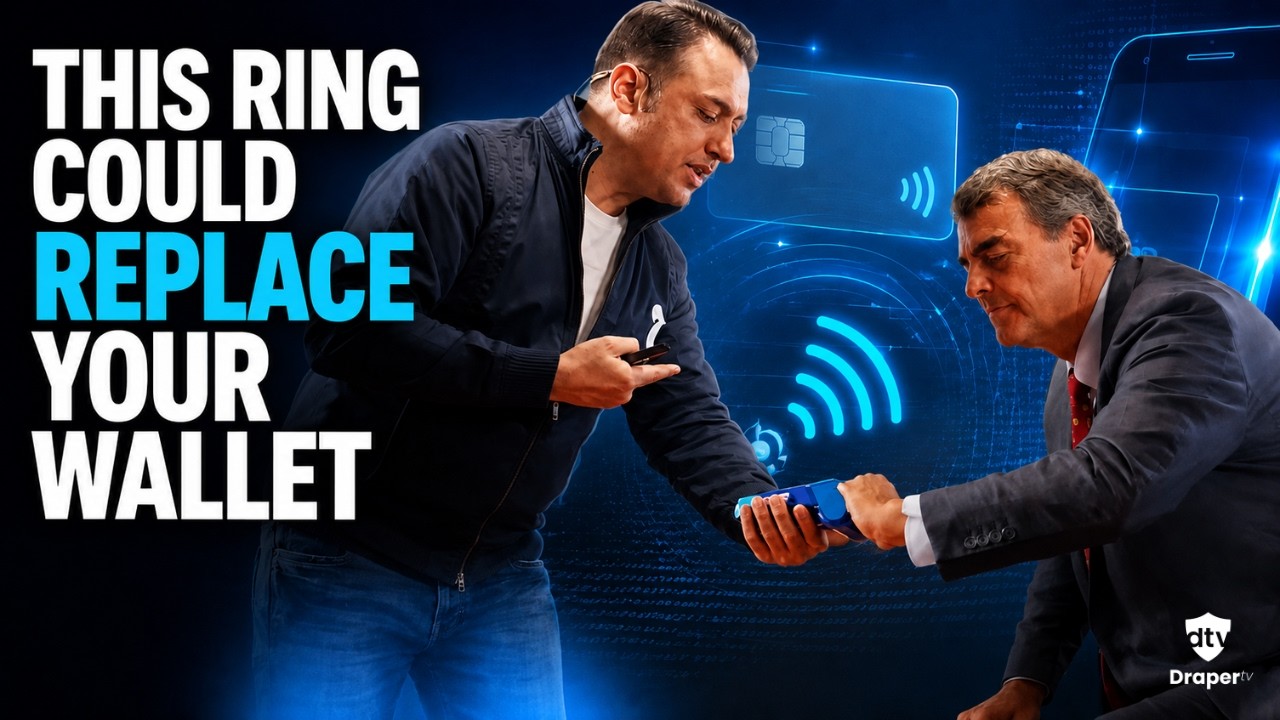
Vijay Khupchandani built Seven, a smart ring that harvests power from payment terminals and needs no charging. The ring costs $18 to $400 depending on the model, works with a fist gesture to prevent accidental payments, and functions as a prepaid wallet for India's price-sensitive market.
Chapters
Now you don't even need your card. You have payment variables sitting on your finger, which you can just simply tap on a POS machine. You heard the beep, withdraw your hand up till $100. You don't need to put a PIN. Your payment is done. We are targeting the passive smart ring market for, you know, price-sensitive areas like India.
My name is Vijay Khupchandani. I'm the founder and CEO of Seven. Seven is a fintech startup in the wearable payment space. I've been always following Apple. as a company, as my inspiration. The way they build their products, the marketing, brand building, right? So always fascinated with that and always thought I should do something which involves some kind of a hardware play because, you know, I mean, hardware also gives you defensibility in many cases, you know, if you're able to get that IP right in the early days. I'm a 4th generation entrepreneur. Everybody in my family has been entrepreneurs and This is my third venture. I worked with Citibank initially for around 8 years selling mortgages. People around me thought I was nuts because the Citibank gig used to pay very, very well. I was not a payroll employee, but I was more like a franchise arrangement with them, but it was a very high-paying venture. So when I did this, of course there was backlash in terms of the family thinking that Are you sure what you're doing? And I've been on my leap of faith for almost a decade now. And, uh, to some extent, uh, yeah, I mean, initially it was a lot difficult, but I think now they understood that he's a, you know, crazy, uh, you know, kind of passionate entrepreneur and trying to pursue. And now that when you see that you're able to generate revenue, there is validation around you, then, you know, they, they also feel that, yeah, okay. in the right direction. But yeah, early days, like, it was very, very bad. We got early validation and we got an investment from an angel network, which is very unheard of in India for a hardware startup back in the day. That was our first small win. The second win was when we got certified by Mastercard. That actually reinforced confidence in us that we can deliver a globally certifiable, globally accreditable kind of a product. So that was that. And then we also had filed a few patents in India. We won those patents. So that also further, you know, reinforced the belief that yes, you know, we are on the right path. And then there have been a few other small victories here and there where we have won government grants, you know, in India, and we won a couple of innovation hackathons and challenges, you know, along the journey. So yeah.
Hyderabad, I think, you know, is culturally known for the City of Pearls. The infamous Kohinoor was actually first discovered in Hyderabad, which is a globally known jewel. From India, and now I mean Hyderabad is being known for the next IT hub in India after Bangalore. So everybody from Amazon to Google, Microsoft to all the consulting firms you can find here. Hyderabad is like the fourth city which is the most upcoming hub now for startups in India. Culturally speaking, you know it's known for very good Hyderabadi biryani if you are aware. It's also known for Irani chai. A lot of young people coming in here to work in the IT hub, so you can make good friends, you know, have a good time post-work.
We're pretty used to doing pitches. We've kind of polished ourselves over time.
We live in an era of speed and convenience where everything around us is just a tap away, and so is our payments today. You know, there used to be a time when you used to have cards which used to swipe. Then they got evolved and we used to dip the cards. Then came along the tap cards. But guess what? Now you don't even need your card. You have payment variables sitting on your finger. You can just simply tap on a POS machine. You heard the beep, withdraw your hand. Up till $100, you don't need to put a PIN. Your payment is done. We are targeting the passive smart ring market for, you know, price-sensitive areas like India where you cannot afford a $250 Health ring. So our rings start from $18. We have a variant of $54. And then we also have a gold variant. I mean, we are talking about India, right? So 18-karat real gold ring, which will start from $400 because of the price of the metal, but it'll do payments. It'll do also transit ticketing, access control, keyless entry, and various other things based on NFC technology.
But there are others that do payments on our rings.
Yeah, they're out globally. In India, they don't.
In India, you're the only one.
Yeah.
So what made you decide to do it?
So my inspiration, Tim, was Apple Watch, actually. Ironically, it's a battery-powered device, but what it kind of, you know, made me think is that what is the future? What is the possibilities? What are the other form factors we're looking at? And we, we cautiously decided to do passive so that it's not one more device you're charging, because people already have, you know, health watches for, uh, you know, monitoring their health. They don't need one more device to be charged. And at the same time, it's a beautiful-looking accessory. We can—
So you don't need to charge this ring up?
No, it works on NFC technology. Never. It doesn't work on solar or motion. So it takes power from the electromagnetic field of the POS. So when you bring it in close proximity, it takes power quickly and shuts off.
When you, when you get to know about a product which doesn't require charging, looks aesthetically good so that you can wear it all day, it's waterproof, I mean, of course, you know, you, you love that aspect of it.
So one of the things, Tim, worth noting is that, see, this is the place where you have to, you know, bring the machine close to, but we have a security feature. If you keep it like this, or if let's say I'm unaware, I'm talking to somebody, somebody brings my machine like this, it will not transmit. It's a security feature so that nobody can steal money from you like this. So you have to create a fist.
Yeah.
And then align my knuckle on top of it so that it comes in that specific distance away.
Exactly.
The whole circle.
Exactly. It cannot work here. It cannot work here, here, here. It will not work like you swipe. So you want to give it a shot?
Yeah, I'd love to.
I hope it fits you.
I mean, I'll try it on a finger.
No, I think the smaller one.
Go for this one.
This finger?
There, how about that?
When I press collect, okay, you, you have a prompt on the screen. Just keep your hand that way. That's it, done. And your payment is done.
And you know that's your ring. This ring has some sort of a signal on it that's unique.
So there's a chip inside and it has your data. And I mean, it doesn't contain your, your personal data. It's your card data that is stored on it and it connects to mobile.
So it's a credit card?
Yeah, no, it's a prepaid wallet that we give today in India. It's not connected to your bank account, doesn't connect to your credit card. We can offer tokenization where you can connect your existing American Express or whatever card onto the ring, but we don't have recurring revenue in that case, so we're not doing it for now. For now, in a wallet, we earn money on, first of all, the markup on the ring. We have a 66% gross margin, and we make 1% on every transaction that you make. And plus, we will make 40 basis points or 40 paise or 0.40% on every transit payment.
So the second she puts this ring on, yeah, it works. She doesn't need to—you don't. She doesn't need to hook it up to anything. Nothing, nothing.
No, you.
Well, she has to send money to it. Vijay, thank you so much for coming out to meet the great person.
Thank you so much, Tim, for the opportunity. Great job. Thank you. We were well prepared, and thanks to the team for handling, you know, kind of. Trying to keep the pitch tight and crisp in terms of logistics, what to expect, what not to expect, and so on. So yeah, thank you, Polly.
What do you think? So do this. I think it's a. I'm always forgetting my credit cards. I'm always forgetting what losing something if I had the ring on. And if you can link it to your credit card instead of instead of the top-ups that they're always trying to do.
No, this is.
I think it's great for the Indian market. and any other market for that matter. I'm sure if it is positioned well, it can become very popular because as we see, there are also nice designs, so it can be seen as a fashion accessory and stuff.