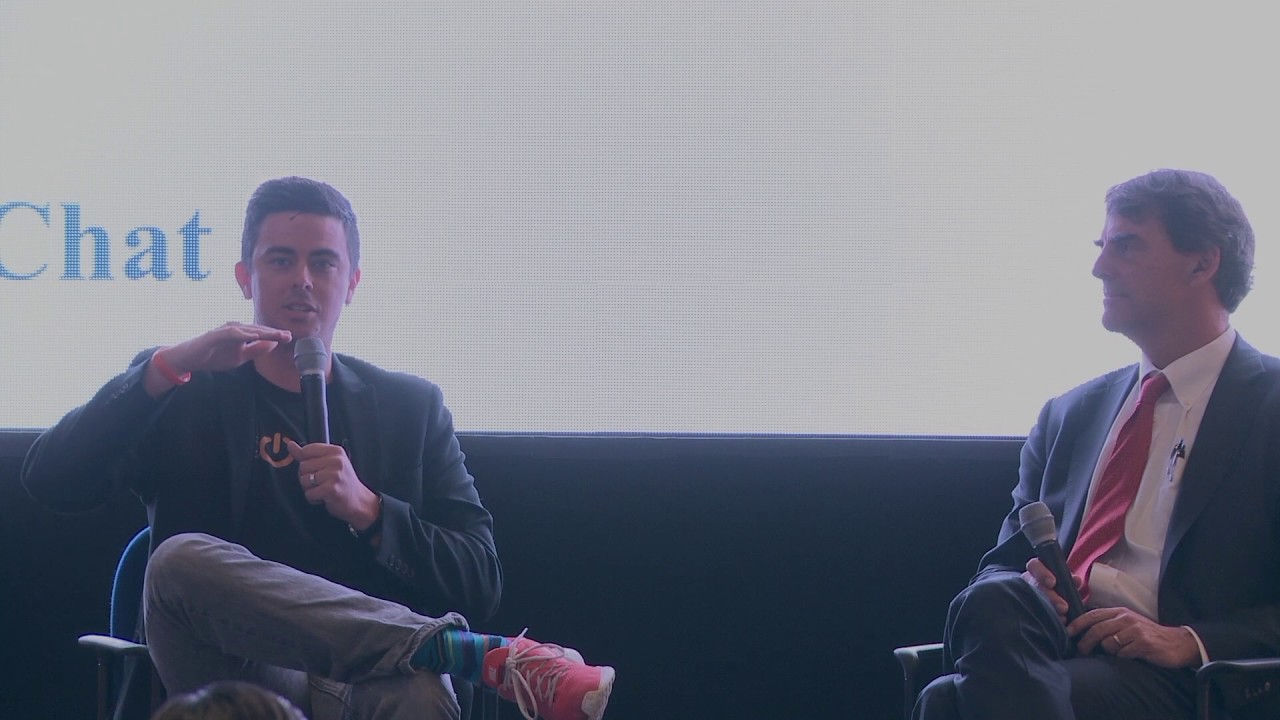
Adam Draper, founder of Boost VC, explains why he trusts his Bitcoin wallet more than banks. He breaks down Bitcoin's three core uses: cross-border transfers, store of value, and microtransactions. Blockchain replaces third-party trust with mathematical proof, letting ideas and assets be tokenized and funded globally without intermediaries.
Chapters
And now I want to hand it over to Adam. Tell us what's happening now, what it's going to be like in the future, and, uh, and what Boost is targeting. What's Boost really focused on?
The future is going to be awesome. Uh, so Boost VC, for those of you who don't know, uh, we're an accelerator. We provide housing across the street, office space on the other side of that wall. And we invest in startups twice a year. It's a programmatic approach to investing in startups. We were the first investors in the Bitcoin space to say we thought it was going to be a thing. 4 and a half years later, it still could be a thing. So that's good. And we're still as excited as ever. We went through this blockchain phase that was exciting, but enterprises sort of took over. And now we're back to this tokenization of the world, which is really exciting. You know what I loved about Bitcoin though, was it made everyone ask the question, what is money? Like, that was the coolest part of Bitcoin, was suddenly everyone was asking, wait a second, 2008 happened, everyone's money could have been taken away. Instead, they flooded the market with more money. Everyone started thinking, like, what is money? What is value? What is this thing? And then schools started teaching So every school, every university started having a crypto class where they started discussing what Bitcoin was, what money was. And it was really an economics class, but it sounded sexier. It sounded sexier than econ. And so everyone started teaching about Bitcoin. And so everyone should ask themselves what money is also. By the way, I don't know what you think, like, how a bank works. But it's not as good as you think it is. I do not trust banks anymore. And I do trust my Bitcoin wallet. I actually have grown to trust my Bitcoin wallet more than anything else. But just to simplify everything for those of you who aren't like deep in the Bitcoin or blockchain space, Bitcoin is good for 3 things. Liquidity is sort of— it touches on all of these things, but it's good for 3 things. When people are talking about how cool Bitcoin is, they're talking about these 3 things. Cross-border transfer, store of value, and microtransactions. And those are the only 3 things that people are referring to technically when they're discussing Bitcoin. The rest of the things, technically US dollars, RMB, everything else, like those other fiat currencies, these government-issued currencies, they do those things, the rest of it. But Bitcoin is a frictionless web of money. And then with the blockchain, the blockchain just does one thing. It replaces third-party trust with mathematical proof. But that's a really, really big idea. So, for instance, you trust your bank. I brought up your bank. You trust your bank that when they're adding up all of the ledgers all over the world that they have under their jurisdiction, that they're adding up yours correctly. And that's why you keep your money in your bank. You're saying, like, but what if you didn't have to trust your bank? What if you could trust— I don't know if it is— yeah, a computer, machines. What if you could trust machines? And that's where we're moving to. We're moving to a network of computers that are really good at one thing, which is just counting, like saying whether or not one thing happened, which is a big idea not only for money, it's a big idea for all assets. So, I mean, title companies. I don't know if anyone here has bought a house, but there is a title— there are 2 line items when you buy a house. The first one is the cost of the house. The second one is the title. And like, for the title company, you're like, what the hell? That was my thought. It was, what the hell is this thing? Because it's a percentage of the cost of it. And all they're doing is putting your file saying you own this thing in In a box somewhere. That's all they're doing. The blockchain literally replaces the need for title companies, although there are a lot of government reasons probably that they want the title company. Okay, so those are the things that Bitcoin and the blockchain are good for. Where we're going, we're starting to see, I think, so I personally think venture capital is— okay, if you think of venture capital as the ability to fund startups, It isn't done, it has changed. And we don't— we haven't realized it yet. Like suddenly people frictionlessly— I'm able to have an idea and launch an ICO, it's an initial coin offering, and if people like the idea, everyone all over the world can actually seed this idea. And this is happening every week already. There's a Projects going up, like most of them are crypto-based projects, but I don't think that that's where it stops. I think suddenly the market will have a market price for all ideas. That's the exciting— that's where the world's going. That's where this fintech thing is headed. If you have an idea, it will have a liquid market price in the world, and you will be able to raise money for that idea or not, and then it will be freely tradable. And so that liquidity, if you can find a buyer for your asset, you, you, you are linked. You can actually link throughout this value-based web. And so that, that's my spiel right now. So that's where, what Bitcoin and blockchain are and where we're going. Like, the world already changed and we're all just gonna be catching on soon. So