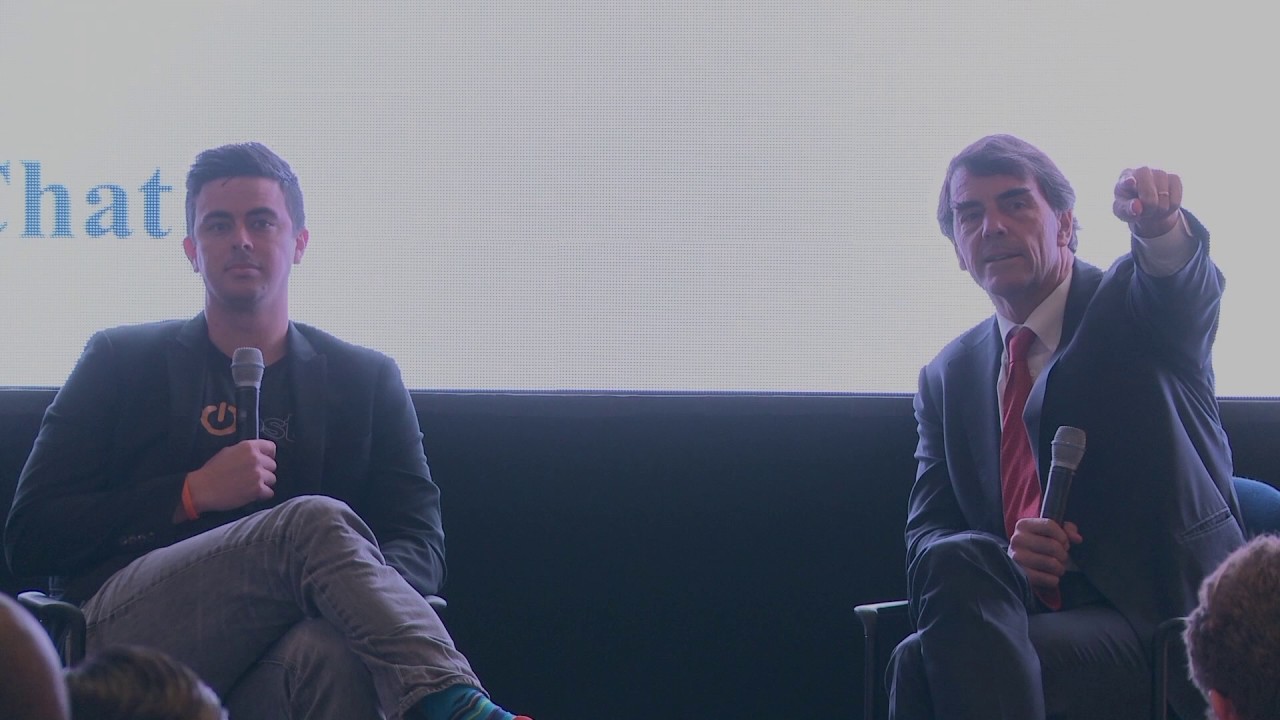
This content was created by Tim Draper. This content was uploaded by Tim Draper. This is a YouTube Q&A titled "Tim and Adam Draper Q&A | Blockchain: Out of the Labs" (posted 2017-05-23) featuring Tim Draper and Adam Draper in a live discussion/session. The excerpt is a back-and-forth Q&A covering Bitcoin for cross-border settlement, ICOs and token governance (mentions Tezos and liquid democracy), potential effects on corporate and government structures, the risks and timelines of quantum computing to blockchain security, and related regulatory/hacker concerns. The format is a public Q&A/talk with audience interaction.
Chapters
So I do cross-border capital raising, and Bitcoin settlement solves so many settlement issues for me. What is the evolution of acceptance among the mainstream that where I can actually legitimately sit down and say, this is what we're doing, this is how you're going to settle, and people are okay with that? So, so think about this from the banker point of view. You have just turned their job into— handed it over to a computer. They are not going to accept this easily. They're not really excited about accepting it, but it is so much easier. And so people are just going to settle and use the blockchain as their bank. And I think, you know, that you're kind of— It's interesting, both these questions have to do with The existing structure and how are they going to catch up? Because what we do, what we really need to do is just go, well, let's just make the transfer and let's just do it ourselves because these guys are never going to catch up.
It's so cool. Yeah.
So what's the most interesting use cases for the ICO you've seen so far?
The most interesting— I mean, the way that it's used right now is speculation. No one's lost yet.
In the future, I think it actually starts changing the nature of government, because I think these coins, or whatever they are, tokens, they're going to be governed In interesting new ways. And that's going to change all of our thinking about how we all operate. And having that sort of weird top-down thing that we have now where we send half our money into the world and somehow they're supposed to provide some sort of service for us, and all they really do with that half of The money has come down and regulated us. I think this is going to be a whole different system of regulations. At some point it will become corrupt too, but that'll be— that's for his great-great-grandchildren to worry about.
It's really interesting because all these ICOs, they have to create governance structures with the coins. So like Bitcoin has miners as sort of the governors of what software gets let into the protocol. Tezos, which is one that's sort of an exciting one that's coming out, is if you have a coin, you have a vote, but you can actually pass without parsing your token, still owning your token. You can actually give your vote to someone you think is going to be more involved in that process, which I think is sort of interesting. It's sort of like you're They've electronically created, like, the US government in some way. Except more, you buy in and you feel like you're a part of it. It's so good.
There's this thing called a liquid democracy that's starting. I don't know, it's this thing where you pass your vote for the legalization of marijuana off to somebody who you know believes the same thing you do. You pass your vote to somebody else who believes in choice in education, and you pass your vote to somebody else who— and then you know your votes are basically taken care of, but it's somebody who is closer to the government or to the final decision maker that makes that call, as opposed to, you know, she seems like a good woman, Let's let her be our representative for everything, even though, you know, even though I don't really agree with her on like 3 or 4 issues, I think overall she's going to do a good job. The liquid government allows you sort of a little bit more of like, this goes here, this goes here, and this goes here. So that could be like some future. And they are the perfect bureaucrat. A perfect bureaucrat is fair, honest—
Non-existent.
Right. Well, the blockchain is the perfect bureaucrat because it's a ledger and it's fair and honest.
It's yes or no.
It's integrated across, and once you commit to it, it's done. I mean, once you have it, you set it there, it's done.
I fundamentally believe that corporations today, like, in 10 years, corporations will look vastly different than they do today. Like, what does a global corporate structure look like? Like, how can you decentralize the system? Like, I don't know, it's, it's a question. I don't know exactly what the answer is. I just know that I'm seeing the beginnings of fundamental government-based disruption, and it's really cool. And yeah, so do, do that. Do we have time for one more question?
How about the woman back there? Well, he has the microphone. I mean, we haven't had a woman ask a question. Oh, I didn't have a question. I gave him the microphone.
She's talking. Okay. So I'm curious, with the rise of quantum computing, how long do you actually expect we'll be able to use blockchain as a backend for money?
That's one of my fears.
We—
I don't really know, and I don't know how— and how powerful the computer can be and how big a jump and how quick that jump happens are all going to be big issues. Quantum computing is— I mean, here's the CMOS technology here and here's quantum computing, and they're kind of growing. These guys are growing like this and these guys are growing like this.
And they're going to meet in the middle.
And if the passing of the baton is smooth, we're gonna be okay. If the passing of the baton is like, hey, we've just leapfrogged to where one quantum computer can hack every single computer on the planet in 22 seconds, or 22 millionths of a second, then we're gonna be in a situation where—
We're screwed.
There will be a new blockchain and there will be a new quantum— I don't know what they'll call them, quantum dots, or there'll be some other currency that we'll be all kind of scrambling for. And then if things keep accelerating like that, we're going to all have to continue to adapt to the new technology.
I mean, yeah. So If you're asking what does it mean for like Bitcoin and blockchain space, like it's about how much you trust the governance structure that's in place for Bitcoin, because they can technically, if they understand how the quantum computing space works, you can update the software to be able to handle the quantum computing. I mean, you're shaking your head. I haven't seen a quantum computer work. I haven't seen a good use case. So I'm really excited to be proven wrong at some point. Yeah, we're not talking about the next 5 years, but if we're talking 10 years— I don't know. I've been talking to a lot of people who think it's the next 5 years, and I really just don't— because no one's been able to explain what it fundamentally does to me. I just don't see it yet. And then we have a quantum crypto asset, so it beats Bitcoin. Like, okay, cool. Like, I'm good with that. Mining is better for the—
But hopefully you'll be able to transfer your one currency into another currency and it'll be a smooth transfer. Usually that will happen. You know, there are always these weird criminals, generally from Ukraine.
I mean, we're hoping for that, you know.
I don't know why the Ukraine government doesn't crack down on these guys. I think they just pay a lot of tax or something, but this is It's a problem. So, I mean, if I were the Ukraine government and I wanted people to actually invest in my country, I would crack down on the hackers.
Yeah, but it's a good question. It's actually a debated question in the space. It's like a very— people say what I say about it, which is we can update, we can upvote, we can change it because that's what we've done up to this point. And then a lot of people say, well, you'll be able to steal all the bitcoins. And, you know, if that's the first best use case, have at it. All right, thank you guys very much. Give him a warm welcome.
Anyway, that's boost.vc. You know, he might— I'm not sure if he may be raising money.