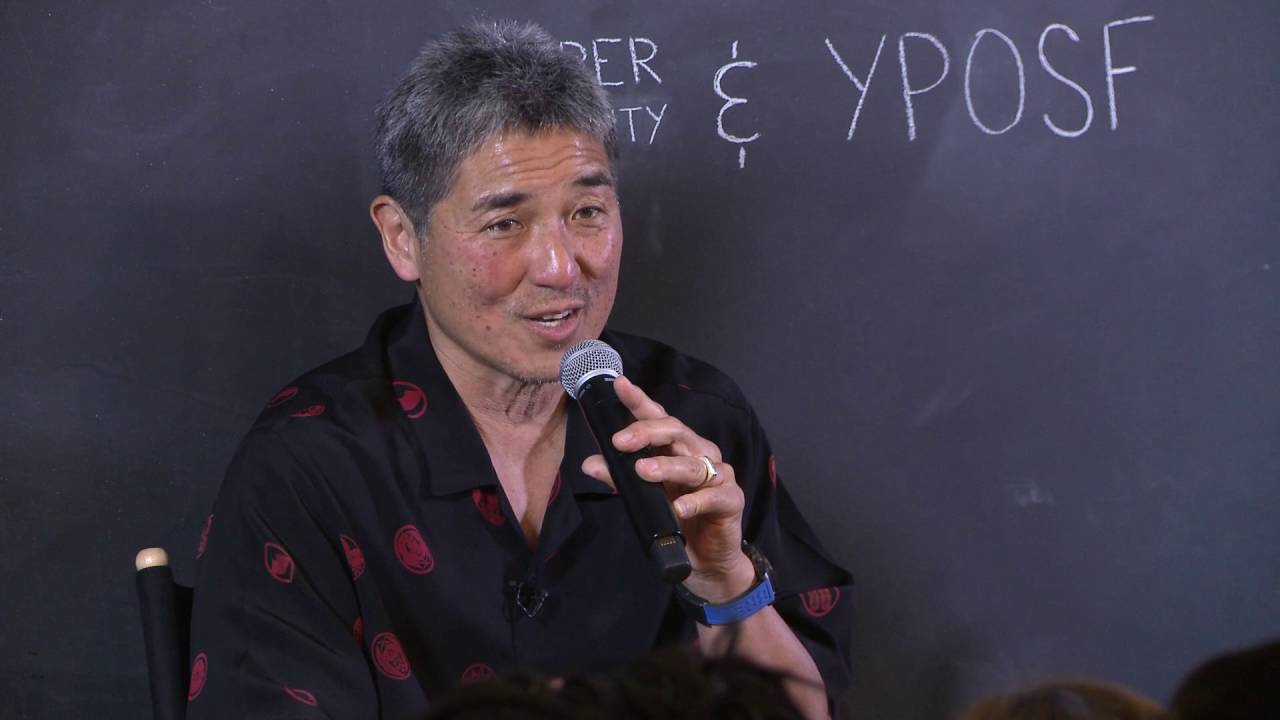
Guy Kawasaki explains why he joined Canva and shares his rules for pitching: the 10-20-30 PowerPoint rule, black backgrounds, large fonts. He emphasizes prototypes over perfection, hiring diverse teams, and names climate change as humanity's greatest challenge.
Chapters
Tell me about Canva. So what was it about Canva that— I mean, obviously you have lots of opportunities to invest in things and to join boards or become advisors to things. What was it about Canva that made you think, this is it, I gotta—
So yeah, so I was using Canva. I love social media. I make a lot of graphics. I use a lot of graphics. And so people who— a person who was helping me used Canva. before it was very popular and she would not tell anybody else how she did my graphics because it was such a differential competitive advantage. And so Canva noticed that I was using Canva and so they reached out to me on Twitter and they said, you know, we see you're using Canva. I said, yeah, I use Canva. And then I sent an email to Peg Fitzpatrick who's this person who helps me and I said, isn't this the company you said is really great on graphics? She goes, yeah. I said, so I should take care of them? She said, yeah. So I took care of them, and then 3 weeks later I was working for them because, you know, with Macintosh I could immediately see that this democratized computing.
Hmm.
And with Canva I could see that, wow, you know, for everybody who doesn't want to pay for or cannot pay for Photoshop and doesn't want to spend weeks and weeks learning Photoshop, this is like the Macintosh of design. I mean, it really is empowering. And so for the second time in my career, I became an evangelist for a company. It took 30 years between the two. I mean, these things don't happen that often. So how many of you use Canva already? You should all be using Canva. We want 100% market share. How many of you use Photoshop? Oh, you're killing me.
Oh, it's about evenly split, I'd say. I'm leaving.
I'm leaving.
Well, the thing is—
So all people who use Photoshop, you have lots of money and lots of time, right?
I think the thing is, once you've invested all that time in learning how to use Photoshop, you don't want to give it up.
That's why people still use Windows today.
Yeah.
How many of you use Windows?
They won't admit it now. Quite a few. Okay. Oh, there's a Lenovo over there. All right.
Are you forced to use Windows?
Are the rest of you using Macs? Hold up your hand if you're a Mac user. How about anybody using Linux or something? Oh, OK. There we go. There's a few Linux people. That's good.
How many of you use BlackBerrys? There's one. Works for Goldman Sachs.
OK, so we can open this up to audience questions at any time. If you have a question, just— actually, why don't you just come up here? Raise your hand so I can get a count, because I'll start early if there are a lot of questions. There's a handful.
Before I do that, can I give some advice?
Yeah, please. Because it's entrepreneurship. Yeah, yeah, we'll bring you up here.
So while you guys are stewing on your question, so my important pieces of advice as an entrepreneur. Number one, focus on your prototype. Okay? Like I think a lot of entrepreneurs believe that the goal of a company is to raise money. It's not. The goal of a company is to create customers. And the way you create customers is to ship a product or service. So your PowerPoint pitch, your Word business plan, your Excel financial forecast, that is not the essence of your company.
All right?
Raising money is a means to an end. It's a necessary evil. The goal is to create customers. So focus on your prototype. If you do a good enough prototype, you never have to write a business plan. That's advice number 1. Advice number 2 is you really don't have to write a business plan, not in Silicon Valley anyway. For early stage investing, a pitch is good enough because your business plan is bullshit. We know it, you know it, you're all making it up. You're like putting out some 3-year forecast where you're going to be doing $50 million and and that's because you read that someplace. And $50 million is enough to make it interesting but not so high that it makes you look like you're hallucinating. So that's how you— we all pick $50 million. You can just buy that Excel spreadsheet, right? So don't have to write a business plan. Focus on a pitch. As far as the pitch, there's the Guy Kawasaki 10-20-30 rule of PowerPoint, all right? 10 slides. You can give those 10 slides in 20 minutes. 30-point font. Minimum font, 30 points. The bigger the font, the better the plan. The bigger the font, the better the product, the bigger the company. Steve Jobs used 190-point font, just FYI. Although Bill Gates used 14-point font, but anyway. So the bigger font, the better. And I will tell you that I'll give you one more power tip. If you want to make your presentation better besides 10-20-30, Make your background black and your text white because black background makes your presentation look more serious and professional. Because when you have a white background, what you are communicating to the audience is you booted PowerPoint, you inserted a text box, and you started typing. When you have a black background, you're showing that I know how to make a master page, create a black background, change the font to white. You're way ahead of most people. So black is the new black, okay? So I mean, think about this. Have you ever gone to a movie and seen the credits where it's black text on a white background? Never. It's always white text on black background. There's a reason for that, okay? Go black. I'm telling you, go black.
That's very Apple-like too. That's how the Apple presentations all look.
So that's another piece of advice. Another piece of advice is you should hire people who complement you, who are different from you. So don't get all the same kind of people. This is a big mistake, particularly in engineering-driven companies. They hire all engineers. You need diversity. It increases your perspective. It increases your ability to relate to customers and vendors and other employees. So you need to diversify. And if you did that, I mean, you know—
Those are great tips.
Ship then test. I mean, yeah, yeah. It was very practical.
Adi wants me to ask a question that apparently we ask all the Draper speakers.
What's that?
Which is, what is humanity's greatest challenge and how are you helping to solve it?
I would say global warming. Because if we don't contend with global warming, we'll all be dead and it won't matter. So I would say global warming is number one. How am I helping?
Yeah, what are you doing about global warming, guy?
That's a different question.
Maybe if Al Gore had used Canva—
No.
—to create his presentation.
Don't I always tell you to shut the lights when you're not in the room? Didn't I change the showerheads to low flow?
Yes, say yes.
No, but seriously, I really think global warming. What do most people say? They say poverty. Poverty, yeah.
Inequality, yes.
I say climate change, I think. That literally could end us, so.