Tomorrow's Tech Titans: AI, Bitcoin and Investments
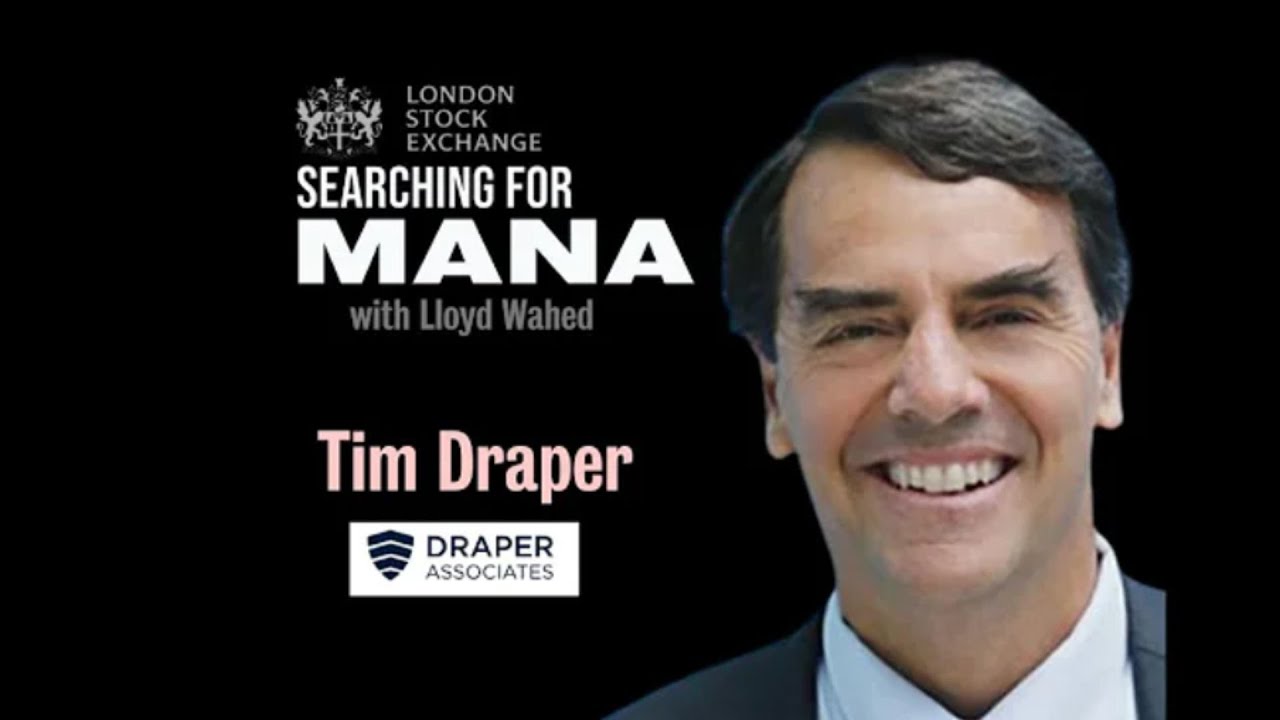
Venture capitalist Tim Draper discusses Bitcoin and AI as the next megatrends, explains how he spots disruption in monopoly-dominated industries, and argues that entrepreneurship and freedom are the engines of progress. He predicts Bitcoin will become a universal currency and envisions governments operating like cloud-based insurance companies.
Chapters
What happens when you combine the most innovative, eccentric, and charismatic leaders, disruptors, and founders from tech with the pedigree and history of one of the most established institutions within the City of London? The Searching for Mana podcast will be produced in partnership with the London Stock Exchange. I'm Lloyd Wildhead, the host of Searching for Mana. We're going to be interviewing some of the leaders, influencers and disruptors in the tech space where I'm going to be trying to dig in and find out what's their mana, their superpower, their magic. Hey Tim, welcome onto the Searching for Mana show.
Great. Thanks for having me, Lloyd. Looking forward to it. Have you found the mana? You've been searching for quite a while now.
No, not yet, but I'm hoping you might be able to answer, answer the secret code to it. At some point I'm going to get there. I don't know if it ends with Satoshi. But maybe it ends with Tim Draper. We're going to find out now.
Well, we'll find out. Go ahead, fire away.
So, so, so Tim Draper doesn't need for our audience much of an introduction, but that would be unfair to take it away from you, Tim. So if you could be so kind to just explain to the audience what you're up to now, there's obviously a very vast group of organizations. But perhaps if you could focus on the things that you're really excited about on your desk right now, please.
Terrific. Well, just so everybody knows, I'm a venture capitalist with Draper Associates. We're doing around the world business plan competition with Meet the Drapers. Now we got 70 million viewers of Meet the Drapers, which is a show I put on when thinking about how to continue to evolve the Draper University, which seems like it's moving along well. Writing another book, it's on its way. And, and I am really captivated by all the industries that are going to be affected by both Bitcoin and AI right now. I'm very excited. Whenever there's a new breakthrough technology like the internet or software or whatever, it moves through all the industries And it's a great opportunity for a venture capital investor to invest. So those are the things that I'm excited about right now and all kind of somewhere on my desk.
Thanks, Tim. So as somebody who is part of a family of venture capitalists, back to your father, and then now I know your children also mostly in the business.
And my grandfather was the first Silicon Valley venture capitalist. So it is very much in the family.
Yeah. And, you know, of course you've seen over the, really the last decade or two, it becoming a much more common choice for aspiring individuals. But when your grandfather, you know, invented the industry and when you came to it, this was very different. What I'd be curious to dig around is the point that you just finished with there, which is it feels like there are a couple of megatrends And that we have right now. And like you say, like the internet that could thread through industry. How are you looking for the difference between fads and trends? And when do you know, okay, we're gonna invest and commit to this because I believe this is gonna have a significant economic disruptive nature?
Yeah. So we separate the trends from the trendy and that's a big part of my job and it's a part of my job to train my analysts and my associates and my interns to separate the trends from the trendy. And the— a good way to do it is often just to ask the entrepreneur, why? Why are you doing this?
How—
what made you decide to do it? And if the answer uses their head, it's probably not a good sign. If it uses their heart, It makes a big difference. So, I mean, I could give you a zillion trendy ideas, but in general, if you do a Google search on the trendy ideas, you'll see 100,000 other people doing the same thing. But if it's a trend, if it's some what they call megatrend or gigatrend, petatrend, whatever, those trends are when you see a total sea change and you see the existing powers or whatever, the existing players all get disintermediated during a mega, a major trend.
Yeah.
And it's really a healthy thing because you'll see big companies get challenged. by startups. And those startups will come in with new technologies or new ways of approaching the customer, and they'll wedge their way into an industry that seems dominated by monopolists. And then eventually those companies become the monopolists, and we need new entrepreneurs to challenge them. And how do you find the monopolists? What you do is you look at the telly, as you call it, at the television, and you say, who's advertising? Who, who's dominating the airwaves? Those are the industries that are run by monopolies and oligopolies. And they're the ones where new technologies can come in and wedge their way in because they get a little bit fat and lazy. And all they're doing is advertising their, their monopoly services. So who are they? Right now, it's big pharma, banks, insurance companies. Let's see, dog food. You know, anyway, those are the ones that seem to keep being— keep coming up. Some consumer goods, and they keep coming up. And you know that they've sort of dominated a field. Well, now we have new technologies that come along and they, they can transform those industries. So software transformed GE. GE transformed anything using electricity. Software transformed GE. The internet transformed, boy, you name it, almost every industry in the world, but more, most recently taxis and hotels. They transformed communications, information, gaming, entertainment. There used to be something called World Book Encyclopedia and they were a monopoly on information. They and one other, Britannica. And when there were search engines, all of a sudden they were gone. There was a company called Kodak. They were selling cameras. Once there was a CCD, They were gone. Once people could digitize photos, they were gone. Now, what do we have? We got AI and robotics. We got really interesting things coming along. And those robots are gonna transform a lot of things and AI is gonna transform a lot of things. And generally, it'll be the things that are mundane, that are boring for people. And I think What's great about AI is it used to be that AI was just, just like rules-based. It's if-then-else. It would be like, if I say do it, then move this over here. But now AI uses neural nets and neural nets learn. And so it moves there. But if there's something in the way, it says, how do I get around it? And so suddenly AI has its own thinking. It can think. And now that means, you know, no venture capitalist has made any money in robotics, period, except maybe the Zumba recently. But now with AI, the robot gets smart. And that is the beginning of a whole new industry. I think that's gonna be a big deal. You know, if you wanted one nobody's going after, that might be a good one. The other one is, AI as a governance. Government is really a service. Government is supposed to be serving the people. And it's, it provides a service. And now with AI, government can do an outstanding job of providing service to its people. So government as a service, I think that's going to be a big AI opportunity. Robotics, I think, are gonna become smart. And in healthcare, I think it's all gonna be data-based. It's gonna be tied to the diagnostics, is all gonna be data-related. It's like, here's my medical history, my genetic history, what I ate on the airplane, who I had breakfast with, what I— all those, all that data will be my Fitbit results. It'll all be put together and it'll give me a good diagnosis of what I have. And then therapeutics are all going to be data-driven too. They're all going to be computational biochemistry, but they're going to be based on the diagnostics that have come from the data. So you start putting those 2 things together and you can find data and therapeutics together, and that could be the new form of healthcare, and that can be almost free. The drug companies don't want to hear this, but that can be almost free. It can be like something that, that data that can all be in software, and it can do an outstanding job. And your, your therapeutic might be go eat a banana. Or it might be go do some algebra problems, or it might be go lift some weights. But, or it could be, here's a drug that is specifically to you that comes out. So I, I'm a big optimist. And you know, by the way, optimists are the ones who make, they make all the change in the world and they also make all the money.
Yeah.
And I think you, so be the optimist, be the one who, when the soccer ball goes down, over the fence and down the road, be the one to go chase after it. Don't be the one who sits back and says, you do it. It's important to be that optimist. Anyway, that's my thinking. That was a little convoluted way of answering, but I do think we are about to hit a real anthropological boom. And it comes a lot from Bitcoin. It comes a lot from AI, and it comes a lot from all these new breakthroughs in healthcare. I also think we're gonna, I mean, space is gonna open up all sorts of new ideas and thoughts and frontiers. Yeah.
So when you talk through that, Tim, perhaps it answers the question from an optimist passion perspective and an intellectual curiosity. My question would be, I understand when you gave some of the early examples around which is a really good thing to do, look at who's advertising. And let's take boring insurance, which when you get to understand it can be fascinating, of course, and much needed. Now, the first time that you come to try to disrupt insurance, let's say you're an entrepreneur who wanted to set up an insurtech. I understand the psychology of why someone does that. In a way, it's in their own benefit. Perhaps they're doing it with their heart, as you say. But when you have multiple trend cycles that you've lived through, I really want to understand for you, what's the driving mission? What's the force? Because, you know, what tends to happen in these cycles is, you know, the Googles come in and the Amazons, and then perhaps now we're thinking, well, okay, perhaps some of the artificial intelligence, you know, if they're not controlled by the Microsoft organizations, are going to come through and be the next big wave. Maybe the next big robotics businesses will be maybe the next big foundations blockchain businesses will be. But once you look at 2 or 3 cycles, you can't be doing it because it just benefits you for that company to come through. You must have something bigger that is your why and your driving force. I'd love for you to let me know about that.
Oh, so you're asking me the question I ask all the entrepreneurs? Okay. Yes. You're asking me why?
Yes.
Well, I really believe in progress. And I believe that humans are progressing at faster and faster rates, and that entrepreneurs drive that progress more than any other people. You know, politicians will claim credit, and they'll identify problems. Existing businesses will slowly move progress forward, but entrepreneurs do the step function. They really move progress forward. And I want a world that where the marketplace really decides and the entrepreneurs have a good shot and they have the freedom to experiment and to try new things and the sandboxes in which to try them. And it tends to be that entrepreneurs don't get that burst of money, that first burst of confidence that they often need to get where they're going. And all— sometimes all they need is somebody else to say, I agree, I think this thing is going to be great. I think if you can create that time travel machine, it's going to be a big deal. Or, you know, that teleportation device that you're coming up with, or that cure-all for, you know, that cures your whole body of everything. Those new ideas seem a little crazy at the time, but if an entrepreneur gets that first money, they can start trying it. And if they get that first burst of confidence, then that's often enough to drive them for years forward. And so I think that's what my role in life is, is to be that encouragement for those entrepreneurs who are going to make a big impact on the world. And even my entrepreneurial ventures, Draper University and Meet the Drapers and Draper Associates itself, are all really driving that entrepreneurial spirit. And when we teach our students, we have a pledge and the pledge starts, I will promote freedom at all costs. Then it goes on and it says, I will fail and fail again until I succeed. The thinking there is if you're an entrepreneur, you've gotta, you gotta try stuff. All our biggest wins in the world that we've ever created all were pivots. They all were entrepreneurs that were going after a big market and they had real drive and determination, but they found something along the way. So on their journey, they found something and then they saw it and glommed onto it and moved it forward. And I think that that's why I encourage entrepreneurs to try and using the word fail is the, I guess, anathema, whatever the anathema of, or the antithesis of what educators do now. They don't want failure. Educators want everything to be the same. They, you get the highest grade if you don't make any mistakes. But if you don't make any mistakes, you aren't trying anything. You aren't testing anything. All you're doing is spewing it back out.
Yeah, it's really like the education system is gonna reward you for some type of memory and discipline and not creativity.
And staying on the track.
Yeah.
It's gonna reward you to stay on the track, but the world is always better off if you stay on the track, but occasionally try something that might hop you off the track or take you off or maybe you fly so you don't have to be on the track. Now, when I talk to politicians, I say, you know, I've had the opportunity to meet the presidents of maybe 30 or 40 different countries. And each time I say, there are 3 things you got to do. You got to trust your people, set them free, and have rule of law for you too. So if you're the leader of a country, whatever laws you put in, You abide by those rules, everybody else will too. And so if you have, I mean, if you have a country with good rule of law and you, and it trusts its people and it sets them free, you get, you know, America for 200 years, you get Singapore, you get South Korea, you certainly don't get North Korea. And you get these extraordinary countries. So trust your people, set them free, let them experiment, let them roll before you start slapping people down or creating new laws. And if you create new laws, allow the early adopters to be grandfathered in.
If we take those principles and we think about in the blockchain space, I'm not sure if it's past trendy yet, but I believe it will trend, which is decentralized autonomous organizations, DAOs. And if we study cultures in distributed teams, as the world has moved that way, and this is a big debate, but nonetheless, you really start looking at some of the initiatives out there where, for instance, London sets up a DAO where it's going to allow people from different communities to be able to join certain forums and make votes on what is important to them or not. To your point about—
hey, that's exciting.
Yeah.
So there's a liquid democracy happening in London, huh?
Well, we're about to start this and it is really exciting for the reasons that you were saying. And it's potentially good. You know, there's going to be a lot of failure and experimenting with it. And I can introduce you to the individual who's leading that. But yeah, really interesting cultural experiments can start to happen. And I suppose with your view, over the next 5 years, it won't all be perfect, but some will be great. And then over 10 or 20 years, this could be a real benefit to society. Is that type of a mentality? So I'm excited about that because in our group, we study these types of organizations. How can we make them productive, but how can we make them creative? And so we use terminology similar to what you were saying, which is Chaos and order. And when this comes together, it's where a lot of the magic and the progress happens. And I think that's the play on the phrase searching for mana. What we're searching for probably never ends. We're looking for creative progress and we're trying to find entrepreneurs and leaders who we think over a long period of time are going to do that. The venture capital model gets a lot of heat around the types of short-term pressure that it might put on these types of individuals. And this is for many reasons, but, and by the way, brilliant things come from it, but based on the LP timeframe that a fund tends to have. Now you've created a really interesting set of companies, which by the sounds of it allows you to find talent right at the start and nourish it. And then also, you know, make investments into more significant projects and everything in the middle. But do you feel that the venture capital model from your grandfather to you needs to change if we're true to this point, which is, I don't personally want to go create the next 5 big monopolies. What I would love and what I think blockchain might enable, and maybe AI, is a myriad of great companies where it's serving the individuals who own them in a collaboration but they don't just go win the whole industry. Now, in the venture capital model, you wouldn't look at it like that. But the way that we're looking at it as a group, whether we're right or wrong, is we think that's a better world. And we think there's more innovation and we think more people benefit. How are you thinking through that?
I'll go through a couple of thoughts. One is I'm dying for a moment when I can raise a fund all in Bitcoin, invest it all in Bitcoin, Have my companies pay their employees and suppliers all in Bitcoin and have their taxes paid in Bitcoin and the whole thing in a walled garden. And why is that? Because the blockchain keeps perfect records and I no longer have an enormous accounting bill. There's no bookkeeper, there's no auditor, there's no— there's Complete trust in the system. And the people, the— my LPs get their, their money back and their waterfall just the way it's written in the contract. The whole thing can be built into a smart contract and totally automated. And I think that moment will come when people can buy their food, clothing, and shelter all in Bitcoin. And at that time, people will say, well, wait, why would I ever hold on to fiat currency of any kind? And that'll be like the— I call it the Confederate dollar moment. My, my father gave me a million-dollar Confederate dollar. And I said, oh my God, a million dollars, what can I do with it? I was probably 8 years old. And he goes, nothing. And he said, no, it's— they lost the war. And, and it's only the union dollars that are worth anything. And you look at that, and the same thing happened to the Greek drachma and the French franc and the whatever. Nobody accepts them anymore. I think there will be a moment where political currencies no longer are accepted because cryptocurrencies, Bitcoin, are the, the standard. And they're much more efficient and they're recognized in value. I mean, Bitcoin, of course, there are only 21 million of them. There's no politician who can just go print more and create huge inflation. You know, I mean, my dollar from 2019 is probably worth 70 cents now. My Bitcoin from 2019 is probably, I don't know, sextupled in value. So I think there will be a moment where people say, like the retailer will say, I don't really want to take dollars anymore. I want to take Bitcoin. And that'll be a moment when there's a race to a major change. And as you said, this will be a currency accepted everywhere. It will be open, transparent, keeps perfect records. It's honest. It's free. And it's trustworthy and it's got very clear sets of rules. So I think that that world is one that is going to allow us the different— I mean, it'll be like the transformation from shells to gold or from gold to the promise of gold or whatever. The world will get wealthier. We'll all be better off. The government part of your question, the DAOs, that kind of thing, I think they are really exciting. And I think we're going to see some times in the future where governments are going to be created offshore, 11 miles offshore, up in space, whatever. And, and what is government but sort of a safety net, a careful safety net? And it's an insurance company and a much more efficient, effective, and fair insurance company can be created in the cloud with Bitcoin and AI. And suddenly you're going to start seeing people say, well, I'm not going to really use the healthcare insurance or the workman's comp insurance or the unemployment insurance that's provided by the government, it's a total waste of money. I can do it much more cheaply and much more efficiently up in the cloud. So I think there are going to be nations created virtually that provide most of the services that government provides. And then governments are going to have to, of course, become more efficient, just the way, you know, the big companies do. Microsoft's been able to make 2 adjustments. They were the software, they were the dominant software company in the world. And then the internet came and Bill Gates turned on a dime and suddenly said, this thing's big, we gotta do something about it, grabs it. And they're still alive. And then now AI came and he jumped on that, not he, but Microsoft jumped on that and stayed on top. That's a really difficult thing for a company to do when you're in a dominant position. You're providing some service, you're making a fortune off of it, and a new technology comes that could completely change everything. It's hard to move in that direction, but they all do in one way or another, and they all get better, and service gets better. And as consumers or constituents, we all benefit from those major changes.
If you had a top 3 of the individuals that you're so passionate about, the individuals who changed the world, is Gates number 1? Is he the GOAT?
Oh no, Jobs. I mean, or Elon. Steve Jobs. I mean, those were inventions that no one believed. He was the kind of entrepreneur no one would believe that he was going after something and he would create. When he did the iPod, it was not anything anybody thought could be done. It was one button. He said one button. No, one button. He fired 50 engineers.
Wow.
Over this one button. They kept coming back. Well, not quite one button, but it's close. One button. Go back. Give me one button. And then he moved slowly in and created the greatest phone of all time. And then he created this ability to build apps on it. That guy has probably made the biggest impact on the world that anybody has. Anybody. Elon. First with PayPal, then with taking over Tesla and starting SpaceX. He, he has transformed 2, 3 major monopolies. And that— and now he's kind of going after Twitter and The Boring Company and a whole bunch of other things. That's harder to do when you got 15 things on your plate. But Those first 3, that, that was really extraordinary. Bill Gates, I think, was, was more brilliant as a business person and as a technologist because he saw, he saw wind coming and figured out which way it was gonna blow, you know, and it was actually his partner who was, who designed the software, I think. I think Gates had something to do with it too. But I, I think all those guys, I mean, they, they are, they're the greatest of all time. I think those are the GOATs. I'd say if you pick 3 GOATs and then maybe Thomas Edison before that, they were, they're the ones that tried something that was unpopular, unlikely, and something really extraordinary came up.
Yeah, agree. Have you— do you think in the last several years we've seen the emergence of perhaps the next one? You know, this searching for more.
Actually, we gotta add Ben Franklin to that. Electricity is a big deal. Okay, what's coming? I think it's really interesting. AI has been created over the last, I don't know, 40 or 50 years. I remember doing AI and I'm old. I remember doing AI at Stanford and it was expert systems. We weren't into neural networks. But I do think that whoever captures people's attention with AI and takes us to a new world will probably be one of the, you know, that'll be a, there's a GOAT opportunity there.
Jensen of NVIDIA seems to be coming through quite nicely right now. into prominence, whether he'll be that person or not. And then we have a few other people who, you know, the actual architects to look at. So yeah, really exciting time. Tim, I want to do the quick Marna round with you, which is just a couple of stock questions we ask all the guests. So the first one is, and as short or as long answers as you'd like to provide, if you have, and you're somebody who probably regularly gets this, the front page of your favorite publication, what would be the message that you'd put on it?
Oh, I think it would be trust your people, set them free. I think freedom is so important. I think that would be the message. So important to entrepreneurs, so important to progress. And regulations are really the enemy of freedom. Some regulations, of course, are necessary. But I would make it very clear that more trust in the world and more very clear and very few rules and regulations.
Do you think technology has accelerated or decelerated trust in the world?
Oh, it's accelerated trust. The world is so much better than it was 50 years ago. They, I mean, there was man-to-man trust. 50 years ago, there weren't many women in the business. There was that kind of man-to-man trust, which meant kind of like, okay, we're going to do this and we're going to treat each other fairly or else. Now, I mean, we've got Bitcoin. It creates trust in the marketplace. We know what a Bitcoin is worth. It is that trust is spreading around the world. I also think Entrepreneurship is a trusting business. When I invest in an entrepreneur, there's a lot of trust there. And the entrepreneur, it's not just with the money, but it's also that the entrepreneur will do the best they can with that money. And the entrepreneur needs to trust their people to get on board and be a part of this, this vision that they've got. And so, yeah, I would say that there is way more trust than there was 50 years ago. And as time goes on, there's going to be even more because the, the, the technology encourages it.
Do you think that, you know, I'm sure as, I mean, you probably know them, for me, someone who reads Walter Isaacson and certainly watched every single documentary on your Elons and your Steve Jobs. Do you think they were trusting of their teams?
Oh yeah. Oh yeah. I think they both had extraordinary trust for their teams. They said, here's what we need and then go figure it out. And I think then they had trust and they, you know, and if the team didn't perform, then, you know, Steve Jobs would get rid of them. Elon too, I think, is pretty— and I think it's good judgment to fire quickly and hire slowly. But then once you've got your team, you build on that trust. I know that it's very— once you've got somebody working, all that institutional knowledge is really powerful. And so you generally want to keep them and you want to continue to build trust with them.
Yeah, I think the key there is that when you were talking around the government, you were saying a couple of things, but, you know, and the rules apply to you. I think both those individuals set the tempo. So, you know, if you're signing up to go into that organization, then you understand that you're getting the opportunity to change the world, but there's an expectation of, you know, doing your greatest work. So then that becomes fair. Certainly from From the reflections I've had on it, and that seems to work incredibly well. Tim, what keeps you up at night?
I sleep pretty well. If I haven't, if I feel like I haven't worked hard enough, then I will often wake up in the middle of the night and finish whatever it was I probably should have been doing during the day. But if I've worked hard enough and I've exercised, sleep comes pretty easy. And, and, you know, then I can go to sleep with it. I think a lot of it has to do with, you know, what, what drives your conscience. And if it's, if you've been, you know, doing everything you can during the day, you can't expect to do more. And so sleep, okay, go ahead, go to sleep. Get a few hours and then whenever you're ready, then wake up. I do know though that I don't sleep as well when I haven't exercised. That's a big deal.
And you're exercising daily?
I know I do it about 4 or 5 times a week. Yeah. Yeah. So, but I vary the exercise. I play basketball, I play tennis, I swim, I play football whenever I can. But, you know, that's football, our kind of football.
Okay.
The one you throw.
Yeah. Amazing. I'm so annoyed.
I don't know how to play your kind of football. I was a goalie, but not a great one.
I'm so annoyed I wasn't born in America. I'm convinced if I was, I'd be one of the greatest baseball players.
Oh, baseball players.
I'm convinced. I'm convinced. I was just very good with the cricket bat, with the hockey stick, but in that, like, those sports don't really justify a career. So I just went into a proper job. I think in America, it could have been a season.
In America, you could have, yeah, you could have done a big deal.
Oh, I'm sure. I'm convinced of it. Okay.
I was a power hitter until like in high school when they realized I couldn't hit a curveball. And once I couldn't hit a curveball, it was like, oh boy. Only if it was straight, it didn't matter how fast it was coming, I could hit it. But when they started to curve, my game was gone. My, my hand-eye coordination wasn't good enough.
Yeah, I, I hadn't accounted for that. That'd probably be the same for me too. So, you know, exercise, feel like you've got the most out of the day, good night's sleep. The question also is there to think about, is there a particular topic or trend right now that keeps you up at night?
Well, as I said, I sleep pretty well, but I do. If, if there is a trend, it seems to be swinging back. There was a trend toward government telling people what to do, and it came from the pandemic. And, and I was starting to feel like I was working for the government and not the other way around. And that was dangerous. And that, I mean, that's one of the many reasons, you know, this, you know, that's where socialism starts. And then when you've got socialism, your economy goes flatline. You get, I mean, you think San Francisco's got a homeless problem now, boy, if you have a socialist government, the whole, all of California is going to be homeless. And then it'll just spread. It's a horrible thing. I mean, you just know whenever you go to— I went to Cuba, and I know that North Korea is a similar thing. Socialism is a very bad idea. It works for the leaders and nobody else, and they starve. And, you know, it's a horrible environment.
And you're seeing this play out.
Capitalism is a good thing. It works. It creates freedom. It creates a personal responsibility. It creates— you have to be working for the good of somebody. You have to serve somebody in capitalism. And by doing so, the whole world gets better. And, you know, whenever the government starts to focus on you know, poverty, they get poverty. They focus on the best and the brightest, they get the best education system in the world. If they focus on the homeless, they get more homeless. If they focus on improving the business climate, they get better businesses and they get more employment. It's a, it's a pretty clear system. And in a democracy, you really need to make sure that you support the politicians that are the optimists, that are the ones that are taking us to a new level, not the ones that are dragging us back. And I think that all that argument about AI, that's— I'm not worried about that at all. I think entrepreneurs, when something goes wrong, they solve those problems. And I'm actually very excited to see what else AI can do for me. I can't wait to see, you know, the AI that accomplishes anything that I want accomplished very quickly. You know, people were freaking out about the printing press because they, you know, they had jobs copying the Bible over and over and over. And now, and then they're thinking the printing press is gonna destroy humanity. Well, I don't think it did. I think it educated people very well. It was an extraordinary accomplishment, and we're all better off from the printing press. I think this is an equally transformative achievement, and I think it's, it's, it's equally fundamental to the printing press. And boy, it's going to be amazing. I imagine these these faculty lounges. You got 10 people in the faculty lounge. You got 2 of them who are saying, wow, the admissions office is doing such a fine job. These essays are fantastic. And 6 of them are going, we got to get rid of this ChatGPT thing. It's ruining our curriculum. I can't believe it. And then 2 of them are going, huh. Wow, this is really gonna change things. How do we get out in front of it? How do we teach this new pupil who is, who has access to all this information and all this intelligence? How do we get them to leap way above the crowd? And those are the 2 that will take us to the promised land. Yeah, I love it.
What a, what a great mindset and great insights from you there. a lesson, a lesson to be learned and thought through by, by many individuals. In terms of the rest of the mile around, I'll move to the final question because I want to finish on, on a major topic with you that I know is one of your passions right now, and it's, it's probably Bitcoin. You're on the Searching for Mana show. As you said at the beginning, you know, the show is about trying to find our magic. Mana is in gaming. The essence, you know, the special sauce, something you're looking for perhaps in an entrepreneur. You've got a CV, hard skills, and you've really got, I suppose, the soul, the mana, the magic. Tim, what would you say your mana is?
Oh, I think I'm still looking for my mana just the way you are. I think we just keep working, looking for the mana. I'm excited about, you know, the kind of the continual search. I remember talking to my dad and I'm saying, hey, Dad, what advice do you have for me? He's 96. He looks at me, he goes, just keep doing what you're doing. And I think the idea there is you keep adventuring, you keep trying new things, you keep innovating and learning and Traveling and whatever else, and good stuff will happen.
Great. Well, this is— you're the first person who's got the same one as me then. So I'm optimistic about my future now. So you come on the show with me for the— we've got Cathie Wood next week. That would be an unbelievable show.
She's amazing. You will have a lot of fun with her. And she is a futurist. She's got a futurist working for her. That, that thinks so far beyond where all of us are thinking. It's so good. You're going to have a great time with her.
Yeah. Oh, maybe I'll ask a couple of questions in my prep, if you'd be so kind. She's, she's great to get the prediction of Bitcoin, of course, which I'm sure you would agree is going to be ever more higher. And it's hard to predict the exact timeframes. You predicted famously back along that we were going to hit around $240,000. At the end of the last cycle, I think it was for 2022. We're now in 2024 as recording, just moving into April, and feels like we're in a really great moment. You know, the markets come back, everyone's more optimistic, and I'm excited about how this space, how the Web3 and cryptocurrency space is starting to build out. We have companies like Coinbase who feel. Pretty generationally significant, in my opinion. And it's starting to see some others coming through. Whether you want to predict the price or not, I'll leave that for you. But I would like you to finish. We've talked about AI, which is super exciting. But for this show and this audience, where we're very passionate about financial technology, if you could really set the Hollywood scene, the prediction on the cryptocurrency and Bitcoin market as you see it, please, Tim.
So it's funny because the— I'm, I'm more famous for the prediction that didn't work than the one that did. Because back in 2013, Bitcoin was at $180 and I predicted $10,000 in 3 years, and it hit it right on the noggin. So it was like 2014, I guess.
No, 2017.
And it hit $10,000 and I was right on. And I started to feel like, oh my God, I can predict everything. It's going to be fantastic. Oh sure, whatever. And then Bitcoin fell to about $4,000. And somebody asked me again on, on air what my prediction was. And I said $250,000 in 4 years. And that was supposed to be 2022. And I think my hubris got the better of me. And I was, I have not, we have never hit that number and it's already, I'm already 2 years late. Now, what went different from what I had anticipated? One was I think the regulators got heavy-handed during the pandemic and they all felt like they should tell everybody what to do.
Yeah.
And that hurt in the US. It hurt a lot. And in other countries, I think that follow the US also were hurt by all those extra regulations. So that was a big problem. So regulatory, I didn't expect. I expected companies like OpenNode to make it very easy for you to buy your food, clothing, and shelter all in Bitcoin. And I thought that was going to be prevalent everywhere by 2022. And, and that has been delayed somewhat too. So those are the 2 things that slowed down the progress. The things that advanced the progress faster than I thought it would go were DeFi and how you can now buy Bitcoin on an ETF. I think that, that's an accelerant. Yeah, because a lot of people are willing to, you know, get your Ledger Pull it out, put it in, you know, and, and put your money on that ledger. And it was sort of a magical thing to have your money on the ledger. Still is. But a lot of people, you know, really just want to kind of do things the way they've always done them. And so they wanted Bitcoin, but they wanted it in a way where they could keep it with their brokerage firm or with Coinbit. Coinbase or something. And I think the ETFs have allowed that to happen. So that's been a recent accelerant that I wasn't predicting either. And I think the halving or halvening— they used to call it halvening, now it's the halving— is just sort of a price is determined by supply and demand. A halving cuts supply. And by cutting supply, you— the price goes up. So that's why over the last, I don't know, 6 halvings, you've seen the price go up after a halving. So be, beware, that's probably going to happen again. Now, 250,000 or a million or 2 million or even 10 million are numbers that are probably going to happen for a couple of reasons. One is when you can buy your food, clothing, shelter, and pay your taxes all in Bitcoin, that's a done deal there. You won't want to use any other currency. You won't want a political currency when, when you've got one that's trusted. So you'll want the Bitcoin.
Currency.
The other thing that is going to have it, you know, hit those numbers is the devaluation of dollars against Bitcoin. It's funny; everybody measures Bitcoin going up against the dollar. Nobody ever—you never see the chart that goes, "Here's the dollar versus Bitcoin," and you're watching it just sink. There will be a moment where it just. really sinks. And that will be a lot of inflation in the dollar and a lot of stability in Bitcoin. And I think those 2 will force the dollar to be, relative to Bitcoin, to be very low. So that's how— I mean, that's where my prediction from before was premature. And Why now it looks like maybe it was not even realistic. It's, it was pessimistic. I think we've got much higher highs than the $250,000 coming.
Well, to add on to your mantra of, you know, just keep doing what you're doing and searching for mana with me, and we can both hit a straight ball with a baseball bat, but not a curveball, it seems. Feels to me like you're living with the principles that you recommend to innovation, which is massive optimism when we see a brilliant trend that can benefit everybody. I love it, Tim. Thank you so much for taking the time to come on the show. Absolute pleasure.
Terrific. It was great fun. And Lloyd, thank you. And I like this MANA concept. And please send me a link and I can, I can send it out.
Yeah. Thank you so much. Thank you for joining us on this episode. We hope you've enjoyed it. Please leave a like and a review and subscribe to our iTunes channel to stay up to date with the newest content. Find us on social media @SearchingForMana. Tell us who you want next on the show. Thanks again and see you next time.
More from Tim


He Sold His Car to Build This Startup, Then Pitched It for $1M 😳 #Startups #AI

This Startup Moves Your Crypto BEFORE Hackers Can Steal It 😳 #Crypto #Cybersecurity




15 Months Without Refrigeration?! This Startup Thinks It Can Go Global 🥥 #FoodTech #Startups



