TOP 10 Rules of Business Pitching | Startup Coach and Investor Reena Jadhav
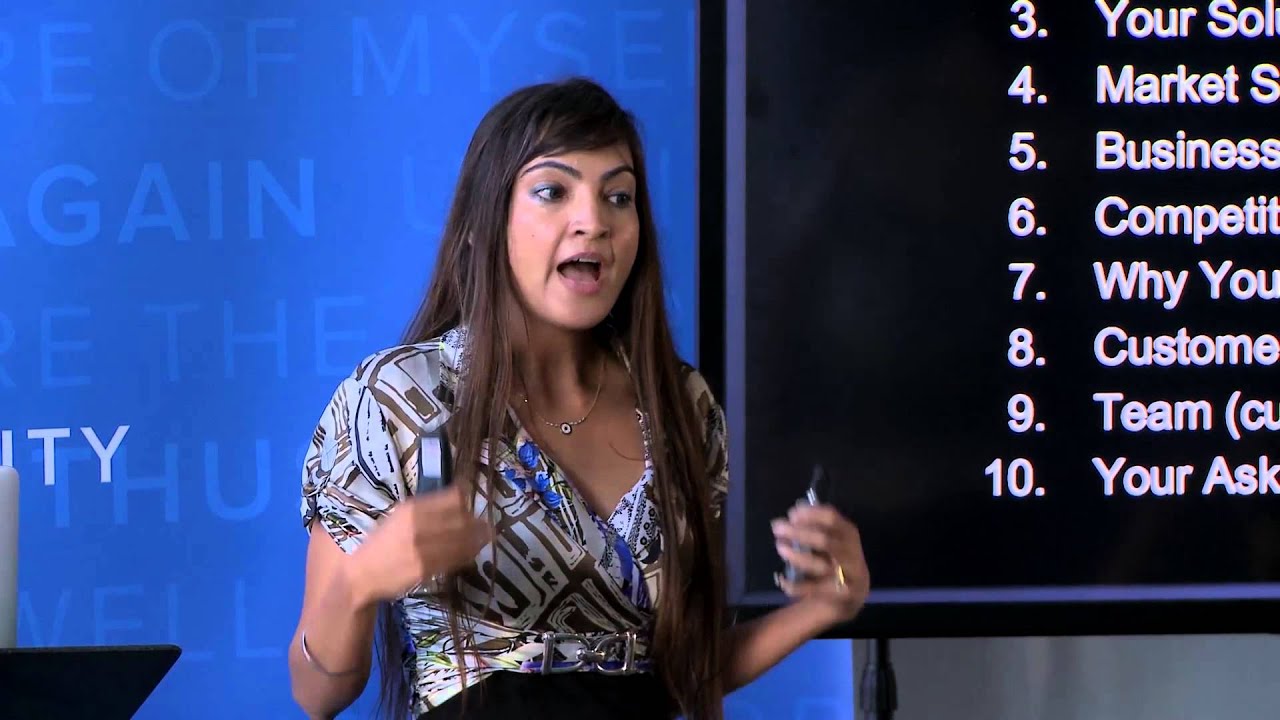
This content was created by Tim Draper. This content was uploaded by Tim Draper. This is a YouTube video titled "TOP 10 Rules of Business Pitching | Startup Coach and Investor Reena Jadhav" (posted June 14, 2015). It is a presentation/workshop delivered by investor and startup coach Reena Jadhav to an audience of founders, with audience Q&A (labeled SPEAKER B). The talk covers how to structure a 10-slide investor pitch (pitch, problem, solution, market size, business model, competition, customer acquisition, team, advisors, milestones), emphasizes rethinking business models (examples: Zenefits), competitive analysis, customer acquisition strategies (references the book Traction), fundraising milestones and stages (MVP, traction, seed/Series A expectations), and practical advice on founding teams and advisor equity. Metadata: YouTube content, title as above, created on 2015-06-14.
Chapters
Now let's move into the investor pitches. How many— I saw a lot of hands raised in terms of investor pitches. So if you're interested in fundraising changes, in my opinion, every 6 months because the market changes every 6 months. There's a great video and presentation that's been done by Dan Martell and he talks about the new 7-week framework for closing a round. And if you're interested, you can go to Startup Dan and go into fundraising and you can see there's 2 posts. One's the actual video transcript and the second is actually the screenshots. So while I'm sharing this with you, I do urge you— this has actually already evolved as of last week. There's a new framework that's being recommended for closing your round in 7 weeks with slightly different slides. But the content is still going to be the same. So the content in your investor presentation will still be 10 slides. The first is gonna be your pitch, right? Your very brief, hi, I'm so-and-so, and this is what I do. Then you're gonna start with the problem. So if your problem isn't really, really crazy well-defined, or if your problem is one of those fun things, like gaming, right? Gaming— gamers always come to me and say, I hate your problem being first slide, 'cause there's no problem. I'm creating entertainment. There's no problem. I'm like, there is a problem. The problem is boredom. The problem is— You could still create the reason. And the problem isn't just something has to be bad. It can also be need, right? So people are looking for this. They're hungry for this. They're thirsty for this. They want this. So from a consumer standpoint, the pro— business to business call it problem. Consumers think of it more as need, want, lust, love. Right, so that's how you would frame it if you were doing a consumer product. Your solution, market size, business model. How many of you are familiar with the importance of the business model? Okay, so then I'm not going to beat it too much, but I will say one thing.
Okay.
One of my newer fascinations actually is the business model. I'm become— as I get older and older, I've become more and more convinced That when they say execution, yeah, of course, you know, it's blocking and tackling on a daily basis, but a really bigger part of it is thinking through your business model. And honestly, Zenefits is a great example of a company whose sole reason for explosive growth is their business model. The product is a pretty basic, simple recruiting platform. So I would urge each and every one of you in this room, To rethink the business model that you're adopting and go, how can I be different? How can I be creative? How can I do something that's going to make people go, what? You're going to make money? How? Can you imagine being an investor in the room the first time Zenefits made their pitch? We're going to give this entire platform away.
What?
How are you going to make money? We're going to take a percentage from the insurance companies. How are you going to do that? That's never been done. Now you've got intention. Now you've created intrigue. Ooh, something different. How do you do that? I think it's easier to do that with your business model than necessarily it is with other aspects of your founding experience. So think through your— you know, I seriously urge each and every one of you to rethink your business models and how can you be out of the box, how can you be more creative.
Competition.
Never say there's no competition, please. Because there's substitutes. Whatever it is you're trying to do, if there's no direct competition, there's a substitute, and you've gotta talk about that. One of my pet peeves is when I see competitive slides or when I hear about people talking about competition, there's a lot of sort of poo-pooing. Oh, competition, they are so lame. Their product is so old. They don't even have these amazing 18 features that we're gonna have. Never poo-poo competition. They're already there. They're already executing. They're already doing something. You're gonna start. I prefer it when founders come in going, here's competition and we're taking them seriously. And we've even thought through that if we did this, how would they react? What would they do? And we've thought that through and we're taking it seriously. And by the way, this is how we're gonna do competitive tracking. I've got Google Alerts set up. I've even done a fake demo with them so I know exactly how they sell. I know exactly what they do. I live on the competitor's site. I feel better about a founder who understands that competition is real. You cannot pooh-pooh them. You can't wish them away. And that it's better to know them than to ignore them. So if you're ever gonna pitch to me at least, Please make sure your competitive slides honor the competition as they should be, with the thought that we're gonna crush 'em, right? So there's a difference. You've still gotta crush 'em and put them out of business and, you know, give them sleepless nights. So this isn't about not being competitive. This is about understanding who those opponents are and getting ready to crush them, and you will never crush them if you don't understand how they function. Why you will win. You have to be honest with yourself in why will you win. So I just finished a boot camp that I taught to the 8 Harvard Business female founders that you're going to see today. I'm very proud of all of them. Um, why you will win is up here, right? It's a mental thing. If you're going in already questioning yourself, it's hard to win. It's hard to win when you, you've got voices inside you going, you don't really deserve to be here. You can't win that way. So why you will win, I always look for this supreme confidence because I'm going to figure it out. We are going to win because I've always won. Here's examples of whatever I've taken on and I've won at that. I will figure out a way. I don't give up easily. I don't lose easily. So why you will win is you sitting back and thinking through how will you compete better, how will you outcompete, how will you deal with all the tragedies that are about to befall you. And I guarantee every one of you is gonna have some serious insane crap come your way. How are you going to win against all odds? Customer acquisition, that actually is the more simple stuff, right? So if you haven't read Traction, the book Traction, that's the new gospel for it. Read that. Again, I've got some posts on Startup Den. You can read up on customer acquisition. How do you think through where these customers are gonna come from, why they will come to you, how much are you gonna spend acquiring them, and then of course the team. How many of you are 2 founders or less in this room? How many of you are 3 founders or more?
Woo!
you're already more fundable. Sorry. So more is better than less. So for all you solopreneurs, there's nothing wrong with it, but it increases the odds of failure. Yes?
What should you put up about people who are founders and then other people who came on later and they're not founders but they're lead engineers and still on the board?
That's a really good question. So I misspoke.
Team members.
So it's fine as long as you're not a solopreneur. So as long as you have a team, then you always say my team. So you don't have to call them founders, but you can say this is my team. With that said, I will still say it's— the journey you're about to embark on, some of you have already been there, is insanely hard. And it's important to have someone of your stature, and hence a co-founder, That's going to be the balancing act for you. So if you are aggressive, reactive, go, go, go, outside kind of person, you want to bring in someone who's calm, analytical, methodical to be that balancing act for you. So the day you start spinning, this person is going to pull you back off the ledge. If you're really calm and methodical and analytical, You're gonna need some serious firepower. So think about your own personalities and think very seriously about the co-founder that you should bring on because it really makes it so much easier when you've got 2, 3 people around a table at 3 AM in the morning figuring out how to get through the next day's crap that's about to hit. It is so much easier. It's very hard to do it alone. If you're 3, it's— the statistics are more startups that have more than 2 co-founders actually make it for the simple reason that there's 3 people in there helping each other out. Now with that said, there's always also issues around personalities and sometimes that makes it hard. Sometimes it's easier to do it on your own. But you want to think through your team. When I say team, I'm not just talking co-founders, I'm also talking advisors. If you haven't started thinking about advisors, I highly recommend you do. It's never too early to get a group of advisors on board. Never too early. Sometimes founders get a little afraid, like why would someone say yes? But you know what, you won't know unless you ask. So ask. Who can you reach out to? You can reach out to faculty. Some of you are here at Cal Poly, there's a large contingent here. See, is there faculty that you admire, that inspires you? Get them involved. Ask them. Obviously, people that you come in contact with. Go to meetups. See if there's someone there that inspires you. I especially recommend finding advisors that are lawyers and accountants so they can give you ultra-cheap labor. Yes?
How about advisors that are stock shareholders or just get some salary?
Yeah, yeah. No, advisors should never be given compensation. If you pay an advisor, then they're working for you. So advisors are typically equity only. But yes, you should consider creating an advisory pool. All this stuff is pretty mechanical right now. I mean, again, you can go on StartupDen, you can Google what's the right advisory equity to be given away. On an average, I get between 1% to 3% depending on how many hours I'm committing to the startups that I advise. So that's the typical number, and it's something for you to think about.
Thank you.
There's others that will get involved at a quarter percent. You know, you could say I'm getting 4 advisors, quarter percent each, giving 1% away. So, but it makes you look better. When you go to an investor pitch and you say my team consists of these 3 great advisors and a team of 3, you're real. I know that you're committed to this. This isn't something that you're having fun with. And then of course you're asked what Always have milestones. Never ever ask for something without committing to what are you gonna do in return. You're asking me for $100 grand, what are you gonna give me in return? Well, for $100 grand I'm gonna give you— and then give me a list of what are you gonna give me. Think through, are those milestones appropriate to raise the next round? Because at the end of the day, whatever you raise now is going to end and you're going to have to raise another round. So the question you have to answer is, I'm asking for this because I'm gonna deliver this, and that's all I need to raise the next round. So that's really where my head's at when someone asks me for money. First question I'm thinking already is, is that enough? And that's what most investors are thinking. Is this enough to get them to where they are going to get funded for the next round? Because otherwise, guess what happens? I'm left filling the blanks, right? When you come back and say, oh, I'm only 6 months short. I only need $80,000 more. Either I can let go of the $100,000 I put in or I put in an additional $80,000 to get you over the hump that you need to get through. So always put in your ask with milestones, knowing that those milestones must deliver the next round of funding.
Yes?
What type of milestones? Depending on which— so I think all of you are pre-funding. So at this stage, whatever money you raise, oh, That's another really good post that you must read. It is the new milestones for funding. It's by, I think Dave McClure put it out, and I think we've again done a rehash of it. But the bottom line is the days of raising money on a piece of paper are gone unless you just sold a big company, in which case, yes, you can go raise lots of money on a piece of paper. But right now the numbers are you're expected to get to a functional MVP that demonstrates some level of traction with a family and friends round. So that's step 1. With that family and friends, so that could be $10K, that could be $20K, whatever that number is. That could be $5K. I mean, I've had— so I have 2 of my female founders that have delivered traction, real revenue traction, for less than $500. So it can be done. You can absolutely do it. It's just It's just a matter of how committed you are to getting there. So that's the first milestone. The second milestone— so now you're gonna go raise money. So these are women, now they're gonna raise money. She's gonna say, look, I did this test, it delivered these great results, I'm now raising. How much are you raising? So the next level of milestones to raise— so Series A or seed round is a convertible. You've gotta deliver real traction. So that depending on which industry you are, you can define, well, real traction for me means this and a product that actually works. So it can't be an MVP anymore. So that would be your next level. So I'm gonna deliver a real product that works as well as real traction, which is I think why I see companies have to like double every week their growth, right? So for the next 6 months, I'm gonna build it out so we're doubling every week. So that's the kind of milestones you need to look at. An additional milestone always that I insist on is building out your team. Because you're not gonna close the next big round if your team's incomplete. What do you need in your team? You need your coding guys and you need your execution guys.
Mm-hm.
So decide who you are. Are you on the coding side of the house or are you on the exec— on the sales side of the house? Figure out who you need on the other side and make sure that team is complete.
More from Tim


He Sold His Car to Build This Startup, Then Pitched It for $1M 😳 #Startups #AI

This Startup Moves Your Crypto BEFORE Hackers Can Steal It 😳 #Crypto #Cybersecurity




15 Months Without Refrigeration?! This Startup Thinks It Can Go Global 🥥 #FoodTech #Startups



