Understanding Different Stocks: Vesting and Preferred | Cooley LLP Partner, Sally Kay J.D.
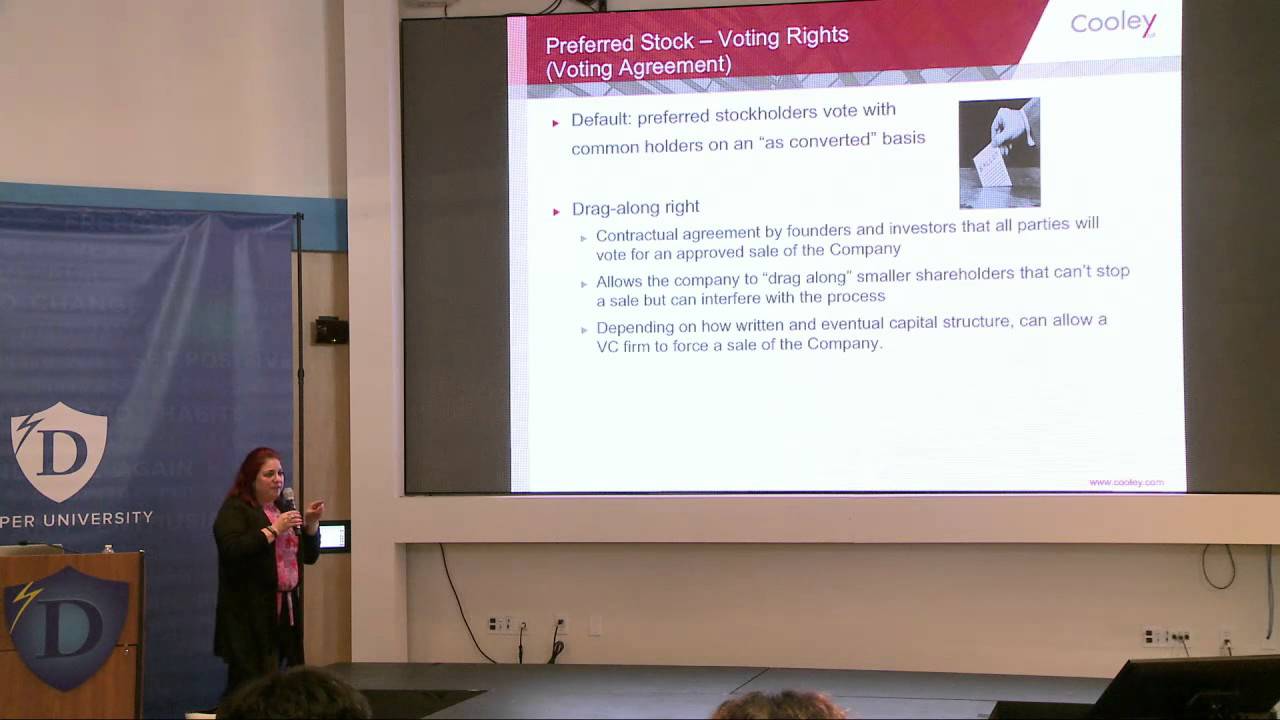
Sally Kay, a Cooley partner, walks founders through term sheets and financing agreements. She explains anti-dilution protections, warns against full-ratchet provisions, and covers preferred stock conversion triggers, drag-along rights, and registration covenants. Kay stresses hiring a startup lawyer early and reading term sheets carefully to avoid non-market terms that could kill future liquidity.
Chapters
Founder vesting, I think we talked about quite a bit. So again, if they come in and they don't like the way your stock vests, they may ask you to amend your agreement to change the way that your stock vests. I just did a financing a couple weeks ago, and the founders were, um, we're about 2 years into it, so the founders are— were 50% vested in their stock, and the investor didn't want them to be that vested. So we actually had to amend their agreement, so now they're only a third vested in their stock. So, they want them to have a little bit more skin in the game. And that was one of the, that was like the make or break in the deal. So, it was like do we really want this money or do we not want this money? And they figured we're in for the long haul. It will be fine. Anti-dilution protection is the other thing that's kind of big. And does anybody know what anti-dilution protection is? You don't generally get it as a founder. You don't usually get it on your common stock ever. But for preferred stock They're basically saying, we've put all this money in the company. We want to be able to protect our position here. So, what we don't want you to do is be able to go out and sell stock super cheap to somebody else after we paid a whole ton of money for it and not get any benefit to that. So, there are 2 different types of anti-dilution protection. And this is also something you'll see in the term sheet. Weighted average anti-dilution is just a formula. It says if you sell stock, To somebody at a price less than I paid, I get an adjustment on my conversion ratio. So, when I convert my stock to common, I get more shares. And it's a big long formula and it's, you know, based on the number of shares outstanding, how much money you raised, how much money you would have raised had you sold it at my price, blah, blah, blah, blah, blah. Much more typical and much better for the existing stockholders. Full ratchet. Full ratchet. And you rarely see it, but if you ever see the word full ratchet anti-dilution in a term sheet, Do not pass go. Do not collect $100 until you talk to somebody. Because what that says is if you do the financing at a price lower than mine, I get an adjustment as though I bought my stock at that price. Fully adjusted. So if I paid $5 a share for my Series Seed stock and then things go really crappy in the company and you do a Series A at $1, I basically get 5 to 1 on my shares. 'Cause I get fully ratcheted down as though I only paid $1 for my shares. You don't see it very often, but if people think that they can take advantage of you that way, A, generally you don't wanna take money from them unless you're completely and utterly desperate. But there are some funds out there that will ask for it, and it should be something that you make sure that you push back on. It's not market. That's actually the best answer. You look at the term and say, that's not really market. I guess the other thing that I would say, And when you guys start to think about financing, if you go to our website, and we're not the only firm that does it, so you can find them a lot of places, but we do quarterly kind of an analysis of all the financing deals that we've done in the quarter. And it will show you what the terms are like at seed stage A, B, C, D. See what the liquidation preferences are. And it'll show you by percentage what the deals that we did in the quarter As compared to prior quarters are. So, you can kind of see where the trends are and where the money is by round. And you can find that stuff on there. Less important issues in term sheets. There's a whole lot of things. Conversion rates. Dividends. Rights of first refusal and co-sale. Voting. Redemption. And all of those things in the term sheets that I gave you the examples of, they're all detailed in there and they spell them out. But they're all things that you're gonna negotiate in the process. So, I think the takeaway here, and like I said before, once you get a term sheet, if you have not worked with a lawyer before then, that really is the time to get involved with a lawyer. Because there's a lot of little things. There's a lot of ways that they can word things that it's not entirely clear what it is that they're actually trying to accomplish. And you wanna be careful because as these things kind of accumulate, they can get a little complicated. Rights of first refusal and co-sale. This is something as a founder that they will ask you to sign up to. Basically, it's a really long agreement that you almost never see get anything happen under it. But basically what it says is that the founders can't sell their stock without A, letting us, the investors, decide if we want to buy it first. And if we don't want to buy it and they still have a buyer, we want to sell some of our shares too. Doesn't happen very often, but what it basically says is typically a company has a right of first refusal on your stock first. So any employee that leaves, if they have an opportunity to sell their stock, they have to offer it to the company first. Company would have to buy it on the same terms that they were being offered by another bona fide offeror. If the company doesn't want it, then the investors have it. The next kind of stand next in line. If neither the investors nor the company want it, then the investors have the right to sell some of their shares too. So you have a million shares and you met a guy. I think you guys, I don't know if you guys follow this, but there are a fair number of secondary sales now and there's a lot of funds now that are doing these buying secondary shares to let employees get out early. But let's say you have a million shares and one of these funds says to you, I'll I'll buy all your stock for $1.75 a share. And you say, that sounds pretty good. I paid a hundredth of a cent for it. Not bad. $1.75. I've been at this 4 years. I kind of like to get out from under. I'm gonna probably transition out. I'm retiring. I've made so much money on my other 15 startups. So then you go to the company and you say, okay, I've got an offer to buy my shares at $1.75 for a million shares. Company says, okay. They take their 30, 60, 90 days and say, you know, we're not gonna do it. Then you gotta go back and offer it to the investors and say, hey, I've got this bona fide offer from this guy right here for $1.75 a share. You guys want it or can I sell it to them? And they say, no, but that looks like a pretty sweet deal. We'd like to sell some of our shares for $1.75. And then they get to go. You have to go ask them. And then there's a period of time where they get to respond. And then you see how many people actually want to, and then you and those people get to divide up on a percentage basis who actually gets to sell shares at $1.75 to your buyer. Now, the good news is it almost never happens, but it is, it's just another document that you as a founder are gonna have to sign and most of the other key holders in the company. So anybody that, any of your co-founders, anybody else that you bring on that has a sizable position usually Anybody that has more than 1 or 2%, the investors are gonna want to have them sign up to it. Conversion. Preferred, I think we talked before, preferred can convert into common whenever they want to. They generally won't unless there's an economic event that will get them more money than if they stayed as preferred stockholders. The thing that you want to have happen though is you do want to have triggers that force automatic conversion. of their stock. So, usually at an IPO. So, you want to make sure that when you are super successful and you're taking this company public, you want to make sure all your preferred stock is gonna convert to common because you don't want to have any preferred stock outstanding after the IPO. So, there will be a term in there that will say all the shares of the companies. I think if you guys look at the term sheet in the Series A term sheet, there's a term in there and I think it said on an IPO of at least $50 million of proceeds to the company. With a return to the investors of at least 3 times what they paid. Right? That's an automatic trigger. Or upon a vote of some percentage of the preferred. So, some of them can force all of them to convert. Something to be cognizant at that point. The place where it comes into play outside of that scenario is if you need to recap, do a recap of your company. So, things aren't going well. You've raised a fair amount of money. You got a bunch of preferred stockholders. Things aren't great, gonna do kind of a down round, or you want to— need to wash out all of your preferred stockholders, convert them to common, and bring in some new money. But you can't just do that. But usually if the board and the funds they represent believe that it's the right thing to do, they will usually, depending on how you set the threshold, have enough percentage of the shares that they can vote to convert all of the preferred to common. in that particular scenario. A little less heavily negotiated there. Dividends. You rarely ever see dividends in a deal. If somebody's really insisting on dividends, again, not market. But if they— what it says in the certificate of incorporation is the company will pay dividends on each share of preferred stock at 8% if, when, and as, or if, as, and when declared by the board of directors, which really means you're never going to have dividends because the boards never declare dividends, not generally in private company. If they want cumulative dividends, which you see a lot more on the East Coast, so East Coast investors ask for this a lot more than people on the West Coast, those are bad because That just means that even if you haven't paid it, they are accumulating a dividend over time until you have money to pay them. I have a company. We took the company public 2009. They had cumulative dividends that had started running from a financing that they did, their Series B financing in 2006. So at the time of the IPO, we were gonna sell the company. And then they decided that between liquidation preferences, And this dividend, which was at that point up to about $22 million, it didn't make sense to sell the company because there was no money left for the common. And we actually ended up taking the company public and then they actually got acquired 2 years later. But at the time we took the company public, when that Series B stock converted to common in the IPO, that dividend became due. So the Series B holders immediately got $22 million of dividends that had been cumulative accruing for a lot of years, 3 and a half years. So, you don't want cumulative dividends. It's— they seem a little bit innocuous in the beginning because you think they're not gonna go on forever and ever. But they go on forever and ever. And they go on as long as that stock is outstanding. And so, you want to try and make sure that you can get rid of those things. Right of first refusal, co-sale we talked about. Voting rights. So, this is another thing. So, in this series of documents that you sign, right. In a seed financing it's pretty straightforward. There's really one document. that contains a whole bunch of stuff. In a Series A financing or beyond that, you have a stock purchase agreement, you have an investor rights agreement, you have a right of first refusal and co-sale agreement, and you have a voting agreement. The voting agreement talks about, you know, Fund A gets to appoint one director and Fund B gets to appoint one director. And so all the director stuff is in there. But the other thing that has become much more common in the last 5 to 7 years is this drag-along provision. And they will always insist that the founders and anybody that holds any sizable amount of common stock signs up to this. I just did a deal where they're saying that the company will have to use its best efforts to make every employee that exercises an option sign up to this drag-along. But essentially it says, in the event of an acquisition transaction that's approved by the board a majority of the preferred and a majority of the common, everybody that's part of this agreement agrees to vote in favor of that transaction. And what that does is it prevents you from having some stockholders that aren't voting in favor of the transaction, which gives them certain rights to challenge the transaction under Delaware law to try and get paid more money, called dissenters' rights, or in California called appraisal rights. 'Cause sometimes, oftentimes, you have an acquirer that doesn't wanna do a deal unless they know that they've got about 98% of the vote to bring it along. So drag-along is something that will drag along everybody. You've already agreed in advance that you're gonna vote the same way as these other people in a sale of the company circumstance. It used to be that founders thought it was horrible. I don't want anybody making me have to vote a particular way. I think that people feel a little differently now, particularly because if you have a co-founder who then becomes a disgruntled former co-founder and he's a party to this agreement, he can't hold up your selling the company. You got a guy who still owns 7 or 8% of the company and he's left and he is pissed off at you. Oh my God. He doesn't care if he makes money. He just wants to make sure that he damages you as much as possible. He wants to make your life miserable. And he, like, believe me, these people, they will fume and fume and fume. All they will do is think about what they can do because you guys didn't work out together. It's like a bad breakup, right? It really is. Co-founders and dating, I mean, it is pretty similar. I mean, as odd as you think about it. And so really you have to think about all the things you think about in a prenup, right, at the beginning. It's kind of like that because you're with somebody, you probably spend more time with your co-founder than you do with your significant other, right? And you get the bad breakup, it is not pretty. And the person that does not stay with the company sometimes is so vindictive. And boy, do they say, wow, I still own 4.5% of this company. If they ever try and sell it, boy, I'm not voting in favor of it because I can hold the whole thing up and I can make everybody miserable. Then they'll all have to come back and apologize to me. They're going to maybe have to give me some more money. And they're going to have to tell me how great I was and how the biggest mistake they ever made was kicking me out of the company. I mean, you laugh. You laugh. But I don't make this up. It's really, really true. So the drag-along prevents you from having that problem because they've already signed a document in advance that says that they're gonna vote in favor of a transaction if certain other people vote in favor of the transaction. Registration rights agreement. Yet another agreement. It basically says that you will help them to do a registration statement to publicly sell their stock after a certain period of time. Or if you are already public, they get some freebies where you're paying for some registrations for them to sell their stock if they don't have a way to get out of there. Reg rights agreement is also a place where they'll sneak in a bunch of covenants. So, in addition to all those protective provisions that they get to vote on, right, which are in your certificate of incorporation, it's a place where they can covenant a whole bunch of other stuff, right. So, the company has to have D&O insurance of at least X dollars. You agree to pay directors, reimburse their expenses for attendance at board meetings. You agree that all the stock options that you grant will vest on a certain schedule. You agree that in addition to any other votes that are required, that in certain circumstances it's a vote of the board including the vote of your Series A director. Right? There are a whole bunch of things that they can kind of stick in there. Right? Lots of things that people will try to bring in there depending on how much control they're trying to take. But to be careful. There's also information rights in there that say you will provide them financials. So not just the guys on your board, but all of your investors generally above a certain threshold of ownership. They get financials on a regular basis. They get your kind of projected plan for the next year. They get the right to meet with the company. Definitely. ask questions. So, information rights. And then preemptive rights. I talked about anti-dilution and not wanting to be diluted by a down round of financing, but they also negotiate for the right to participate in all the future financings. And again, that's something usually limited to investors above a certain threshold of ownership, but they also get the right to participate in financing alongside new investors. You can carve some things out of that. But it's pretty typical to have that. And nobody— you're always happy to take more money, so it's not usually a problem. And that's everything I have. I know that we went through this stuff really fast. So are there any questions? Yes. Yeah, so thank you, Sally. Yeah, it's really helpful. And I would like to ask, because It seems that it's really important to get a good lawyer. So can you tell us like the signs of a good lawyer or how, or the channels that we will be able to engage with a good lawyer? Sure. So there's lots of lawyers, lots of lawyers out there. I think it's just like any, the way that you engage anybody in a long-term relationship for business, right? First, you want them to have some expertise in the area where you need. So I would, If your father's golfing buddy is a tax lawyer, he can probably help you with the tax stuff, but he probably can't help you with the startup stuff, right? So here in the Valley, and actually really all over the country, and really all over the world, there are lawyers that really do this. They work with early-stage startup companies and really know this stuff. So start there first, with people with that area of expertise. The rest of it, and I would say this exactly the same way in thinking about people that you take investment from, They just have to be somebody that you like. I mean, it's somebody that you're probably gonna have a long, hopefully long, successful relationship with. And so it's gonna be somebody that you feel comfortable with. And not somebody that you would be uncomfortable asking hard questions to and to say that you've made mistakes. I know even me, you know, grownups, people— Grownups. startups, right? But people who seem to be in positions of authority to me, like my senior partners. And sometimes, like, if you don't want to go in and ask a question because you feel like you're an idiot, so you don't want to look stupid, but you need to be with somebody that you can ask a question where you won't be made to feel stupid, because that can probably save you from getting into a lot of trouble. Um, and then I guess the other thing I would think about is how they structure their fees, um, and how they work with startups, because We're not inexpensive. I mean, you know, and fees can accumulate, but I think most people that work with startups understand that startups don't have a lot of money, and so can generally structure fees with you in a way that will be workable for the company. So I think that that's kind of it. And, you know, most of my clients, they're referral-based, so I meet them mostly from people that I know in that kind of way. And so, you know, check out some references. I think those are kind of the general ways. I do the same thing with auditors, accountants, those kind of people. And, or if you're already working with an accountant or an auditor or somebody, or you're already, you know, you can ask, I mean, the folks here at Draper know every law firm in the Valley. Or there's other co-founders of other companies that you guys have met, folks across the street or any of that. I'm gonna ask them who they're working with. But I would talk to a handful of people before you picked one. You know, at least talk to 2 or 3 so you can get a sense and feel like if somebody that understands you is somebody that you understand, somebody that you wanna work with, 'cause you probably spend a lot of time together over the course of the life of your company. Thank you. Sure. So, I'm just curious, how complicated is the process when you go from, say, one type of corporation to another, or like an LLC to a C-Corp? Is that a complicated process? Kind of. I mean, well, the famous lawyer answer to every question is it depends, right? So, that gets us out of everything. But it depends at what stage you're at, how many stockholders you have, and what state you're in. But it's not horrible. I mean, I'll give you an example. So let's say that you're a California corporation and you're gonna go public and you wanna be a Delaware corporation, right? So at that point, the company's pretty mature. Reincorporation from California to Delaware probably takes 10 weeks and costs you $50,000. Not cheap because you have a whole bunch of stockholders and so you have all this All these California regulations about being able to swap the California people's stock out with Delaware stock and all that. If you're an LLC and there's 3 of you, 3 members in an LLC, and you need to become a corporation, that's pretty simple. Okay. I mean, that can be done pretty quickly and it can be done pretty inexpensively. So not hard. But if you've got 100 stockholders, then it's more complicated. Or you've got 100 members, depending on what the— your vote requirements are, that generally is where it's held up. I just did a deal where we had an Arizona LLC that we did, we converted to a Delaware corp, but we actually just merged it into. So we formed a new corporation which then acquired the LLC. Okay. So it isn't, that's not hard. It's just sometimes time-consuming and then sometimes it's a cat-hurting exercise because you're kind of trying to go out to your stockholders, your members to get signatures for stuff. Okay.
More from Tim


He Sold His Car to Build This Startup, Then Pitched It for $1M 😳 #Startups #AI

This Startup Moves Your Crypto BEFORE Hackers Can Steal It 😳 #Crypto #Cybersecurity




15 Months Without Refrigeration?! This Startup Thinks It Can Go Global 🥥 #FoodTech #Startups



