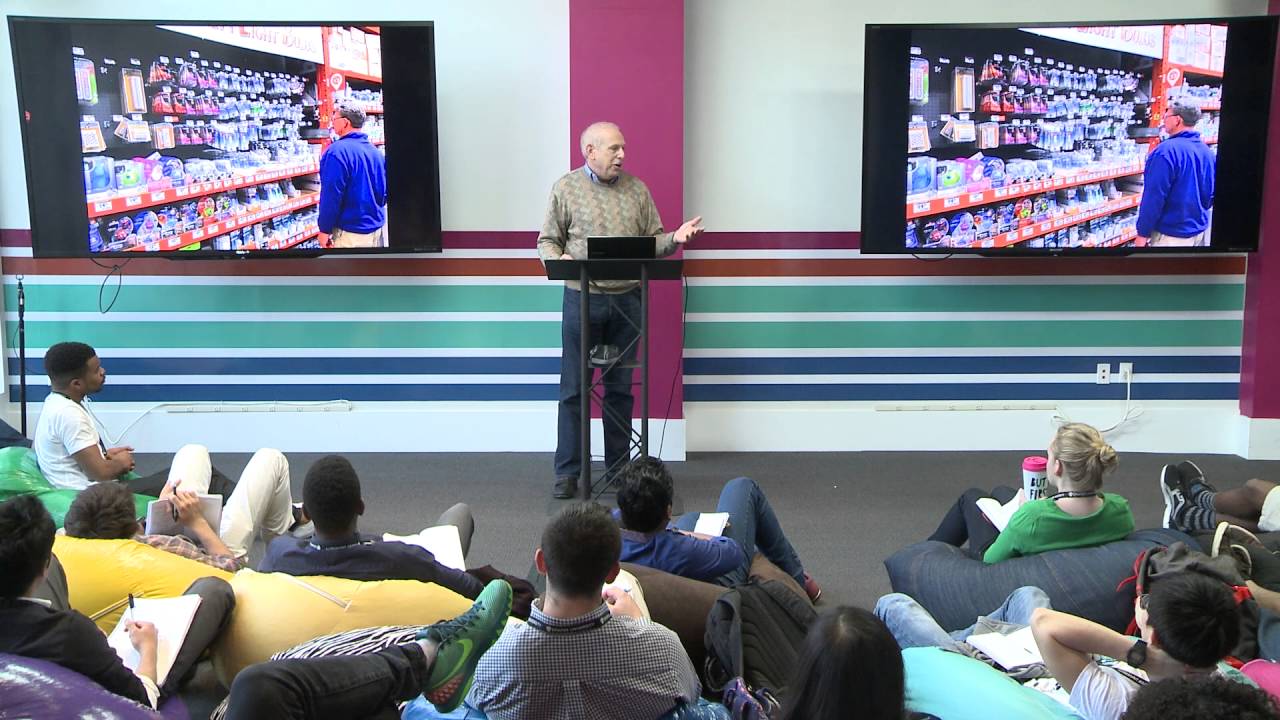
In this talk Michael Rothschild explains why traditional profit metrics that focus on profit per unit are inadequate for asset‑intensive manufacturers that produce thousands of product variants. He argues that firms should measure profit per machine hour – a concept he calls “profit velocity” – because the speed at which a product runs through equipment dramatically affects overall profitability. Rothschild illustrates the idea with a simple two‑product example (high margin but low throughput vs lower margin but high throughput) and then expands to the real‑world complexity of companies that manage tens of thousands of SKUs, such as battery makers (8,000 battery types) and integrated steel mills (≈40,000 steel shapes). Using observations from a Home Depot visit, he shows how everyday items (light switches, paint colors, bottle caps) represent a massive, often ignored, sub‑segment of the economy worth roughly $10 trillion in annual revenue. He quantifies the upside: a modest 1‑10 % improvement in profit velocity across this market could generate $100 billion to $1 trillion in additional profit each year. Rothschild positions the PV Accelerator as a tool that aligns sales, operations, and finance to capture these gains by shifting focus from margin alone to the combined effect of margin and machine‑hour efficiency.
Chapters
I figured that if we were going to— if I was going to— whatever idea I came up with, I'd like to do it against something that was already big. I mean, if you're going to change the behavior of a dry cleaner, that's one thing. If you're going to change the behavior of a steel mill, that's something else. So I was kind of more interested in the steel mill than the dry cleaners. Probably the same amount of effort pretty much to sell one as the other. So we got very focused on what I'd call asset-intensive manufacturers. And within them, and you'll see more and more on this, there's a subgroup of kinds of manufacturers who produce a ridiculously broad array of parts, products. Some companies, some big manufacturing firms, for example, if you're making bulk chemicals, there's a billion-dollar facility, billion dollars of assets screwed into the ground, And they make 1 or 2 chemicals that come out and go onto big ships. We don't mess with those guys. We mess with people who make 10,000 different, slightly different versions of a chemical or a metal piece part or a computer chip. There is a set of companies out there who make a ridiculously wide array of parts and components. And that's our world. So that's just a little preface before we run this guy here. Where are we? Go back. And let's see here. Hopefully you'll be able to hear this.
Turn the volume up.
You want to help me with that? Oh, you get the volume here? It's your machine, so.
Variety have a difficult time achieving their ultimate profit potential.
You want to take it back?
Traditional way of looking at profit. There we go. Manufacturers with high product variety have a difficult time achieving their ultimate profit potential. This is because the traditional way of looking at profit generation has been to look at the profit made on each unit. In reality, companies should be looking at the amount of profit made by machine hour rather than by unit. Although most companies collect data on the profitability per unit, they don't match that data up with how quickly these products run through the machinery. Let's take a look at a simple scenario. Product A makes $20 profit per unit and Product B makes Using the traditional method, everyone would say make more of Product A. But what's not taken into account is the machinery can only make 4 of Product A in an hour. However, the same machine can make 10 of Product B. Adding the element of time changes the equation and understanding of profit generation. The bottom line is combining margin and velocity might not be too difficult with 2 or 4 products, But with hundreds or thousands of products, the problem becomes overwhelming. PV Accelerator gets sales, operations, and finance teams aligned on a whole new understanding of what drives profit in your business. We can show you how to use the same machines to generate more profit.
So now I think it's a pretty straightforward It's the kind of idea where it's like, kind of, why didn't I think of that? Or moreover, isn't everybody already doing that? So what I find for folks who have not spent their lives in the trenches in manufacturing really have a hard time believing that companies don't actually measure in detail how fast they're making money. It seems inconceivable that, given the sophistication that business operates on, that everybody wouldn't already know that. But they don't. And I'm just going to click through. I wanted to show you some examples. I went into the Home Depot on Saturday with my iPhone and said, Let's give some examples of the kinds of things that are made in great variety that we never, ever stop to think about because they're all around us and we don't care about. We think of manufacturing, we might think of something like, well, maybe your iPhone. It's made somewhere, right? But we don't think about these trivial things. Or light switches. Or what are these? Different kinds of bulbs. You ever walk down the aisle in a Home Depot and go, Man, it's amazing. Or I've got to go buy a part, and I'm confused because which one was I supposed to get? Colors of paint. Colors of paint. Floor coverings, faucets. Well, we all buy batteries. You know, we think of these batteries, there's some variety there. I've worked with a battery company out of Hong Kong, and these are what, maybe a dozen different kinds of Duracells?
Energizers.
Energizers. They made 8,000 different shapes and sizes and powers of batteries. It's hard to believe, but in the real world where these guys operate, we only, as consumers, we see 1/10 of 1% of what's available out there. Brass fittings, rope, chain. This one, you see these, oh, it's a 10 by 1 inch, a 10 by 1 and a quarter inch, 10 by 1.5 inch. Well, that's a variety. Well, that's on a shelf with a bunch more. And then, of course, if this shelf included all the different kinds of nuts, bolts, and screws in the world, the factory, the floor of the operation would go on for miles. There's just a huge variety and profusion out there. So what's this look like if you kind of back up a little bit and look at from an economic standpoint. And I'm really interested in complexity, the number of products. So if you have 10,000 products and you have 1,000 customers, 10,000 times 1,000, it gets big. How many facilities? How many production lines? How many factories? So if you're trying to run a company that's got thousands of products and hundreds of customers and a couple dozen production lines, you got a lot of dials. I mean, you got a lot of things you could kind of fine-tune and adjust to make it go better. And if your company was very capital intensive, meaning it took a lot of equipment and machinery to be able to do it at all. So in the upper right-hand corner, you get kind of the most extreme case, like an integrated steel mill, like companies like U.S. Steel or ArcelorMittal, companies that are doing $50, $70 billion a year in multiple facilities around the world. And, you know, not knowing much about steel when I started this, I always thought, well, you know, they make flat sheet and they make that kind of coil stuff that they make cars out of. And they make tubes for oil pipelines. So that's 3 kinds of steel that I could think of. But we've worked with a lot of steel companies. And the typical steel mill will make about 40,000 different shapes, sizes, thicknesses, widths, chemistries, et cetera.
So it's Unbelievable profusion.
So in this area right here, metal and plastic parts, all kinds of electronic components, food processing, all the packaging. Think about it today when you go home. If you just look and open your refrigerator or in the bathroom, how many different kinds of bottle caps would you come across in a day? Dozens. Different shapes, different sizes, different colors. They're made somewhere.
In China.
These are the little things we don't pay attention to. So this part of the economy, not including auto assembly, bulk chemical, things like that, but that part of the global economy does about $10 trillion, with a T, worth of revenue.
OK.
It's all this stuff we could care less about. pay no attention to. But it's that kind of subcomponents of our lives. So keep that number in mind, $10 trillion. How much is a 1% improvement, or let's say a 10% improvement in $10 trillion would be $1 trillion, right? 1/10.
Yeah.
Oh, keep that in mind. So if you could improve The efficiency, the economic viability, the profitability of something by 10%, that's a huge improvement. But it's on the order of a trillion dollars of gain globally each year. Not one time, but every year.