Using AI to Fix a Broken Legal System | Meet The Drapers Global: AI TikTok
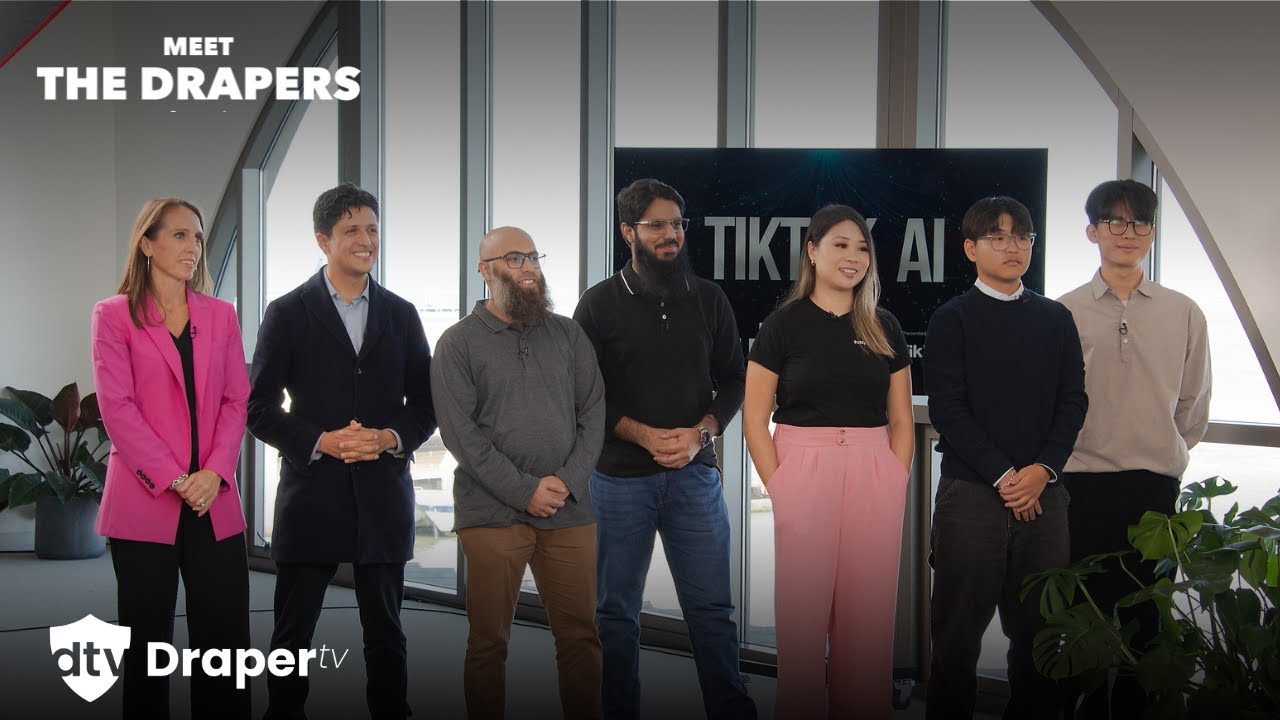
Tim Draper hosts a pitch competition where four AI startups compete for TikTok viewers' votes and a $1 million investment. Kazi AI built a legal case-management tool to speed up justice in Pakistan. Fuzzy AI's sales copilot claims 13 times higher reply rates, while Kindworks reports 11% lower absenteeism with workplace kindness nudges.
Chapters
I'm Tim Draper, and I invest in big ideas before they become the next big thing. I invested in Tesla, SpaceX, Twitch, all when they were just a sparkle in that entrepreneur's eye. This season, I'm traveling the globe to find game-changing entrepreneurs with world-transforming ideas. I'll bring these visionary innovators to Hero City in the heart of Silicon Valley, where they'll compete compete for a million-dollar investment. Here is the twist. You, the viewers, can vote for your favorite entrepreneurs and help them secure a spot in the finale. Who will rise to the challenge and secure the funding to, to turn their dreams into reality? Let's find out together on season 7 of—
Meet the Drapers!
I think I'm at the right place. There's this ladder to get up to the— supposed to be on the second floor. Oh, why don't I try the stairs? We're in San Francisco at Shack 15, upstairs from the Ferry Building, which is Pier 1 here in San Francisco. It's an absolutely beautiful building. It's been transformed into a restaurant. transformed here into an incubator of sorts. We're launching the San Francisco AI episode. All this will be artificially intelligent. You don't know if this is really me or a digital me. Can't wait to see these entrepreneurs. We're gonna get 4 AI entrepreneurs. Great day for Meet the Drapers episode.
What a million-dollar investment would mean to me.
What would a million-dollar investment mean for our project?
Okay, so a million dollars.
A million dollars It's probably more than we are thinking of raising right now.
Yeah.
The really tricky thing for us right now is we're not building fast enough.
We've invested almost nothing in marketing and just sales has been, again, ourselves. When people see and understand what we've built, everyone wants to bring it to their company.
As you know, working with AI is cool and everything, but it's quite expensive. Without having to worry about any of the financials, we can just really focus on what we really love.
All right, welcome everybody to Meet the Drapers. We've got a fantastic relationship with TikTok, and they went out to their TikTok audience. I think there are like 2 billion of them. They've brought back some entrepreneurs for us. To my right is Bill Draper. This is my father, and he was administrator of UNDP, highest-ranking American in the UN. Chairman of the Export-Import Bank. He was a pioneer of venture capital. He started Sutter Hill Ventures, was the first Silicon Valley venture capitalist in India. There are 30,000 of them now. To my left, we have Nicky Farb, and Nicky is a founder turned funder. Is the grass really greener on the other side?
It's pretty good.
Great.
I like what I call paper routers. Entrepreneurs from a super early age.
Oh, that is good.
Right? You like that?
Well, I've done it. I've had a paper— I didn't have a paper route, but I filled in for a guy who had a paper route. Tim Nativedad Draper is the GM, US Head of Enterprise Sales and Global Business Solutions at TikTok.
A big part of why we're excited about our partnership together today is to see what that next frontier looks like.
I look for energy. I have to look at this entrepreneur and say, would I like to work for him or her? I don't know. Sometimes I go to sleep.
We're going to see if the— if these entrepreneurs pass the dad sleep test.
I will not fall asleep. I know, because these entrepreneurs Are gonna be good.
Okay, let's bring on the first entrepreneur. But before we do, let's see what's going on behind the scenes.
Hi, I'm Serena, CEO of Fuzzy Sequence, and we are transforming the way people do sales. The movie, weirdly enough, that inspired me the most was The Social Network. When they got in trouble, the dean said, at every other university they create great CEOs, but at Harvard We have great people who help hire CEOs. And I think that was the moment where I knew that I wanted to hire CEOs. I remember after that movie, I started my first startup called The Perfect Date. The thing about a dating startup is if you're successful, customers leave. Ever since then, I've pushed from a corporate career, tried to learn skills. When I was at IBM, I did a lot of, I guess, coding. And every single time I didn't know something or I wanted to build something from a business point of view, I tried to gain that experience. Through IBM, trying again to build a startup, but that's when COVID hit. And then last year, after getting all that experience, I finally had the confidence to build my own startup. So from the beginning, I think coming from a conservative Asian family, also it being quite risky, I don't think they took it too well. Now I think my family is quite supportive, and my mum like talks really nicely about me, so does my dad. From a partner point of view, I don't think I would have been able to do what I can do right now without His name's Banks. Yeah, we had this joke. I used to work at a bank, I was dating Banks, and I lived in South Bank. The uncertainty, I like it more. It's kind of fueled me a bit more, weirdly enough. When I was in corporate, it was boring, so I've always found things to do outside of work because I didn't get that fulfillment when I was in like my other jobs. I can try every single thing, whereas like with corporate, you're just stuck with this one little like cog that you have to do. Our company is in Australia, Singapore, and then we've got some some employees in Philippines as well. How I came to build this was I was just frustrated with all the sales tools out there. And so I kind of looked at removing all the frameworks, removing what normal sales should be, but building on like what makes sense if I wanted to build a relationship.
If you did win tomorrow—
Yes.
Who would be your first call?
Oh wow. I'm getting emotional thinking about it. Sorry, I'm just imagining. Yeah, I think it'll be my mum, my partner. I think dad too, I love you.
What happens when Salesforce comes in and sees you and says, hey, I can do this?
Oh, it's beautiful. I think it's pretty breathtaking actually. It's better than what you see on TV and in the movies culturally. I took a Waymo yesterday. There's just so much. It's a bit of a melting pot, which is great. You have all these different cultures. I think I've met everyone from every different country. I know that a lot of Chinese people came here during the Gold Rush in the 1700s. Everyone's really open. That's something that's so different. I met 3 people on the street yesterday and we were just talking randomly about tech and they were like answering questions and we're jamming and going back and forth. And I think that's very unique to San Fran. I want to experience SF food. Oh, I want to try In-N-Out Burger. That's probably one of the things I want to try. Riding a scooter and trying that. I've never tried that before as well. It's illegal in Singapore. In Australia, you can't do it outside of the city. When we came into this side town, it was all this greenery and super lush. And it was just beautiful just to get out of the city, and it felt like you're in nature in such a short amount of time.
How are you going to go out to celebrate tonight?
Uh, depends if I win or not, but if I win regardless, I think just having a good meal, having a good night's sleep would be amazing. So hi, I'm Serena, founder of Fuzzy AI, and we're the sales go-to-market copilot that actually drives 10x growth. So last year I was building a business, actually a different business, and I wanted to get meetings with the right people. But to be able to do that, you actually have to build a relationship Right? If I wanted to build a relationship with one person, I had to first research them. That takes 20 minutes. Figure out how to craft a message that's compelling and then build a campaign off of it. But each person takes about 1 hour on average, and then you've got to follow up as well. And I thought, surely there was software to be able to do that. And I looked again and again and again, and I waited months for it. And surely with this boom of AI, something would be there. But actually nothing happened. So I thought, you know what? What if I were to build this myself? So that day I built something, showed a few people, and it was the easiest sale I made.
Are you a coder?
I am a little bit of a coder as well. I studied IT in uni. One of the other things that I looked at was sales seems like such a convoluted space, and so I thought I'd do a bit of digging. And I found that 28% of time for salespeople is only spent on meetings, which means 72% of time is spent on all the admin work. And so I thought, okay, what is the opportunity there? People are spending $1,000 per month on sales tools, and what's worse, enterprise teams are spending $1.3 million just to land the first customer.
Isn't that $1,000 just really Salesforce?
No, no, that's just the CRM. What we're trying to do is do the hardest thing. We're trying to get you the first meeting. And so we're revolutionizing this, and we're actually changing the way sales operates. Instead of using all these different tools, you can use us, and we've added a bit more as well. We can add the research, we personalize the message, and we do all that within one. And our results are already phenomenal, and we get 13x better results.
So how does it work? Okay, so let's say Dad is your possible customer.
Yep.
How do you find him?
Yes.
And then how do you pitch him with either voice or text or email?
So at the moment, I would try to do a lot of stalking. So I look at the news articles, I look at what your company does, what you care about, what's your annual report, and I figure out what's the most important thing to you right now.
So you find out what I've been tweeting about, and then the AI Just says, "Hey, I saw your tweet on blah blah blah." Exactly does that. Clearly, that's something we all love and need.
Yep.
Now let's go.
Yeah.
Let me tell you about this.
Exactly, exactly.
Oh wow!
Yeah.
That's interesting. It says write voice and video.
What is?
Tell me how that works.
So we've only done writing right now. We're already getting 13x results. So next we want to go to voice, and then next we want to go to. It's a video, which is why I'd love to talk to you later as well from a potential TikTok partnership.
Video, is this canned video that you send out to people or is it an AI agent?
You can do both. Well, not an agent per se, but you can train a video to be like you in terms of your personality.
Because if you go to Draper Decentralized, you see my digital twin. It looks like it's me, but it's— he's way better looking and he's way smarter.
That was pretty funny. I mean, it can get away with you. I mean, my digital twin looks better as well. No more wrinkles. I think what sales is right now is actually going to be fundamentally changed. The current workflows and processes in place are going to be completely different as well, and that's where AI will take it. Precisely that.
When you're getting these better results, is it because you're sending more emails per salesperson or you're converting better?
Our competitors actually focus on the volume game. We focus on the quality game. Before using our product, our customers will get 1% reply rate. Using our product, they're getting 13 times reply rate.
So you're promising stronger conversions, not necessarily a higher volume of leads.
Correct.
So Serena, my question for you, prior to Fuzzy, did you have a background in sales?
No, but I've always had this natural curiosity about people. Everything from a personality point of view and how I've met people has led me to this moment.
What happens when Salesforce comes in and sees you and says, hey, I can do this.
Yeah. Then what?
Yeah, good question. It's tricky because Salesforce, it's a large tool, but like it's not helpful for most salespeople. All the customers say that they're held hostage by Salesforce. I think they've got a bigger problem than what I have right now. They need to fix their CRM quick because everyone wants to move out of it.
They hate it.
They want to speak to people and they want to meet people. They don't want to do all this boring stuff. Salesforce in itself is solving the fundamental layer of a CRM. How do you store data, make data more interesting? I'm trying to build the relationship.
Serena, thank you so much for being on Meet the Drapers. You're a force of nature.
Thank you.
Thank you.
I think we were just hit by a tornado.
I love it when we have a conversation because I can talk about the product as opposed to a pitch, then questions. I actually didn't get through all my slides either, so hopefully I was able to describe what we do in a succinct and meaningful way.
Dad, what'd you think?
I liked I liked her very much. She could do it if there is very little competition.
I got to ask her her first dollar earned in the dressing room.
What was her first dollar earned?
She was arbitraging, buying popsicles with her Chinese New Year money.
And selling them? And selling them?
And selling them, yeah. I do think she's got the sauce. If there's someone to build it and win those customers, it felt like it could be her.
I liked her. I thought she was full of beans. I mean, that was a tornado that just hit me, the Drapers. And I was thinking, wow, She's already making sales 2 months in. But as a venture capitalist, a salesperson is a little bit dangerous. If they're really good at selling and they think you're the customer, then they keep coming back for more money instead of going out to the real customers. Let's hear from our next entrepreneur. But before we do, let's see what's going on behind the scenes. But, you know, if you look behind the scenes, you see the Bay Bridge. I don't know what's going on back there. Traffic, I think.
Is it your first project together?
How did this come about? Oh, it's a fun story. We go back together since about 2009, I guess. Yeah, we did our high school together, university together, first job together. We ran away from that first job together. One startup, second startup, third startup. We wanted to do something more cool. In those days in Pakistan, most jobs were like either web development or app development. We were lucky to land a client. It was autonomous car software development in Pakistan. It was quite something when we started it. We had a good run on that and eventually we pivoted towards more generic AI and embedded software development, particularly with Qazi.ai. It's more of a personal story. We are in litigation for about 2 years now. We were told by the lawyers that it will be resolved in 2 months, maybe 4 months tops. And we're like, let's go for it. We felt that the law is on our side. It's 2 years and it's still unresolved. We are entrepreneurs, so why not try to solve this, right? People don't know about legal rights. They don't know how to navigate legal formalities, how courts work. And all of these thoughts basically converged onto this idea. I had full support from my family, but yes, I got this a lot from other people. What are you doing? You are dropping a secure job with possible post-pension benefits and whatnot. We knew that we have to do this. We need to do something exciting. We can't keep on doing something we don't like for, you know, next 40 years maybe. We want to do something that we like.
People, when they have a problem, they think twice or maybe 10 times before going to the legal system. That, yeah, who will draft the petition? Will the lawyer turn out to be, you know, a turncoat?
So basically, we are trying to cater to all 3 segments: the government/registry, the law firms, and the citizens. I fundamentally believe that the core system that needs to be fixed in any country is the access to justice and the determination of justice, that the justice should be served. I fundamentally believe that if you fix this, you can fix almost everything. We are in a business dispute.
What's your case about?
It's a business dispute with some employees. So I'm sorry, do you owe them money?
This has been on our go-to list to visit the Bay Area with all its energy and innovation in tech.
If you have to be, you know, in the hub of AI, this is the place to be. You can hit a conversation, come up with a product, make an MVP in 3 months, get funding, next unicorn. It's very interesting how we ended up here with our AI startup from Pakistan, so thank you, Drapers. But this place is amazing. I wasn't expecting it like, you know, in San Francisco, right? Much more greener. I'm loving it. Not too much concrete around and just the right balance, I guess. Somewhat European.
Yeah.
One of the most striking places we visited was the Golden Gate, and it's really iconic. And to see it in the midst of the fog and the clouds— I have quite a list of places to visit in San Francisco from the movies and TV shows I have watched. I plan on visiting Pier 39. And Alcatraz, a lot of movies from Alcatraz. Yeah, Shutter Island.
So it was like, you know, our first major VC pitch. We haven't done that, especially not on TV. I could easily tell these guys are probably better than me, right? Bill, Tim, Adopted Drapers, do you know that 80% of Pakistanis face legal issues? And only 20% get the help they need. Why is that? Because it can take up to 15 years to resolve cases in courts. There are 2.1 million cases in backlog, and mine is one of them. We are in a business dispute.
What's your case about?
I'm sorry. Some days ago, I did think that this can be a question because it's important what kind of litigation the founders are into. It's a business dispute with some employees.
Um, so do you owe them money?
No, no, no. So basically, uh, they stole our IP a long time ago.
Oh, okay.
When we started off with it, we were told that it will take 2 to 4 months. It's already been 2 years. So being entrepreneurs and engineers, we thought, let's solve this. And this gave birth to Kazi AI. If we had not had that case, Kazi wouldn't be there. It's an LLM-based end-to-end case management suite to transform the judicial landscape. You can generate legal documents, you can perform legal analysis, precedence referencing, as well as draft judgment generation. We want to accelerate justice, we want to increase court credibility and court accessibility, and we have been very lucky into it so far. We are already engaged with the government of Pakistan, we are trying to secure funding from State Department and EU. On B2B and B2C end, we are already partnered with some law firms. Most proudly, we are second in Meta's Llama Hackathon, and that's exactly what sets us apart. We are not just a wrapper around an API. We are working on Meta's open-source AI. We have the complete control over the model. We can deploy it as per countries' local directives. We are working with all 3.
Is, is this your mascot?
Oh yeah, this is Llama, Meta's mascot.
Fantastic.
Our team is really good with making You know, presentations with us, and we work in AI, so they took up an AI model and generated really good visuals. So we are working with all 3 stakeholders: the government, the law firms, and the citizens. And it's not just a chatbot, it's a complete suite being developed by our in-house team, a team that has experience in AI, product development, and law.
This is like my favorite founder to invest in, a serial founder with a chip on their shoulder. But I have a question. You said if this works out, what's the one thing that has to happen and turn that if into like it does?
So right now we are at the stage where we have a proof of concept. We have a couple of features implemented that we're testing out with the law firms. This is where we need to start investing in the infrastructure, the cloud where the whole AI is going to be hosted, and the marketing budget.
So the product works? You have people, the product, it's go time?
Certain features are working. We need to expand on the feature set as well.
Cool. Is the product going to be sold to The government, the lawyers, the end consumers, or all 3?
So this is the good part, I guess. So since the ecosystem is self-fulfilling, there is going to be an end with the government, which is going to help judges make decisions faster. There's going to be a certain end of the software that is going to be with the law firms. And finally, the citizen end, which is like what I'm most passionate about as well, being there, done that, to understand where do you stand if you have a contract with your landlord and he's not painting the building again. Can you get help? Is there a contract?
Can you move to another country easily, or is it like we know the Pakistani law, we don't know these other laws?
This system can work well everywhere there is this Anglo-Saxon legal system.
Pakistan has the Anglo-Saxon legal system?
Yes.
Okay.
And so there are many other countries. So only the Pakistani market is around $50 million, and we can easily translate it to India, Sri Lanka, Philippines, etc.
as well.
I'll tell you what I love about this, the increased court accessibility. There's a lot of vague ambiguity about what the laws actually are, and so is there an opportunity for Qazi to actually help own a more democratized or easily accessible record of how certain cases might be evaluated in the court of law? I mean, can that information scale?
Yes, exactly. So one of the challenges in all of these countries is that, for example, in Pakistan, the courts are not completely digitized. So whenever you need to access some court file, which is open record per se, and everyone should have access to it, there's no simple way to do it. Through our system, you will have access to all of these cases, how they were resolved, what were the outcomes, etc.
I've been to Pakistan, and I'm not sure they speak English there.
So, uh, so you're right. He said that, you know, he has been to Pakistan and people don't speak English. In terms of courts, high courts and above are in English. That's the official language. Yeah, a lot of people speak English there now. We have been a British colony, right? So, you know, I wouldn't imagine pitching to Bill ever if it wasn't for Meet the Drapers. So I would put it like this: the national language is Urdu, but the official language is English.
I see.
Terrific. Adeel, Danielle, thank you for being on Meet the Drapers.
Thank you.
Terrific. Great, thanks.
Were you guys nervous?
Yeah.
So I would say nervous, excitement, and, you know, oscillating like this between.
Dad, what'd you think?
Language is a problem.
If language weren't a barrier, what would you think?
I'd think they're pretty exciting.
There's so much knowledge that lives in those past court documents, so if they can find a way to summarize that and help people know if they have a chance, In their case, that seems pretty cool.
I'm kind of thinking that the courts should be all done by AI. It would be instantaneous. You have a fight, you have a decision, it's done.
Maybe even more fair, more judicious, right?
Oh yeah, oh, it'd be very fair.
Yeah.
And then you just kind of go, okay, that's what the machine said. What if companies wrote into their contract instead of, you know how you say, well, the first line of defense Defense is arbitrage. Yeah, but what if the first line of defense is AI judgment? Then you don't actually need the help of the government.
That's a much less expensive, faster resolution time as well.
Yeah, yeah, fast resolution is more important than anything.
Yeah, the suggestion was basically we can have Qazi AI mediate for them. I think it's great. It has multiple benefits, first being that you don't have to wait for the courts, you don't have to be in that long line resolution. And number 2, you can have a very unbiased judgment. Third, it's good business case for us, so I love it.
Let's bring on our next entrepreneur. But before we do, it's the eyebrow show. Let's see what's going on behind the scenes.
What we do is use AI and kindness to help every single person bring their very best So we have a platform to encourage and enable the intentional practice of kindness because kindness is like a muscle, and the more that you work it, the more that it becomes a habit.
So I was born and raised in Colombia. I worked in finance all the way to chief economist and head of strategy at a major asset management firm. And there I was like, what am I doing with my life? You know, what's my impact in the world? And I didn't have a good answer.
My background's in I'm a brand and in marketing, but I always say my passion is helping people be happy, not just at work but in life. And when Daniel came to me with the idea for Kindworks, I started diving into the research on kindness, and I'm like, this is what I have been preaching my whole life and career.
We want to bring a transformation to the world that changes how people live and work every single day, impacting positively the life of a billion people. That's our real definition mission of being billionaires at Kindwords. Not every act of kindness works for every person, or not the same frequency or the time to do an act of kindness works for a person. That's where the AI and the data we have is really powerful, giving them the right act of kindness at the right time with the right frequency. It took one year for my mom to finally say, oh, now I understand what you're doing. And it took my dad until, wow, what you can do is really transformational and huge. And that connects with, you know, an 11% decrease in absenteeism that we've created and measured and attributed to Kindworks. That connects with a boost of 6% of productivity.
When I had the opportunity to work with Kindworks and started as an advisor, and then I was like, we have to do this. This is, this is it.
So I and quite a few others in the room Feel that we are very kind.
You are. You absolutely are.
So, why do we need help?
So I lived here in 2016 to 2018, and I loved it. Feels incredible and natural to be back.
When you're here, you're actually. It's actually like sitting and having coffee next to someone who has done something so impactful that you can see has truly changed the world.
The movement we're building to use AI to change the world for the better should have a spot in the Bay Area, which is emerging here in Cerebral Valley, as they call it.
AI takes a lot of creativity, and like you can just see the creativity coming out in the neighborhood, the art on the walls, in the coffee shops. In the conversations and the people. That underlying creativity, I think, is what is going to make AI what it is.
I think the culture of taking risks, moving innovation to the next level, building and changing the world is something that is very unique in the DNA of culture here, and it's something that I learned that changed my life when I lived here.
The Blue Angels are extremely impressive. It's a very fun bonus to be here during it.
We are here to talk kindness. Think about the last time you did something kind. Maybe it was feedback you gave to a startup that helped. Science shows that these acts boost your mood, reduce stress, and is one of the most powerful tools we humans have to be at our best. At Kindworks, we inspire that feeling every day. We help people bring their very best starting at the workplace. The way we're working and living is completely broken. People are burnt out and stressed out, and this has massive costs in productivity and well-being. Our data shows that when people do these acts of kindness, there's connectedness, there's impact, and when that happens, sales go up. Boom! Productivity goes up. Also, Kindness is so much more than being nice. It's sincerity in the hard conversations. It's the hard feedback you guys give. It's gratitude and so much more.
So Kind Worx is a platform to encourage and enable this kindness at scale. Benny is a friendly AI agent who shares personalized kindness exercises through WhatsApp, Slack, Microsoft Teams, and you can shuffle the exercises and respond, and it's all gamified to incentivize your kindness journey. And then Benny also connects in a community channel and shares recognition boards, shoutouts, and other kindness contests.
What advice is it giving me for kindness?
It might be, say hi to someone you don't usually say hi to, share feedback with a colleague to help them grow.
It's writing them down, I'm not giving it to them.
No, and so Benny will actually connect you directly to colleagues. So it might actually say, reach out to Tim to give feedback to Tim to help him grow. And then there'll be a button. It doesn't show here because we cleaned it up, but it would say connect directly to Tim, and then it would connect in Slack. And then when you hit finished, you get streaks, you get badges.
Where does that list come from?
I'll actually show you guys. There's more than 300 research papers that show that when you do something kind for somebody else, there's actually a chemical reaction happening in your body, and the AI chooses what's the act of kindness that creates the biggest impact on every single person.
And then it also gives leadership at these companies real-time pulse checks on the sentiment of their team.
What's your business model? Is it just a SaaS business to—
Yep. So the revenue model is $9 per person per month recurring. This year has been really pivotal. We added 9 new customers.
I and quite a few others in the room feel that we I am very kind.
You are. You absolutely are.
Why do we need help?
I think of everything in an urgent and important matrix, and we often don't think kindness is urgent. Sometimes we don't even think it's important. So we're giving those nudges so that it's top of mind and you realize it is not only important, it's also urgent at the workplace.
Is it about reminding me to be kind? So I have the ability, I just forget?
Benny is not there to teach you kindness, not there to force you to do kindness. It's putting just the nudges for you to transform the way you live. We have more than 50% correlation between the sales people do at Prosegur, where they've had 9 months in a row of record sales since they implemented Kind Words, and how people feel and the results.
Building that intrinsic motivation is really rooted in behavioral science. I was just going to add to the 300 research papers you talked about, there's actually hundreds more even. They're almost all based on nudged kindness. The data shows that it doesn't matter if it's nudged as long as it comes from a place of authenticity.
How do you kind of evaluate or adjust the prompts based on different cultural settings and pockets of communities?
Our AI has been effective in South America, in New York, and is able to personalize the experience in a way that it's effective for everyone.
I've seen 4 or 5 different companies doing something similar. None of them have really taken off. $415K in revenues. That's good. I mean, I'm looking for a trillion-dollar business. What happens here?
So this is a benefit for the individual. What we see is people are like, oh, I met someone who I wouldn't have connected with. And then we had a conversation that sparked a new line of business. And so I had a personal benefit as well as a benefit for the company. And they feel that. So it's like a flywheel effect.
How is this getting seeded?
We tell them, it's like, do you want to save $1.5 million for each 1,000 employees? We can decrease absenteeism by 11%. $700,000. We can also boost productivity and sales levels by 6%.
I just wanted to go back to, you want a trillion-dollar business. We see this as being for everyone and ultimately being the global well-being market.
Terrific. Well, thank you, Nicole and Daniel. Great to have you on Meet the Drapers. Well done.
I was inspired and I was energized.
Yeah, I said I was definitely a mix of excitement and nervousness. It's definitely the lights And as soon as you put a camera in front of me, I feel like, uh, feel just a little bit different.
So, be kind.
I just think that people generally feel they're kind enough. I think I'm missing something, uh, and I'd like to hear the rest of you.
I like that, uh, kindness is part of a broader well-being. I thought that was a big vision. I mean, if it's tops-down, hey everyone, be kind to your neighbor today, you gotta use this, that's a tough sell. I think that the go-to-market is really where they win or lose here and how this gets seeded in a company.
Well, I do think there's room for this in the workplace setting. If this is built into, you know, your internal Slack or if this is built into your Google Spreadsheets, a reminder to just kind of balance out the quant with Maybe the, maybe the EQ component, right? I think there's been a lot of literature on psychological safety being the number one driver of employee satisfaction.
It's hard to get a monopoly on kindness.
Should there be a monopoly on kindness?
If they could create a monopoly on kindness, they could be a really big business. I do know there are lots of ways to do this. I kind of like the message, and it would be great if I got that message sort of once a month. I think it would be irritating if it showed up every day.
Or does it lose value?
Yeah.
Yeah.
I love this show. I hope you guys do because there are a lot of you out there and I hope you guys are enjoying yourselves. So with that, let's bring on the next entrepreneur.
Hi, my name is Sunwoo Joo and I'm the co-founder and CTO of The Orbit.
And my name is Joshua or Minsu Kim and I'm the co-founder and CEO. Our goal is to make news more accessible. We're living in a world where people have shorter attention spans. And we're being drowned by so much information. We just want to make it more accessible and understandable for the younger generation. We actually know each other because we go to the same university and study the same thing. I have entrepreneur parents, so I would say this is my first ever time properly working on my own thing.
My parents don't have any entrepreneurial backgrounds, but they know the ages and the time has been changed. They mostly supported the things that I actually wanted to do.
I grew up even in middle and high school reading a lot of news. I stopped reading news probably because of the overwhelm. One of the traits we actually realized was most people our age have stopped reading news just because there was too much stuff. They just felt, I guess, overwhelmed. We're also now looking into maybe using a variety of sources just so that there's less repetitiveness in a sense.
So we are using an AI model to not only We actually summarize the long form of article into 5 bullet points as neutrally as we can.
In a sense, we're sort of trying to become a place where people can learn, and we're also thinking about potentially being like a new type of search engine or a way for people to interact.
There are so much fake information and overwhelming information, so we are making tools to help people find the right information. What actually they wanted to do.
It's just the two of us right now, and we started about a month and a half to 2 months back. We're now looking for office spaces, looking for funding, and we just finished a very, very minimal MVP.
We conducted a private test across Instagram.
So far, the feedback has been pretty good. A lot of people are sort of rediscovering their, their love for news.
It's my first time on the camera and filming such things as an English pitch and so many important people, so I felt some burdens. We're here at the Bay Bridge, which connects Treasure Island and San Francisco, and we're near Shack 15 where we're doing our main shoot.
So far I love it. It's a very vibrant city and the weather so far So far, it's been perfect. One thing I really want to do is go on a redwood hike. I've heard it's really nice. The national parks here, I've heard great things about it. It would be nice to rent some bicycles and just bike around the city like a local as well.
And also, we'll eat many delicious foods. While I'm heading to here, I see there's some highway signs of the startup, so we thought, I want to be in there too.
It's very different from what we're used to back In Seoul, but because I was growing up in an international environment, I think it still quite resembles what I'm used to with a vibrant community. I see a diversity here with different ideas, different perspectives, and different cultures all combined. Back in Seoul, it's just Koreans and one culture.
And it's such the city of America. Yeah.
Ah, Tim, I wanted to ask you a question. Do you actually remember? me. Back in 2018, when I was 14 years old, I came up with an idea for a phone case, and I actually reached out to you asking for $1 million.
What was the phone case? What was special about it?
It was basically shock resistant, so even if you dropped your phone like 1,000 times, it was supposed to not crack. And I reached out to you about that.
You were 14. Then I would remember, right? Yeah, yeah. I hope I was kind.
The fact that he actually— it rang a bell and he sort of remembered it really surprised me. You might not remember as well, and that's because we're living in a world where information overflows every day, which is one of the most key problems in modern society. What actually reaches out to you is very limited and often cluttered with low-quality content, specifically news. News is an area that hasn't seen change in the last decade despite changes in consumer behavior. People are craving for new and high-quality news to help them understand better.
That's where Orbit comes in. Orbit curates 10 most interesting and relevant news per day, delivering equally to everyone.
Who chooses what 10 are the most relevant? I mean, I, I don't think I'd be interested in any of these.
So basically, we have our AI model that picks out based on an individual. So we learn the individual and curate based on different types We tested it out with politics. The US presidential elections are going on, and we wanted to see with so much noise if it could actually maintain neutrality.
That's a summary of article, Meet the Drapers. Pretty cool, right?
So this is not just about giving users news clips, but actually giving information synthesis and summarization?
Right. We're not only providing them news, we're actually getting people to fill out like a short Q&A right after. To read the next news. If they don't fill it out, they can't move on. It allows us to build our own unique database of basically labeled data that we can use to train NLPs or large language models in the near future.
Why is this better than those things that are already out here?
In the near future, we hope to create our own standard of being able to tell whether something is fake, and we hope that with these labeled data, we're able to tell the difference. And we're hoping to work with other different AI companies to actually What are your sources? Right now we had a meeting with Reuters and we're reaching out to way more different media outlets to expand our reach.
How many users do you have and what's your path to monetization?
We actually don't have any users right now because we're pre-revenue and pre-launch. We did private testing.
You haven't launched yet?
Yeah. We're thinking 2 ways, one of which are basically advertisements that are related to the articles you read. The other is that we're actually able to sell these labeled data into companies like like OpenAI or all these type of different companies.
I'll just say this, I've sold an ad or two in my lifetime.
A lot of them. And a user—
there's a sensitivity to putting your brand logo up next to news. You might want to think about what is the type of content that a brand would feel comfortable having their logo up against. Is it news talking about the war and conflict in Middle East, or is it other types of content that might When we talk about news articles, we weren't necessarily talking only about politics or things like war.
We're talking about fun articles as well that Tim was talking about as well, like soccer or things that people would actually enjoy reading.
Instead of just synthesizing and AI-ifying the news that's out there, is there a way that you could decentralize it?
When we select articles, it depends on if you're interested in this topic, If you're interested in startups, then it will be curated to interesting startups and what's actually happening around the world about startups and different changes and technological shifts instead of just, in some senses, gibberish.
I think this is just the start of our journey and we continuously grow and develop together as a team.
Thanks for being on Meet the Drapers. Great to see you too.
Not only were we able to pitch, but we felt like we had a meaningful conversation and got a Yeah, so we—
I think we expressed our generation's power and enthusiasm, Will.
Tim, why don't we start with you?
Well, it's early. This is, I'd say, closer to an idea than a company. And I think there's a lot of news aggregators like this. And the concept that comes to my mind is the filter bubble, right? The more that we see technology give us more of what we want or have already seen. I actually think there's room to experiment on the opposite end of that spectrum, which is, as you say, decentralization, or I call it discovery, right? Can they use their technology and the AI application to bring maybe the opposing view on our particular news topic rather than continuing to feed through the same filter bubble?
Yeah, or I mean, there are 8 There's 8 billion people on the planet and we see 1 or 2 of them every day, front page, over and over and over. That—
I don't care.
Yeah.
Look, I like that they pitched you when they were 14.
I know! You told me you liked the paperboy guy.
I like those paper routers. You know, these news orgs want to get paid. And like Spotify, ultimately you have to pay the content creators. So monetization, I think, is critical.
I just was not very taken with it.
Now we've got to decide, all of us. But here's the thing, don't worry, there's no pressure on you. It's all in the crystal ball. So all of you out in TV land, look into the crystal ball, send your vibe as to which one of these 4 you really liked. Dad, do you have a favorite?
I'm a little fuzzy, so I can't quite remember, but I like fuzzy.
Nikki, what do you think?
I'm torn.
What's your choice?
But because we're going for trillion-dollar outcomes, I think kindness has the biggest vision.
Tim, what do you think?
You know, I'm with Nikki here. Kindness. They're answering and exploring questions that I know a lot of business leaders have questions about, which is employee engagement, employee retention. Um, there's a good runway there.
I was sort of a Quasi guy.
Oh!
We're gonna have to go to the crystal ball. Why don't we bring up all the entrepreneurs? Are you guys sending your vibes? I'm not seeing vibes. Okay, there. Oh, oh, oh my God, it's Quasi! Quasi, you move forward. Congratulations.
I think this gives us a A lot of credibility. We probably will get some sort of funding that we are looking for to take it to the next step. It also gives us the credibility in front of our clients in Pakistan, especially the government.
Vote for us because we want to change the way people build relationships. We don't want people to spend time on admin. We want people to meet people and actually have great friends and relationships off the back of it.
You're not only voting for a startup or a business plan or an opportunity or, you know, however you want. It's being part of a transformation for a kinder, more authentic, sincere world for everybody.
I think the viewers should vote us back because we're just a month and a half in of actually starting this business. I think by the time viewers watch us, we would have been way more developed with actual products that people can use.
More from Tim


He Sold His Car to Build This Startup, Then Pitched It for $1M 😳 #Startups #AI

This Startup Moves Your Crypto BEFORE Hackers Can Steal It 😳 #Crypto #Cybersecurity




15 Months Without Refrigeration?! This Startup Thinks It Can Go Global 🥥 #FoodTech #Startups



