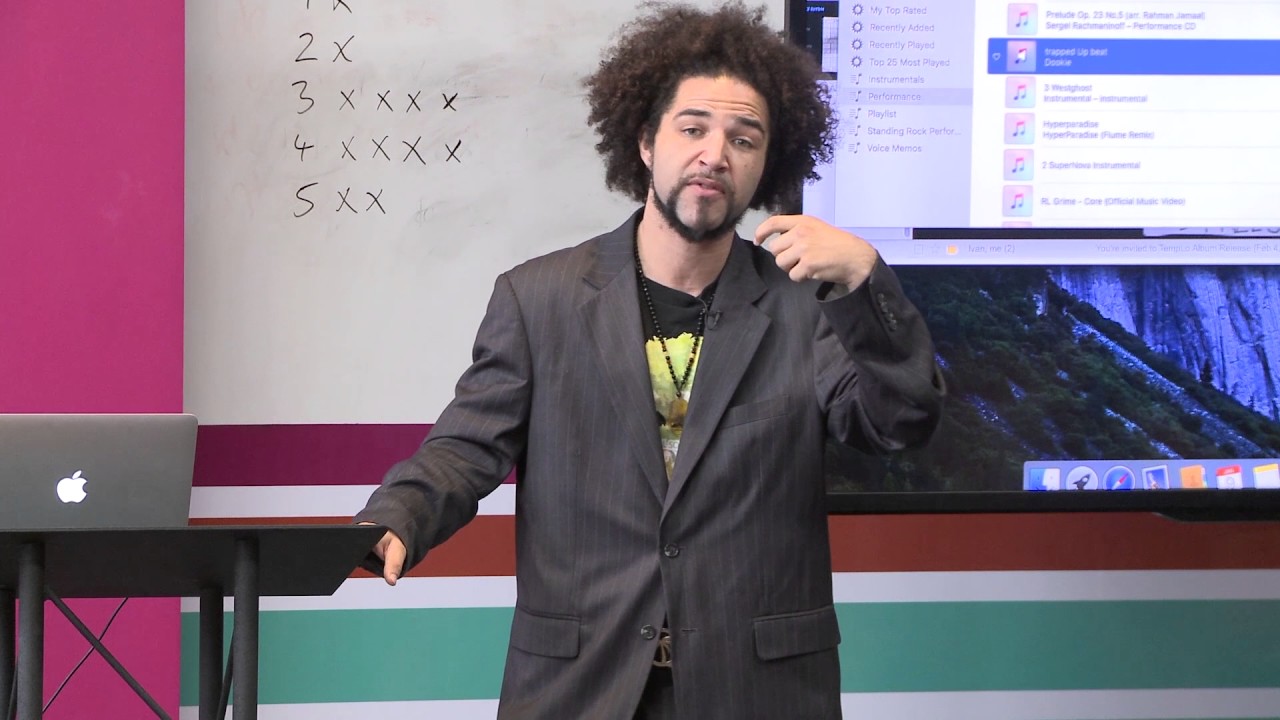
Rahman Jamaal shows how rhythm and music activate both sides of the brain for learning. He leads participants through syllable-timed reading exercises and uses rhythm to help them practice delivering business pitches more effectively.
Chapters
So what— now what we need to do, now that you've shown yourself that you are capable of speaking in rhythm, one, I'll give you one thing you could try on your own. Just like we read the sentence, you can try this with any reading material, okay? And if you want to challenge yourself, pick up something, some reading material that is, you know, is challenging in terms of the words there, and go through those steps. You know, start off slow, put on a beat, Start off slow and just practice reading one syllable at a time. And when you get that down, your brain's like, all right, okay, I got that, ready for the next challenge. Then try it at a faster rhythm. You're actually doing something really important to your brain that makes this stuff easier. And they don't teach this in school. I discovered this on my own. But we have a right brain and a left brain, right? And what are the two responsibilities, aside from like the physiological kind of thing, but like the ways of thinking? Thinking. What does the right brain do, and what does the left brain do there? One is analytical, and the other is creative. Right. Analytical, creative. Somebody else say something different? Yeah, I just said the left is logical, and the right is more like— yeah. Correct. Exactly, exactly. And interestingly enough, little kids when they're born are like— they're bundles of energy, and emotions, and creativity. It's that right brain that's really— Getting, you know, feeding off of this experience. And then when we start going to school, we start learning, we become educated, we start learning these left-brain things, and it becomes about grades, and it becomes, you know, you start learning math and science and history and English, all of these things that are left-brain activities. And for some reason, when we're learning as little children, you need music to teach a left-brain activity, a left-brain thing like the alphabet, right? Can you guys imagine learning the alphabet without the alphabet song as a 4-year-old? Wouldn't work, right? It would be very difficult. Music is what helps us, what helps little children become engaged, and the thing is, is that it never changes. Music is a part of us, you know, whether it's through school or not. But when you are doing— so when we're going back and we're reincorporating music into our learning process, What you're doing is, for example, reading is a left-brain activity, language, recognizing things, but music is a right-brain activity. So when you combine them and you focus on the timing, you are actually using both sides of your brain at the same time, and they're communicating with each other through the corpus callosum, which is like right in between the two halves. So just like anything else— working out, building a muscle, trying to learn an instrument, playing a sport— if it's a challenge for you at first, It's only because your brain isn't used to it. You're like engaging a new muscle. The more you do this, the more natural feeling it becomes. Okay, so like I said, you could read with this. What we're gonna do is— do you guys have like your, actually your like pitches? You guys working on projects and you guys have like business pitches or something, something that you're working on, right? Yeah. All right, so here's what we're gonna do. We are going to stand up and actually before we do, I'm gonna let you guys kind of— do you guys have your pitches written out? No. No. We're just gonna start working on them today. Oh, you guys are gonna start working on them today. Okay, so this will be a good sort of buildup to that. What I want you guys to do is I want you to think about the intention And the goal of whatever your idea is, okay? And you're just— Sorry. You're just going to think about like as if you were to explain that to somebody, you know, what is the intention, what is the purpose of it, why is it important kind of thing, and just like a sentence or two, okay? I'm gonna play a beat though, and you guys are going to practice saying that in rhythm. Now you could do it super slow, okay, just to make sure that You're on beat, and think about the syllables that you're saying. Normally, we do this like you would write it down and then read it. But since you guys are going to be doing that, we're just you guys are just going to kind of do it in your head first. Let me pull this. Okay, so you could do it this slow. My I-D-A is making a— Right? So that's slow, okay? But if you want to kind of get that challenge, you can be like, my idea for my business is to start a company that dot dot dot. All right? So kind of just go over in your head a little bit. As, um, I'm gonna give you guys like 1 minute to just kind of like think about it in your head. And then we're gonna get up and go in a circle, and I wanna hear what you guys are working on, okay? Okay.