Using VR to create new experiences | Brent Bushnell
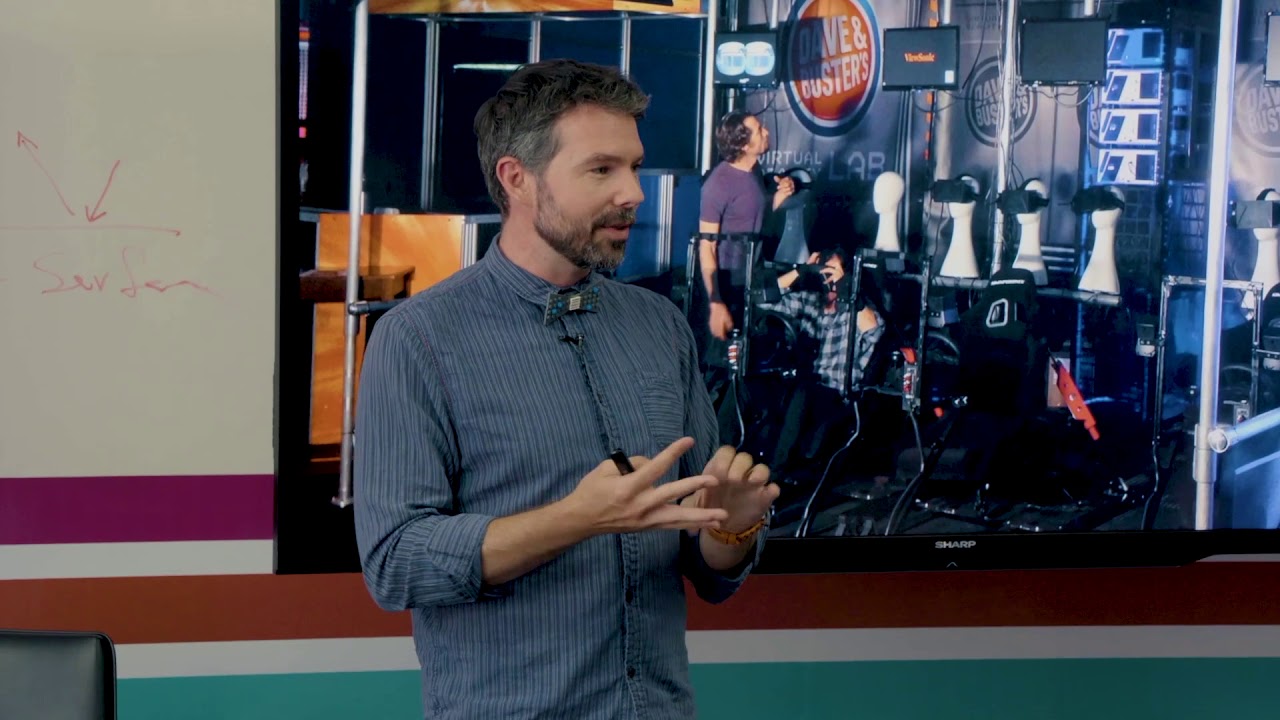
Brent Bushnell walks through immersive projects he's built: escape rooms, a tequila-raining cloud for Mexican tourism, VR attractions for Dave & Buster's, and Samsung Gear VR experiences for the Olympics and NFL. He covers the operational realities: keeping equipment clean, staffing challenges, and managing motion sickness.
Chapters
How many have done an escape room, by the way? Wow, really? Everybody who doesn't have their hand up, do you like fun? Yeah. Go to a fucking escape room. They're so fun. Okay, well, so we built an escape room before escape rooms were really around for Warner Brothers to launch The Flash. It was a big immersive adventure. You get to feel like a superhero. One that we just did recently that was really a ton of fun, the Mexican Board of Tourism. wanted to convince people in Germany to come to Mexico in the dead of winter. And so we built a cloud that rains tequila. So it's literally a— it's like this big cloud. Every time it rained in Berlin, it would rain out of this cloud, and you could just put your shot glass under there and get some tequila. We're very happy to say that this just won a Cannes Lion Award, which is like the Emmys for advertising. So that was super exciting. But lots of this kind of stuff, right? Physical, experiential things, stuff that's fun in real life, but also fun to take a picture of, selfie, share on the internet. One of our investors, actually Dentsu, the big agency in Japan, I was out there visiting them and I'm in the elevator and they're like, dude, have you heard about this tequila cloud? I was like, you guys are fucking with me, right? You know we made that. And they were like, what? It was already going around their whole place, so that was super fun. Okay, so early Dave Buster's, 100-location sports bar and arcade. Arcade, came to us and they were like, hey, the arcade industry hasn't changed a lot in a while. We want to experiment with a bunch of new stuff. We've heard about this VR thing. We think it could be cool, but we want to know some real fundamentals about it. How much do people want to spend? Do they care about the cleanliness? How much operational overhead is there? They had a lot of really tactical questions. So it's funny to talk about 2013 being so far away, but freaking so hard to do some of this stuff. We took a game that wasn't even made for VR and smashed it into the headset. The Oculus didn't even exist yet. have head tracking at the time. We built our own head tracking. We took— you can't really see this terrible photo. We're terrible at documenting stuff. But these are motion platforms, 4 motion platforms, computer-controlled fans. And we built a 4-player driving game so that we could test, do people like VR in public and what do they like? This was 2013. What did you learn? Great question. People don't care about the cleanliness, interestingly enough, which is weird because I travel with my own freaking face condom. And I think we should treat those things like toilet seats. It's freaking disgusting. But yeah, people did not really care about the cleanliness. I found in schools, because I do VR for education, that they do care about that. I would not be surprised. You mean the teachers do? Yeah, both parents and teachers. Parents and teachers, but the kids are probably like, whatever. Yeah, yeah. And so that was our most— it was like 90% of people in public just didn't care. Now, I would actually love to rerun that test now, because I feel like people are getting a little more aware of it. At the time, it was like brand new. VR wasn't even really on people's— Lips, even from a media perspective. So I'd be curious to see if it's changed at all. We also learned that it's an operational nightmare, absolute nightmare. You know, when you are in public, a public restaurant, public entertainment place, you're basically in the rental business, right? I'm going to rent you that seat at this table. I'm going to rent you this space at this arcade. I'm going to rent you this space on a roller coaster. And I want to get you through— I want to make sure you have fun and get you out of there as fast as possible. And I'd rather no staff were involved, right, 'cause staff is expensive. The problem with VR is I need to say, hey, is this comfortable? Oh, I see you have glasses. Like, are those near, you know, what kind of prescription? Like, you gotta take those off. Oh, let me clean this for you. Every single person, that sort of hand-holding. And by the way, I just put a blindfold on your face, so now I gotta make sure you don't hurt yourself. And so that was really a project operational overhead. But people do love it, right? VR is exciting. It is a powerful technology. You can do a lot of cool stuff with it. And so it was definitely an invaluable tool. invaluable set of research. We actually did another one that was like a skydiving game. You got a multiplayer skydiving experience. The other important piece here is the haptics. Still, and we still have this problem, driving games in VR are really prone to motion sickness. And this is something that the whole industry is trying to figure out. But that incidence of motion sickness goes down If you associate a motion platform, right? It's so ridiculous that we say we just have 5 senses. We definitely have more than that, minimally 7, the 6th being your proprioception, right? You have hairs in your inner ear and they have, you are, you have an awareness of where your bodies are in relation to your head, where your head is in relation to the earth. And so when that stuff starts to not agree with what your eyes are seeing, you get sick. And so bad VR does this There's so much bad VR. But that's great to include a motion platform in order to be able to make that incidence go down. But it did get us playing with VR really early. We built our own 360 cameras. You can see this little 3D-printed rig with a bunch of GoPros. And we strapped it to a race car. We drove that around an Indy track, 200 miles an hour, so that we could install an attraction at the Indy 500 and around all the Indianapolis races. So you could feel what it was like to be in a race car. So toured that all around, started doing really a lot of sports content. It was sort of goofy for a big band of nerds that don't really like sports. We did like tons and tons of sports stuff. For the NFL, we did a whole experience where you got to feel what it was like to run the touchdown pass. We captured a whole experience, rented Cardinal Stadium and brought in a whole bunch of football players, and then at the Super Bowl installed a bunch of rigs like this. Where you got to put on the headset. This big helmet did the acoustics. These black plates would vibrate so that you could feel what it was like to run the touchdown pass from the perspective of the punt returner, I'm pretty sure, is the character. Okay, and then, so this was all for Samsung, Samsung Gear VR, launching Gear VR. We did stuff for the Olympics. What's it like to be in with the gymnasts? What's it like to dive off the high dive? We built 20 of our own cameras, cameras that could fly, cameras that could go underwater, cameras that we could drop off of diving boards, so lots of different kinds of cameras. Interestingly enough, I don't really love 360 video. I think that when people say VR, they mean really one of 3 things, 360 video on a mobile phone, HTC Vive and Oculus, or arena-scale public VR with motion platforms and the Void and all that really awesome stuff. This first category is, I think, more a threat to the industry than it is something awesome, because if your first time in VR is some terrible 360 video that makes you sick, you might be like, ooh, not for me, I'm not gonna do that VR stuff. Meanwhile, you do the arena-scale stuff that's freaking magical and you get to walk up to a fireplace and feel heat on your face, that's awesome. So at any rate, just a little aside. We did a thing with, Digital Domain built a big 360 haptic turret so you could be in a 1942 bomber. For the nerds in the audience, this is on a slip ring. The whole computer is inside there. Really hard engineering in order to be able to make it so this thing could spin full 360 all the time without the cabling getting all caught. So this was— that whole arc was kind of phase 2, right? Two Bit Circus as engineering consultancy for out-of-home attractions. At a certain point we said, gosh, you know, we've done 100 events for other people, like we really want to do our own event. We want to do our own stuff. And so we decided to throw a carnival, a big traveling carnival. We had a bunch of games, big entertainment. Why not do our own event, go direct to consumer? So we launched it on Kickstarter, which was freaking ridiculous to put an event on Kickstarter. You know, most people, if you're going to buy like a watch, like anybody in the world can be your customer. We were like, hey, we want to throw an event somewhere in LA. Want to come? Want to buy a ticket? We don't know when or where, but what do you think? But it did actually work. We had a pretty ridiculous video. It was really kind of early in the Kickstarter phase. And we called it Steam Carnival. Steam Carnival.
More from Tim


He Sold His Car to Build This Startup, Then Pitched It for $1M 😳 #Startups #AI

This Startup Moves Your Crypto BEFORE Hackers Can Steal It 😳 #Crypto #Cybersecurity




15 Months Without Refrigeration?! This Startup Thinks It Can Go Global 🥥 #FoodTech #Startups



