Was the Hashtag Successful? | #Hashtag Inventor Chris Messina
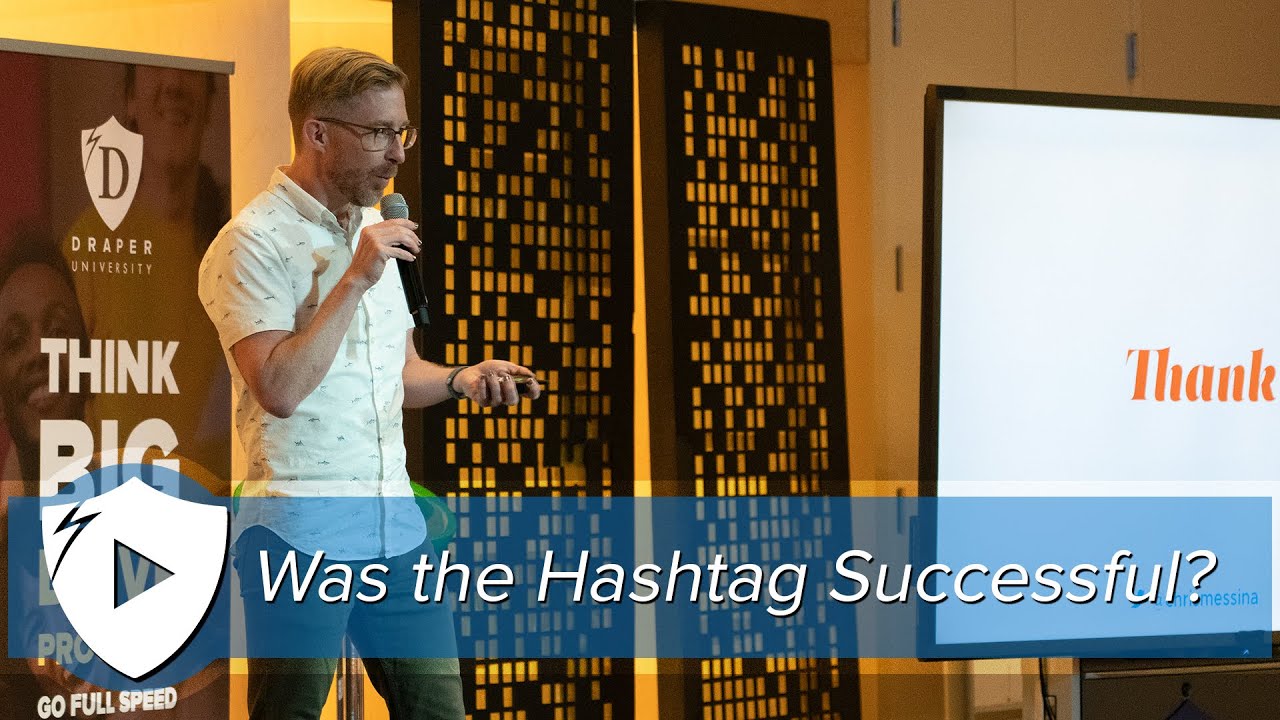
Chris Messina, who invented the hashtag, explains how it spread through virality, decentralization, and generativity. He chose not to patent it, and it became central to everything from the 2007 San Diego wildfires to Black Lives Matter and MeToo.
Chapters
What if you used a hashtag in front of your tweets instead of just using the words spaced out? And so half an hour later, he changed his behavior. I convinced this one person to do this thing. And what was amazing about this was that this idea itself was viral. It was open source. And so shortly after that, other people started to do the same thing, even though they didn't know why. They didn't understand what they were doing. They didn't understand what Nate was doing. And yet they saw that if they did this, they were participating in something that was happening. Hey, so I'm Chris Messina. Today I'm talking about the unlikely lesson from inventing the hashtag. I'm here with a bunch of students from Draper University. If you wanna find out more, you can go to draperuniversity.com. And what I've learned is that there are a set of sliders, a set of different pressures that you can push on when you're creating products or coming up with ideas, where you can emphasize this or that, and that that'll make a difference in terms of the trajectory of your thing. These are essentially like the sweepers. In front of your stone. So I thought about it, and these were a number of the things that I pushed on that enabled, I think, the hashtag to succeed over time. And I'm gonna look at a few of those in detail, but this is roughly kind of how I thought about it, right? So these are just sort of poles. We're gonna look at these 3 in particular in a little more detail. So let's start out with virality, the virality of the hashtag. So, in the beginning, like I said, when you used a hashtag, of course, it was just a weird-looking word. It didn't do anything. We needed a way to actually demonstrate how it worked and why it was useful. And that happened when a friend of mine from the BarCamp community was down in San Diego. His name was Nate Ritter. And essentially, he was using Twitter for one of the first examples of citizen journalism. Essentially, what he was doing was taking information from the police and and fire scanners, and was sharing that information on Twitter to help his community find out about these wildfires that were raging in October of 2007. You can kind of see what these look like here, right? So what he was doing was essentially sending out tweets that said San space Diego fire colon, and then a bunch of information, right? And he was doing this for hours and hours. He was barely sleeping. He felt so passionate about this, and this was so important to him. But at some point, I got in touch with him, and I was like, Nate, I see what you're doing, and it's really valuable, but imagine if people could actually track these updates and get them sent their phone using Twitter's track feature. What if you used a hashtag in front of your tweets instead of just using the words spaced out? And so half an hour later, he changed his behavior. And so I convinced this one person to do this thing. And what was amazing about this was that this idea itself was viral. It was open source. Anybody who saw Nate doing this could then emulate him without getting permission from anybody else to do the same thing. And so shortly after that, other people started to do the same thing, even though they didn't know why. They didn't understand what they were doing. They didn't understand what Nate was doing. And yet they saw that if they did this, they were participating in something that was happening. And so people were able to get their updates not from doing this, because this didn't work, but instead from doing this. And this became one of the first examples where social media was no longer thought of as just a toy, as something that you could use to, like, update your friends on what you were having for breakfast, but you could actually share useful and valuable information in real time. And it wasn't lost on the press. This is an article that a friend of mine wrote for Wired about how Twitter was used to disseminate this information and where the hashtag story was told for the very first time. Okay, so another thing. So that was virality. Let's talk about decentralization. So this is a friend of mine. She actually was my fitness coach. This is Joanne. She found and got involved in her own fitness journey through a hashtag. And this happened actually completely independent from me. I hired her as my coach and then later she found out of course my relationship to the hashtag when I had to tell her and then she Googled it. That's awesome. And then she was like, oh shit, like, that's interesting. And ended up finding this Bay Area community for people doing fitness. And so she joined that community, and it quickly grew in bringing people together to learn about each other. And there was a sub-community within there called BBG Bay Area, where a bunch of women got together to organize their workout routines, to get together on a regular basis, and keep each other accountable. And years later, after this community came together through that hashtag, many of them have started businesses, They've gone into business together, they found their own success. Now, there's an important aspect of the hashtag, which is about its adoption story. I was very intentional about not trying to control this idea too much, not patenting it, not trying to own it in a way that required people to get permission from me in order to use it. Because if that had been the case, that would have inhibited adoption. And what I wanted, if you remember, my success was about cultural change, was about getting more and more people to use this idea without having to even know who I was. And so that was very important. This idea is, I think, best represented in biology. There are essentially different ways that biological systems reproduce itself. One is, of course, the tree where it produces a nut and the nut falls and it, you know, goes into the ground. Another is a rhizomatic structure. A rhizomatic structure essentially has all the information within itself to reproduce itself without any attachment to the original. If you cut off the leg of a starfish, for example, it will grow a new starfish. So I wanted the hashtag to be self-evident and something that anybody could pick up and use without coming back to me for permission. And so in a very similar way, my friend Joanne took the idea of #BBGBayArea and then created her own hashtag called #GoFitShow, which is about her own journey. And as a result of that, magazines and the press and the media started to realize that they could follow along on her journey and join in, and she quickly became a pretty well-known fitness influencer. And in fact, just last year she signed this amazing deal to become an influencer for Adidas. So from someone who was just casually interested in this stuff, she found a community through this BBG community more broadly, found a sub-community within that, and then created her own hashtag. She found this success on her own without ever coordinating or asking me for help. So the third thing that I wanna talk about is generativity. So my friend Jonathan Zittrain, who's over at Harvard, essentially describes generativity as the capacity of some technology to allow its users to make new things out of it, things which the designer never anticipated. And this is really important. My background in open source, in working on the Firefox browser, for example, and working on the web, was about giving people the ability to contribute to something that the original designers had never intended. Something bigger or potentially even more interesting than what the sort of original people creating this wanted to do. So the hashtag itself is an example of generativity. You take an idea like this, a simple idea posted in a very simple context like social media on Twitter before there were thousands or millions of users, and people have adopted this idea and used it in lots of different ways which I never even thought about. Leading up to the IPO of Twitter, USA Today put a hashtag on the front page of their paper. I thought this was ridiculous. Like, you can't like click on it, you can't tap on it, it doesn't do anything, it's in print, right? And yet this symbol became a way of identifying this cultural norm that was emerging online. In a similar way, hashtags of course have become in a way the new URL, the new link. It doesn't matter which social media platform you use, there's going to be content that's available when you search for it on any of these existing platforms. It's something that is showing up in street art to identify both the artist as well as a place or a message. You can see churches are starting to use hashtags to recruit people. And I don't know if any of you have been married or if you've gone to weddings, but of course one of the favorite pastimes these days seems to be to pick the wedding hashtag. Good luck finding one that's unique. My friends were able to, fortunately. There have been #ComedyNights that I've discovered. There is a #CoffeeShop, which is a little bit redundant because I think this reads as ##CoffeeShop. And of course, there's been cultural controversies that have occurred. It's become a fashion symbol, a sort of meta-fashion symbol where it's on the label for fashion. It's become something for sports teams to identify themselves with, to bring fans together. And apparently, there's no too young an age to start kids on hashtags. In case you didn't get that, this is a baby book for Baby's First Hashtag. The hashtag has also been used to organize protests both small and quite large, right? Bringing people together in all sorts of places around the world where I had no idea or thought that, first of all, Twitter would be used in these places, let alone that the hashtag itself would be used to organize movements. And more recently, it's been used to spark very important cultural conversations like Black Lives Matter, as well as Me Too. Yeah, so I mean, it was like super awesome to both get like this like standing introduction reception. That was great. And like the students are like super pumped, super excited about what's going on, and really engaged after the talk. And so I thought it was really good to have a chance to like talk to them, share my ideas, and also hear from them. In terms of things that they're thinking about. So it was a real honor to come to Draper.
More from Tim


He Sold His Car to Build This Startup, Then Pitched It for $1M 😳 #Startups #AI

This Startup Moves Your Crypto BEFORE Hackers Can Steal It 😳 #Crypto #Cybersecurity




15 Months Without Refrigeration?! This Startup Thinks It Can Go Global 🥥 #FoodTech #Startups



