In this instructional session, startup coach and investor Reena Jadhav walks entrepreneurs through the anatomy of a compelling pitch. She emphasizes three overarching qualities—persuasiveness, conciseness, and the ability to spark interest—because audiences are skeptical and time‑constrained. She then breaks down the mandatory content of a pitch: a clear problem‑solution idea, the founding team, and a quantified promise/ROI, all woven into a personal story that explains why the founders care. Drawing on a Harvard Business School framework, she asks presenters to identify the single takeaway they want listeners to remember and to align that with the value they create, both financially for investors and socially for the world. Jadhav challenges the conventional “secret sauce” requirement, arguing that early‑stage startups often lack patented technology and must instead articulate the differentiating model, pricing, or customer‑service approach they will build. She illustrates this with real‑world examples (Airbnb, Zenefits, Uber, Doje) and introduces a 2×2 competitive‑landscape matrix to map where a startup sits relative to incumbents on axes such as availability and price. Finally, she stresses that every pitch must end with a concrete ask or offer, turning the presentation into a call to action. Throughout, she provides practical tips, encourages audience interaction, and offers to share additional resources via LinkedIn or Twitter.
Chapters
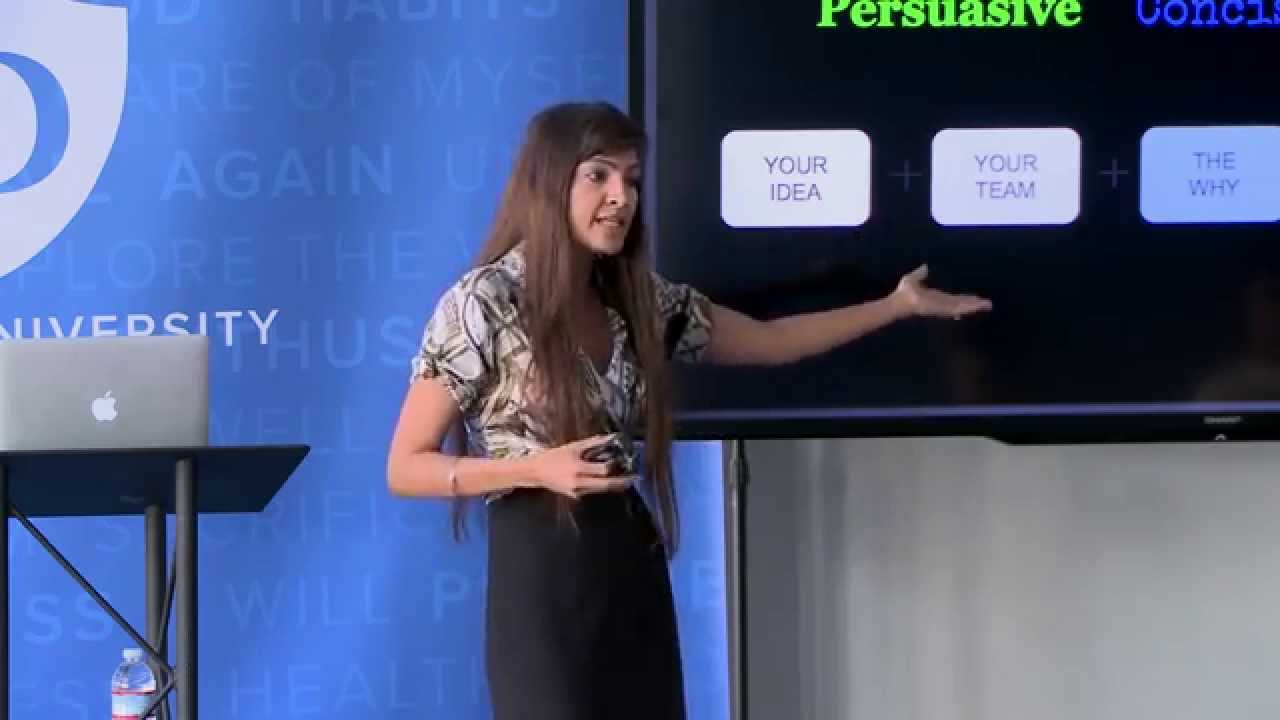
So let's get into a little more sort of the framework aspect of it, right? So, so what does a pitch— what must a pitch include? What are the sections? So it must be persuasive. Why? Because you've got a skeptical audience. It's got to be persuasive. It has to be concise. You've got a short amount of time. Whether it's 5 minutes or 20 minutes, it's still always going to be a really short amount of time. It's got to be concise. And it has to spark interest. If it doesn't spark interest, you are so dead in the water. If all it is is very clinical and there's really no oomph to it, it's going to be not something that you're going to either attract funding to or people to or obviously customers. So it's got to have those 3 pieces to it. When you look at that, now you've got to start putting in, well, what must it contain? What must your pitch actually contain? Your idea. So what is your idea? Right. In cities with conferences where hotels get booked out, we're gonna convince people to rent out their mattresses to strangers. Okay, sounds intriguing. Your team? It's 2 of us. We've never done this before. Why are you doing this? Because we went to a conference and couldn't find a place to stay, and we really honestly believe that this is a really important problem to solve, and I think there's money here. Look at how big the hotel industry is. What's the promise? We believe that this is gonna give you an ROI of at least 200% based on the numbers we've run, and then that becomes your story, right? So it starts with, we went to a conference, there was no place to stay. By the way, how many of you know what I'm talking about? Airbnb, right? Yeah. And if you haven't, heard the Airbnb interviews, I highly recommend— there's a bunch of YouTube interviews with the CEO and he talks completely from the beginning to the end of sort of their journey all the way through. Bless you. So that's, that's the components of your pitch. So you want to start writing out, and I'm sure all of you have already done that, you've already written out sort of those components. Now the question is, how do you decide what gets included and what gets included— excluded? So I went to Harvard Business School, so of course I have to show you the pitch structure proposed by Harvard faculty. So here's the 6 elements that HBS faculty recommend in terms of your pitch structure. So the first one is, what do you want the listeners to remember the most? So we're gonna actually, in the next few slides, look at different pitch structures and different frameworks. None of them is perfect. It all depends on which framework you're more comfortable with, and that's the framework you wanna go with. So with that said, this is a framework. So the first one is, you know, if you're on your mobile phone, you're online, whatever your choice of writing notes is, I see there's some still paper pen people, start jotting down what do you want someone to remember about you? And if you can't figure that out, that's a problem, right? So you want to really sit down and think, what do I want the people that are listening to my pitch to remember about me? What's the impact I'm gonna create? What's the value that I'm bringing into this world because of this idea? And if it doesn't sound like there's a lot of value, you may wanna think about that. You know, is this really something you're gonna do for 8 to 10 years if there isn't a lot of value created? Who knows Ryan Hoover? He does Product Hunt. Bingo.
Bingo.
So Ryan Hoover was interviewed recently and, you know, he talks about the number of things that he did prior to Product Hunt. And he's pretty honest when he says, well, I was doing this. And the guy goes, well, why'd you stop doing it? Because my heart was not into it. I just couldn't emotionally connect with it. We had all the stuff. You know, there were people were coming and signing and I wasn't committed to it. Not until Product Hunt did he find something that he could emotionally invest in. So what's the value that you're creating is going to directly impact how committed you're going to be to your venture. Yes?
Do you find that 1 and 2 can sometimes go hand in hand and what the listener should remember most is your value creation and that impact that you're trying to have?
That's a really good question. Do they go hand in hand? Does value creation and memorability go hand in hand? Actually, some of the most memorable pitches I've heard are stories that start with, this happened to me and hence I'm going to do this. So actually not necessarily. It can be. Value creation often— if value— so value creation breaks into 2 things. One is how much money are you gonna make for me as an investor, which as an investor I really care about because I'm not doing this for charity. If I put money in, I want to know that you're gonna believably give me some real returns. Secondly, how are you gonna make the world a little bit better? Each investor is different. For me personally, I love stories that begin with— I'm just gonna give you one simple one. When I was in the hospital, I loved this nurse, and there was no way for me to thank this nurse. I came out of the hospital, and it stuck with me that this nurse had really made my experience in the hospital survivable. And I wanted to figure out how to repay her. I couldn't, I couldn't, I couldn't. I've created a company that is a new way to thank caretakers in hospitals, because there's really no way of doing that today. And if anyone's and God willing, this never happened to you, but if anyone of you have ever been in a hospital in a serious way, which I have, and/or have had other loved ones be in the hospital, you know how much difference the caretakers there make, right? You are frightened for your life and there are these amazingly loving, giving people, but no one ever says anything back to them in terms of either a reward or a thank you. So she started a company called Doje, which does exactly that. So those are the kind of things that I personally, I'm like, yes, where can I write my check? Because I love your story. So the third is your unique, your secret sauce. How many of you were told your pitch has to have a secret sauce or your business needs to have a secret sauce? Okay, so I'm gonna say something controversial. I don't think we ever really start something with a secret sauce unless MIT PhD with 5 patents and they're building a business on those patents. Then yes, you have a secret sauce.
Totally agree.
But unless you have some hardcore patented stuff, you don't have a secret sauce. You're starting out. How can you possibly have a secret sauce? That question used to drive me crazy when I was a founder because I would struggle so hard and it all seemed so inauthentic. So what do you do? If you don't have a secret sauce, you're, you're a guy and a gal with an idea, what do you do? Well, you're gonna have to build that secret sauce. And that's gonna be the question to answer. The secret sauce we're going to build, what's gonna make us better than anybody else is, and what is that? Is that pricing? Is that deals? Is that a flipped-up model? Who's heard of Zenefits? Okay. Our secret sauce is that we offer an entire recruiting suite for free. Go compete with that. And we take a significant cut from insurance benefits, which everybody needs. Brilliant. Their secret sauce is their model. Now, until somebody decides to go out and replicate, which I'm sure somebody's going to try, that's a beautiful secret sauce. So your model can be a secret sauce. For Uber, we had a terrible experience. The Uber guy said he was there. 5 minutes later, he was not there, but he charged us anyway, $8.60. I got one of those feedback things. So I said, yeah, it was fine. By the way, he showed up, but then he was gone, so we never took the ride, but he— we got charged anyway. That was it. That was my feedback. In less than an hour, I had a refund on my account. I had a phone call and an email. Talk about obsessive customer support. That's their secret sauce. That's what you need to think about when you're doing your pitches, your thoughts in terms of what is going to be your secret sauce. What is it that you're going to build in that is going to guarantee your success, your sustainability, your survival? Competitive differentiation, so that's more on the models, right? If you— how many of you know the 2x2? The 2x2? Did we stop teaching those? Ah, the— I'm sure you know the 2x2. X-axis, y-axis, competition is here, I'm up here.
Oh yeah. Really?
Okay, we should do another session on that. So how have you been taught to talk about competition? How do you decide where you fit in competitively? Yes?
Do a bunch of Google searches, see if anyone's doing something similar to you, and talk about the ones you think are threatening and how you're gonna kill them.
Okay, that's research. How do you landscape it out?
Do it too.
Smart one. Okay, so landscaping. So just, okay, just Google competitive landscape and you'll get a bunch of stuff. stuff you can read on your own time. You've got to think through how— yes?
I think that's a very important element, and I would love to start—
Sure, I can— I'll email you. So ping me on LinkedIn and I'll— or Twitter, and I'll just send you the deck. And if you have any questions, please feel free to follow up. You want to have a competitive landscape. You're going to need that for your invest— investor decks. So traditional investor decks, you've got to have a competitive landscape in there, and that explains where do you fit in in the continuum of life. So for example, if you are Uber, what does your landscape look like? Well, it looks like cabs, shuttles, and private limos. And Uber said that the problem with each of these was as follows, and they were then going to do this. So your x and y-axis was, in their case it was, it should have been availability, because Uber is what?
Flexible.
5 minutes or less, right? So availability was a big one. Taxis, who knows when. Uber, less than 5 minutes. And then price points and variety, right? I can pay— I know right up front how much, and I can actually negotiate because it's an open market. I love that. So they are up here. They have great availability with variable pricing. And taxis are down here, right? Crappy availability. And then limos are up here because very, very expensive. So you need to map out where do you fit. And that's important as well in terms of a one-line. Unlike this, this is what we do. Your immediate goal, so that's your ask. And then what are you expecting the listener to do? So we're gonna talk about that at the end. But you must, must always end your pitch with, and here's the help I'd love to get. It could be something as simple as, I'd love to show you a demo. But always end with either an ask or an offer of some sort.